Roger Jean-Claude Mbédé and the crime of love

Roger Jean-Claude Mbédé has died after being released from prison.

On January 10, 2014, we learned that Roger Jean-Claude Mbédé had died in Cameroon. Roger had been sentenced to 3 years in prison because he sent another man an SMS that said "I’m very much in love w/u" – in a country where it’s illegal to be gay.

The details of how Roger died are not yet clear – but what we know is this: In prison he faced physical abuse and medical emergencies. Out of jail he was attacked and turned away from employment, school, shelter and even critical healthcare.

Actually, we are learning a little bit more about how he died, and it’s horrible. Mbédé had testicular cancer, and had surgery last summer, but had ongoing problems that needed treatment. His family refused him that treatment; they wanted him to die.

Alice Nkom, a lawyer who worked on his case, said he died on Friday after his relatives removed him from the hospital where he had been seeking treatment for a hernia.

She said: ’His family said he was a curse for them and that we should let him die.’

The only curse here was his hateful family.

Like Snow White’s mom

The Kellers, those big name media people who punched down at a woman with cancer, are never going to live it down. I have been entertained by many take-downs on the internet (none of which will perturb the Kellers in their little bubble of arrogance), but one I particularly liked was Christie Aschwanden’s dissection of their errors. She hit on several major problems that I initially missed.

It’s Bill Keller’s complete failure to see the woman he saw fit to criticize that has ignited rage and charges of sexism. ("Whiny woman making a big fuss about cancer. Shush! Go pet your therapy dog!" tweeted Susan Orlean.) His grand (though by no means novel) ideas about death and dying blinded him to the human being he sought to exploit for his argument’s sake. He violated the journalists’ ethical obligation to treat the ill people they write about with respect and sensitivity. As a result, he didn’t open the discussion about dying that he’d intended, but instead provided the internet with one more example of female invisibility in the face of a powerful man with a big idea.

I wonder if we’ve been conditioned by that familiar Disney trope of the dead mother as a generic symbol of privation, with no specific consequences and no details about the individual. Women are supposed to die offstage so the hero can get on with his or her journey!

One thing I also found striking is that we talked about these same themes in my cancer class last semester — the problems with the ‘war’ model of cancer research, the ethics of dealing with death, etc. — and my students showed more awareness, sensitivity, and intelligence on these subjects than Bill Keller.

A conference gets cancelled

This is unfortunate: a SF con scheduled for Chicago this March had to cancel after a disagreement with the hotel.

We regret to inform you that Chi-Fi 2014 will not be taking place at the Westin Chicago River North as planned. After several meetings with the staff of the Westin, we had concerns about the ability of their staff to create a welcoming and accepting atmosphere towards our attendees. A senior Westin employee referred to our staff, attendees, and guests as “freaks,” and hotel staff expressed their disapproval of our anti-harassment policy. As we want to put the safety and enjoyment of our guests and attendees first, we requested that the hotel make changes to ensure that our attendees and guests be treated with the same respect as any other Westin hotel guests. By mutual decision, we agreed to part ways with the hotel. We wish to make clear that these views were expressed by staff of the Westin Chicago River North and do not reflect the opinions of the Westin brand or Starwood Hotels. We are grateful to certain individuals working for Westin and Starwood who have been supportive throughout these discussions. Our organization does not condone any sort of retaliatory actions against either Westin or Starwood.

“Freaks”? And why would the hotel want to argue with a policy that discourages harassment?

Oh, well, I’m disappointed with the Westin Chicago River North — a very unprofessional place, apparently — but am impressed with the management of the con. They’re rescheduling for 2015, and it sounds like the kind of event that cares about its attendees, and I hope they are well-attended.

Essential reading for conference organizers

Alex Gabriel has written an article about 10 Ways to Make Sure the Atheist Movement Is Not Just for the Wealthy. I mostly agree with it, but I’d add another point, and his #8 is, well, problematic.

8. Pay your speakers—well.

Speakers’ fees are commonplace in U.S. atheism. Britain lags far behind. It shows. Our speaking circuit is far whiter, wealthier and more dominated by academics and national groups’ staff. It’s far less accessible to bloggers, artists, filmmakers and people who aren’t stably employed. This happens when speaking isn’t recognised as work.

Covering expenses—say, for travel—is not enough. Good speakers put hours into talks. They’re writers, researchers, editors, lecturers, comedians, orators, things we pay people to be. They’re often discussing costly activism. (Jonny Scaramanga, whose blog about creationist exam papers went viral recently, spends huge sums getting hold of them.) Speaking for free means a real-terms loss even before expenses: the hours of work that go into it, as with graphic designers, could have gone into paying the rent. Academics, wealthy authors and the stably employed comprise most of our speakers because they can afford this loss. Others can’t. You need to cover it.

Given what U.S. speakers earn, the minimum wage and the skill involved, I recommend offering a $200 honorarium. You can’t afford that? Bollocks.

Humanist assemblies: you found 20 people to pay for your childcare. Now find 40 to put extra dough on the collection plate (better still, give it by monthly direct debit). Student groups: charge non-members that much on the door. Foundations like Todd Stiefel or Richard Dawkins will sponsor local groups. Secular authors will donate books to fundraising sales. Online atheists will donate to your page. For more ideas, see Darrel Ray’s advice.

If you can’t pay all your speakers yet, ask them to consider waiving the fee if they’re well off. Don’t allow negotiation. Higher and lower individual fees mean a race to the bottom where those who’ll work for least get booked the most. You’re trying to prevent that.

First of all, there’s a tell here that Alex doesn’t know much about the conference circuit: first he says to pay speakers well, and then he gets to specifics, and he says…$200. That line would get a laugh if he were Dr Evil.

You are asking a professional to take two or three days out of their schedule to grace your event, and you think $200 is fair compensation for that much of their time? Add another zero, and maybe $2000 would be more like it; a few hundred bucks is just plain insulting. Are you seriously going to call up Richard Dawkins and entice him to sign on by waving a few bills at him?

Even I am not anywhere near the mid-tier of conference draws, and I would find it weird to be offered a few bucks to show up. I do it because I care about this movement and want to see it grow, and also because I personally think my views are an important contribution — I lose money every time I go off to speak anywhere (I have to have my basic travel expenses covered so I don’t fiscally bleed to death, but all the little details I just pay out of pocket), but it’s worth it to see atheism growing.

I’m relatively well-off, though, with a stable job and a reasonable lower middle class salary; I would waive any honorarium because I don’t need it. I think it is fair to offer some general compensation to cover the miscellaneous expenses of those who aren’t quite as secure as I am, but I’m not too keen on expecting conferences, especially the home-grown free ones, to cover the expenses of a professional atheist lecturing class, even while recognizing that it’s necessary to expand our list of potential speakers.

You know what I would appreciate as an honorarium? Instead of paying me, tell me that X hundred dollars will be invested in scholarships to cover the cost of bringing in attendees who wouldn’t otherwise be able to afford the event. That’s what matters.

Or if you do want to help out the working people who are encouraging atheism in their spare time, look realistically at their mean income and estimate what they’d earn over your conference weekend if they stayed home and roofed houses or did company accounting or sold televisions at their local Best Buy, and offer them that. Someone like me would still waive the fee, but contributors who are otherwise trying to make ends meet would finally be able to use their talents well.

I said I would also add a #11 to his list of ten.

#11. Take advantage of local talent.

I see a lot of the same faces, drawn from the same big national and international pool of well-known atheists, and effective as they are at being a good draw for an event, it’s also important to grow the local talent pool. Sure, try to get one or three recognizable big names, but don’t make the conference revolve around them — they’ll be leaving the moment the conference ends…or as I’ve seen a few times, they’ll flit in just before their hour lecture, and then they’re off to the airport immediately after.

It’s the locals, or perhaps regional or state-wide people, who are going to hang around and make a difference, and who will be aware of the specific issues your attendees are dealing with. Make a commitment to have at least half your speakers be drawn from the same group as your attendees — and if you want to bring in more atheists from the black community or the poor or the working class, try to bring in speakers from that very same demographic.

Turning the tables

Oh, yeah, we’re always hearing about sperm whales and how they just chow down on the grandest cephalopods in the sea, but we never hear enough about how squid eat vertebrates. The answer is: horribly, slowly, agonizingly.

Am I a traitor to my phylum that I was cheering for the squid?

Where a rational conversation about guns ought to start

The newspaper of record reflected the disease last night. They had an article about the man killed over texting during the previews at a movie that included this ridiculous paragraph.

The killing underscored the increased debate about when to use smartphones in public. In October, the singer Madonna was spotted texting during the Lincoln Center premiere of “12 Years a Slave.” That led Tim League, chief executive of Alama Drafthouse, a Texas-based chain of boutique cinemas, to post on Twitter that she was banned from watching movies at his theater.

No, it did not underscore that debate. It underscored the debate over whether we should continue to allow armed assholes to wander the streets freely. You know, that real issue that no one in America, including the New York Times, wants to deal with, because the proponents of armed assholery like to kill you if you disagree with them.

(By the way, if you go read that article now, you’ll discover that it has been cleansed of that astonishingly stupid paragraph.)

It’s about time the US had a rational discussion about gun control, though. It’s way past due, and the weird aversion to changing the way we manage guns has to be overcome. So here are my suggestions for a start.

  • Repeal the second amendment. All right, we don’t actually have a mechanism to strip that sucker out of there, but we can override it with a new amendment. Face it, the second amendment stinks: it’s an 18th century relic, it’s ambiguously worded (it’s about militias, people), and somehow stupid Americans have it fixed in their brains that the Constitution is sacred magic — all they have to do is shout, “Second amendment!” and we’re supposed to dissolve into accommodating bits of gelatin before them. We can criticize and revise the Constitution, you know; if you revere the Founding Fathers, you should at least still recognize that they thought an informed citizenry was important. You’re supposed to think, not just follow rules.

  • Regulate gun ownership. Regulate the heck out of it. I live in a state where all liquor sales, even of wine and beer, have to be made through state-licensed stores — but I can order a freaking AR-15 through reddit. This is absurd. End all the loopholes, including the gun show provisions. All gun sales must be made through strictly licensed dealers, with extensive background checks, and all gun sales must be made in person with photo ID and a permanent record made. Make gun ownership public: anyone and everyone can look up who owns guns and where the guns are.

    If you are a responsible gun owner who needs the tool for hunting deer, this should be no burden at all on you. I’m very suspicious of people who insist that their possession of a deadly weapon must be secret and untraceable, and that they must be allowed to buy it from the skeevy guy operating out of a trailer.

  • You have no right to carry a gun in any public place. No more concealed carry permits. No more “stand your ground” laws. Only authorized agents of the law should be carrying weapons in public, and even there, not all of them should be armed, and those who are, should be clearly and obviously armed. You’re packing heat in a movie theater? Fuck, WHY??.

  • End the “gun collector” excuse. I don’t believe the pretense that you’re merely building a historical archive, that you’re simply gathering Americana of note. Collect bottles or hubcaps, instead. If you must insist that you’re creating a museum, OK…then you won’t object if every weapon in your collection is thoroughly and irreversibly modified to be non-functional: firing pins removed, solid plugs placed in the barrel, mechanisms locked in place with a nice glop of super-glue. If you have religious reasaons that they must be functional, go collect old hand grenades and undetonated bombs. You’ll expunge yourself from the population soon enough.

    We have no problem recognizing that if you have a bale of marijuana in your garage you’re in the business of dealing, not just recreationally consuming, drugs. If you’re accumulating an arsenal of deadly weapons, this isn’t for your personal enjoyment any more, you’re up to nefarious purposes.

  • No more “self defense” excuse. The only people we need to defend ourselves from are the jerks who carry guns. And guns are a lousy instrument for self-defense — they’re indiscriminate and irreversible, they tend to punch holes in objects and people that we didn’t intend to punch holes in, and there are no take-backs after you punch a hole in someone by mistake.

    You want to defend yourself? Take a martial arts course. Too unathletic to do that, like me? Support your local police and have a phone by your bedside.

  • Change the culture. You may think you’re a macho stud when you swagger down the street with a pistol at your hip, but the rest of us think you’re a pathetic asshole who is not just stupid, but a real danger to others. The rest of us have to get that message across to the NRA membership.

    There are very few legitimate uses for guns by general citizens — hunting, target shooting — and none of those require assault rifles, secrecy, or huge stockpiles of guns and ammo. If you actually have a practical use for the gun as a tool, I can respect that and have no problem with it, just like people who have a use for a tractor. But you know, it’s a tool with a specific purpose, and the nitwits who want to extend that purpose to being a constant presence in our lives are overcompensating losers.

Now, cue the stupid people declaring their love of guns in the comments, and accusing me of being a commie. I’ll prime your anger by telling you right off the bat that if you love guns, you are a sick, pathetic, twisted dingbat, and I won’t care about your arguments.

America has a disease

A man and his wife are out on a movie date, and before the show starts, he talks to his 3-year-old daughter at home on his cell phone. And apparently he was doing some texting, too. Clearly, our big problem is our dependency on these ubiquitous little telecommunications devices…

Wait, no, that’s not it. The problem is that sitting nearby was Curtis Reeves, 71, a retired police officer, who resented the chatter before his movie came on, and Mr Reeves was carrying a goddamn fucking gun in the theater, and argued with the talkative father and eventually shot him dead and wounded his wife.

The Tampa police seriously “considered if this could be a ‘stand your ground’ case but decided the criteria did not apply.” Obviously not. The victim was white. But holy shitballs, they considered this? An armed asshole guns down a man over some noise during the movie previews and they contemplated letting him go?

Then, minutes after I read that, aghast, I get a little beep, and someone sent me this link.

reddit-rifle

Reddit is selling personalized guns with their logo.

Personal privacy is prized among Redditors, most of whom participate on the site anonymously. A fervent pro-gun constituency among them makes the market opportunity for gun dealers all the more attractive. The primary subreddit on the topic, /r/Guns, currently has more than 154,000 subscribers, and GunsForSale, created in March 2011, has doubled in size in the last year, with more than 7,200 subscribers. Gun dealers using the site indicate that they’ve enjoyed a spike in demand in the past year, after the Sandy Hook massacre ignited a national debate and pro-gun activists whipped up fears about a regulatory crackdown.

Yeah, that’s the big worry with a bunch of dead kids — someone might grow a spine and a brain somewhere and take steps to regulate guns. They needn’t have worried: this is America, we’re aspiring to mutual bloody annihilation among the citizenry.

And christ, reddit.

Shut up and die already. No fussing.

The appalling privilege and bad taste of the well-off rears its ugly head again. Bill Keller, former executive editor of the New York Times, took the time to pen an op-ed to shame cancer victims who speak too militantly of their disease. In particular, he singles out Lisa Bonchek Adams, a cancer patient who blogs and tweets and writes poetry about her disease and treatment, as somehow…unseemly. He contrasts her public battle with the resignation of his father-in-law.

In October 2012 I wrote about my father-in-law’s death from cancer in a British hospital. There, more routinely than in the United States, patients are offered the option of being unplugged from everything except pain killers and allowed to slip peacefully from life. His death seemed to me a humane and honorable alternative to the frantic medical trench warfare that often makes an expensive misery of death in America.

I can respect that choice; everyone should have the freedom to die with dignity. But where Keller becomes an obnoxious ass is in his implication that a calm death is an ideal for everyone, and that there is something enviable about going gently, and then he dares to question whether Adams’ campaign has been a public service. Guess what, Bill Keller? You don’t get to question how a cancer patient gets to live. I appreciate what Adams writes, and what Jay Lake writes, and what every person who wrestles with this terrible disease chooses to say or not say. It is their choice.

Keller knows he’s treading on shaky ground here, since his wife apparently wrote something similar for the Guardian (I can’t read it because the Guardian yanked it) asking, What are the ethics of tweeting a terminal illness?. I’d rather ask, what are the ethics of telling someone with a terminal illness that it is unethical to talk about it? So for backup he asked Steven Goodman of Stanford Medical School for an opinion.

“I’m the last person to second-guess what she did,” Goodman told me, after perusing Adams’s blog. “I’m sure it has brought meaning, a deserved sense of accomplishment. But it shouldn’t be unduly praised. Equal praise is due to those who accept an inevitable fate with grace and courage.”

Oh, so the problem is that a cancer patient is being “unduly praised”? Where? How? What is an inappropriate level of praise, and is it being given here? If someone compliments Adams on her writing or her courage, is Dr Goodman or Mr Keller going to tut-tut them and ask them to be more reserved? Or is the finger-wagging going to be restricted to cancer patients who lack the decorum to be “calm” and “go gently” into death?

What Goodman should have said in response to that request for an opinion is, “Who the fuck are you, Bill, to stand in judgment over how a cancer patient deals with their disease?” And then somebody should have slapped him with the ethics of airing his distaste for a person who chooses to not go gentle into that good night on the pages of the New York Times. The ugly spectacle is all Keller’s.

How do you measure willingness to rape?

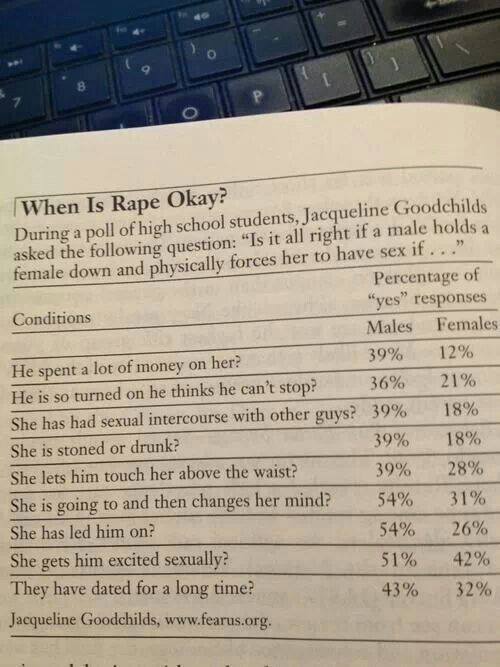
I was sent this horrifying data table: an awful lot of people think there are circumstances in which force is legitimate to use in order to get sex.

whenisrapeOK

Now an interesting twist. The source for that table is defunct, but someone else bought the url fearus.org and has put together a fairly detailed analysis of the claims. Before you jump to the conclusion that it was some MRA trying to debunk it, though, read the analysis: it’s substantial and impartial. The original study by UCLA researchers does exist, but it’s more complex than this oversimplified version can accurately reflect.

The actual data contained answers that were on a 5-point scale, rather than just a simple yes/no, so there’s some crunching going on here. But let’s crunch it some more.

Excerpts from the paper reveal that only 24% of men categorically rejected all use of violence against women…so apparently, about 76% of us considered some of those circumstances a possible reason to rape. That is disturbing.

Also disturbing: only 44% of the women categorically rejected all uses of violence against them. So 56% have absorbed the idea that they can be at fault for leading men on? Weird.

Anyway, the fearus site is an interesting effort to dig into the original data. It’s a little off — it seems obsessed with the idea that it is a gross error to simplify a 5-point scale to a yes/no answer — but it does make the excellent point that it is disgraceful that it is so difficult to get access to the original, published scientific data.