It’s like a juice box

Yesterday was not a good day. I had way too much on my calendar and worked late, and didn’t get around to my spiders until 5pm…and then, it was a lot of scut work, since their containers were getting filthy with insect corpses, and I had to move everyone to new, clean boxes. Then I discovered that two of my precious males had died! Males really are the weak link. There’d been a wave of moltings throughout the colony, and sometimes they just don’t succeed. I expected one to fail — he was asymmetrical, with one excessively long forelimb, and he’d probably messed up the previous molt — and yeah, sadly, he didn’t make it this time.

Whenever I move them, the spiders all go frantic with activity. The new space is barren, have to put up new webs everywhere! So I threw them each a couple of flies and left them to their business, and this morning they’re all lounging in their silk hammocks, webbing everywhere, and the flies are all trussed up. They are meticulous in their work.

So here’s one I found having a delicious breakfast. I had to stack a few images to get everything in view, so if there’s some blurriness, it’s because she was practically vibrating with happiness (I presume).

[Read more…]

Always nice to get a little company

Mary and I have been laid out flat this weekend — I shouldn’t have been so quick to suggest yesterday that my recovery from the second vaccination was relatively painless. I got the fever & chills & headache that evening, and it hasn’t been at all fun.

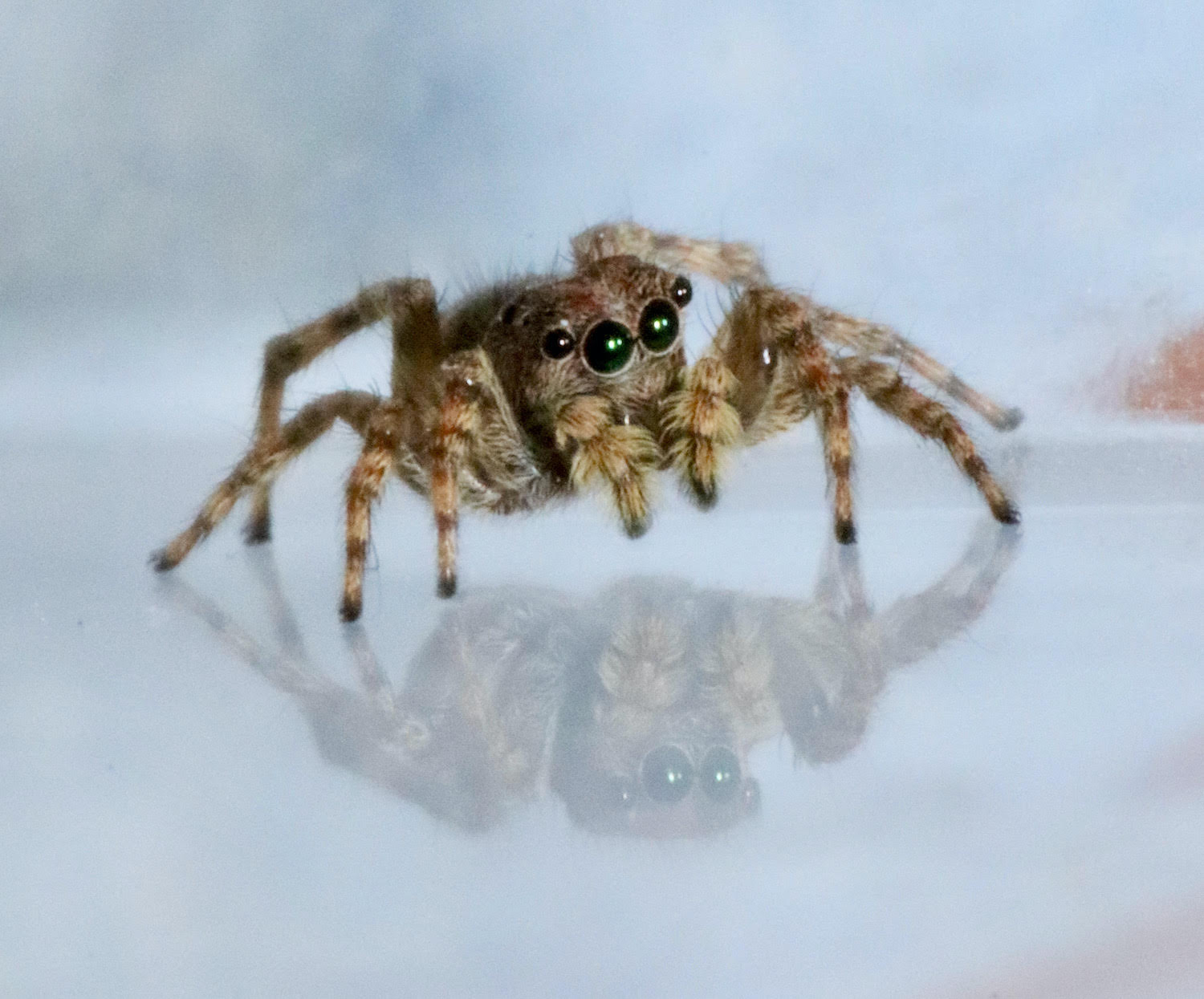
Then just now this pretty little Asiatic Wall Jumping spider descended from the ceiling right into my face. He’s clearly trying to cheer me up.

It worked!

Spider deaths

The spiders I’ve been raising live to be approximately two years old in the lab. What typically happens is that they start showing signs of decline: they aren’t as responsive, they begin to hide in small silken nests, they fall into lassitude, and then one day they fall to the ground, dead. I worry that I’m doing something wrong, that the cages are too humid or not humid enough, that some disease is spreading through the colony, but I’ve tried different regimes of watering them, it makes no difference. It’s not surprising that very small animals are not evolved to endure. I tend to think “The light that burns twice as bright burns half as long – and you have burned so very, very brightly, Roy,” about my little friends.

They live longer than they do in the wild, at least. The past couple of summers I’ve kept my eye on a few spiders that take up residence on the outside walls of my house. They thrive for a month or two, and then one day they’re abruptly gone. There are waves of spider species that flourish over time: early in the summer, I start to see young Parasteatoda and Steatoda building cobwebs along the downspouts and under the windows; mid-summer I see them being replaced by the denser webs of grass spiders; around the time of the first frost, they’re all gone or in decline. We had a large, beautiful cat-faced spider lurking under the eaves of our house all last summer, and then in the fall we found her unmoving corpse. Every year in late summer those big yellow garden spiders take over the grasslands, building their zig-zagged orb webs and growing large enough to hog-tie grasshoppers, and then they die as winter arrives, leaving behind another generation that will overwinter in egg sacs. It’s a tough life, being a spider, especially when you live in a region with strong seasonal variation and severe climate.

And then I read about a trap-door spider in Australia that was documented as living for 43 years. I don’t consider most of Australia to have a gentle climate, but what they did have was constancy, so they could be adapted to a fairly uniform seasonal environment. She also didn’t have to cope with months of sub-zero temperatures, which are harsh on little poikilotherms, and that also wipe out the prey these predators have to consume. Even spiders in the Australian wheat belt are going to die, sometimes in even more horrific ways.

When she arrived at the clearing that day, she noticed that the twigs around the door had lost their meticulous spiral fan shape. They lay scattered in disarray.

Mason looked at the silk door, and saw a tiny hole in the center, as if something had pierced it.

She lifted the door and lowered an endoscope into the burrow, and confirmed what she already suspected. The spider was gone.

A parasitic wasp had likely broken through the seal, and laid its eggs in 16’s body.

“She was cut down in her prime,” Mason said. “It took a while to sink in, to be honest.”

On April 19, Mason, Main and Grant Wardell-Johnson co-published a paper in Pacific Conservation Biology, announcing the death of spider 16 at age 43.

She was the oldest spider known to have existed, Mason wrote, eclipsing the previous record set by a 28-year-old tarantula.

Ugh. Parasitic wasps. I think I’d rather freeze to death, or gently fade away in the decrepitude of old age.

Playing with my camera

Today’s spider time was a bit abbreviated, because my day is jam-packed with stuff scheduled on top of stuff, so I only had a brief moment in the lab. I decided to tinker a bit with a camera lens I’ve been neglecting, the Laowa 25mm f2.8 Ultra Macro 2.5-5.0x. This is a strange little lens with a lot of potential, but I have struggled with it before. It’s just so different from my other lenses, with different properties, and I think I’ll have to invest some serious effort to master. Today was not that effort. I shot a few quick photos before I had to refocus on today’s classes.

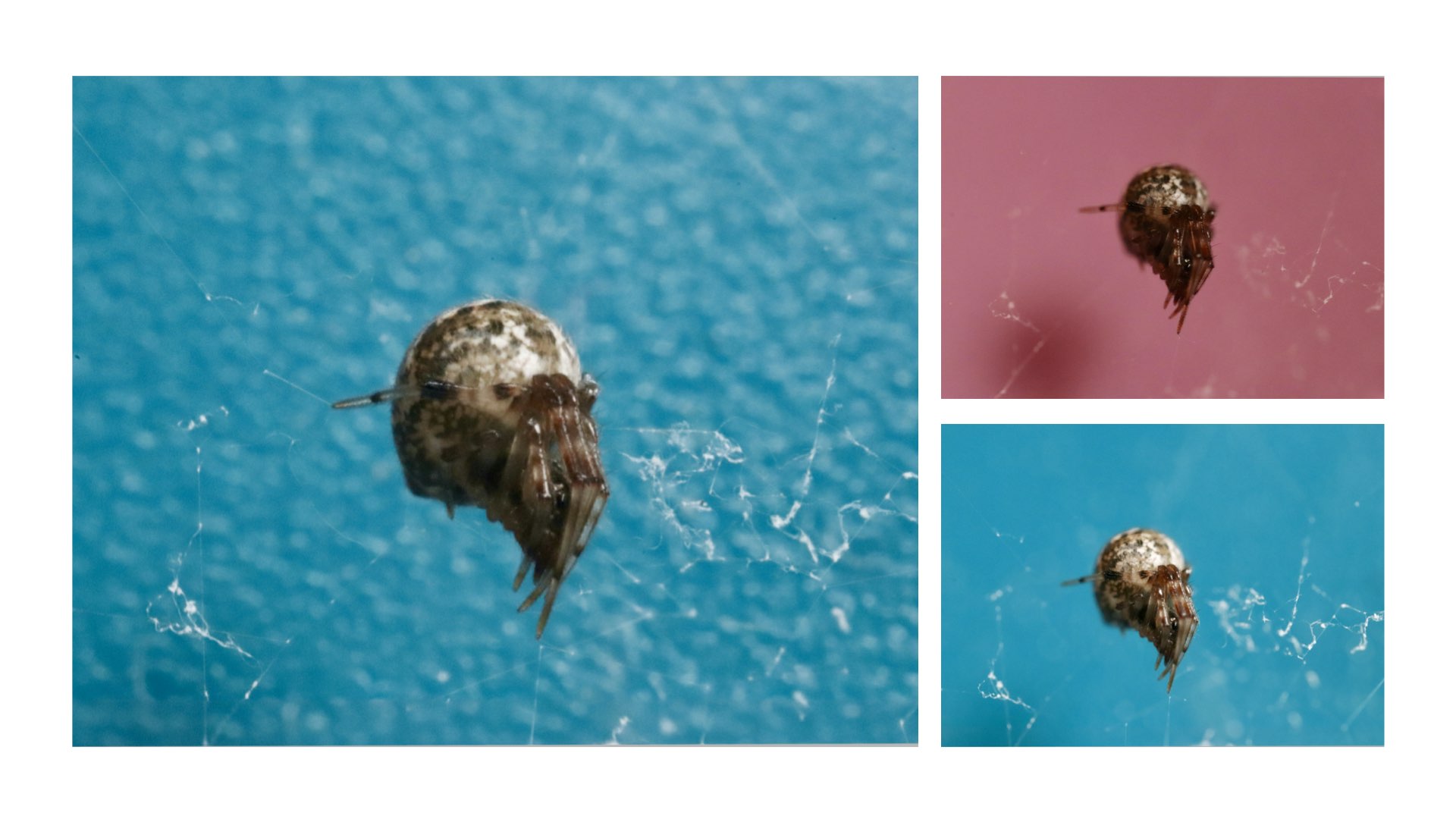
Spiders are the ideal models for macrophotography, because the ones I have are so calm and stable. This little lady was practically immobile for the entire half hour I spent playing with lights and backgrounds and moving in close for pictures.

One thing I discovered is that the Laowa is surprisingly good at collecting light. My first photos were at f/2.8, an exposure of 1/500, and they were all washed out. I kept reducing the exposure and closing off the aperture, and still got usable photos. So it’s got that going for it. On the other hand, the depth of focus is still pretty shallow and I had to stick the lens right in the spider’s face to get it in view, and one thing I like in a lens is a forgiving working distance. Fortunately, this spider was imperturbable.

Anyway, I played for a bit. The one on the left is shot at f/16, the other two at f/2.8. I’m not straining for light in any of them, which is nice. All are at 2.5x, I’ll have to try the 5x option next and see how that goes.

I have a mostly free day tomorrow! I’ll have to practice some more, and maybe do some comparisons with the Tokina Macro 100 F2.8 D, which is currently my favorite lens for field work. I don’t think the Laowa can replace it, but might make a good choice for the lab.

Now…on to classes and grading!

Sad day in the lab

With great sorrow, I must report the passing of a member of the lab family. This beautiful golden spider my wife caught in Colorado in January of 2020 is no more. She was the wrong species, Steatoda triangulosa, for the work I’m trying to do, but I kept her around because she was lovely and vivacious, with her golden color and zig-zag stripes, and she was always eager to kill anything I put in her cage. She’s so pretty her picture is my cell phone screen.

I’d noticed she was a bit lethargic lately, and wouldn’t respond to flies in her web. Yesterday, she was slumped low in her cobweb — they usually favor a high position — and was only feebly responsive to a gentle touch. Today, I found her corpse lying on the floor, legs curled inward.

It’d been a year and a quarter since she was caught as a fully grown adult, so she may have been a year and a half, possibly even just shy of two years old. That’s a long, long life for these little spiders.

Lab time, and a whatsis

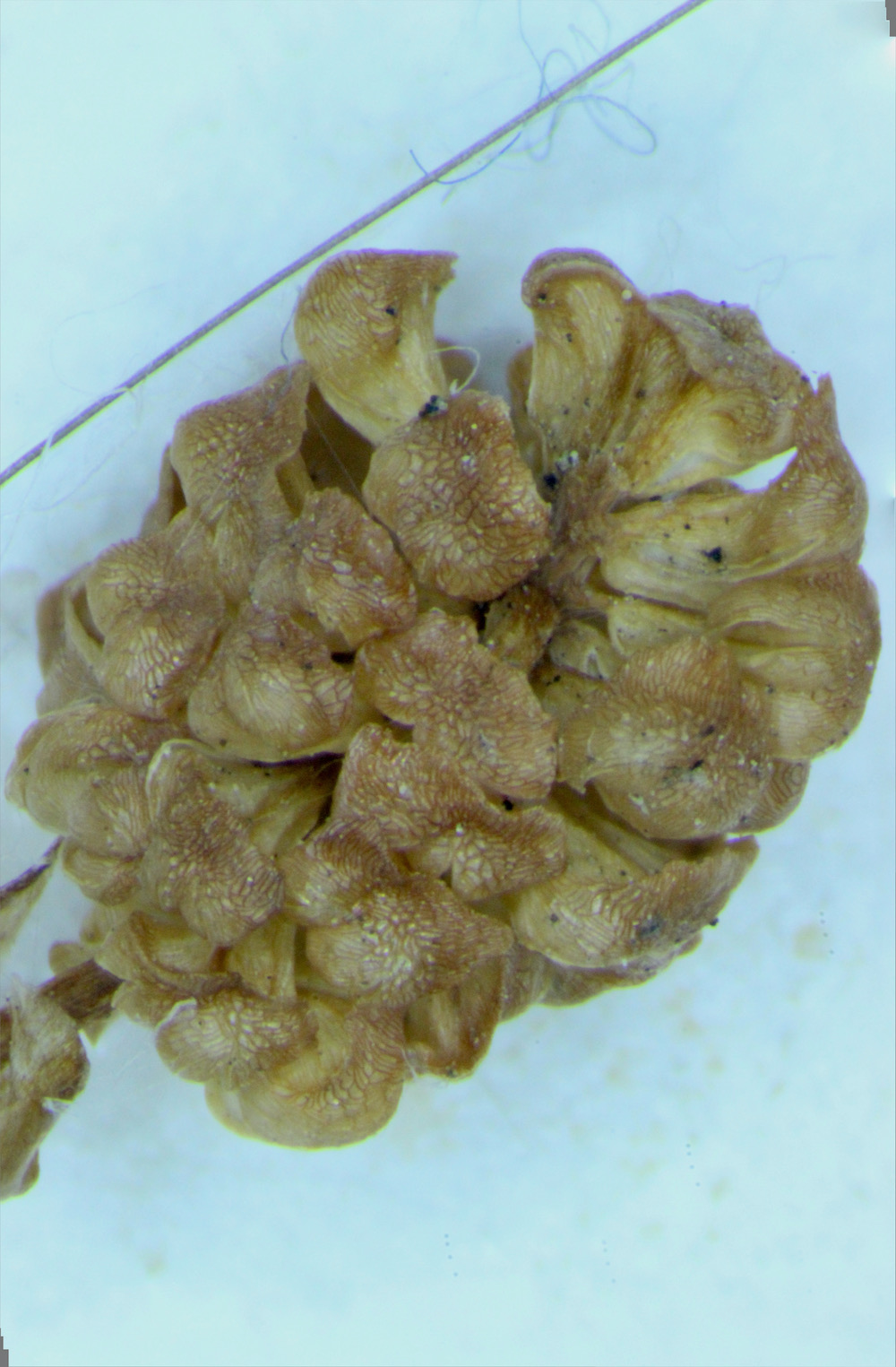
Yesterday, Mary startled a jumping spider which had been hiding under a mysterious small object. That object was also attached to the wall of our house by strands of spider silk. Is it an egg sac? I put it under the microscope, and no, it is not.

It is something tiny, about 2mm long, and botanical. I know nothing of botany. It is not a spider thing, which is enough for me.

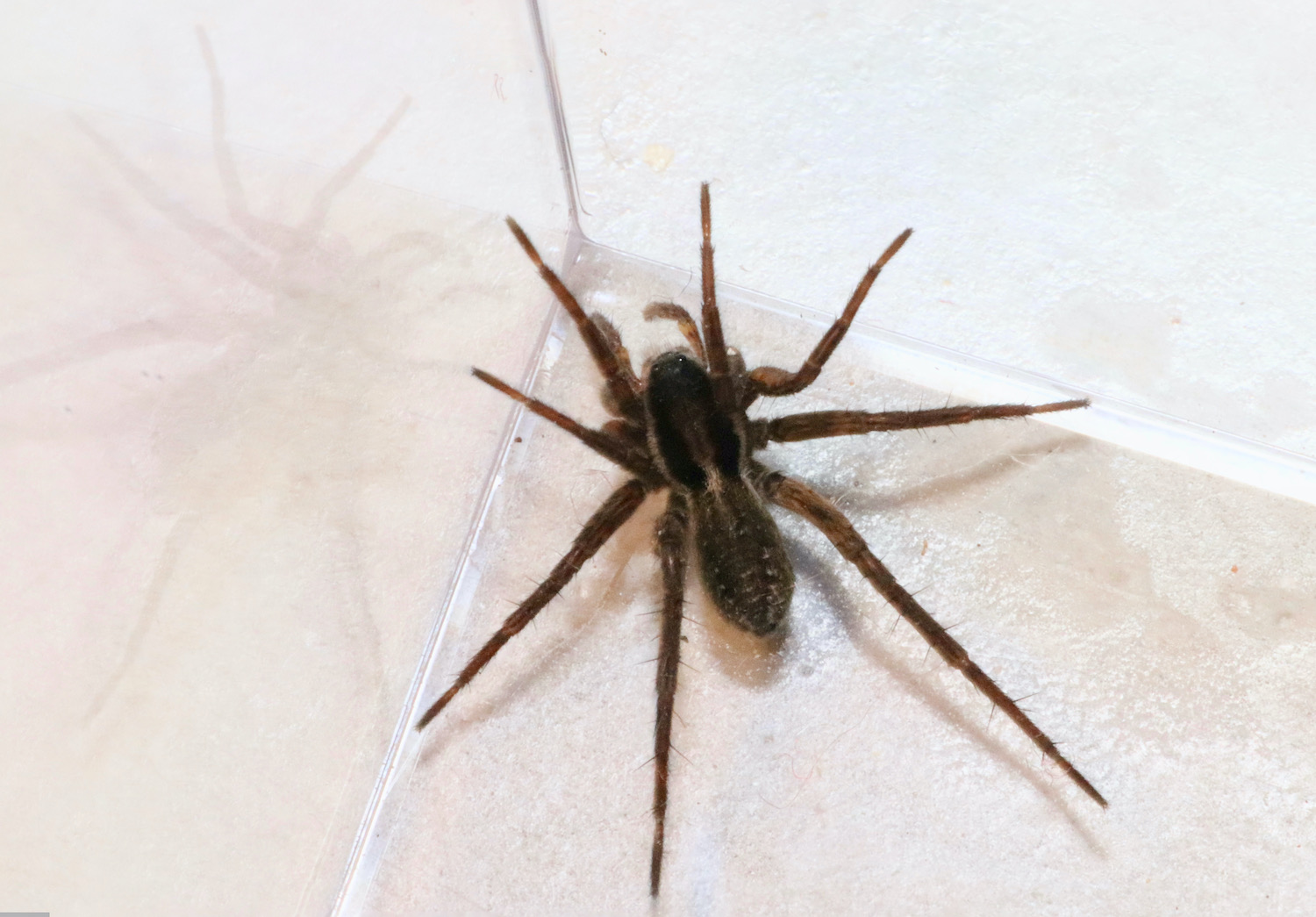
While I was in the lab anyway, I tended to the spiders, who are all doing fine. Here’s one just relaxing in a spider-like way.

[Read more…]

They’re like knitters, wrapping skeins, and bearing poisoned knitting needles

It was another morning in the lab, and as usual, I implemented my new feeding regimen. Previously, I was feeding the juveniles two flies, twice a week. I am now feeding them two flies, every day, and they are still avid and greedy and leaping right onto their prey. I feel guilty, like I must have been starving them. This also means more work for me in the future, but hey, it’s hardly working, and the customers at my restaurant are so appreciative.

I include a photo of one of the feeding spiders. There’s a lot of motion blur in the hind limbs because that’s what they use to draw out silk and wrap around the fly. She was whirring away pretty fiercely there!

[Read more…]