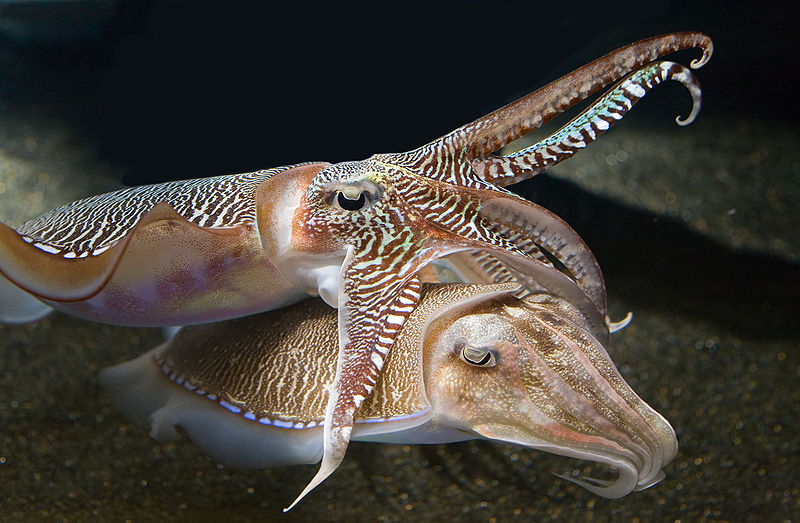
It’s one of a series of photos of the Deepwater Horizon disaster. That’s the real price of oil you’re seeing.

It’s one of a series of photos of the Deepwater Horizon disaster. That’s the real price of oil you’re seeing.

They’re evil…EEEEEEEVVVIIIIILLL.
In a horrifying study, ordinary housecats were fitted with little cameras to monitor their activities throughout the day and night. It turns out that cats are carnivores, real predators, that scurried about murdering little creatures. Are you surprised?
About 30 percent of the sampled cats were successful hunters and killed, on average, two animals a week. Almost half of their spoils were abandoned at the scene of the crime. Extrapolating from the data to include the millions of feral cats brutalizing native wildlife across the country, the American Bird Conservancy estimates that kitties are killing more than 4 billion animals annually. And that number’s based on a conservative weekly kill rate, said Robert Johns, a spokesman for the conservancy.
"We could be looking at 10, 15, 20 billion wildlife killed (per year)," Johns said.
When we had cats, they were confined to the house, and only allowed outside under close supervision, because we understood their savage, beastly natures.

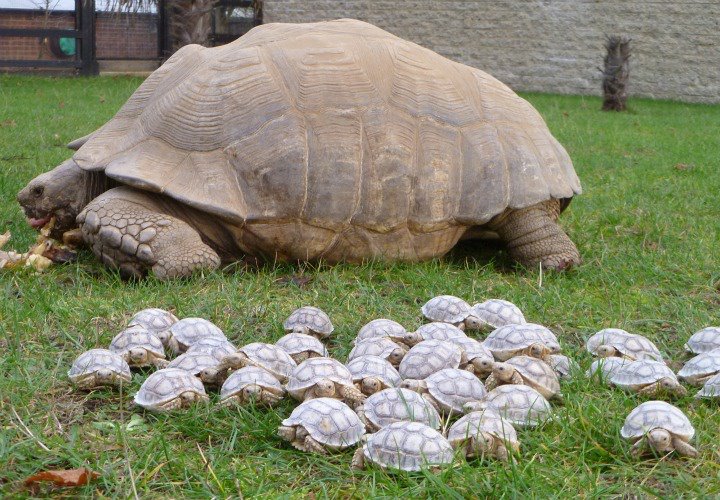
Just think of them as little armored cats. With much bigger litters.
(via Freethinking for Dummies)

I’m getting a bit peeved at all this new technology. Why, back in the day when I was doing electron microscopy work, I’d spend days slicing up tiny fragments of zebrafish embedded in epon-araldite with an ultramicrotome, and I’d end up with hundreds of itty-bitty copper grids that I’d put in the EM one by one, pumping the chamber down to a good vacuum and scanning and focusing and taking pictures. On a film cartridge! That I had to take into a darkroom and process myself! Both ways, uphill, in the snow!
And now look at this. These guys can make a single thin section slice of the whole larva, throw it in a machine, and step back while it automatically scans everything, and then throws it all onto a digital image. Of course, in this case it took their machine 4½ days to shoot over 26,000 images and then stitch them all together, but that’s still far faster than I ever was. I’d slave away to get just one good picture of a chunk of synaptic neuropil maybe 20 micrometers on a side.
Damn. Now I know how John Henry felt.
So here’s a transmission electron micrograph of a zebrafish at low resolution, just to help orient yourself. Ah, this is all familiar stuff; I spent most of my time hanging out in the nervous system, but those blocks of muscle (pink) on the left are always beautiful to look at. That big hole in the middle is the swim bladder, and the guts are slung underneath that. This is a parasaggital section — just off the midline — so it slices nicely through the eye (the big dark circle on the right) and also catches one nostril, above (that’s right, not where you might expect it*) and to the right of the eye. The scattered fragmentary stuff at the bottom, in front of the swim bladder, are sections through the pharyngeal arches. Take a look at the pretty cartilaginous rods sliced through in there.

This is at high enough resolution that you can browse around the brain and find synapses and vesicles. Oh, you can’t see that? Go to the visual browser, and you’ll be able to zoom in and in and in. Easily. With no effort. Just glide on in there and find what you want.
Unlike my old experience with EM. Hey, if any of you have a time machine handy, could you grab one of these gadgets and drop it off for me in Eugene, Oregon, about 1982? Thanks.
*In case you’re wondering how nostrils can be above the eye, visualize a bulldog. Now grab it by the snout, and lift upward, stretching the face up so that a forward view is just a shot of the jaws with eyes on either side. Or, better than a bulldog, start with Admiral Ackbar.
Frank G.A. Faas, M. Cristina Avramut, Bernard M. van den Berg, A. Mieke Mommaas, Abraham J. Koster, Raimond B.G. Ravelli (2012) Virtual nanoscopy: Generation of ultra-large high resolution electron microscopy maps. Journal of Cell Biology 198:457-469 DOI: 10.1083/jcb.201201140.

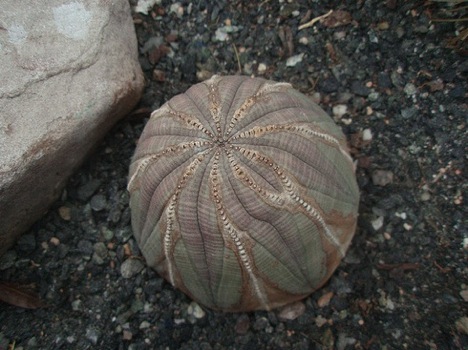
See? It’s a plant that looks like a baseball! And on Friday, the Minnesota Atheists Regional Conference will be sponsoring a baseball game in St Paul, the Mr Paul Aints vs. the Amarillo Sox. You should come. Here’s the schedule for the meeting: Dave Silverman, Hector Avalos, Ayanna Watson, Robert Price, Teresa McBain, J. Anderson Thompson, and me. Probably no baseball plants, though. They’ve been wiped out in the wild.
(via WebEcoist)

…beautiful things happen.

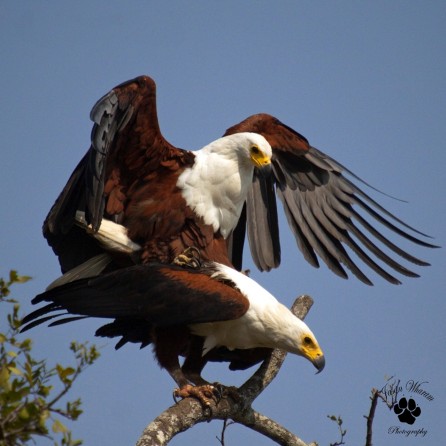
Even though they are African fish eagles. I think we own the symbolism of all eagles everywhere, don’t we?
(via NatGeo)

The 50th Carnival of Evolution went up a few days ago — my apologies for being late, but I’m traveling. Which also explains the paucity of entries lately.