Islam and science are compatible, as long as you cut out the bits of science you don’t like

I visited Brighton, once. I took a pleasant stroll down along the beach, dipped my toe in the water, and I liked it! Therefore, my current physiological state is entirely compatible with swimming the English Channel, and how dare anyone criticize my lack of swimming practice and stamina and strength as somehow incompatible with being a successful English channel swimmer. Didn’t you see in my first sentence that I liked it?

That’s how I read Sana Saeed’s article in which she declares that Richard Dawkins is completely wrong about the incompatibility of science and religion. Her reasons are remarkably superficial and trivial, and she manages to kill her own case midway through. Here’s why she thinks they’re compatible:

I spent my childhood with my nose firmly placed between the pages of books on reptiles, dinosaurs, marine life and mammals. When I wasn’t busy wondering if I wanted to be more like Barbara Walters or Nancy Drew, I was busy digging holes in my parents’ backyard hoping to find lost bones of some great prehistoric mystery. I spent hours sifting through rocks that could possibly connect me to the past or, maybe, a hidden crystalline adventure inside. Potatoes were both  apart of a delicious dinner and batteries for those ‘I got this’ moments; magnets repelling one another were a sorcery I needed to, somehow, defeat. The greatest teachers I ever had were Miss Frizzle and Bill Nye the Science Guy.

I also spent my childhood reciting verses from the Qur’an and a long prayer for everyone — in my family and the world — every night before going to bed. I spoke to my late grandfather, asking him to save me a spot in heaven. I went to the mosque and stepped on the shoes resting outside a prayer hall filled with worshippers. I tried fasting so I could be cool like my parents; played with prayer beads and always begged my mother to tell me more stories from the lives of the Abrahamic prophets.

That’s all very good — it’s a great start to have a childhood in which she was enthusiastic about science, and perhaps she could have even gone on to be a practicing scientist when she grew up (she didn’t) — and she could have even continued to be a practicing Muslim. There is nothing in her story that rebuts any claim of the incompatibility of science and religion.

But here’s where there is an incompatibility: she could do experiments with magnets and potatoes, but did she ever ask herself if those long prayers really worked? Did she ask her grandfather how he knew heaven existed, and would she have been content if he’d simply said it was a tenet of their religion? Did she ever examine those stories of the Abrahamic prophets and ask if they were really true?

No, she did not. She comes right out and says it: magnets and potatoes, sure, but there are some things you are not allowed to question.

In other words: There’s plenty of wiggle room and then some. On anything that is not established as theological Truth (e.g. God’s existence, the finality of Prophethood, pillars and articles of faith), there is ample room for examination, debate and disagreement, because it does not undercut the fabric of faith itself.

She’s so blinkered by her faith that she doesn’t even realize that setting boundaries on what you may question is completely antithetical to science, and that her religion compels her to accept counterfactual nonsense. The only way she can say religion is compatible with science is by imprisoning a broken science within the limited boundaries of what the patriarchs of her faith will allow.

You may not question god, angels, the Qu’ran, Mohammed, the existence of the afterlife, or God’s will, but hey, as long as you unquestioningly accept everything the antique holy book says about the nature of the universe, it’s totally compatible with science.

She gives an example of how Islam and science are compatible, but it’s enough to make one cry in despair.

Muslims, generally, accept evolution as a fundamental part of the natural process; they differ, however, on human evolution – specifically the idea that humans and apes share an ancestor in common.  

Well, then, that means you don’t accept evolution. There is no good reason to single out humans as exceptional — the science says one thing, religion defies the evidence, and Saeed accepts the religion.

In the 13th century, Shi’i Persian polymath Nasir al-din al-Tusi discussed biological evolution in his book “Akhlaq-i-Nasri” (Nasirean Ethics). While al-Tusi’s theory of evolution differs from the one put forward by Charles Darwin 600 years later and the theory of evolution that we have today, he argued that the elemental source of all living things was one. From this single elemental source came four attributes of nature: water, air, soil and fire – all of which would evolve into different living species through hereditary variability. Hierarchy would emerge through differences in learning how to adapt and survive.

This is a “theory” that is not founded on evidence and experiment, propagates archaic ideas about the structure of the universe (water, air, soil, and fire are not the fundamental attributes of nature), contains erroneous statements about biology (al-Tusi endorsed a hierarchical ladder of life, and also set humans apart as a special case), and completely lacks the population thinking that was the core of Darwin’s insight. He was a smart fellow who did some brilliant things, but he was also a person of his times and his biological explanations were most definitely not comparable to what Darwin came up with 600 years later.

That Saeed thinks they are is just another sign of her ignorance.

Al-Tusi’s discussion on biological evolution and the relationship of synchronicity between animate and inanimate (how they emerge from the same source and work in tandem with one another) objects is stunning in its observational precision as well as its fusion with theistic considerations. Yet it is, at best, unacknowledged today in the Euro-centric conversation on religion and science. Why?

Because it was wrong? Because it did not lead to greater understanding of how biology works? Because it was all tangled up in ridiculous religious beliefs that you were not allowed to question?

I think Saeed understands her religion very well. But despite some early promise in childhood, it’s clear that she doesn’t understand science at all.

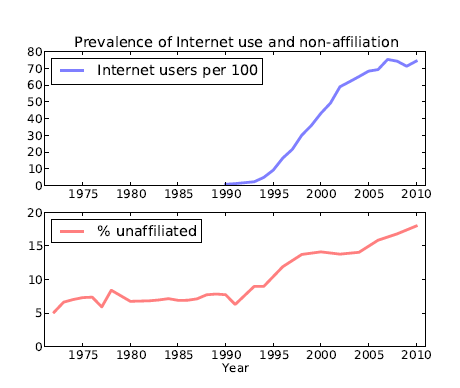
What’s causing the boom in atheism?

It is only appropriate that now, while I’m at Skep-Tech 2, we should get an article about the influence of technology on religion. It seems to be primarily corrosive.

Back in 1990, about 8 percent of the U.S. population had no religious preference. By 2010, this percentage had more than doubled to 18 percent. That’s a difference of about 25 million people, all of whom have somehow lost their religion.

LosingReligion

(By the way, I’m not a fan of graphs that mislead by having different scales: the percent change in the adoption of the internet is far, far greater than the percent change in the adoption of atheism — this chart illustrates a similarity in timing, only.)

A computer scientist, Allen Downey, has dissected these trends to identify the major components affecting religiosity, and has narrowed it down to three big ones: upbringing, education, and access to the internet.

He finds that the biggest influence on religious affiliation is religious upbringing—people who are brought up in a religion are more likely to be affiliated to that religion later.

However, the number of people with a religious upbringing has dropped since 1990. It’s easy to imagine how this inevitably leads to a fall in the number who are religious later in life. In fact, Downey’s analysis shows that this is an important factor. However, it cannot account for all of the fall or anywhere near it. In fact, that data indicates that it only explains about 25 percent of the drop.

He goes on to show that college-level education also correlates with the drop. Once it again, it’s easy to imagine how contact with a wider group of people at college might contribute to a loss of religion.

Since the 1980s, the fraction of people receiving college level education has increased from 17.4 percent to 27.2 percent in the 2000s. So it’s not surprising that this is reflected in the drop in numbers claiming religious affiliation today. But although the correlation is statistically significant, it can only account for about 5 percent of the drop, so some other factor must also be involved.

That’s where the Internet comes in.  In the 1980s, Internet use was essentially zero, but in 2010, 53 percent of the population spent two hours per week online and 25 percent surfed for more than 7 hours.

This increase closely matches the decrease in religious affiliation. In fact, Downey calculates that it can account for about 25 percent of the drop.

That’s a fascinating result. It implies that since 1990, the increase in Internet use has had as powerful an influence on religious affiliation as the drop in religious upbringing.

I think there’s more to the story than this, though. The internet is too big and messy to be simplistically causal: there are also a great many sites dedicated to reinforcing the lies of religion, obviously, and there are Chrisians and Moslems who use the internet as a tool for evangelism and tribe-building. A more interesting question would be about how people use the internet. I don’t think a person’s faith would be challenged by the internet alone, but only if they use the internet to explore and compare conflicting views.

It’s been a bad month for the creationists

I almost pity them. First there’s the discovery of gravitational waves that confirm a set of models for the origin of the universe — I can tell they’re trying to spin that one (it confirms the universe had a beginning, just like the Bible says!), but it’s obvious which perspective, scientific or religious, has the greater explanatory power.

Then there’s Neil deGrasse Tyson’s Cosmos, in which every episode so far has taken a vigorous poke at creationist nonsense. I think they cry every Sunday after church, because they know that later that evening they will be attacked by the intelligent, educated segment of the culture. It’s been great.

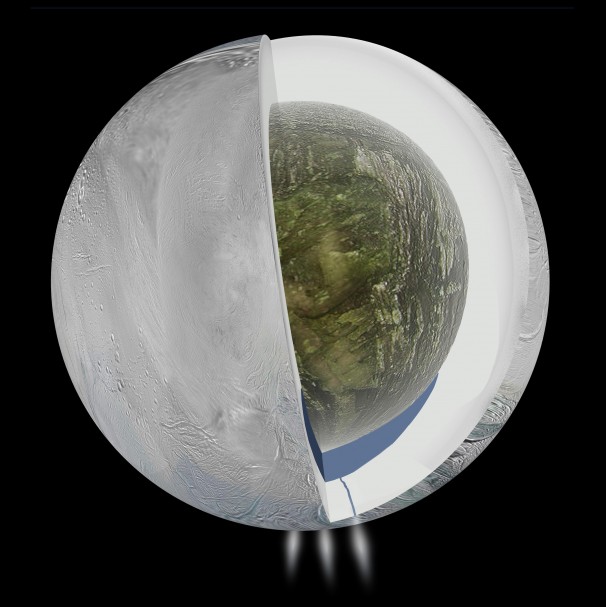
And now, look, the Cassini spacecraft has found an ocean beneath the ice of Saturn’s moon, Enceladus.

For years, the motto among astrobiologists — people who look for life in distant worlds, and try to understand what life is, exactly — has been “follow the water.” You have to start the search somewhere, and scientists have started with liquid water because it’s the essential agent for all biochemistry on Earth.

Now they’ve followed the water to a small, icy moon orbiting Saturn. Scientists reported Thursday that Enceladus, a shiny world about 300 miles in diameter, has a subsurface “regional sea” with a rocky bottom.

This cryptic body of water is centered around the south pole and is upwards of five miles deep. It has a volume similar to that of Lake Superior, according to the research, which was published in the journal Science.

Enceladus

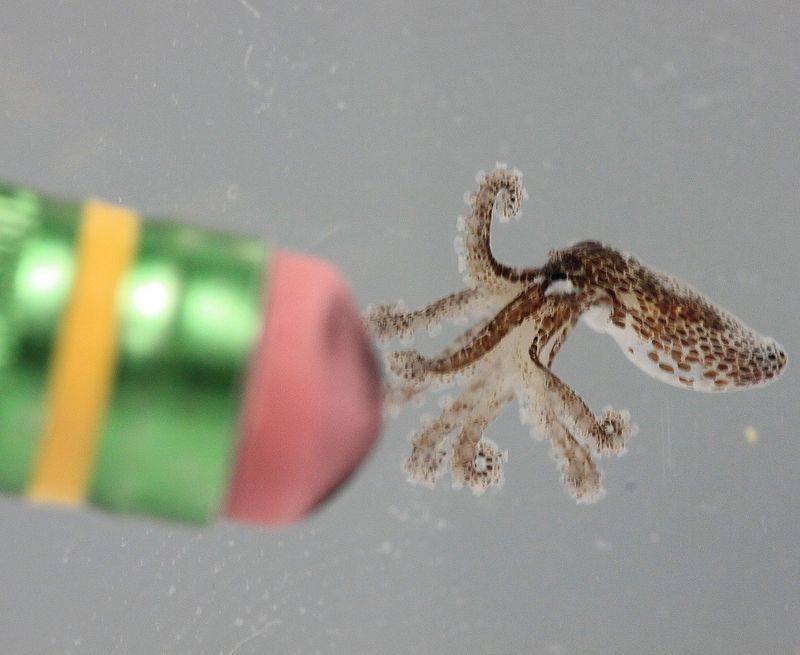
There is hope yet for Space Squid! Or maybe space progenotes. Isn’t it wonderful that we keep finding gloriously natural discoveries in the universe?

The tears will flow again in a few weeks, when Neil Shubin’s new series, Your Inner Fish, premieres on PBS. I’m really looking forward to this one.

It is a good time to be passionate about science.

A poll! To benefit my campus!

This is terribly self-serving, but I finally aim to use my poll-crashing powers for personal gain. UMM is competing in a video contest, and we’re currently a distant third. This is the contest:

For the third straight year, Planet Forward is partnering with Second Nature to host the Climate Leadership Awards Video Voting Competition. Second Nature, which seeks to create a sustainable society by transforming higher education, has selected the top climate-related ideas from colleges across the country.

All of Second Nature’s Climate Leadership Award Finalists were asked to create a 1-3 minute video highlighting climate innovations on campus. We’re asking our online community to select the most innovative campus.

And this is UMM’s entry:

Go ahead and browse the many videos, and vote. I’d prefer you voted for us, but there’s a lot of worthy entries there, and I won’t hold it against you if some other college’s entry appeals to you more.

You’d just be wrong.

Ignoring the scientists, part 2

We’re not doing anything about slow, steady climate change, and we’re also not dealing with acute, local environmental risks, like the recent Washington mudslide.

The Snohomish County officials who control land use permits asserted last week that there was no way of knowing a giant mudslide would ever happen there.

In fact, the area was primed for just such an extraordinary event, according to geologist Daniel J. Miller, who twice surveyed the area for local Native American tribes who rely on the river’s health for fishing and for the Army Corps of Engineers. He wrote in his 1999 report that the Hazel Landslide, as the mountain is known, was constantly shifting, experiencing landslides and would one day suffer “a catastrophic failure.”

“This landslide moves every year when it gets wet, and pieces fall off,” said Miller, a consultant in Seattle, in a telephone interview Friday.

It was a nightmare waiting to happen.

An ancient glacier is jutting out of the mountain, making its flat plateau unstable, Miller said. The Stillaguamish River was eroding it from below. Rows of conifer trees that helped to mitigate erosion by sucking water through their roots and releasing it into the atmosphere were chopped down by loggers. Rain fell on the bald spots they left, drenching dirt and sand, making the mountain even more precarious.

March 2014 has been a ­record-breaker, the wettest in Seattle’s history.

Miller realized his warning was not heeded when he visited the site following a major landslide in 2006 that did not do nearly as much harm. He could not believe what he saw.

“There was new construction,” he said. “The sound of hammering competed with the sound of [destabilized] trees snapping after the mudslide. I can’t believe that someone wanted to build their home there. It was a very bad idea.”

Damn warmists and catastrophists — they keep hurting the economy, like homebuilding, with these warnings that the mountainsides have been made unstable by melting glaciers, logging, and heavy rains.

But don’t you worry. People will keep working along, because they’ve got Someone to tell them everything will be OK.

We’re a little logging community, she said. There are so many missing, so many dead. We definitely feel God protected us. My neighbor’s house is gone. My husband’s out there digging for bodies.

Thank God that God especially loved a few people so that they can dig for the corpses of those other people he really hated.

That woman, I hope, has read that article and had a moment of awareness in which she realized what a stupid thing she said. But nah, it won’t happen.

Update on Olivia McConnell

The eight year old girl who was trying to get the South Carolina legislature to make the woolly mammoth the state fossil has reason to be happy today: the ass of a state senator who was trying to insert Bible quotes into the bill, effectively killing it, has withdrawn his obstructionist amendment.

He said he removed his objection after another senator told him the story of how an 8-year-old Lake City girl had written to lawmakers suggesting the mammoth as the state fossil because fossilized mammoth teeth had been discovered in a swamp in the state in 1725.

Yeah, right. More like he saw that he was being perceived as the sanctimonious ogre who beats up on little girls, and withdrew in the face of withering scorn.

25 years of futility

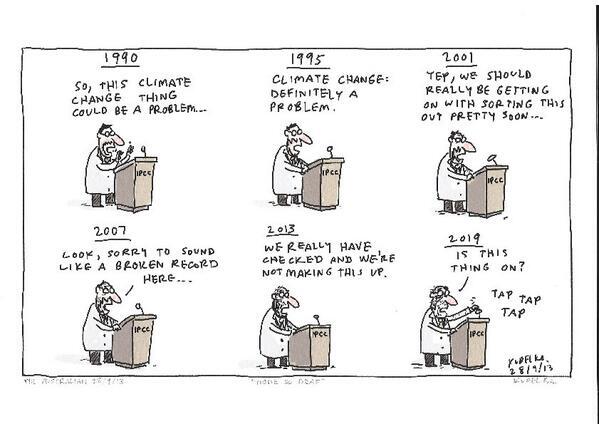
The IPCC has been issuing climate change warnings for 25 years. Here’s the net result:

But if we go back to brass tacks, it’s worth asking how the world has reacted to these repeated warnings.

Since 1990, annual global greenhouse gas emissions from burning fossil fuels have gone up 60 per cent.

Or perhaps you’d rather get it in cartoon form?

ipccwarnings

This is what happens when you ignored the scientists and instead obey the self-serving lies of industry.