
It’s an interesting discussion, focusing on the famous The Spandrels Of San Marco paper, but also talking generally about SJ Gould’s ego (it was big and ambitious), and how to properly do an evolutionary research program.

It’s an interesting discussion, focusing on the famous The Spandrels Of San Marco paper, but also talking generally about SJ Gould’s ego (it was big and ambitious), and how to properly do an evolutionary research program.

This video explaining why so many Americans are circumcised is funny…but it’s also accurate.

Posting it here is not an endorsement of Ben’s position, but he has reasonable arguments that I’m willing to give an airing.
PZ Myers
I imagine most readers of this blog are familiar with Jerry Coyne. If not, he’s a prominent biologist and atheist who maintains the blog Why Evolution is True. And apparently, he has taken to blocking commenters who disagree with him, even over substantive scientific issues.
First, some background: A conflict has been brewing over how to model the evolution of social behavior. At issue is a method called inclusive fitness theory, which emphasizes the role of genetic relatedness between interacting organisms. In 2011, Martin Nowak, Corina Tarnita, and EO Wilson (hereafter, NTW) published an article arguing that inclusive fitness is a mathematically limited method, and that the role of relatedness has been overemphasized in the evolution of worker castes in social insects.
NTW’s article generated a strong response—most famously, a letter signed by 137 prominent researchers (also some talking bears). I happen to agree with Nowak, and have collaborated with him and Wilson on follow-up work. However, intelligent people can disagree on this issue, and I trust that science will sort it out.


I previously cited that extremely critical evaluation of evolutionary psychology by Jonathan Marks, but what I didn’t realize is that it was one part of a whole series of articles that were mostly favorable reviews of EP. Of course, the pro-EP articles were awful.

But at last, I have an excuse! I’m not a wallflower, I’m a Noble Gas!


It’s not just because they are lucky enough to live in one of the most spectacular landscapes on the planet. It’s also because they’re great model organisms, guinea pigs — the zebrafish of humanity. They represent a small, isolated population with a well-documented history and excellent medical records, so they’re just the people you might want to do in-depth genetic studies on.


I get asked that question so often. My usual answer is, “I don’t know, probably.” (It’s also a good answer if they ask, “does this prevent cancer?”) That’s safe to say, because just about anything can be found associated with cancer, if you look hard enough. I’ve read enough papers to know that if you can find a study accusing a food to be of the devil, you can find another one saying it’s angelic. And there will probably be some feckless mass media organ screaming CAUSE or CURE.


They’re the boogeyman of pop astronomy: the ravenous, all consuming black hole, with gravity so intense that you can’t escape it, and lurking in the center of the Milky Way, working to devour the entire galaxy.
Except they’re not that bad.

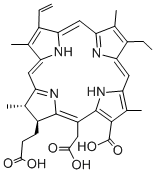
Photosensitizers are chemicals that absorb photons and use that energy to promote electrons to higher energy states, and typically those activated electrons produce free radicals that react with other substances in the cell. That’s not particularly scary: your eyes contain proteins, opsins, and a chemical, retinal, that also absorb photons and use the energy to cause a conformational change in retinal. But photosensitizers are also used in cancer therapy. Load up a tumor with photosensitizers, then shine a laser on it, and all the free radicals do a bang-up job of destroying the cells, exactly as you want.

A certain deep, primal part of my brain went “Squeeee!” at this video of a nautilus being fed by hand. I want one. I want a cephalopod to be my friend. But sorry, people, taking an exotic animal out of the ocean and confining it to an aquarium is not exactly the friendliest thing to do…and a lot of cephalopods are finicky and delicate.
