Science in America

Neil deGrasse Tyson has a few words for you.

I agree with all of that. My concern is that we’re dealing with an industry — exemplified by creationism and climate change denial — that has built up a body of well-funded propaganda which allows their believers to rear up and say, Well, we are citizen scientists who have our own facts, and we say that the Earth is 6000 years old and global warming is just a natural cycle. They aren’t going to be impressed by published, verified facts about the natural world when they have something even more significant to them: validation of their biases, consilience with their holy book, resentment and paranoia about those damned ivory tower eggheads.

Tyson will reach the people who already support good science, and that’s important in sustaining resistance to ignorance. But I fear he will not change the minds of the dumbasses who currently hold the reins of power. All that we can do is work to throw them down. And that is a political solution to an existing situation in reality.

The Science March and partisanship

[Guest post from Sam Roy]

There is a lot of talk on the March for Science being “non-partisan” and above “politics.” Three points on this:

  • When science is under attack by the powers-that-be, the defense of science is a political act, and we should not shy away from this.

    What this regime has unleashed is potentially catastrophic in its consequences for humanity. Humanity confronts a warming planet, with rising sea levels, melting glaciers and extreme weather events causing droughts and famine; it is nothing short of a crime against humanity to accelerate this by denial of global warming, by muzzling of climate scientists, by de-funding this research, approving fossil fuels and oil pipelines, and effectively undermining any global response to this crisis. Humanity confronts increased incidence of global pandemics; it is nothing short of a crime against humanity to de-fund public health research. Let’s not forget Trump’s inhumane, mean-spirited and chauvinistic response to the doctors and nurses who went to Africa to deal with the Ebola crisis, tweeting, “The “US cannot allow EBOLA infected people back” and they “must suffer the consequences.” Imagine what his policies and response will be to the next pandemic outbreak!

  • The March for Science should be non-partisan, if that is to mean NOT favoring the “Democrats” over the “Republicans”.

    Let’s not forget that not a single prominent Democrat has come out and boldly proclaimed that evolution is a fact – all life on planet Earth evolved from common ancestors over nearly 3.5 Billion years. Democrats have constantly conciliated with Christian fascists and Biblical literalists who have waged well-funded and deceptive campaigns to undermine the teaching of evolution in schools. They did not oppose Betsy deVos, the Christian Fascist Secretary of Education, on this front despite her well-known and historic efforts to impose this worldview on society, denying generations of children the science of evolution and the scientific method. To rely on the Democrats to “save” and “defend” science is a fool-hardy enterprise.

  • But the March for Science should be Partisan – In the Name of, and For Humanity!

    The March for Science has a wonderful celebratory spirit in sharing science with the world.

    At the same time, let’s recognize that this regime – the Trump/Pence regime – is a fascist regime, posing existential threats to humanity, including with nuclear brinksmanship. Some say it may be true but it’s not useful or too scary or too polarizing. Imagine if some didn’t raise the alarm about AIDS, when the powers-that-be refused to even acknowledge it – because it’s not useful or too scary or too polarizing. Imagine if they knew in 1933 what we know now about Hitler and the Nazis. Let’s call scientific reality for what it is, let’s not make this mistake – for the sake of humanity.

    The terror unleashed on millions of immigrants in this country by this regime is very real, and is happening – right now! The world’s most devastating bomb short of nuclear was dropped – last week. Today they threaten an unbelievably catastrophic war against Korea. Imagine what harm this regime can do over the next few days, weeks and months with its levers of power, bludgeoning truth and repressing dissent as it carries out its horrors.

    We need to drive out this regime – at the soonest possible moment.

The gospel according to St Ray

Deja vu, man. Transhumanism is just Christian theology retranslated. An ex-Christian writes about her easy transition from dropping out of Bible school to adopting Ray Kurzweil’s “bible”, The Age of Spiritual Machines.

Many transhumanists such as Kurzweil contend that they are carrying on the legacy of the Enlightenment – that theirs is a philosophy grounded in reason and empiricism, even if they do lapse occasionally into metaphysical language about “transcendence” and “eternal life”. As I read more about the movement, I learned that most transhumanists are atheists who, if they engage at all with monotheistic faith, defer to the familiar antagonisms between science and religion. “The greatest threat to humanity’s continuing evolution,” writes the transhumanist Simon Young, “is theistic opposition to Superbiology in the name of a belief system based on blind faith in the absence of evidence.”

Yet although few transhumanists would likely admit it, their theories about the future are a secular outgrowth of Christian eschatology. The word transhuman first appeared not in a work of science or technology but in Henry Francis Carey’s 1814 translation of Dante’s Paradiso, the final book of the Divine Comedy. Dante has completed his journey through paradise and is ascending into the spheres of heaven when his human flesh is suddenly transformed. He is vague about the nature of his new body. “Words may not tell of that transhuman change,” he writes.

I’ve never trusted transhumanism. There’s a grain of truth to it — we will change over time, and technology is a force in our lives — but there’s this weird element of dogmatism where they insist that they have seen the future and it will happen just so and if you don’t believe in the Singularity you are anti-science. Or if you don’t believe in Superbiology, whatever the hell that is.

Anyway, read the whole thing. I’m currently at a conference at HHMI, and we’re shortly going to get together to talk about real biology. I don’t think the super kind is going to be anywhere on the agenda.

I’m trying to be optimistic here

Here’s this chart of the caloric value of cannibalism.

The article tries to spin this negatively — as a game animal, humans are a very poor return on the investment of effort in hunting them. As a cheerful optimist with a sunny disposition, however, I prefer to put this in a good light: if you are on a diet and trying to lose weight, then cannibalism might just be the perfect weight loss plan for you.

Basically, if you’re eating kale regularly, you might as well try switching things up a bit.

Tissue Organization Field Theory

It’s been a while since I brought everyone up to date on the progress of my Ecological Development course, because I’ve been busy. So have the students. After our spring break I subjected them to the dreaded oral exam, which actually isn’t so bad. I tried to engage them less in an adversarial role and more as a quiet conversation between two people on science. Some students took to it easily — the more outgoing ones — others were noticeably nervous, which was OK, and I hope they learned that it isn’t that terrifying to have a discussion with a mentor.

Then the next few weeks were a mad whirl of horrible things done to babies: teratogens, endocrine disruptors, multi-generational epigenetic inheritance, all that fun stuff. We wrapped up with the depressing stuff for me, although the young’uns were more sanguine, I think. We talked about adult onset developmental diseases (it’s good to look at heart disease through the lens of developmental biology), aging, and cancer. Next week they get some time off, because I’m being drawn away to a conference on the east coast, but they’re supposed to spend it preparing for their final presentations, which will consume the last two weeks of class. And then we’re all done. School’s out for summer!

I’m going to say a bit about our last class discussion, because it got into some interesting territory and reflects the theme of the course well. We talked about that theory mentioned in the title of this article, and the origins of cancer, and to do that I have to give you all a little background.

Tissue Organization Field Theory (TOFT) is an alternative to what is sort of the dominant paradigm in cancer biology, the Somatic Mutation Theory (SMT). I have to say “sort of” because what I get from the literature is that SMT is more of a working assumption, and that cancer biologists are open to new ideas. The SMT is a useful molecular perspective on carcinogenesis. It postulates that cancer is a cellular disorder in which the genetic material has been perturbed to produce a lineage of cells with aberrant characteristics, that if we want to figure out what the primary cause of a cancer was, we can trace it back to a somatic mutation, or a change in a critical gene or, more likely, multiple genes, that lead to uncontrolled proliferation. So we pursue oncogenes, genes that have the potential to acquire mutations that trigger cell division or bypass control points, and tumor suppressor genes, protective genes that, when damaged, remove essential regulators of growth.

So, under the SMT, cancer is a disease caused by the progressive accumulation of mutations in cells of the body, as they divide. These mutations gradually strip away the normal restraints on cell division, and on immune system recognition, and on cell death activation, etc., etc., etc. until you have a rogue cell that can seed the growth of a massively disruptive tumor.

And it’s not wrong! Cancer biology has been immensely productive in identifying the enabling mutations, and even developing treatments that specifically target molecular agents of cancer. We know that somatic mutations are a routine part of the progression of cancer, and we also know that there heritable alleles that can affect the likelihood of the disease. The SMT is a tool to explain many of the phenomena of cancer, and it’s not going to just go away. It’s also a tool that is amenable to a reductionist approach to cancer biology, and is well-adapted to the utility of molecular biology.

Tissue Organization Field Theory is an alternative explanation for the origins of cancer.

TOFT argues that the focus of the SMT on single cell events is inappropriate and misses a whole range of effects at the level of tissue organization, effects which are more important in creating a pathological environment in which those mutations can accumulate. Further, it gets into field theory, which is important in developmental biology but isn’t exactly the subject of common conversation. Here’s one standard definition of a field: “a morphogenetic (or developmental) field is a region or a part of the embryo which responds as a coordinated unit to embryonic induction and results in complex or multiple anatomic structures.” If that’s not helpful — and it probably isn’t, we’d have to go over a textbook if we wanted to explain developmental field theory — here’s a diagramatic metaphor. Do you see the field in this picture?

There’s something special about part of that image, but it’s not that the individual subunits are intrinsically different — it’s tied up in the relationships between the central set of blocks and the blocks outside of it. There’s something different going on with a subset of the blocks, but it’s not necessarily best described by explaining the details of single blocks, but is more easily explained at a higher level, as properties of a tissue within a tissue. Of course, what will eventually happen in a developing organism is that those central blocks will express a unique pattern of genes, so eventually it’s identifiable by molecular markers, but the field first arises in a sea of genetically and epigenetically uniform cells.

Another important property of a field is that it is not itself uniform. It’s going to acquire complex spatial properties over time. Insect limbs, for instance, arise from a disc-shaped field with extensive patterning information within them, so the central region will become the distal tip of the limb, and there is information that is interpreted as polar coordinates that specifies what portion of the limb is anterior, posterior, medial, and lateral (the limb is not a uniform cylinder). Similarly, vertebrates have a limb field represented in the limb bud, with gradients of morphogens specifying the orientation of the limb, and with re-expression of Hox genes used to specify longitudinal positions. Hox genes in a limb field are interpreted in different ways than Hox genes along the body axis, obviously.

The key factor here is that in field theory cells are not simply independent units — they are part of a larger assemblage, a tissue, that has complex fates that are not easily summarized by individual gene expression. They have to be understood as a network.

That’s the first thing to remember: TOFT is treating a cancer as a field, with field properties, which are not adequately described if you only look at cancer as a collection of autonomous cells all doing their own thing at the command of their broken genes. Aberrant disruption of the field can produce aberrant structures without requiring any genetic changes.

This is the difference between a mutagen and a teratogen. The effects of a mutagen are caused directly by damage to the structure or sequence of DNA; they produce heritable changes to the cells of an organism. Teratogens, on the other hand, are not necessarily mutagenic at all — they disrupt the normal pattern of development without changing genes at all. Thalidomide babies, for example, had some extreme morphological changes, like phocomelia or truncated limb development, but those are not heritable, and the people affected by thalidomide can grow up to have normal, healthy children.

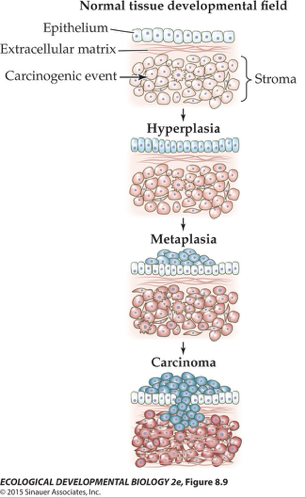
TOFT argues something similar, that there is a disruption of a tissue that initializes aberrant growth, that may then be an enabling precondition for the accumulation of mutations. One piece of evidence for this is a set of experiments on tissues, illustrated below.

Most cancers arise in epithelial tissues, like the sheets of cells that line glands or your organs, in large part because those are the cells that divide most frequently. These epithelial cells, also called parenchyma, do not typically grow in isolation, but on a substrated of connective tissue, extracellular matrix, and other cell types, called stroma. The stroma supports and signals the overlying epithelium, and vice versa, and together they make a coherent functional tissue.

The theory suggests that cancers can arise in epithelia by way of disruptions in signaling in the stroma. A carcinogen could distort the interactions between stroma and epithelium at the level of the stroma, and the epithelium then goes nuts and proliferates to produce a pre-cancerous mass.

One test of the theory would be to separate stroma and epithelium, expose the stroma to a short-lived teratogen, and then after the teratogen was washed out, re-associate the two and determine whether there was an increase in the frequency of cancers in the epithelium, which has not been exposed to teratogens.

The experiment has been done. Here are the results for rat mammary gland tissue in which the epithelium was exposed to the solvent vehicle but no N-methyl nitorsourea (a potent mutagen), while the stroma was soaked in NMu, labeled VEH/NMu. The numerator describes the epithelial condition, and the denominator is the stroma condition, so NMu/NMu means both were hit with the mutagen, VEH/VEH means both were exposed only to the vehicle, and NMu/VEH means the epithelium was poisoned with NMu, while the stroma was not.

There’s an awfully strong positive correlation between exposing the stroma to mutagens and getting tumors, and a negative correlation with exposing epithelia to mutagens and tumors.

You want more evidence? Here’s a very interesting experiment. Start with aggressively metastatic melanoma cells from a human patient (labeled in green, below). Inject them into a completely different environment, the neural crest pathway in a developing chick embryo. Surprisingly, if you accept the SMT, the cancer cells calm right down and are conditioned by their environment to participate in normal development in the chick and get incorporated into the facial cartilages and sympathetic ganglia.

I suspect those melanoma cells do carry somatic mutations, and are not actually “cured” of a predisposition to cancer. What the experiment says, though, is that environmental influences are extremely important in regulating the behavior of these cells, and that modifying the cells communicating with the cancerous cells can have a profound effect on how they act.

Note that this is not a pathway to a cure. It’s all well and good to say that if we could break up a tumor, separate the individual cells and put them in a more nurturing, embryo-like environment, they’ll stop acting up and resume normal, regulated growth, but if we could do that, slicing out the tumor and tossing it in an incinerator would also be effective. The problem is that in a human patient we do not and cannot have such precise control of the micro-environment of the cancer, and in fact, the tumor itself is a kind of bubble of micro-environment that actively reinforces cancer growth.

My students and I read a paper from Carlos Sonnenschein, who is a major proponent of TOFT, as well as our textbook summary. The paper was titled The tissue organization field theory of cancer: a testable replacement for the somatic mutation theory. They’re a smart bunch, and they see the promise of the idea, in part because this whole course is about thinking a level above reductionist cell biology, but they also found the word “replacement” off-putting. It doesn’t invalidate everything about the SMT, but it does support an important alternative route for carcinogenesis. They also weren’t impressed by the rather aggressive insistence by some TOFT proponents that they have the One True Explanation, and that their observations are sufficent to explain cancer — we came up with a few alternative interpretations of their own favorite experiments that they haven’t nailed down completely just yet.

One thing that amused me is that the class consensus actually converged on the views of another paper by Bedessem and Ruphy, which I did not assign them to read, largely because of its more philosophical argument (I’ve focused on empirical/experimental papers in the class). This is how I feel about it, too.

The building of a global model of carcinogenesis is one of modern biology’s greatest challenges. The traditional somatic mutation theory (SMT) is now supplemented by a new approach, called the Tissue Organization Field Theory (TOFT). According to TOFT, the original source of cancer is loss of tissue organization rather than genetic mutations. In this paper, we study the argumentative strategy used by the advocates of TOFT to impose their view. In particular, we criticize their claim of incompatibility used to justify the necessity to definitively reject SMT. First, we note that since it is difficult to build a non-ambiguous experimental demonstration of the superiority of TOFT, its partisans add epistemological and metaphysical arguments to the debate. This argumentative strategy allows them to defend the necessity of a paradigm shift, with TOFT superseding SMT. To do so, they introduce a notion of incompatibility, which they actually use as the Kuhnian notion of incommensurability. To justify this so-called incompatibility between the two theories of cancer, they move the debate to a metaphysical ground by assimilating the controversy to a fundamental opposition between reductionism and organicism. We show here that this argumentative strategy is specious, because it does not demonstrate clearly that TOFT is an organicist theory. Since it shares with SMT its vocabulary, its ontology and its methodology, it appears that a claim of incompatibility based on this metaphysical plan is not fully justified in the present state of the debate. We conclude that it is more cogent to argue that the two theories are compatible, both biologically and metaphysically. We propose to consider that TOFT and SMT describe two distinct and compatible causal pathways to carcinogenesis. This view is coherent with the existence of integrative approaches, and suggests that they have a higher epistemic value than the two theories taken separately.

Anyway, keep an eye open for more on the tissue organization field theory — there seems to be a fair bit of ongoing debate in the scientific literature about it. I’ll keep telling everyone cancer is a developmental disease, so you need more developmental biologists to study it. Or, alternatively, every cancer biologist is already a developmental biologist.


Bedessem B, Ruphy S. (2015) SMT or TOFT? How the two main theories of carcinogenesis are made (artificially) incompatible. Acta Biotheor. 63(3):257-67.

Soto AM, Sonnenschein C (2011) The tissue organization field theory of cancer: a testable replacement for the somatic mutation theory. Bioessays. 33(5):332-40.