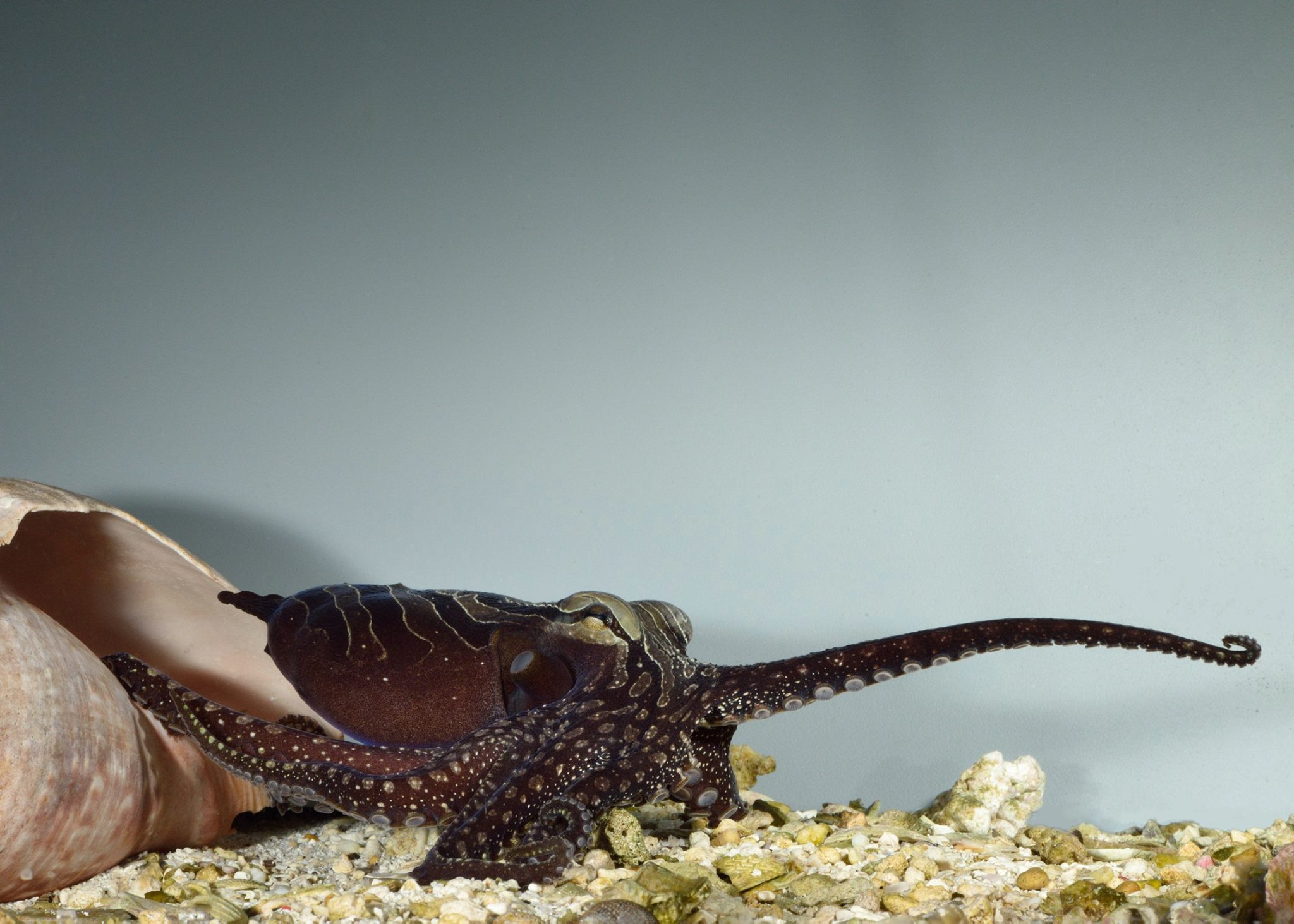
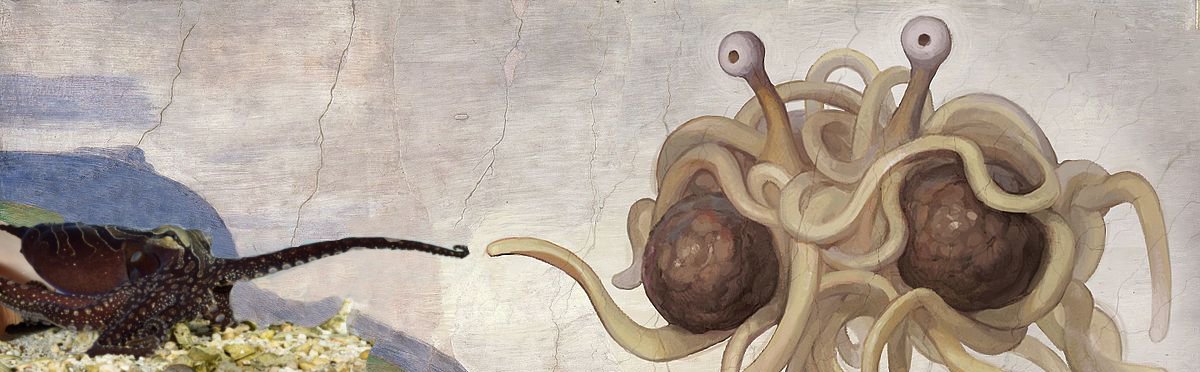
None of the above: it’s a unique canid, the long-legged South American maned wolf. But it’s not a wolf.
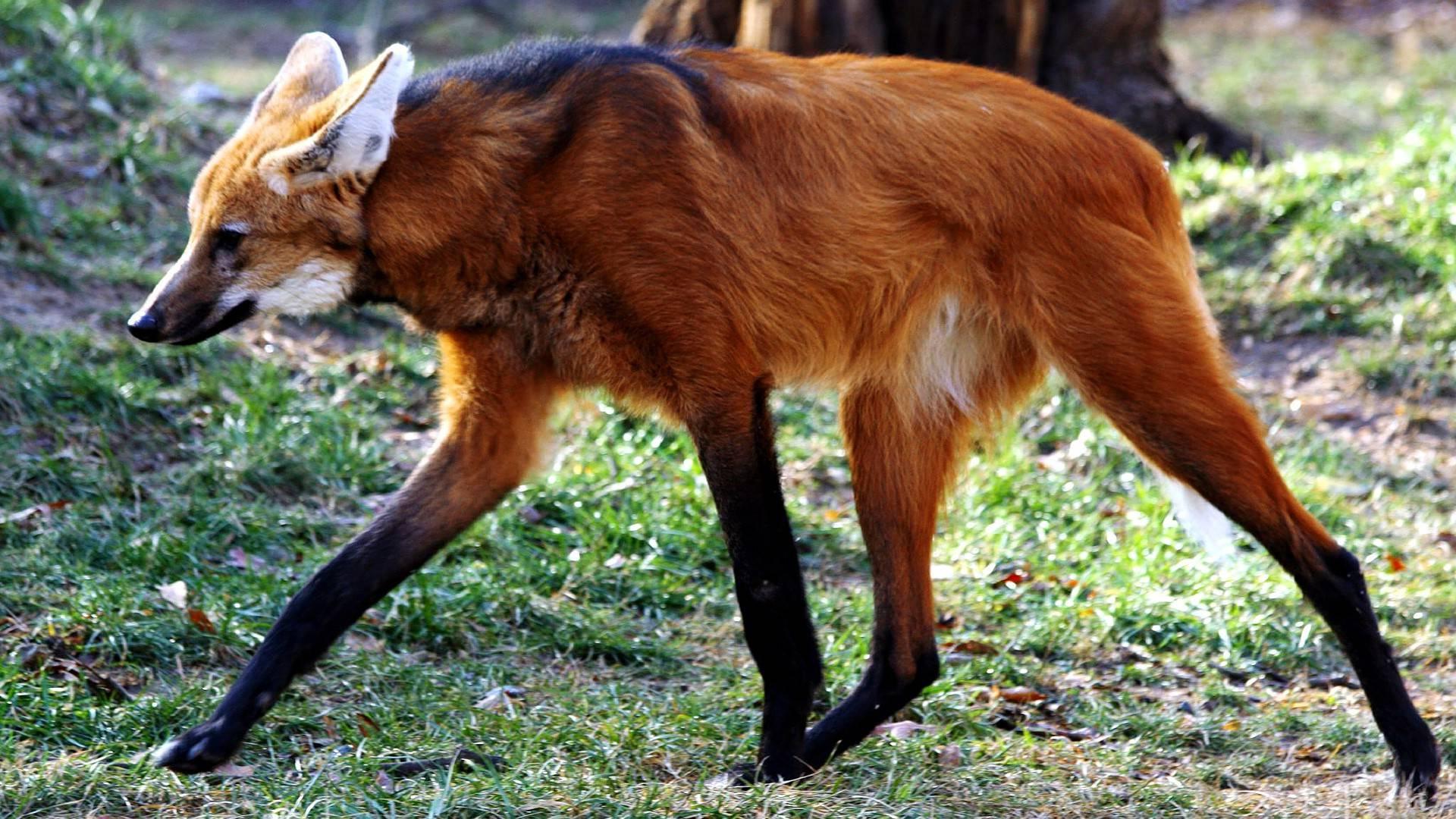

None of the above: it’s a unique canid, the long-legged South American maned wolf. But it’s not a wolf.

As you might guess, this collection of photos is not safe for work, even though there is nothing particularly prurient about it. One hundred men stood in nearly identical poses, and were then photographed between waist and thighs, and there they are, a hundred weird-looking dinguses in an array.
What’s striking is how much variability there is. It looks to me like evolution has not been paying much attention to this feature: they all work well enough so the differences really don’t matter much. “Normal” is a word that covers a surprisingly wide range here.

This will not end well. Social scientists are happy to see human studies rules relaxed.
If you took Psychology 101 in college, you probably had to enroll in an experiment to fulfill a course requirement or to get extra credit. Students are the usual subjects in social science research — made to play games, fill out questionnaires, look at pictures and otherwise provide data points for their professors’ investigations into human behavior, cognition and perception.
But who gets to decide whether the experimental protocol — what subjects are asked to do and disclose — is appropriate and ethical? That question has been roiling the academic community since the Department of Health and Human Services’s Office for Human Research Protections revised its rules in January.
The revision exempts from oversight studies involving “benign behavioral interventions.” This was welcome news to economists, psychologists and sociologists who have long complained that they need not receive as much scrutiny as, say, a medical researcher.
I would have expected social scientists to be even more acutely aware of the bias of self-interest than us clueless nerds over in the other sciences. If there’s anything we should have learned from the history of scientific experimentation it’s that scientists do not provide good ethical oversight of their own research. Some do seem to know that.
“Researchers tend to underestimate the risk of activities that they are very comfortable with,” particularly when conducting experiments and publishing the results is critical to the advancement of their careers, said Tracy Arwood, assistant vice president for research compliance at Clemson University.
Yes. Onerous and annoying as they are, we have human research review committees to specifically provide input from outside the blinkered perspective of the researcher. That’s necessary. Not everyone sees it that way.
A vocal proponent of diminishing the role of institutional review boards is Richard Nisbett, professor of psychology at the University of Michigan and co-author of the opinion piece in The Chronicle of Higher Education.
Social science researchers are perfectly capable of making their own determinations about the potential harm of their research protocols, he said. A behavioral intervention is benign, he said, if it’s the sort of thing that goes on in everyday life.
“I can ask you how much money you make or about your sex life, and you can tell me or not tell me. So, too, can a sociologist or psychologist ask you those questions,” Dr. Nisbett said.
He’s a psychology professor, and he thinks that in a study in which a professor is asking personal questions of a student, there are no social pressures on the student, and they are completely free to ignore the question? Jesus. I guess I wouldn’t trust any papers published by that guy, then.
If those questions are really benign, then shouldn’t the study proposal fly through the institutional review board process without a hitch?
I mean, I could propose a whole bunch of experiments that involve having students drink lots of vodka before undergoing various cognitive tests, and drinking to excess is the sort of thing students do in everyday life, so it must be benign, and why should I get an IRB to rubber stamp something that the students are doing anyway, am I right?
You don’t want to know what I could argue biology experimenters ought to be able to do without outside assessment because students are already doing it anyway.

 The media do like their kooks. They’re far more entertaining than the truth. So once again, the ludicrous Eugene McCarthy, the man who believes humans are the product of hybridization between pigs and chimpanzees, gets a long write-up that dwells far too long on McCarthy’s pathetic rationalizations. His justifications are superficial and often wrong: they amount to looking in a mirror, and noticing that we’re kinda mostly hairless, just like pigs, and we have lots of body fat, like pigs, and we have organs, just like pigs, and we’re bipedal, just like pigs, and we have tusks, just like pigs, and we have nipples, just like pigs, and we have 12 of them, just like pigs, and we’re even-toed ungulates, just like pigs…you get the idea. He’s an idiot, but he’s an idiot who makes long pseudoscientific lists with sciencey terms, so he impresses the rubes.
His ill-informed views get another long airing in which he gets to present his self-pitying schtick of being a martyr to intolerant scientists, and how he’s a true revolutionary who’s going to change the modern paradigm. He’s basically full of shit. The whole article could have been truncated to its early statement of the premise:
Since the early ‘80s, he has believed that humans are the result of an errant sexual encounter between our closest relative, the chimpanzee, and the animal with which we seemingly share all aforementioned traits: the pig.
Followed by this one paragraph buried deep in the story:
The most damning refutation of McCarthy’s hypothesis is “the absence of any pig or pig-related genes in the human genome,” according to Roger Butlin, a professor of evolutionary biology at the University of Sheffield in Britain. Instead, the human genome is “entirely consistent” with the explanation that humans are great apes, most recently sharing an ancestor with living chimps and bonobos, he said.
Yep. If we were pig-chimp hybrids, it would jump out at us from the data. The sequences aren’t there. We’re done.
But the article goes on. McCarthy has an excuse — he always has an excuse.
If McCarthy did crave more recognition from mainstream experts (he doesn’t, he insists), his best bet would be to look for a signature unique to pigs in the DNA of humans but not other apes, said John McDonald, a biology professor at the University of Georgia and a former advisor of McCarthy’s.
A few years ago, McCarthy tried to do just that. He and a friend wrote a computer program to search the human genome for traces of pig hybridization. But the task was too computationally intensive. “It would have taken a lifetime to process the data on the small computers we had access to,” he said.
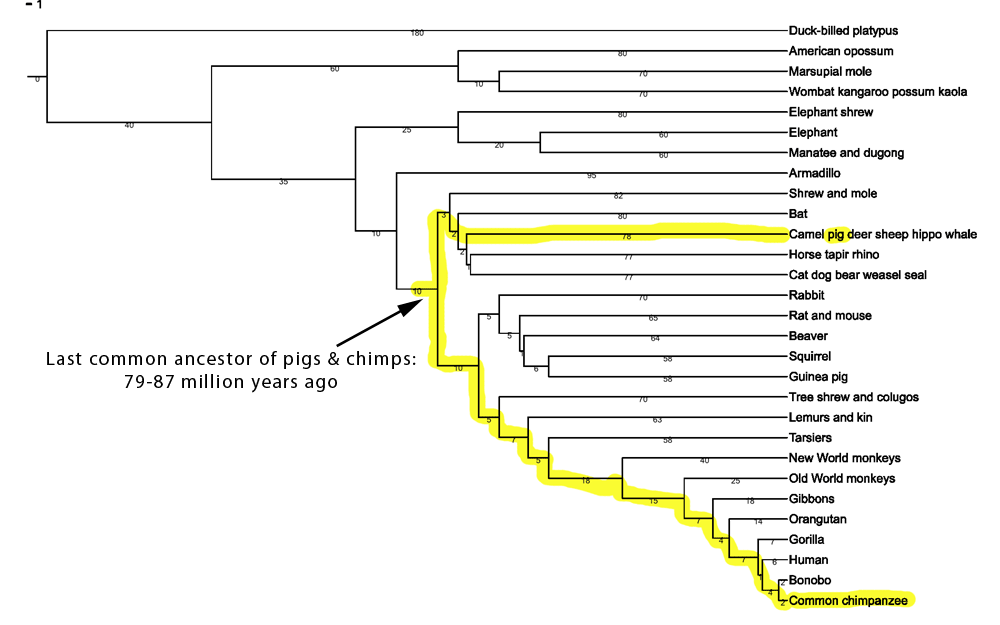
So he tried to reinvent BLAST, a publicly accessible program that you can run on NIH’s computers over the internet, and couldn’t get it to go. You know, ya great goofy loon, you could also pick up any of a number of molecular phylogeny papers and find that other people have done the work for you. That’s what molecular phylogeny is all about: you gather a bunch of DNA sequences from a bunch of different species, and you compare them and weigh the differences, and you throw them into a computer program that churns through all the species and all the genes and spits out a summary of how closely related they are. It’s been done! The pig and chimp lineages separated in the Cretaceous.
Can we just be done with this? Media, ignore the clown capering over there — there are good science stories to discuss.
I do have to end with one final quote from McCarthy.
There’s also another reason McCarthy remains so attached to his ideas: He believes altruism, not competition, is the way of the world. With neo-Darwinism and natural selection, competition is a fact of life, and that logic can be used to justify war, conflict, and ethnic cleansing (“Darwin’s biggest fan was Hitler,” he said).
That’s a common creationist claim, but it’s wrong. Hitler was not a fan of Darwin, and even if he were, it would not have the slightest implications for the truth of the theory.


Ollie is a good dog, yes she is. Such a good dog! It’s not her fault that she has ended up on the editorial boards of medical journals.
…in one respect, the Staffordshire Terrier differs radically from her canine peers: she has a burgeoning academic career, and sits on the editorial boards of seven medical journals.
As you may have guessed, the journals on whose boards Ollie sits are of the predatory variety. These are shadowy, online publications that mimic legitimate journals, but are prepared to publish anything in exchange for a fee that can run into thousands of dollars. Predatory journals prey on desperate young researchers under huge pressure to get their research published to further their careers.
Ollie’s owner is Mike Daube, Professor of Health Policy at Curtin University in Perth. Ollie likes to watch Mike working on his computer, and Mike gets a lot of emails from predatory journals. Wondering just how low these journals would go, he put together a curriculum vitae for his dog – detailing research interests such as “the benefits of abdominal massage for medium-sized canines” – and sent it off to a number of these journals, asking for a spot on their editorial boards.
She has also been asked to review papers. I suspect she’d be a harsh critic, despite being such a good dog, because usually when you put a paper on the floor they poop on it. And that’s good! Good doggie!


I guess everyone is going to be doing this now. In this case, it’s a ridiculous paper accepted for publication in the journal Personality and Individual Differences, and it’s a doozy. It’s about evolution, it says.
In the introduction, it throws around some buzzwords and tries to impress us with elementary scientism.
New alleles can arise from mutations. An allele’s influence on a trait is likely to have both negative (c) and positive (b) fitness effects; thus, the allele will increase in frequency if the balance of positive minus negative fitness contribution (b – c) i.e., the net fitness effect (f), is higher that the respective balance of the original gene, and it will decrease in frequency if the balance is negative. Please note that we refer here to the case averaged across all bearers of the allele, so that an allele will be favored even if it has a net negative effect on the fitness of some individuals as long as it has a net positive effect on the fitness of other bearers of the allele.
The joke’s on you if you read this assuming the paper is about genetics, though. Nowhere in this work do the authors identify any genes or alleles; they don’t even try. They just assume that if a behavior exists, there must be a gene for it, and further, it must have undergone positive selection. They’re also not going to test for fitness of a behavior; in fact, they’re not even going to examine any behaviors directly, but are instead going to rely entirely on self-reported assessments in an online survey of college students.
You’ve probably figured out by new that the discipline in question is evolutionary psychology. Just to titillate you further, it’s arguing for a selective advantage for same-sex behavior.
At first sight, alleles that arise through mutation and predispose for same-sex attraction appear to experience a substantial negative fitness, since they lead individuals to divert part or the whole of their mating effort toward same-sex outlets from which children, who would carry these alleles, cannot be borne. Accordingly, in order to understand the prevalence of same-sex attraction in the population, scholars have argued that these alleles also experience positive fitness effects, which compensate for the negative fitness effects, turning the net fitness (f) positive. There is, however, a different possibility.
Oh, boy. How could a sexual behavior persist that diverts mating efforts in a direction that does not produce children? It’s a mystery.
I can’t wait until the authors learn that heterosexual couples indulge in cunnilingus and fellatio. Their minds will be, umm, blown.
But wait! There’s more hilarity! This is a paper about “The evolution of female same-sex attraction”. Where did lesbians come from, they wonder. What a conundrum! Why would women prefer each other’s company, rather than a man’s? Lesbians can’t put a baby in their tummy! They resolve this problem easily, by suggesting that men provided the selection pressure to favor lesbian genes. It’s all about the cucks.
Men with multiple wives, as opposed to men with one wife, face an elevated probability to be cuckolded, because they have to divide their sexual effort toward several wives so, inevitably, some of their wives will remain unsatisfied. They also have to divide their mate-guarding effort between multiple wives, which makes such effort less effective. If their wives experience same-sex attraction, they can satisfy their urges with other co-wives, who are readily available, reducing, in effect, the risk of cuckoldry (see also Kanazawa, 2016).
Note the Kanazawa reference — another in-joke. This paper is hilarious. There’s also another reason lesbianism is evolutionarily advantageous.
In our proposed theoretical framework, men can benefit from the same-sex attractions of their partners through gaining access to additional women.
That’s right, guys: you should date lesbians because then you’ll get to have sex with their lesbian girlfriends. Yeah, that’s exactly how it would work.
Now you might argue that the fact that this hypothesis is counter-intuitive and is built on a framework of not understanding basic evolutionary theory does not necessarily make it wrong, but maybe they’ve got some kind of empirical evidence that cleverly illustrates the existence of this lesbianism gene, and that men are actively selecting for it.
They don’t.
The ‘experiment’ is basically, “let’s ask guys if they’d mind if their wife had sex with another woman.” I’m not kidding. That’s the experiment. It’s also done with an online survey, because they could get more honest answers in this way
.
Here are the results. It shows that a minority of Western men (Greek Cypriots) like the idea of girl-on-girl sex, but that they like it more than women like the idea of boy-on-boy sex. Apparently yaoi isn’t very popular on Cyprus…but shouldn’t the cultural variations clue them in that this is probably not a genetically determined behavior?
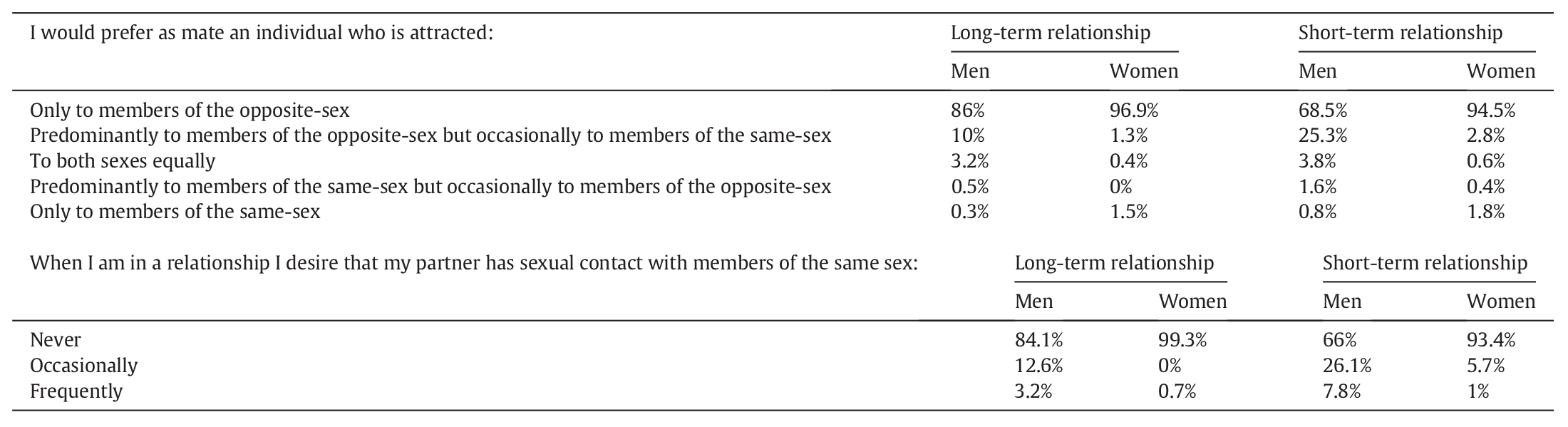
To be fair, they do consider that there might be cultural effects, but all they can think of is one factor, religion, and they only argue that it would repress honest expression of the participants’ views.
Last but not least, the observed effects are unlikely to reflect only evolved dispositions, and social and cultural effects may also be at play. For instance, male preferences for same-sex attraction in a partner may be moderated by religious beliefs. Participants in the sample were Greek-Orthodox Christians, and in the Cristian religion same-same attraction is considered reprehensible. Accordingly, male participants may have perceived their preferences for same-sex attraction to be inconsistent with their religious beliefs, and if they were very religious, to have suppressed or have been unwilling to report such desires. The present study did not control for this possibility, and future research can do so by measuring participants’ religiosity.
The possibility of a few cultural biases do not, however, make them question their basic assumption that lesbian preferences have nothing to do with women’s choices, but are entirely a consequence of males selecting for women who do not like sex with them, and would prefer sex with people who do not have a penis. Apparently, lesbians only exist to provide girl-on-girl porn on the internet, and their own desires have nothing to do with it. Or rather, they only have those desires because men have bred them for possession of a hypothetical lesbian allele.
In conclusion, the present study found that a large proportion of heterosexual men considered same-sex attraction in a partner desirable. These findings suggest positive selection on same-sex attraction in women: Men’s desire for women who are attracted to other women selects for women who are attracted to other women. In turn, male desires, along with factors such as arranged marriage, which weakened the negative fitness costs of same-sex attraction, can explain the relatively high frequency of this trait in the population. Future research needs to replicate and extend these findings in order to better understand the evolutionary origins of same-sex attraction.
Or maybe the authors need to go back to school and learn how evolution works.
This paper was so ridiculously bad, though, I’m sure the authors are going to come out with a confession, maybe in the pages of Skeptic magazine, that it was all a set-up to show how absurd the entire field of evolutionary psychology is (I checked; there isn’t a single evolutionary psychology journal in the top 100 of the SCIMago rankings, therefore the field is entirely made of low-quality papers).
Any moment now they’re going to pop up and say, “Just foolin’!”
Yep, any moment now.
Aaanyy moment.
Apostolou M, Shialos M, Khalil M, Paschali V (2017) The evolution of female same-sex attraction: The male choice hypothesis. Personality and Individual Differences 116:372–378.

Yesterday, I was being mildly harangued by a cancer quack — I know, this is usually Orac‘s beat, but there’s a lot of non-specific cross-talk by ignoramuses, wouldn’t you know. Anyway, this quack told me I’m supposed to read this book by another quack, Travis Christofferson, and didn’t I know that the Warburg effect was the key to curing cancer? This is annoying, because when I’m given a source I feel obligated to look it up, so I had to waste time digging around the internet for Christofferson. Fortunately, this guy is easy to dismiss.
He has a website titled Single Cause, Single Cure
. That’s right, he claims that there is a single cause for cancer, and it’s a metabolic disorder cause by your bad diet. There’s also a single general strategy for treating it, which involves targeting the Warburg effect with a ketogenic diet, among other broad metabolic treatments.
First strike: treating cancer as a single, simple disease caused by one factor. We know this isn’t true. I recently wrote about Tissue Organization Field Theory, that postulates that one factor in generating cancers might be epigenetic shifts caused by the cell’s environment, but no one (well, no one sensible) thinks that’s the only cause. We know about the effect of carcinogens, which may damage DNA; we know about inherited genetic predispositions caused by variations in gene sequence; we know about effects of local inflammation; there are viruses that can induce transformations to a cancerous state. We’ve taken cancers apart gene by gene and found the frequent players that trigger the cancer, and they are genes that regulate, for instance, cell proliferation, cell signaling, and yes, cell metabolism. You are not going to fix a broken retinoblastoma gene with a low-carb diet.
Second strike: Christofferson has zero qualifications. He has a Pre-Medical undergraduate degree and a Master’s degree in Materials Engineering and Science
. There is no such thing as a pre-medical degree. A pre-med is someone who has declared an intent to apply to medical school when they graduate; I have lots of students I advise who are pre-med, and all that means is that I recommend that they take courses outside the required courses for their degree within a discipline, so they’re told to take anatomy and physiology courses, a psychology course, a communications course, microbiology, etc., outside of the list of required courses to get a B.A. in biology (they can also be, for instance, an English major and a pre-med), and that I nag them in their junior year about taking the MCATs. You either have a medical degree, which requires going to a qualified medical school, or you don’t. He doesn’t. He has a degree in molecular biology from Montana State University, and either lost interest in or didn’t get accepted to medical school, and instead went to the South Dakota School of Mines and Technology for a Master’s degree in Material Engineering and Science. SDSMT is not a medical school, not even close.
Third strike: Christofferson is endorsed by Joseph Mercola. When the money-grubbing, dishonest arch-quack is your sponsor, you can trust that everything about it is tainted. Mercola did a fawning interview with Christofferson in which he asked, Wouldn’t it be interesting if there were a simple dietary tweak that could not only prevent but treat the vast majority of these cancers?
Yes, it would be interesting. It would also be interesting if every time I sneezed, hundred-dollar bills shot out of my ears. It does not mean that I’m snorting black pepper as a revenue source. That Mercola asks a stupid question does not imply that there exists a simple dietary tweak
to cure cancer.
Fourth strike (how many of these do you get before the umpire drags you off the field?): these quacks like to pretend that they have some bold new insight, but the fact is that legitimate cancer researchers have been exploring metabolic treatments for decades, and there are real studies in progress. They aren’t a magic bullet, but tackling metabolic processes in cancer cells might be helpful, and real doctors are testing it.
This brings me back to the question of whether cancer is a metabolic disease or a genetic disease, the answer to which I promised early on. The likely answer? It’s both! Indeed, a “chicken or the egg” argument continues about whether it is the metabolic abnormalities that cause the mutations observed in cancer cells or whether it is the mutations that produce the metabolic abnormalities. Most likely, it’s a little of both, the exact proportion of which depending upon the tumor cell, that combine in an unholy synergistic circle to drive cancer cells to be more and more abnormal and aggressive. Moreover, cancer is about far more than just the genomics or the metabolism of cancer cells. It’s also the immune system and the tumor microenvironment (the cells and connective tissue in which tumors arise and grow). As I’ve said time and time and time again, cancer is complicated, real complicated. The relative contributions of genetic mutations, metabolic derangements, immune cell dysfunction, and influences of the microenvironment are likely to vary depending upon the type of tumor and, as a consequence, require different treatments. In the end, as with many hyped cancer cures, the ketogenic diet might be helpful for some tumors and almost certainly won’t be helpful for others. Dr. Seyfried might be on to something, but he’s gone a bit off the deep end in apparently thinking that he’s found out something about cancer that no one else takes seriously—or has even thought of before.
Fifth strike: the foundation of a useful cancer therapy lies in empirical research. You test it. It’s hard work. You do not leap into publishing books for pop audiences that declare you have a path to the cure, as Christofferson has. If switching to a ketogenic diet could cure cancer, why do people still die of cancer? This is a disease that provokes desperation and fear, the perfect medium for quacks who want to profit by selling false hope.
I am unpersuaded.
I may have to write something up about the Warburg effect later. I am not a cancer researcher, but I am a cell biologist, and I know a fair bit about cellular metabolism — it annoys me to see basic cell biology, which Christofferson would have been exposed to as an undergraduate, being abused by quacks, especially when there are so many readily available papers in the scientific literature about the molecular biology and biochemistry of the Warburg effect.