Trying to figure out why this spider appeals to me

I think it’s the idea of living in your home for 16 years and never leaving it except for brief forays to leap out, kill, and eat passers-by.

I still have questions, though. What about sewage? How do they clean up the spider poop that accumulates? Also, they show a spiderling … are males more prone to wandering from home? How do they avoid getting eaten when they tap on the turret door?

Spider update

First, the bad news. I now have no adult males, because Xena ate her consort, as I feared she would. I am beginning to suspect that she’s one of those radical feminist lesbian spiders who is going to kill every male she encounters. I don’t know if they successfully mated before the murder, and she hasn’t yet produced an egg case.

Also, one of my second generation spiders, a young female, abruptly died. Before she curled up and expired, though, she did produce an egg case, so maybe her line will live on.

The good news is that right now I am keeping an eye on three egg cases. The next few weeks will tell if can keep any spiderlings alive any more.

I hope I live to be 90 before all of my sins catch up to me

James Watson, 90, has had all of his honors from Cold Spring Harbor revoked. It turns out that documentary on PBS had quite an impact.

Cold Spring Harbor Laboratory (CSHL) unequivocally rejects the unsubstantiated and reckless personal opinions Dr. James D. Watson expressed on the subject of ethnicity and genetics during the PBS documentary “American Masters: Decoding Watson” that aired January 2, 2019. Dr. Watson’s statements are reprehensible, unsupported by science, and in no way represent the views of CSHL, its trustees, faculty, staff, or students. The Laboratory condemns the misuse of science to justify prejudice.

When Dr. Watson expressed offensive views in 2007, CSHL’s Board of Trustees took immediate action to relieve him of all administrative duties at the Laboratory and terminated his status as Chancellor. Dr. Watson has not been involved in the leadership or management of Cold Spring Harbor Laboratory for more than a decade and he has no further roles or responsibilities at CSHL. In response to his most recent statements, which effectively reverse the written apology and retraction Dr. Watson made in 2007, the Laboratory has taken additional steps, including revoking his honorary titles of Chancellor Emeritus, Oliver R. Grace Professor Emeritus, and Honorary Trustee.

Lucky Jim’s luck has run out at last.

A day at the science fair

I’ve been off at the local high school, judging the local science fair. It’s a strange experience. An awful lot of the experiments involved playing with guns, which I guess is to be expected in a rural area.

They were still a bit disturbing.

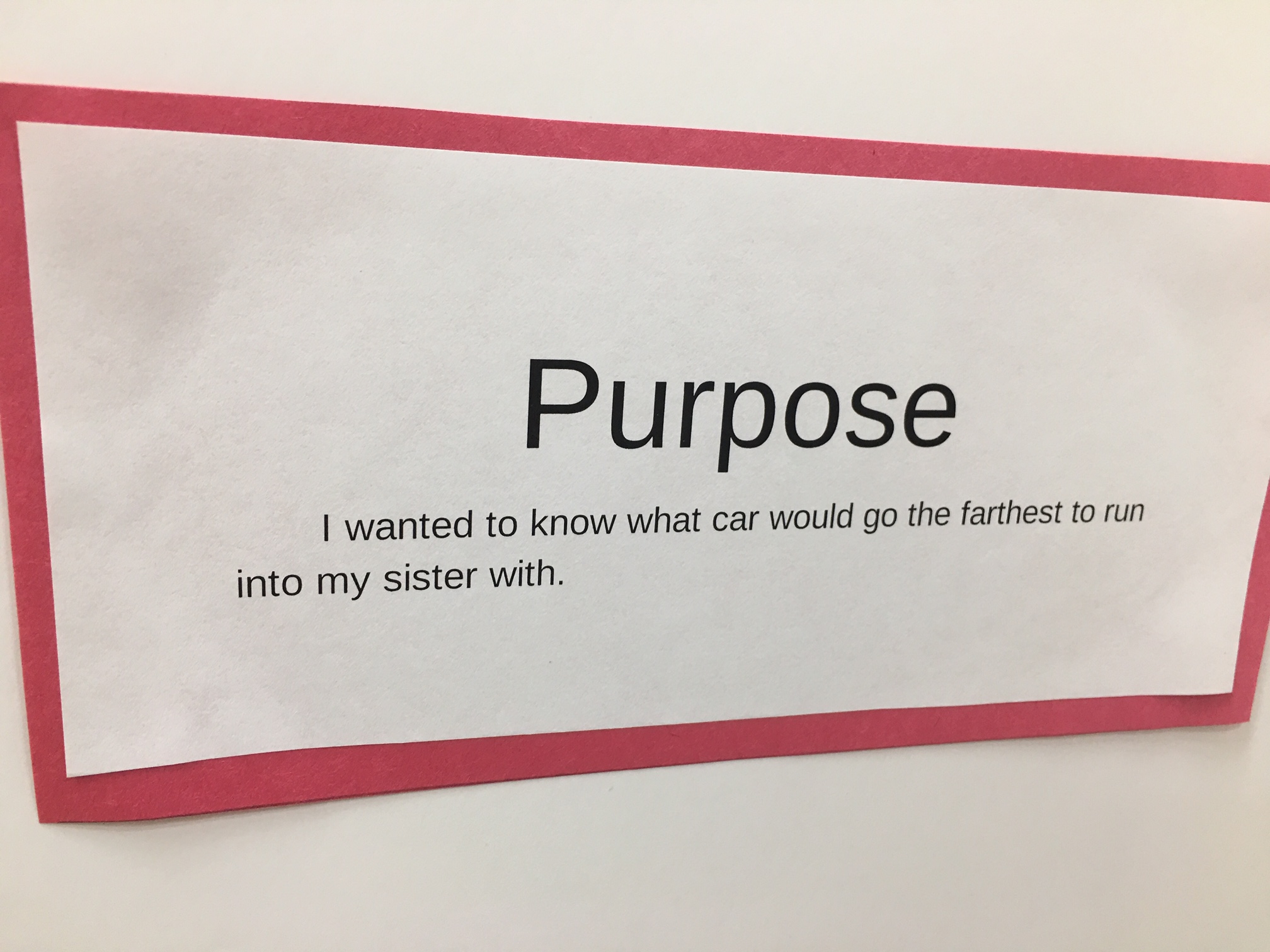
And then you occasionally run into a peculiar rationale, in this case for an experiment involving weighted Hot Wheels cars.

I also had the student who thanked me afterwards, saying “Thank you for judging me.” I had to tell him I wasn’t judging him, I only judge the project.

Anyway, it didn’t matter if they did odd, off-the-wall experiments on phenomena that I didn’t find at all interesting. What mattered is that they actually tested their hypothesis appropriately, and how well they presented their data. And they were all good kids.

How not to clean up the ocean

For those of you who have been follow Boyan Slat’s debacle — you know, the pretentious kid who claims to have figured out how to clean up ocean garbage — you should be reading Deep Sea News for all the Ocean Cleanup Schadenfreude. You might also learn a little physical oceanography, which is cool. I was startled in that article by the discussion of Stokes Drift, which I hadn’t heard of, but I know all about Stokes Shift, which made me wonder if they’d been discovered by the same guy. They were. Now I’m imagining a Victorian gentleman going around discovering scientific principles and giving them rhyming names. Did Stokes Thrift mean he gave cheap Stokes Gifts? Was Stokes Sift used to excavate Stokes Rift?

I’m punchy. I need a nap.

Anyway, I don’t know oceanography. What convinced me that this was a con was how young Mr Slat & Co. treated Dr Miriam Goldstein and Dr Kim Martini. Dismissing relevant expertise is a bad way to build a real initiative.

May their booms keep on breaking.

Call to arms, Minnesota!

I got a letter from the Minnesota Science Teachers Association. It seems there is some skullduggery going on to undermine our state science standards, from the Minnesota Rural Education Association. Well, cool: I’m an educator in rural Minnesota, but I know nothing about the MREA. I’m sympathetic to the idea of an organization that opposes/complements those elitist tyrants of the Twin Cities <shakes fist eastwards>. So what does the MREA want?

Minnesota Science Teachers and Citizens:

Science education in Minnesota is at a crossroads. As the Science Standards Revision Committee works to produce a new set of state science standards, the Minnesota Rural Education Association (MREA) is going to the state legislature this session in an attempt to reword statute 120B.023 thereby diluting the quantity, quality and rigor of the state science graduation requirements. Their proposed wording to the statute would still require biology and either chemistry or physics, but would reduce the current third science credit to a set of electives that does not require that “all academic standards in science” be met. This essentially removes earth and space science standards as part of the graduation requirements already in state statute 120B.024 (4) (ii.) and would allow districts to choose what science standards they will or will not teach.

If we, as science educators and citizens, want our students to receive a balanced, comprehensive background in all science disciplines, i.e., be scientifically literate, it is essential that you act now.

Below are samples of letters/emails that can be reworded or used as is and sent to your state representative and state senator. (These letters are also attached as a Word doc to this message.) Your voice must be heard or our new state science standards will be reduced in rigor and merit. Hand-picking which benchmarks will be taught in our schools harms science education for all students. A strong response from science teachers and citizens will tell the Legislature that our students deserve the best science education possible.

Go to https://www.leg.state.mn.us/ to find the names and e-mail addresses for your state representative and senator.

Please e-mail your state representative and senator as soon as possible. Be sure to include “Don’t Cut Science Education Standards” in the subject line. Thank you for your continuing efforts to provide our students with a quality, comprehensive science education.

Shorter version: they want to change the standards to allow high school students to focus narrowly in meeting their science requirements, and also want to open school districts to allow them to decide what science to teach. The first part I’m already disinclined to support because public school educations are already general enough — I’d rather they get a solid overview of multiple disciplines, because I care more about a broad background than that students get to ignore geology or chemistry if they want. As for the second part…I don’t trust rural school districts that much. State standards are there to make it harder for schools to compromise.

But OK, let’s be fair. What does the MREA say about their own plan?

MREA Executive Director Fred Nolan encouraged the state to amend the benchmarks statute 120B.023 that states, “Schools must offer and students must achieve all benchmarks for an academic standard to satisfactorily complete that state standard” by adding that high school students must meet the benchmarks in biology, physics or chemistry, and one elective set of benchmarks from the following: physical sciences, life sciences, earth and space sciences or engineering, or technology and the applications of science. Schools must offer at least two of these elective sets of benchmarks.

So currently, high school students should take biology, physics, and chemistry, and one of a defined set of electives. The MREA would like to change that to an or, and let the schools decide what the additional science elective ought to be. Why? They don’t do a good job of justifying the change.

Minnesota faces a well-documented skilled-worker shortage and Minnesota Academic Standards currently hold high schools back from providing the education and training needed to effectively prepare students for their future jobs. Today’s system operates on a one-size fits all approach for students no matter their plans after graduation.

Ugh. Education as a purely vocational enterprise. No, thank you. I have a lot of respect for good vocational training, but that’s not what public school should be about — it should be about giving citizens a broad, basic background knowledge so that they’re better informed, and know better what they want to do with their life after schooling. No matter their plans after graduation, students should have at least a rudimentary understanding of science (and art, and history, and language, etc.) Focusing on JOBS is counterproductive.

I also find it weird that they say they’re concerned about a skilled worker shortage, and their solution is … to teach less science? Strange. I think there must be other motives they aren’t talking about.

The MnSTA provides some sample letters for Minnesotans to use if you want to write to your rep. I’ll include them below the fold.

[Read more…]

Bad day in the lab

The good news: I’m getting roughly one new egg sac every week, so I’ve had one produced on 27 December, another on 4 January, and another this week, on 7 January. I can make progress with that level of production.

Except the bad news: that egg sac from December should have hatched out by now. I opened it up: mostly dead. There were a total of 35 eggs in it; 6 had made it to the postembryo stage, and then died; 4 had made it past the first instar, and then croaked; 24 were arrested in an earlier embryonic stage, and were clearly not going to make it any further. There was ONE second instar survivor, waving its legs weakly in the midst of the charnel house of its siblings. That’s not very good. I’m not even certain the survivor is going to make it — I put it in a little chamber of its own with a fruit fly it can try to eat.

The other egg sacs…well, I’ll have to wait and see. I isolated the one from 4 January, and like the December clutch, put it in a petri dish on a cotton pad, which I spritz with water daily. Unfortunately, I’m finding that the pad doesn’t seem to help, acting more as a dessicant, I think. So I threw out the cotton on that second clutch. I’m leaving the 7 Jan sac with its mommy, in a large vial. We’ll compare outcomes under those two conditions.

Another hypothesis for this problem is that my original wild caught stock produced vigorous clutches of spiderlings, where the majority were healthy and fine…and cannibalistic, which contributed to a rapid culling. All of the egg sacs recently have been the product of inbreeding between progeny of the extraordinarily fecund Gwyneth. So I’ve placed my sole remaining male, a son of Gwyneth, in the company of a daughter of Xena, and will, I hope, get a new outbred clutch to compare. Or maybe Xena1 will consume the puny male. It was tough to get Xena0 to put up with any mates at all.

It would be interesting if Parasteatoda were sensitive to genetic inbreeding, rather than this low output being a result of my poor spider husbandry skills. I’m so used to zebrafish and flies that don’t care if you cross an individual with its sibling, its offspring, its parents, its grandparents (The Aristocrats!), but it is possible that wild species that engage in more mixing might be carrying a higher load of recessive lethals…although I’d also think there’d be limits to how much mixing there’d be in a synanthropic species with limited mobility in adults. Maybe there’s a lot of juvenile ballooning going on that I’ve missed? I’ll have to keep my eyes open in the spring, and see how my garage gets repopulated.

I’ve also noticed something strange going on in my brain. The questions I’ve been asking myself have been shifting from the generally embryological to something more ecological — I might turn into an eco-devo guy yet.

Will scientists be smarter than atheists?

Once upon a time, a small group of atheists declared that not believing in gods was not enough — that atheists should also stand up for justice, fight for equality, and oppose the fascist tendencies that were even then becoming apparent in government. They decided to set themselves apart and call their movement Atheism+, and the goal was to organize people to do more than promote the separation of church and state, but also to oppose sexism and racism.

They didn’t last long. The howls of opposition were prolonged and vicious…how dare anyone proclaim that, as atheists, they had wider, deeper interests? They were harassed out of existence. The knives came out, and the regressive, tribal atheists launched constant hate campaigns that linger on today. I still get frequently accused of being the wicked instigator of this perfidious attempt to organize SJWs who were also atheists (I wasn’t, but the idea that it was women who actually did the work was unthinkable, so I have been promoted to Atheism+ General). If you look in some places, especially YouTube, you find instead that anti-feminist jackholes rule the roost, and they do so by specifically ridiculing anyone who believes in the equality of women and minorities.

I wish Chanda Prescod-Weinstein, Sarah Tuttle, and Joseph Osmundson luck with their manifesto, We Are The Scientists Against A Fascist Government.

Science, even just within the United States, is an international enterprise; it’s an intricate multinational dialogue and financial ecosystem. The scientific community in America contains — indeed relies on — immigrants from countries around the world. We recognize that there are hierarchies of power — as with every other facet of society — within the scientific community. We must stand with those at the greatest risk, including people of color, women/gender minorities, immigrants, and those at the intersections of these identities. Attacks on those at the margins — both within and without the scientific community — are attacks on human knowledge, on the very advancement of our society.

They are attacks on all of us.

As scientists, we cannot accept this new status quo. While we are deeply concerned about what the future holds for scientists — especially scientists from traditionally-excluded communities — we are also concerned about the impact of the administration’s agenda on the broader U.S. population, the global population, and our planet’s entire ecology. We understand in this context that it might seem simpler for scientists — especially those from backgrounds that have been more readily welcomed into the scientific community — to “reach across the aisle” and work with the new administration.

But we believe it is imperative that scientists pause and consider the profound implications of this proposal.

They’re aware of the pushback they’re going to get, and have already received.

Already we have heard our scientific colleagues murmur about trying to keep our work and ourselves “apolitical.” We even saw an early, now-retracted statement from the American Physical Society (APS) that sought to capitalize on Trump’s racist dog-whistle slogan “Make America Great Again.” While APS eventually recanted their statement, we understand that it reflects a deeply flawed, but broadly held belief among scientists that bipartisanship is always the answer, even if that means power-sharing with an administration that intends to cause financial and physical harm to vulnerable members of society — many of whom are scientists, the very people doing the work they claim to want to protect.

We have also heard private rumblings about what type of scientific funding might be spared in Trump’s America: Climate change will go, but cancer research must be safe. Even if they come for cancer research, particle physics merits an independent defense. Max Planck, for example, similarly argued that Jewish theoretical physicists were different from other kinds of Jews, in an attempt to spare Jewish scientists’ lives. As we know, this protective presumption was swiftly disproved by the Holocaust, which targeted the already marginalized Roma and most widely known, European Jews.

Science has never been apolitical. The only people who claim it is are the privileged ones who benefit from the status quo.

They have a list of action items so there are things scientists can do. At the very least, sign up for the cause. This is important, every level of society must mobilize to oppose the Republican dystopia, and scientists don’t get to hide behind that cowardly ‘apolitical’ canard.

Be better than the atheists have been.