I guess corrupt old cronies of the Trump administration can’t simply fade away, they have to constantly pop up in the news, over and over again. But at least I learned something new to me: Steve Bannon is one of those creepy fanatical Catholics? Yikes. I thought he was just a garden-variety fascist, but apparently he has a philosophical ethos.
Bannon’s philosophy has been written about quite a bit, including by yours truly [Heather Digby Parton], because it is extremely radical and very, very weird. It’s all wacky mysticism mixed with antediluvian, pre-enlightenment, authoritarianism posing as nationalism based upon the writings of an obscure French writer named René Guénon from the early 20th century and the teachings of one of his followers (and Mussolini adviser) Julius Evola. The school of thought is called “Traditionalism” and it is like no tradition you’ve ever heard of. But Bannon is not alone with this philosophy. It’s held by members of far-right leaders’ inner circles throughout Europe and in places like Brazil and Russia. If there is an intellectual rationale for Trumpism beyond the Dear Leader cult of personality, this “traditionalism” is it.
No, I do not want to know more. But Digby gives a couple of sources, and like a doomed character in a horror movie, I can’t resist the urge to go down into the dark basement alone. So here’s one.
From an early age, Bannon was influenced by his family’s distinctly traditionalist Catholicism and he tended to view current events against the broad sweep of history. In 1984, after Pope John Paul II permitted limited use of the Latin-only Tridentine Mass, which was banned by the Second Vatican Council, Bannon’s parents became Tridentine Catholics, and he eventually followed. Though hardly a moralizing social conservative, he objected bitterly to the secular liberalism encroaching upon the culture. “We shouldn’t be running a victory lap every time some sort of traditional value gets undercut,” he once told me. When he was a naval officer in the late 1970s, Bannon, a voracious autodidact, embarked upon what he described as “a systematic study of the world’s religions” that he carried on for more than a decade. Taking up the Roman Catholic history first instilled in him at his Catholic military high school, he moved on to Christian mysticism and from there to Eastern metaphysics. (In the Navy, he briefly practiced Zen Buddhism before wending his way back to Catholicism.)
Bannon’s reading eventually led him to the work of René Guénon, an early-20th-century French occultist and metaphysician who was raised a Roman Catholic, practiced Freemasonry, and later became a Sufi Muslim who observed the Sharia. There are many forms of traditionalism in religion and philosophy. Guénon developed a philosophy often called “Traditionalism” (capital “T”), a form of anti-modernism with precise connotations. Guénon was a “primordial” Traditionalist, who believed that certain ancient religions, including the Hindu Vedanta, Sufism, and medieval Catholicism, were repositories of common spiritual truths, revealed to mankind in the earliest age of the world, that were being wiped out by the rise of secular modernity in the West. What Guénon hoped for, he wrote in 1924, was to “restore to the West an appropriate traditional civilization.”
No. Enough. Stop. Wait…what’s that creepy figure crawling out of the television set?
Bannon acknowledges affinities with the philosophies of Julius Evola and Dugin in relation to his conservative vision for world politics. Like them, Bannon believes in an Eurasian Christian empire led by “the church militant” that will reform religious, economic, political and social foundations around the world. Such views underlie his speech about conservative Christianity as a bulwark against liberalism at the Vatican in 2014, and it’s no coincidence that Bannon has been integral to the establishment of the conservative Catholic Dignitatis Humanae Institute in an 800-year-old monastery.
All of this should give pause. These appropriations of the Middle Ages by figures like Dugin and Bannon pose an odd reversal of the problem of calling things we don’t like “medieval.” Yet these appropriations are equally misleading and even more dangerous. The resulting racist, xenophobic, misogynist, “traditionalist” construction of the Middle Ages is pervasive in conservative spheres. This ideology is now not only Dugin’s construction but also the view that informs many right-wing thinkers like Putin, Bannon and Trump.
No more, please. I’m going to have nightmares about Catholic fanatics under the bed.
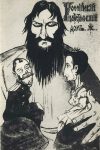
It’s a little bit difficult to sort out exactly what Bannon does believe since he’s definitely a populist and nationalist. Mostly, it seems, he’s a sort of spiritualist, like the Russian Rasputin. According to Green, Bannon’s most important influences are René Guénon, a French writer whose 1929 book “The Crisis of the Modern World” stated that everything started to go to hell in 1312 when the Knights Templar were destroyed; and Julius Evola, an Italian writer whose 1934 book, “Revolt Against the Modern World,” influenced Mussolini. Interestingly, that book was also a seminal work for the Russian philosopher Alexander Dugin, Vladimir Putin’s most influential ideologue, and the man who once called Steve Bannon his ideological soulmate.
Alexandra Nemtsova at the Daily Beast reported:
According to Alexander Verkhovsky, director of Russian SOVA, a Moscow-based NGO monitoring ultra-nationalist groups, “Dugin is talking about creating some new cross-cultural nation of anti-Atlantic, traditional ideology—his theory often sounds like a pretty fascist approach. He said and wrote a lot, calling for a war in Ukraine; many Russian nationalists who listened or read Dugin’s texts actually joined the insurgencies in Ukraine afterward.”
I don’t think Bannon looks quite strong and healthy enough to put up as much of a fight as Rasputin, but you never know. He could be like Jason, or Michael Myers, impossible to kill.
“This devil who was dying of poison, who had a bullet in his heart, must have been raised from the dead by the powers of evil,” Yusupov wrote. “There was something appalling and monstrous in his diabolical refusal to die.”









 We want our country back, we want our culture back, and if you want to stand in the way that, we will run you over.