Sure looks like design to me!

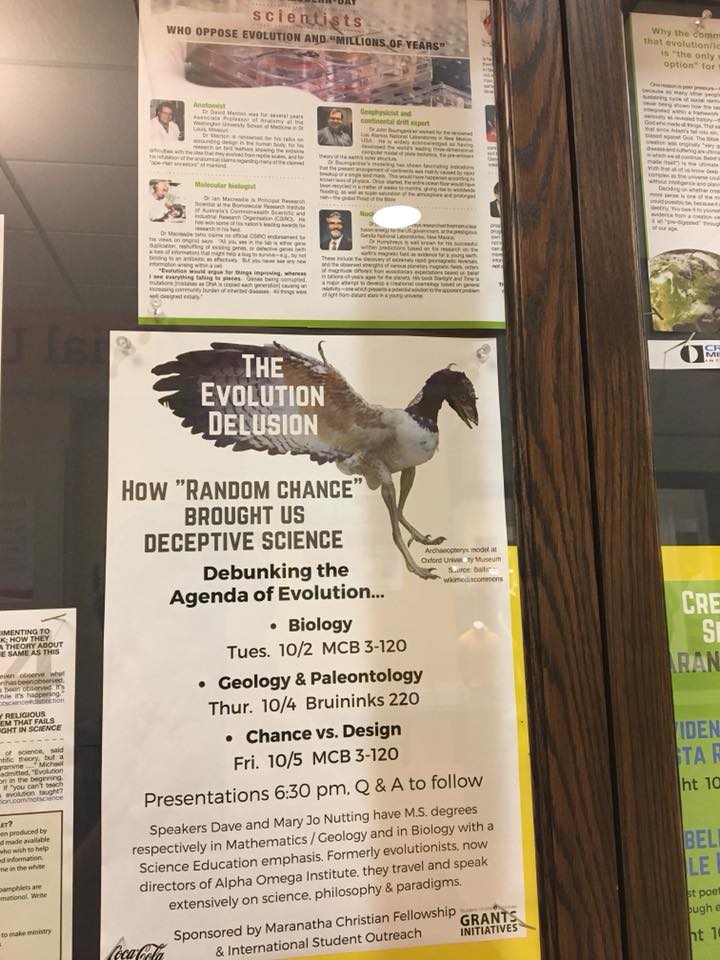
I attended a lecture by Dave and Mary Jo Nutting of the Alpha-Omega Institute, a creationist…well, I was going to say “think tank”, but it’s really just an apartment in a building that also houses a cleaning service, and is nothing but Dave & Mary Jo promoting themselves as speakers, and there isn’t much thinking going on. What is it with creationists putting pretentious labels on their homes?

Which reminds me…I’ve got to get that sign for the “Institute of Eight Legged Freaks, Departments of Mollusca and Arachnida, and the Academy of Pharyngula Studies” made up for my lawn.

Anyway, it was terrible. Godawful boring and repetitive. Two and a half hours long. Fucking dreadful, even for the low expectations I have for creationists. I sat through the whole thing, seething, until I erupted a little bit in the Q&A.

My wife doesn’t go to these things, but this time Mary came along. I think she wanted to make sure I didn’t misbehave. She doesn’t like to make a scene, so when I started chewing out these ignorant frauds, she was right next to me, drilling her elbow into my ribs. It was a bit uncomfortable, but I persevered. But ow, my side aches today.

Anyway, you probably don’t want to listen to the whole thing, even though I recorded it all. I can summarize it for you: Dave briefly shows an example of a scientific discovery, like the blood clotting pathway, or dolphin countercurrent exchange systems, or DNA repair mechanisms, and then announces, Sure looks like design to me! Over and over. He doesn’t actually address any of the mechanisms behind any of the phenomena, or discuss the evidence, or fairly present the evidence for their evolution — he relies entirely on the pretense that complexity and/or function are synonyms for design. So he throws up an abridged slide of the clotting pathway, and then slaps a label on it claiming it’s all evidence for creation.

It was a poorly attended talk, and I can understand why — they were utterly inane. The Q&A got a little more interesting, largely because every question was pushing back against their claims. If there were attendees who were pro-creationism, they were utterly silent the whole long evening.

At the end, in the Q&A, I rudely called bullshit on them. Look: complexity and functionality are outcomes of a process. We all agree that biological systems are functional and often complex. The question is about the nature of the process. Biologists say there are natural mechanisms that can generate those outcomes, and we have bucket loads of empirical evidence that allow us to explain how functionality and complexity are generated, to widely varying degrees of thoroughness. Creationists say there is one explanation, an explicit act of intentional creation by a designer, and have no evidence whatsoever for it, other than a Gomer Pyle-like expression of incredulity that revels in their ignorance of what the scientists have said.

When I pointed out this disconnect between evidence and their conclusion, and that they are falsely equating complexity with intentional design, Mary Jo denied it. Then she said it wasn’t just complexity, but the intricacy and interconnectedness of organization, which is just throwing out some new nouns and adjectives that say exactly the same thing: complexity equals design. They really have no idea about what they’re talking about.

This was demonstrated perfectly in the first question, at about 1:40. What is it exactly about finding a watch on the beach that tells you it is designed? The reply: I see organizational structure. I see function. A follow-up question was roughly, “if everything is designed, how would you recognize something that wasn’t designed?” To which they said there is also some randomness, giving them an excuse to babble about a tornado in a junkyard assembling an airplane.

The second questioner asks for a clarification: that they’re talking about these crazy complex systems to show that chance is insufficient to explain them. I believe things are too complex, so there must have been a designer. Then he asks about the possibility that design is simply an interpretation based on human bias and experience. They don’t seem to understand the point: Mary Jo goes on about how a building must have a builder. Dave’s answer is familiar: Based on what we see and know, it sure looks designed. Then he goes on to say it taxes credulity to think it could have happened by accident. Wooooooosh, way over his head.

The third question asks whether they understand the argument from ignorance, or the argument from personal incredulity. Nope. They had to ask him to explain it. In a follow-up, he points out that he can’t see the difference between their argument, and saying a magic pixie did it. Mary Jo counters by saying that they have to use other evidence, like historical evidence…by which she means the Bible.

She keeps talking. The talk was long-winded, their answers were equally long-winded. She starts off with the complexity thing again, saying that molecules bouncing around randomly can’t explain complexity.

That’s where I finally erupt and tell them they can’t do that — it’s an invalid argument to simply claim complexity is sufficent to justify the design explanation. (Warning: I come off very loud, like the voice of God, but it’s only because my recorder was sitting on the desk directly in front of me). She replies by saying it’s not just the complexity, it’s the ordered complexity. Jesus fuck, they are dense. Systems, machines, computers. Mindless buzzwords.

Another question: what about species that go extinct? Guess what the answer is?

Yeah, The Fall. The Flood.

A follow-up: Given the Flood, how did organisms repopulate the earth? Perhaps they hopped.

There was another question about biogeography after the flood. I felt like shouting, stop pandering to their delusions. There was no flood. It just gives them opportunity to meander on with Bible stories.

Next question: Why do you prioritize supernatural answers over natural ones, when we’ve never seen anything propely answered with supernatural explanations? The supernatural makes more sense to us. Also, an admission: we have no evidence.

Next: questioner brings up an example Nutting used, of a sea slug that eats anemones and recycles nematocysts for their own use. Did that happen before or after the Fall? They don’t know.

It came around to me again. I demanded that they show evidence for design other than reiterating the mantra of complexity. Their argument, after I told them that just claiming evolution relies only on chance is dishonest, was to argue that natural selection can only act on what is already there. I mentioned biology as a property of chemistry; they claimed that chemistry is evolution. What I didn’t bring up, and should have, is that they’ve just pushed back their unanswerable questions of evolution to prebiotic chemistry, which doesn’t fit with their claims of a 6000 year old earth and a global flood.

The next question is a conciliatory comment in which the questioner says he appreciates the sincerity of their beliefs. But then he asks a really good question. He asks how they explain that their position is becoming less popular. And that’s true: there might have been 20 people in the audience, and judging by the questions, almost all of them completely disagreed with the Nuttings.

Their answer is that all that’s taught at the university is naturalism. They also blame separation of church and state. You’ve been brainwashed, sheeple!

Next question: The Nuttings believe as they do because of personal experiences; the questioner accept the concensus of science. Do they believe personal experience over empirical evidence? They waffle pointlessly. They don’t reject empirical evidence (which wasn’t the question) they just…I don’t know what. So the question gets repeated. There’s way too much that indicates there must be a designer. Then he starts babbling about the Bible.

I count that as a total non-answer.

Next: it’s pointed out that science doesn’t work the way they claim. It’s not a collection of facts followed by interpretation, where every interpretation is equal. Science builds on progressive hypothesis testing; they put up slides of the end conclusions of a lot of work to giggle over, but that was all based on a lot of legitimate work that they didn’t show. Mary Jo offers vague agreement that there is a process of science, but claims it doesn’t tell us how it got there. I’d say it does; they just intentionally neglected to discuss it. In follow up, the questioner points out that invoking the supernatural basically kills our ability to address the question, and returns to the initial question of how you recognize undesigned organization. It’s mentioned that the hypothesis that the devil buried all those fossils is a supernatural explanation. The moderator says that their organization (Maranatha) doesn’t believe that — which misses the whole point. How do they know?

The next question hammers on a point that had been made a few times: biology doesn’t explain the world in terms of pure chance. So why do the Nuttings keep going back to this claim of nothing but random chance? Dave replies by asking, rhetorically, if he thinks protein folding is purely chemistry and natural laws. He then claims that natural laws…are not going to do that. It’s a folding machine. (Throughout the evening, “machine” was their magical word to imply a process was artificial.)

I will also remind you all that the title of the talk asserted a dichotomy, Grand Design vs Chance. This was a fundamental issue, and they didn’t address it.

And with that, I’d had enough. We left.

You can listen to the whole thing, if I haven’t sufficiently discouraged you.

A nice day, topped with nuts

As it turns out, I’m traveling to Minneapolis today to have a pleasant time swanning about parks and such with my best beloved, so I’m probably going to drop by the ridiculous creationist talk by the Nuttings this evening. MCB 3-120 at 6:30. They always try to book rooms in the most sciencey building they can find, and MCB is short for Molecular and Cellular Biology, the antithesis of what they’ll be lying about.

“Chance vs Design” tonight — anyone want to bet they don’t understand the first and will present no evidence for the second?

Oh, and if you go, don’t expect me to draw down thunder and lightning on these frauds — I don’t debate, I’m just going to document, and later rebut the more egregious lies right here. Judging by commentary by an attendee at the previous two talks, I’ll have a lot to rebut.

Boghossian, Lindsay, and Pluckrose are simply incompetent hacks

There are many reasons why that inane fake article “study” was bad. Here’s a good summary from HJ.

But we also know bullshit gets published, with relatively little effort, in non-“grievance studies” journals. SCIgen is a program that automatically generates Computer Science papers. The authors were able to get one such paper accepted to a scientific conference in 2005. Eight years later, some researchers discovered that a whopping 120 SCIgen papers had been published across thirty conferences. That same year, John Bohannon submitted a paper on “medicinal lichen” that was machine translated from English to French and back again to 300 open-access journals; it was accepted in 157, and of the 36 submissions where peer reviewers caught the hoax a whopping 16 journals published the paper anyway. Not recent enough for you? While Boghossian and his two friends were toiling away on twenty papers, one person submitted an obvious hoax paper to fourteen biology journals; it got published in three journals and accepted in a further five.

Again, their core claim is that “grievance studies” journals are more prone to hoaxes than non-“grievance studies” journals. If we use my examples as controls, their hypothesis lacks sufficient evidence to be considered true; if we do not, then they don’t have control group and their hypothesis lacks sufficient evidence to be considered true.

Boghossian, Pluckrose, Lindsay, and Mounk do not have the science knowledge of an alert High School student. They should be deeply ashamed and laughed out of academia, instead of rewarded with wingnut welfare.

They used the same hatchet science denialists employ to criticize everything from evolution to climate to physics to medicine: find a few deficiencies — and that peer-review in general can be gamed is a recognized, ongoing problem — and use them to pillory an entire field of study. And like the denialists, they focus on one thing they don’t like, in this case feminism, and selectively criticize narrow, specific problems while generalizing to the whole. This is precisely the kind of game kooks play to claim that evolution is unsupported by evidence, that the earth’s climate isn’t changing, that cigarettes aren’t really that bad for you, and that the AMA is hiding a secret cure for cancer.

I agree. All of them have demonstrated a sophomoric understanding of science and a weird ideological bias that taints everything they do, and they’ve just earned a universal thumbs-down from academia.

Give it a rest, Boghossian and pals

You’d think they’d learn. When Boghossian and Lindsay published their phony “conceptual penis” paper, they were roundly mocked and ridiculed for concluding that academia was corrupt because they got a badly written paper published in an obscure journal, proving nothing. It’s the skeptical equivalent of p-hacking — yes, if you carry out a badly designed experiment, you will sometimes get a positive hit, but you can’t conclude anything from it. No one is surprised that, in the volume of papers submitted to the peer-reviewed literature, clunkers get through. We know the system is not perfect.

But now we learn that, after their initial ‘success’ with the “conceptual penis” article, they sat down and repeated the same thing, over and over again. They intentionally flooded journals with “fake news”, and when some of it leaked through, cried triumph.

Beginning in August 2017, the trio wrote 20 hoax papers, submitting them to peer-reviewed journals under a variety of pseudonyms, as well as the name of their friend Richard Baldwin, a professor emeritus at Florida’s Gulf Coast State College. Mr. Baldwin confirms he gave them permission use his name. Journals accepted seven hoax papers. Four have been published.

What I have learned from this is that the familiar trio of frauds — Peter Boghossian, James Lindsay, and Helen Pluckrose — have a real talent for writing garbage papers, which I’d actually kind of already known from their activities on social media. Now they’ve gone beyond their original efforts of making nonsensical interpretations to making up data, as in a paper about observations made at a Portland dog park, which made a number of people suspicious, and which led to an unraveling of their game.

All of this prompted me to ask my own questions. My email to “Helen Wilson” was answered by James Lindsay, a math doctorate and one of the real co-authors of the dog-park study. Gender, Place & Culture had been duped, he admitted. So had half a dozen other prominent journals that accepted fake papers by Mr. Lindsay and his collaborators—Peter Boghossian, an assistant professor of philosophy at Portland State University, and Helen Pluckrose, a London-based scholar of English literature and history and editor of AreoMagazine.com.

The three academics call themselves “left-leaning liberals.” Yet they’re dismayed by what they describe as a “grievance studies” takeover of academia, especially its encroachment into the sciences. “I think that certain aspects of knowledge production in the United States have been corrupted,” Mr. Boghossian says. Anyone who questions research on identity, privilege and oppression risks accusations of bigotry.

You know, if you’re a left-leaning liberal, there are plenty of gigantic targets you could be taking aim at: all you need to do is look at all three branches of the federal government, or police activities nation-wide, or the military-industrial complex, or the undermining of regulations by big corporations, or wealth inequality. We have no shortage of big, serious problems. But for some reason, these left-leaning liberals have decided that academia is too left-leaning, and must be exposed. And what have they exposed? A set of problems that Francis Bacon railed against in the 17th century.

Bacon was well aware that science had a weakness, that it was done by flawed humans who had their own biases (he was rather deeply flawed himself), and strove to make people self-aware of their own weaknesses and make efforts to use a rigorous methodology to circumvent those problems. Even the big name journals in technical fields occasionally publish terrible work because it meets pro forma conventions and is backed by lots of money (<cough, cough&> the ENCODE project), but you don’t see PluckBogSay going after those — instead, they have an agenda of conspiring against feminist and social science journals, which says something about their intent.

It might have been interesting if they’d chosen journals in their own fields, and written articles that satirized weaknesses in their own discipline…oh. Hey. I just realized — maybe Boghossian’s entire career has been a performance art piece criticizing how lackluster frauds can get academic jobs in philosophy. He may yet pull a valid criticism out of his hat.

But punching down at marginal journals because they have a soft spot for tendentious prattle ain’t it. It’s also exploiting a feature of academia that I rather like — trust. Even Alan Sokal has problems with what they’re doing.

This isn’t the first time scholars have used a hoax paper to make a point. In 1996 Duke University Press’s journal Social Text published a hoax submission by Alan Sokal, a mathematical physicist at New York University. Mr. Sokal, who faced no punishment for the hoax, told me he was “not oblivious to the ethical issues involved in my rather unorthodox experiment,” adding that “professional communities operate largely on trust; deception undercuts that trust.”

I could agree that many disciplines can be too trusting, and that more self-discipline is warranted. We do, however, have an ethical mechanism for addressing that problem: it’s called writing rebuttals and critical arguments that directly address bad work. It’s what I do with creationism, for instance. I’ll write a confrontational article pointing out why their claims are bogus, using knowledge of my own field to explain why they are wrong. I don’t sit down and write 20 garbage creationist articles (even though that would be trivially easy to do) and contribute to their body of work, which they’ll then use to justify creationism.

If you can find a bad article accepted for publication in a feminist journal, please do jump on it and tear it apart. That contributes to the strength of the discipline. Don’t write a bunch of bad articles of your own, which are clearly intended only to weaken the whole discipline and provide a set of easy, straw-man arguments that you can use to pretend you’re a smart guy.

They seem to know deep down that what they’re doing is wrong and unethical, and they have a rather fatalistic view of their future prospects.

Mr. Boghossian doesn’t have tenure and expects the university will fire or otherwise punish him. Ms. Pluckrose predicts she’ll have a hard time getting accepted to a doctoral program. Mr. Lindsay said he expects to become “an academic pariah,” barred from professorships or publications.

Interesting that they frame the anticipated consequences in terms of being punished or barred. That’s not the case at all. They’re going to have serious problems with a future in academia because they’re writing trashy papers that don’t further the knowledge in their disciplines at all, and seem to be more interested in policing people they don’t like than in advancing philosophy, mathematics, or literature. Maybe if there were a department of anti-feminist studies somewhere, they could fit in. Or maybe their real specialty is “grievance studies,” the very thing they are complaining about.

Otherwise, setting themselves up as martyrs is all the qualification they need to get a position in some right-wing think-tank, which is clearly the appropriate destiny for these “left-leaning liberals.”

Uh-oh. I get the Tim O’Neill treatment

And it’s a long treatment, so brace yourself.

I’m not going to disagree with his major points, but am just going to say that I think our background disciplines also tend to color our interpretation of the data. As a biologist, this summary resonates perfectly with me.

As already noted in relation to Myers’ rather different form of “agnosticism” on the question, historical analysis of pre-modern evidence simply cannot arrive at definitive answers and can only make structured, evidence-based but subjective assessments of what is most likely.

Evolutionary biology does the same thing: we gather all the evidence we can, sieve through it, and try to make a best assessment that accounts for all of the data with as little subjectivity as possible…but since we’re human, we can’t eliminate it all. We also try to conform our explanations to existing models of how the world works, and I think that’s where we often get conflicts. When I say there’s a question of parsimony here, I’m really saying is that I have a model in my head, and what’s the simplest way to fit these data to it? And as a biologist I have one model that involves thinking about populations and downplaying individuals (individuals make a transient contribution that is then broken up and blended with all the other individuals in the population), while a historian might focus more on specific instances and place greater weight on an individual’s role. So that’s where this bit doesn’t fit as well into my head.

The problem is that the whole of Mythicism, in all of its forms, is based on a fundamental supposition – that a non-historical Jesus form of early Christianity existed – which has no sound evidential foundation. And Occam’s Razor makes short work of this kind of idea.

This is how the Principle of Parsimony applies to the question. It is not merely that, as Myers seems to think, the idea of a single person as the point of origin is “simple” therefore it is most likely. It is that the sources all say that there was a historical preacher as the point of origin of the sect and all of the alternative explanations for how this could be is based on a weak foundational supposition which can, in turn, only be sustained by contorted readings of the texts which are also propped up by still more suppositions.

OK, I agree with the point that “the sources all say that there was a historical preacher as the point of origin of the sect”. If you’re just going to accept the sources as your sole objective data (a fair decision!), then sure, an argument between informed historians is going to converge on a single answer, as he does.

Unfortunately, that collides with my biases as a non-historian evolutionary biologist who tries to answer historical questions about organisms. When we try to identify the last common ancestor of all tetrapods, for instance, we don’t have any doubt that such a thing existed, but the “thing” is not a single individual (it ain’t Tiktaalik!), but a population, or a group of populations, or even a few loosely interbreeding species, and we’re averse to holding up a fossil and declaring, “here is the mother of all four-legged vertebrates!”, because we know it’s not true.

So I look at the Middle East of a few thousand years ago (or even today), and I see a fermenting chaos that is throwing up preachers and prophets all over the place, and to point to one guy and say he’s the one seems to avoid the bigger question of what was going on in that particular environment. Wouldn’t it be better to acknowledge the cross-fertilization and interbreeding of ideas that had to have been going on? This Jesus fellow is just one focus, and given how little we know about him, not even a particularly interesting focus.

I also have to question the reliability of the sources that all say there was one man. Writing that Christianity was produced by a committee, or the complicated interplay of a gang of scholars living in one little town, isn’t as compelling a story as saying it was this one enlightened individual. It’s like how in evolution the popular press seems to be locked into the idea of a “missing link”, looking for that one bone that ties a convoluted history into a pretty package, even as all the biologists try to tell them there wasn’t one link, and it’s not all missing, but parts of it will always be lost to us.

But all right, I can accept that historians have reached a practical consensus based on available evidence that there was a guy named Jesus who triggered a major religious movement 2000 years ago, and that denying his existence is a pointless exercise in pedantry that is often misused by lazy denialists. After all, if some revisionist came along and tried to claim that Devonian sarcopterygians were a fantasy and illusion cobbled up by Carboniferous limb apologists to justify the righteousness of tetrapody I’d also find them annoyingly obtuse.

Another thing: if you’re an atheist already, this is an argument that is totally irrelevant. If we had definitive evidence that Jesus existed — a time machine goes back, snaps a photo and takes a DNA sample — it wouldn’t change my mind at all, nor would it persuade Christians to abandon their faith. If the time machine goes back, and the time travelers flounder about, unable to identify which of the multitude of preachers is “the one”, that similarly is not going to change the mind of anyone about the truth of Christianity. It’s a kind of peculiarly bad pattern of argument that doesn’t resolve anything that matters at all.

I guess if you’re the kind of atheist who wants to say, “Hur hur, Christians are wrong about something, therefore there is no god,” maybe it would appeal. But this is like picking the most fuzzy, vaguely definable claim with known deficiencies of data that you can find and then splitting hairs to find a way to say the other guy is wrong, and doing it in the face of a whole mob of scholars who are telling you that your interpretation is non-standard. Tactically, it doesn’t sound smart.

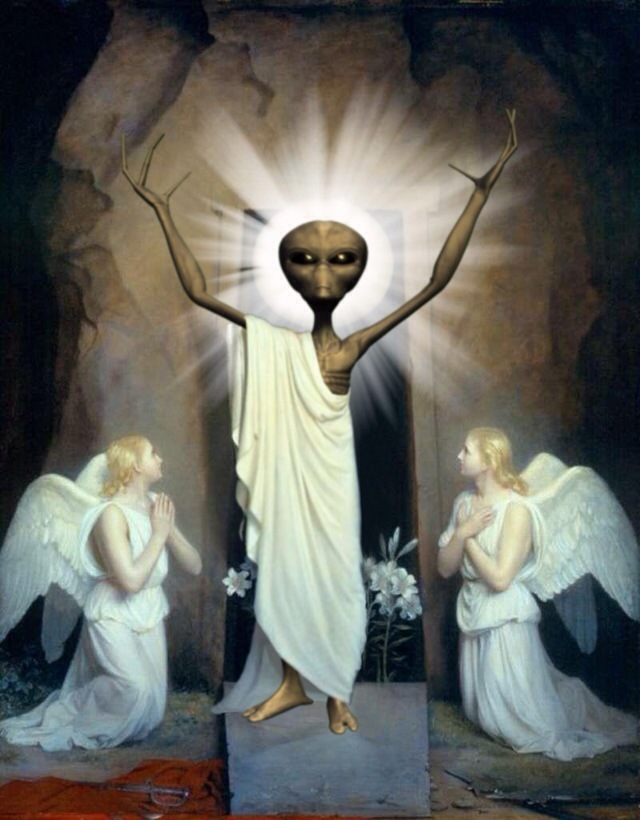
We might as well be arguing that Jesus was an alien. The whole debate just puts us in a looney-tunes cartoon.

In which I disagree with xkcd

This is not a perspective I share.

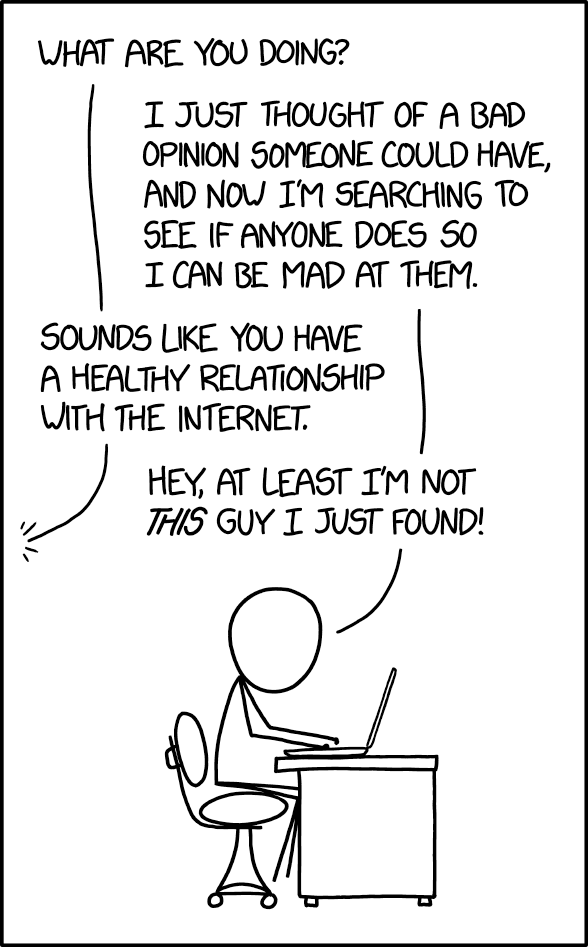
This has not been my experience at all. I plod forward with reasonable expectations of humanity, and am constantly horrified by the worst opinions that I never imagined anyone would hold, flung at me in surprise.

Seriously, did anyone ever anticipate incels? Did you go looking for them? Did you imagine they could exist?

Bad memories

I had to look high and low to find a copy of that old debate I had with Geoffrey Simmons, because I wanted to reference something he said, so once I found a copy, I put it where I’d more easily find it in the future, on YouTube. Some of you old-timers will remember that debate — I blogged about it at the time, and there was a follow-up, too.

It was disillusioning for me at the time. I knew that creationists misrepresent the facts all the time, but this guy was just right there in my face, pretending he was an authority on the fossil evidence when he wasn’t, and also flat out lying about that evidence. He claimed that the entirety of the whale fossil evidence consisted of five bones — “five or so fossil pieces from dog-size animals”! Debate really doesn’t work as a tool to get at the truth when one side’s sole tactic is to lie brazenly, as we’ve also learned from Republican politics.

It’s also frustrating when the debate format doesn’t allow you to bring out the evidence and rub your opponents face in it, and if you point out that he’s lying he gets all indignant and smarmily whines about tone, and the moderators are both grossly biased and using your appearance as a gimmick to sell tours to the Creation “Museum”.

Ken Ham, innumerate evolutionist

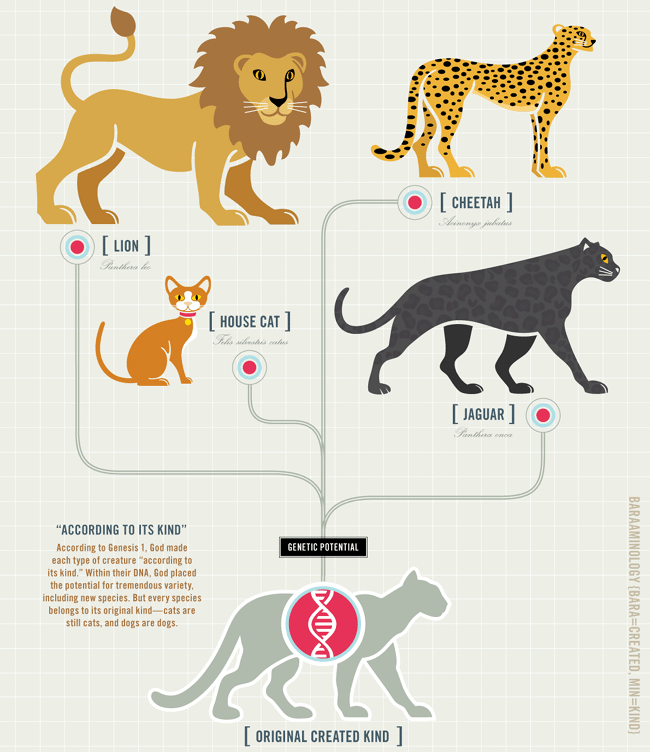
I visited both the Creation “Museum” and the Ark Park, and one thing that leapt off the displays to me, and to other biologists I’ve shown these things to, is that Ken Ham has evolved to become a kind of hyper-evolutionist. Take a look at this illustration from Answers in Genesis, for instance.

Now compare it to this diagram of cat evolution.

Not that different, are they? They’re both tree diagrams, they both show an ancestral form diverging into multiple modern species, they both imply change and evolution. AiG’s is more cartoony and simplified, the real evolutionary diagram has more species, but the differences are more of style than substance, except for one little thing.

The time scale on the evolution image is 20 million years.

The time scale on the AiG image is 4 thousand years.

It’s weird. Answers in Genesis has gradually gone from complete denial of any evolution at all to arguing for so much evolution so fast that it’s enough to make a population geneticist choke. Does his audience care? I guess not. They’re not used to recognizing the implications in a quantitative chart, I guess, and see no conflict at all in ol’ Ken Ham waving his hands at a phylogram on steroids while claiming evolution is false.

Naturalis Historia has a more detailed discussion of this phenomenon, with a very nice wrap-up.

Would you recognize many of the animals that boarded Noah’s Ark? Not according to Ken Ham and his colleagues. The ark contained only the common ancestors to the great diversity of animals you see today. Giraffes on the ark? No. Chimpanzees? No. Lions? No. etc… One cat pair evolved into more than 100 species of cats most of which went extinct just a few hundred years after the Flood. Yes, Ken Ham has fully embraced Post-Flood Rapid Evolution as a mechanism of creating the amazing variation we see today. As he falls further down the slippery slope into the rabbit hole of radical hyper-evolution Ken Ham is, ironically, more accepting of naturalistic speciation (Darwinian evolution) than Old Earth advocates such as Hugh Ross.

Talk me out of this (or into it)

I’m considering dropping in on some creationists speaking at the Twin Cities campus next week.

Dave and Mary Jo Nutting have been to Minnesota before, but I didn’t bother going — but I wasn’t on sabbatical back then. The Alpha Omega Institute is a rather nutty organization, so maybe I should scribble up some notes on them.

What do you think? I’m on the fence, so I’ll let the comments decide. Also, would any of my Twin Cities peeps want to make an evening of it?