Quacks are thriving nowadays

The Republicans have a new favorite doctor, Stella Immanuel. She loves hydroxychloroquine and detests face masks, so of course the Trumps love her. She has a few other…interesting…ideas.

Immanuel, a pediatrician and a religious minister, has a history of making bizarre claims about medical topics and other issues. She has often claimed that gynecological problems like cysts and endometriosis are in fact caused by people having sex in their dreams with demons and witches.

She alleges alien DNA is currently used in medical treatments, and that scientists are cooking up a vaccine to prevent people from being religious. And, despite appearing in Washington, D.C. to lobby Congress on Monday, she has said that the government is run in part not by humans but by “reptilians” and other aliens.

A couple of Trumps are retweeting her claims, as is Turning Point USA, but Twitter and Facebook are removing the false information she’s spreading.

I think the White House ought to go all in and fire Birx and Fauci and replace them with Immanuel, and also that all of Donald’s medical care henceforth be provided exclusively by Dr Immanuel.

I don’t even know what’s going on in atheism anymore

I feel good about that, too. I still get email from various organizations, though, so I still get sent the Atheist Alliance International newsletter, AAI Insider. The latest issue contains this dodgy gem:

Earlier this year, two AAI staff members made false accusations regarding a Director, then resigned and immediately set up their own organisation with a deliberately similar name, claiming that we are corrupt and that they are white as snow. We have refuted their accusations and they have acknowledged that they were groundless, but they did so on condition that we didn’t tell! We have the evidence. Draw your own conclusions…

Ooookaaaay. I think they’re talking about the International Association of Atheists, which formed a few months ago, but they can’t tell us, and they can’t tell you that they refuted everything that triggered the schism, but they did. Sorta.

I’ve attended a couple of AAI meetings, 8-10 years ago, and they were pretty good. I don’t understand what happened to them since, and I really don’t want to know. Deep rifts, ongoing fragmentation, and crumbling reputations seems to be the order of the day in atheism.

The contradictions of anti-SJW atheists laid bare

The latest atheist scandal: Michael Sherlock, executive director of Atheist Alliance International, was a bit less than professional on Twitter. He called religion “retarded”, and when told that word has a lot of baggage, escalated the argument and ended up calling a woman a “cunt”. This has led to the organization suspending him without pay for one month, which seems like a reasonable rebuke to me, and the process leading to that punishment seems fair, as well. Atheist organizations have had a bit of trouble with poorly behaved leaders lately, so it’s a good idea to set standards and enforce them. If anything, the punishment was too light for an action that led to three board members announcing their resignation, and the Atheist Foundation of Australia severing their ties to AAI. I get the impression that Sherlock has been an antagonizing figure at AAI, especially given that they had recently appointed and then fired David Silverman.

Except…now Sherlock has become the newest cause célèbre for all those anti-SJW folks who are outraged at consequences — you know, what they’re calling “cancel culture”. Any effort to clean their room and tell the paid professionals who are supposed to be running the show to stand up straight is met with petulant whining from the spoiled children who otherwise adore people like Jordan Peterson. How dare you expect them to behave?

The funniest reaction comes from Atheists for Liberty, which claims that social justice is destroying atheist groups. To which I have to say, if they oppose social justice, let them be destroyed, along with the Catholic church and Islamic fundamentalism, two things they typically oppose for their lack of justice. Their rant is written by Justin Vacula, a terrible person with the same sensibilities as Sherlock, apparently, and he is mad about everything.

David Silverman was innocent, he suggests, his accuser was “screaming”, and the #metoo movement opposes due process. He takes a few swipes at me, too, calling me social justice warrior PZ Myers who remains out of favor (wait, what? I was “cancelled”, and he’s fine with that?), citing a pair of wankers, Michael Nugent and Hemant Mehta, to justify that. So apparently women and PZ Myers can be cancelled, but no, not his regressive little buddies.

But here’s the real meat of the complaint:

The intrusion of social justice and woke ideology into atheist circles continues. To name just one example of many, Alex DiBranco spoke at the Secular Student Alliance’s 2020 National Convention, where she argued for “a feminist humanist approach” to “contest white, male, and cisgendered supremacism” saying, “the organized secular/atheist movement has over-emphasized opposition to religion or the belief in a god for its own sake, rather than prioritizing the problem of harm posed to social justice from any direction.”

Atheists for Liberty stands against destructive social justice entryism and the overblown response to an atheist activist calling religion a “retarded relic.” Atheists for Liberty instead prioritizes the free exchange of ideas, individual liberties, religious freedom (including non-belief), Enlightenment values, and secular government.

I think I like this Alex DiBranco. Yes, any atheist movement should fully embrace feminism and humanism, and seek to expand their remit to embrace human social values. Anything less and you collapse into the black hole of conservative insularity and a mob of smug men patting themselves on the back for being enlightened. You get creatures like Trump and Boris Johnson, amoral exploiters and abusers. Any movement that seeks to make fundamental changes in society, like the removal of the influence of religion, is fundamentally not conservative, and to succeed and gather influence must adopt a progressive stance — these libertarian, right-wing atheists are doomed to implode in contradictions. Social justice is the only thing that can save atheism, while it’s people like those at Atheists for Liberty that are destroying it.

To quote Amanda Marcotte:

The moral is there is no leftism that can function coherently without anti-racism and feminism at its center. What is obvious now — anti-government sentiment was just opposition to government showing any interest in equality — was always obvious to “social justice warriors”.

You’re saying now that atheism is not leftism, but I’ll reply that it should be. In this era when western civilization is clearly sick and capitalism has exposed itself as a Ponzi scheme, no viable philosophy can afford to ignore reality and pretend that these right-wing sympathizers are anything but a poison pill for progress.

Astroturfing education

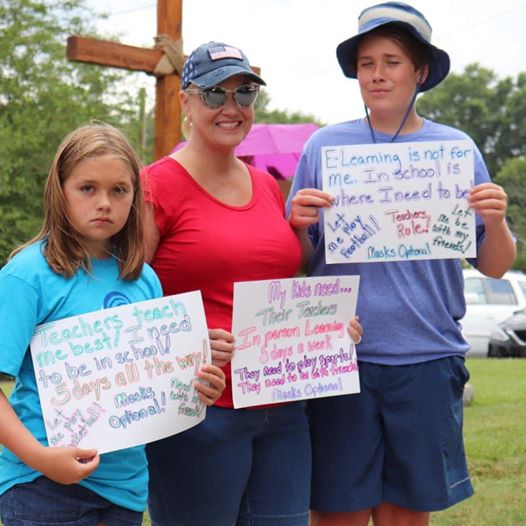
Look at these poseurs.

The one person who looks to be of an age to be a student doesn’t look very happy to be out there. Those are terrible signs, too, wordy and hard to read and attempting to make scattershot points. “Teachers teach me best”, “e-learning is not for me”, “My kids need…in person learning 5 days a week”, yeah, the agenda is clear: get these damn kids out of my house every weekday. The real giveaway is that every sign insists on “masks optional” — why? It’s such a peculiar conservative shibboleth.

But here’s the deal. I agree with a lot of what they want. I’m not a fan of wearing a mask all day, and you probably aren’t, either. I think in-person teaching is best. Some students will thrive with remote teaching, the majority will have a less enlightening experience. I’m at a residential college, and I agree that immersion in the academic experience is valuable. I must also confess that remote teaching, even while I think it is less effective, requires twice as much work out of me. I’ve got 30 years worth of stuff all prepared and ready to go in a classroom and lab, and you’re telling me I have to start over from scratch? Yikes. I was miserable last spring, I expect to suffer some more this fall (but with a little more time to prepare and cushion the blow, I hope).

So here I am, already agreeing with the sentiments on their little, hard-to-read signs, and they’re not at all persuasive. They seem to have forgotten the whole reason we’re doing all this: it’s because we don’t want their kids to die or suffer life-long consequences of infection — the won’t be playing football with scarred lungs! — and we’re trying to find compromises to allow ongoing progress in their education while not increasing their risks of disease. The signs don’t mention any of that. They seem to be thinking that all of these changes in the schools are just to discomfit their conservative values, rather than protecting the kids.

What I also don’t understand is that, if my situation were different and I was the parent of school-aged kids again, I would be welcoming efforts to keep them out of the plague-pit. Just as every winter I’d make sure they had a warm coat and a scarf when they went out, I’d be nagging them to wear a mask. Just this week my wife and I made a trip to St Cloud to deliver a high-quality mask to our oldest boy. He’s a grown-ass man in his 30s, and we worry! On the flip side, my grown-ass daughter stitched up a mask and sent it to me last month. This bizarrely cavalier attitude about masks tells me one thing: they don’t believe in science and medicine. They probably believe in the two sticks lashed together behind them, and the American flag on their hat, but neither of those things will help them if their daughter gets COVID-19, or if she comes home from their “mask-optional” public school or church incubator and pass it on to them.

My sign would be a little pithier. “MY KIDS NEED TO BE HEALTHY.” I’d sacrifice everything to have that be true.

This is a barroom conversation, not a publication

It must be awfully easy to get published in the Journal of the British Interplanetary Society. A couple of beers, some scratches on a cocktail napkin, and you get to call it research.

According to a research paper accepted for publication in the Journal of the British Interplanetary Society, extraterrestrials are sleeping while they wait. In the paper, authors from Oxford’s Future of Humanity Institute and the Astronomical Observatory of Belgrade Anders Sandberg, Stuart Armstrong, and Milan Cirkovic argue that the universe is too hot right now for advanced, digital civilizations to make the most efficient use of their resources. The solution: Sleep and wait for the universe to cool down, a process known as aestivating (like hibernation but sleeping until it’s colder).

Understanding the new hypothesis first requires wrapping your head around the idea that the universe’s most sophisticated life may elect to leave biology behind and live digitally. Having essentially uploaded their minds onto powerful computers, the civilizations choosing to do this could enhance their intellectual capacities or inhabit some of the harshest environments in the universe with ease.

OK, sure, yeah. Maybe. Why not? Evidence would be kind of nice to have, but hey, speculate away. They just guess that extraterrestrial life might be like my laptop, with a “sleep mode” that conserves battery power, just like a 19th century scientist might speculate that alien life is steam-powered and has periods where they cool the boilers and scrape the accumulated scale out of the pipes. Perfectly plausible. Take what you know and extrapolate it far off into the unknown, all while pretending you know exactly what you’re talking about.

The idea that life might transition toward a post-biological form of existence is gaining ground among experts. “It’s not something that is necessarily unavoidable, but it is highly likely,” Cirkovic told me in an interview.

Experts. How do you become an expert in alien species that have progressed so far beyond our known technologies? Especially when you’re willing to recognize that these hypothetical aliens would face challenges on such a cosmic scale that trying to imagine how they would cope with them is like stone age tribesmen trying to come up with an explanation for how to amplify a weak wi-fi signal to reach your deck.

The funny thing is, these guys don’t even believe their own theory.

Interestingly, neither Sandberg nor Cirkovic said they have much faith in finding anything. Sandberg, writing on his blog, states that he does not believe the hypothesis to be a likely one: “I personally think the likeliest reason we are not seeing aliens is not that they are aestivating.” He writes that he feels it’s more likely that “they do not exist or are very far away.”

Cirkovic concurred. “I don’t find it very likely, either,” he said in our interview. “I much prefer hypotheses that do not rely on assuming intentional decisions made by extraterrestrial societies. Any assumption is extremely speculative.” There could be forms of energy that we can’t even conceive of using now, he said—producing antimatter in bulk, tapping evaporating black holes, using dark matter. Any of this could change what we might expect to see from an advanced technical civilization.

Well then, why even propose it?

Yet, he said, the theory has a place. It’s important to cover as much ground as possible. You need to test a wide set of hypotheses one by one—falsifying them, pruning them—to get closer to the truth. “This is how science works. We need to have as many hypotheses and explanations for Fermi’s paradox as possible,” he said.

The important word there is TEST. Very good, smart guys. How do you propose to test it? I don’t mean that silly suggestion they made that we could send a space probe to the alien’s planet and poke the bear, since we won’t have the capability to do that in the foreseeable future, and even if we did, it seems incredibly stupid to propose to annoy some god-like aliens. Inventing empty hypotheses with no means to test them that are so improbable that you think simpler hypotheses are a better explanation is not “how science works”.

My job has always been toppling idols

A curious phenomenon: after my post yesterday about Krauss’s bad op-ed, I got complaints. I always do, but these had this odd tone: ‘I used to like you, but now you’re being critical of my heroes’. It confuses me. Why do you have heroes? Why do you think being critical of people is bad? Wait…why are you being critical of me? It all smacks of unthinking idolatry. We should be critical thinkers, and prominent people who aspire to be leaders and inspiring figures should be criticized most of all.

(Don’t look at me. My aspirations nowadays mainly involve spiders.)

I went easy on Krauss. That op-ed was dishonest right-wing trash that lied about the people who were “cancelled”, and could only have been published on the sleaziest of conservative publications, like the Wall Street Journal opinion pages. For a more thorough dissection, you might want to read John Jackson’s exposure of Krauss’s lies and misrepresentations.

  • Krauss claims one of Hsu’s “crimes included doing research on computational genomics to study how human genetics might be related to cognitive ability—something that to the protesters smacked of eugenics.” Well….yeah, manipulating the genetic material of humans for certain traits for the sake of future generations is kind of the definition of eugenics. Krauss doesn’t explain why it wouldn’t be nor why people should be unconcerned with such a plan. So, this doesn’t really advance any argument he thinks he’s making.
  • “He was also accused of supporting psychology research at MSU on the statistics of police shootings that didn’t clearly support claims of racial bias.” Well, as I explained before, that study was mentioned on Twitter, but nowhere else during the controversy. So, technically true, but largely irrelevant to the controversy.
  • “Within a week, the university president forced Mr. Hsu to resign.” Ten days, actually, Mr. Objective-Intellectual-Standards. And welcome to the land of post hoc ergo propter hoc. The two things Krauss listed preceded Hsu’s resignation in time therefore, Krauss concluded they caused Hsu’s resignation. Here’s few possible causes completely unmentioned by Krauss:

That’s just the stuff Krauss wrote about Stephen Hsu! His whole op-ed is that repulsively dishonest about everything, as one might expect of a disgraced academic who is lashing out at those who uncovered his bad behavior.

The author of this fallaciously argued piece is Lawrence Krauss, a man who was found guilty of sexual misconduct by his own university and has been banned from the campuses of three others. Hsu, who hosted a Holocaust denier on his podcast has now defended himself with a neo-Confederate and a serial sexual harasser. These are people who obviously have problems with presenting the truth. Credibility counts and Hsu’s defenders have none.

If these people are your heroes, and if you’re more annoyed at those who point out their feet of clay than at their bad behavior, you’ve got a problem.

Gussying up creationism with math doesn’t make it valid

I’m trying to read this article, “Using statistical methods to model the fine-tuning of molecular machines and systems” by Thorvaldsen and Hössjer, and wondering why I even bother, and why the Journal of Theoretical Biology bothered to publish it, because a) it undermines its own premise in the introduction, b) it’s loaded with irrelevant math, c) it contains no observations or experiments, and d) at the end it devolves into the usual circle jerk of references to the usual suspects in the Intelligent Design community. I had to throw up my hands and give up. It’s just mathematicians juggling assumptions and numbers to come to the conclusion they want.

The one interesting aspect is that unlike the Discovery Institute gang, they do give clear explanations of what they mean by “design” and “fine tuning” — it’s just that, once you read them, you feel like telling them that their work is done, further noodling about is pointless. Maybe that’s why the Intelligent Design creationists try harder to fog over the meaning of the words they use?

Anyway, here’s the only interesting stuff in the whole thing.

The term fine-tuning is used to characterize sensitive dependences of functions or properties on the values of certain parameters (cf. Friederich, 2018). While technological devices are fine-tuned products of actual engineers and manufacturers who designed and built them, only sensitivity with respect to the values of certain parameters or initial conditions are considered sufficient in the present paper. We define fine-tuning as an object with two properties: it must a) be unlikely to have occurred by chance, under the relevant probability distribution (i.e. complex), and b) conform to an independent or detached specification (i.e. specific).

To which I would reply that a) unlikely events happen all the time, so mere measures of probability, especially after the fact, are of little consequence, and b) groovy, so does this mean you are going to provide an independent or detached specification for a specific evolutionary event? [Answer: No, they are not.] If your definition requires addressing two parameters, and at the very outset of your project you have to admit that you don’t have the second one and that playing mathematical games cannot provide it, then aren’t we done? That was the second paragraph of the whole article, which makes for a quick read, too.

But no, sorry, they go on.

The notion of design is also widely used within both historic and contemporary science (Thorvaldsen and Øhrstrøm, 2013). The concept will need a description for its use in our setting. A design is a specification or plan for the construction of an object or system, or the result of that specification or plan in the form of a product.

Yes, yes. I’ve been saying this for years. If you want to claim there was a design for an organism, show me the blueprint from which it was built, and I’ll believe you. If you go to Mars and find a set of billion year old program specifications for Project Mouse, laid out by the Martian designers, with a couple of thousand manuals that lay out the details of the biochemistry, physiology, and morphology of Mus musculus, then I’ll have to admit that you’ve got solid evidence that mice are the product of design. You’ve said it right there in your definition, that you have to have a specification or plan the precedes the product.

Except then they immediately waffle. All you need is the product itself, and then you get to infer the specification or plan. That makes no sense. I can find a pebble in my yard which is unique in all of its particulars, where every scrape and mark and fracture sets it apart from otherwise similar pebbles. The probability of that specific pebble having its specific constellation of attributes is minuscule. Are you going to try and tell me that therefore there is somewhere on file in the Great Designer’s filing cabinet a project laid out for Pebble, Minnesota, 21st Century, Myers yard, grey, roughly ovoid? You might believe that’s the case, but I’d like to see it.

Instead, we get a lesson in etymology. I had to laugh, this is so ridiculously irrelevant.

The very term design is from the Medieval Latin word “designare” (denoting “mark out, point out, choose”); from “de” (out) and “signum” (identifying mark, sign). Hence, a public notice that advertises something or gives information.

Great. So where’s the public notice? Somewhere in the main Megabrantis office which is open on Tuesdays, between 1 and 1:15pm, standard Vogsphere time?

The design usually has to satisfy certain goals and constraints. It is also expected to interact with a certain environment, and thus be realized in the physical world. Humans have a powerful intuitive understanding of design that precedes modern science. Our common intuitions invariably begin with recognizing a pattern as a mark of design. The problem has been that our intuitions about design have been unrefined and pre-theoretical. For this reason, it is relevant to ask ourselves whether it is possible to turn the tables on this disparity and place those rough and pre-theoretical intuitions on a firm scientific foundation.

Just once, please consider that our intuitions can be wrong, rather than struggling to find some mathematical justification for them.

Unfortunately, the paper is primarily about fine tuning, allowing them to ignore this problem, and they’re going to move on.

Fine-tuning and design are related entities. Fine-tuning is a bottom-up method, while design is more like a top-down approach. Hence, we focus on the topic of fine-tuning in the present paper and address the following questions: Is it possible to recognize fine-tuning in biological systems at the levels of functional proteins, protein groups and cellular networks? Can fine-tuning in molecular biology be formulated using state of the art statistical methods, or are the arguments just “in the eyes of the beholder”?

Yes. We are quite confident that biological organisms have been fine tuned by natural selection. Is that what you mean?

There’s no point in worrying about it, though, because after I read the following sentence I threw my hard copy of the paper in the trash.

The chances that the universe should be life permitting are so infinitesimal as to be incomprehensible and incalculable.

But…but…if they’re incalculable, then how did you determine that they are infinitesimal? Jesus. Creationist mathematicians.

Cultivating a British flavor of narrow-mindedness

Trying to figure out why so many TERFs are British, I think this answer hits the nail on the head.

The answer lies in part to the coalescence of a certain set of ideas in a very specific circle of voices in the early 21st century — voices that later went on to hold high profile positions in much of the U.K.’s print and broadcast media.

I’m referring here to the U.K. Skeptics movement of the early 2000s. Despite the fact that it was basically a loose network of people who were far too impressed with themselves for not believing in astrology and homeopathy, they have an outsized legacy. The movement consisted largely of groups meeting in pubs and organising talks promoting a specific brand of scientific skepticism and concerned primarily with the “debunking” of alternative medicine and pseudoscience. So far, so niche, but there is compelling evidence that suggests that both the ideological basis and some of the specific proponents of U.K. skepticism in the noughties are implicated in the spread of transphobic thinking into the mainstream media in this country.

While claiming to be the country’s foremost critical thinkers, the group was riddled with anti-humanities bias and a fetish for a certain kind of “science” that it held to reveal a set of immutable principles upon which the world was built with almost no regard whatsoever for interpretative analysis based on social or historical factors. Part of this mode of thinking was an especially reductivist biologism: the idea that there are immutable realities to be found in our DNA, and if we just paid enough attention to Science and stopped trying to split hairs and discover meaning over in the superfluous disciplines of the humanities, then everything would be much simpler. It’s precisely this kind of biological essentialism — which skirts dangerously close to eugenics — that leads people to think they can “debunk” a person’s claim to their gender identity, or that it should be subjected to rigorous testing by someone in a lab coat before we can believe the subject is who they say they are.

I saw the same thing in US skeptics, of course. But there was something fundamental going on that is also reflected in the British school of evolutionary biology, represented by Maynard Smith and Dawkins, that totally embraced reductive explanations and adaptationism, vs. the American subset led by Lewontin and Gould, who fiercely opposed eugenics and detested the arrogance of thinking biology could be reduced to a catalog of alleles. My experience may also be colored by the fact that there were several prominent UK skeptics (at least, I was told over and over that they were big names) who I had to ban here because they were persistently obnoxious and insistent that there are only two sexes/genders because “biology”.

Then there’s the outcome of all this activity by bigots claiming the mantle of science — some people actually believed them.

Tracey King, a skeptic activist who credits herself with establishing American-style organized skepticism in the U.K., has pointed out that the movement collapsed in the last decade. She attributes this to some good reasons (turns out it was full of sexists, which the rise of social justice concerns helped bring to light.) But these voices did not go away; many of the figures who made up the movement are now prominent voices at one level or another. Helen Lewis, for example, is the deputy editor of the center-left political magazine the New Statesman, and has promoted a barrage of anti-trans articles. Julie Bindel at the Guardian and elsewhere has a well-documented history of transphobia.

Then there’s Graham Linehan, a formerly beloved high-profile comedy writer who has recently been given a warning by police for directly harassing trans women online. Imagine if Larry David or Jerry Seinfeld suddenly started a social media hate campaign against a particular group of people that took up most of their time and you had to accept that was just part of your reality now. It feels a bit like that.

I met Linehan — he came to one of my talks in Dublin. Then, I was quite pleased to see him, but now…oh god what kind of wanker was I inspiring/being inspired by?

By the way, Seinfeld has been a loud voice whining about PC culture on college campuses — if I were him, I’d be wondering why smart young people no longer find him funny, rather than blaming it on a contrived slogan like “political correctness” — but at least he hasn’t carried his obsession as far as Linehan has.

Confessions of a has-been atheist

I gave up on creationist debates when I realized I was being taken advantage of — I’ve always been willing to do these engagements as an opportunity for science communication, so I wouldn’t charge anything except for travel expenses. Then I did one event where, after getting there, I learned that there was a banquet planned for their honored creationist speaker, to which I was not invited. Then I discovered that he was put up in a suite in the big hotel in town, but I was told that surely I’d be able to find a motel somewhere nearby. That’s the kind of respect you get from creationists.

Atheists aren’t much better.

Would you believe I still get tentative invitations to speak at atheist conferences? (For the past 6 months, those have all been online events, of course.) I hardly believe it myself, since I consider myself persona non grata in atheist circles, but apparently some people have good memories of events I’ve done in the past, and they call or email me. “Hey, we’re in the planning stages SuperAtheistCon, and your name has been suggested as a potential speaker. Are you interested?” And I’d say, sure, if I’m free that day. They’d ask for the usual headshot and bio, and sometimes they’d ask for an abstract for the talk, and sometimes they’d even ask for a complete outline of my topic, which was usually something science-related. I’d provide what they’d ask for, and let it lie. Then, usually, silence. I’d never hear from them again.

I’d just figure, “wow, my idea must have been really boring,” which may well have been the case, and that’s OK.

A few times, I’d get a regretful call back. They decided not to go with me, after all, because one of their board members objected that I was a feminist or an SJW (unspoken: the rest of the board went along with what they thought was a legitimate complaint), and also they landed some Hitchens-loving islamophobic misogynist speaker who was more popular than me, and now they’re out of money. Fair call.

One event even got to the point where I had all the slides done for a talk when they pulled the plug. It’s sinking in that I’m not ever going to speak at an atheist conference ever again, and that atheist conferences have achieved a kind of uniformly vaguely right-wing ambience that means they don’t want me, and that I don’t want them.

That’s all fine, I do not expect to be given a platform. However, please stop pestering me with tentative requests that you and I both know will get squelched by the dominant right-wingers in your organization, especially if that request is accompanied by a demand that I do the work of providing a justification for myself. It’s getting old and really hardening me in my cynicism.

P.S. I have zero sympathy for those professional atheists who whine about getting stiffed by conference organizers like Pangburn Philosophy. Sorry, guys, I’ve always done it for the cause and not for the money, so your petty bourgeois demands leave me cold. You’re doing it for the cash, and you got robbed by capitalist parasites, but still you defend the status quo? Boo hoo.

P.P.S. Maybe another reason I get disinvited from conferences is that they know I might sneer at their headliners.