
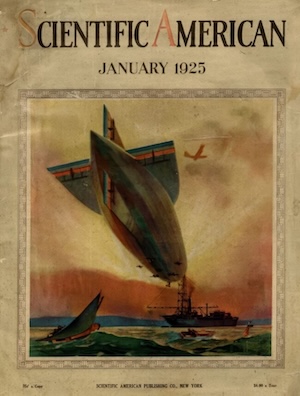
Some of the best years of my youth were in high school…but not in high school. During those years, we lived in a nice old house in the center of town, my parents and six kids, which was going to change after I graduated, when I moved to another state, my brother joined the army, and my parents moved to another town, after the rental home we lived in was torn down by the Catholic church. There was a sharp division ahead of us.
Before all that changed, though, we lived in this nice older house that was only a few blocks away from the public library. Every day after school I would go to the library and hang out until my mother would send one of my younger siblings over to tell me to come home for dinner. I had a favorite spot in the library, a large table facing the periodicals section, and the first thing I’d do was scan the racks to see what new journals had come in. I liked Natural History, Smithsonian, and especially Scientific American. SciAm would engage me for several days as I would read it cover to cover. Every month throughout my high school years. That’s what made those years happy and memorable because I was a nerd, who missed out on all that socialization that normal kids experienced.
It’s the end of an era now, though. Scientific American is dying. Guess why.
Last year, a Breitbart article had criticized Springer Nature, Scientific American’s German owner, for attacking those “skeptical of the coronavirus vaccine” and spreading “gender insanity.” “No more taxpayer money for woke publishers!” declared Donald Trump Jr., retweeting the article. In June 2025, Axios reported that all federal subscriptions to Springer Nature publications had been canceled. Although Trump officials later walked back the bulk of the cuts, they had shocked the scientific community: Without access to Springer Nature’s thousands of journals, including the prestigious Nature publications, researchers at federal agencies—from the NIH to NASA—would struggle to stay abreast of scientific developments. The company itself, meanwhile, risked losing as much as $25 million in federal contracts.
So if Ewalt had asked people to keep Trump out of the headlines last summer, it was because corporate higher-ups were visiting the site all the time. “And if they saw the word ‘Trump,’” he said, according to the recording, “they were wetting their fucking lederhosen.” People had no idea how “lily-livered and weak-kneed and cowardly” Springer Nature was, he said. “They are so fucking afraid of the Trump administration.”
Springer Nature no longer owns it. SciAm has been bought by a company called LabX. This is not good news.
In the immediate aftermath of the sale, staffers were left scrambling to learn more about Scientific American’s new owner. Previously, LabX’s best-known publication had been Discover, a onetime dentist’s office stalwart that was hollowed out by private equity buyers in the aughts; according to multiple staffers, the ownership transition seemed rushed, chaotic, and disorganized. When one worker reached out to a former employee of one of LabX’s other publications, the stories they heard—including ones related to editorial independence—were part of why they turned down their job offer, they said. (LabX did not respond to multiple requests for comment.)
I remember Discover. It was not one I ever looked forward to reading — too shallow, never providing much to engage with.
At least one freelancer has already written publicly about their negative experience with the new Scientific American, and two more editorial staffers were laid off at the end of September, including Megha Satyanarayana, Vergano’s former colleague in the opinion department—who declined to comment for this piece—and a data reporter. Vergano remains worried that LabX seems more interested in “gee-whiz stuff” than critical, substantive reporting. From what he’s seen of their publications, he said, “they produce things that are schlockfests. And we were doing good work at Scientific American.”
The end is near. The schlockification has begun. I don’t think the new SciAm will be inspiring many high school students to pursue careers in science.

Well, that stinks. Sad news indeed altho’ the SciAm articles online have been paywalled a lot lately if memory serves. Got the occassional print issue sometimes.
I remmebr Discover fondly ~ish too back when the old Bad Astronomy blog could be found there. Tho’that had its accessibility issues as well at times memory serving.
I remember Discover being quite good. I also remember seeing Discover go to shit. It wasn’t long from one to the other, so you might have missed it.
I still read discover occasionally.
I get it at the library so it is free.
It is popular science so of course, it doesn’t go into depth. It is now also 4 times a year.
All the print publications are a shadow of what they once were.
I wish Springer Nature had spent a little time finding a responsible new owner for Scientific American. Maybe even a nonprofit foundation or something.
And fearing the Trump fascists is OK. Not finding a few vertebrae and standing up to them is not.
They are bullies and often back down if challenged.
A huge congratulations to the vertebrates of Hungary, Serbia, and Brazil who have recently shown where courage can take you.
OK, I should probably expect that Discover started out strong and later declined, like most things under capitalism.
You read SciAm articles all the way through? In high school? That’s pretty impressive — I rarely made it past the first page of any article.
We had Sci Am in the town library, so it was never a problem to read the latest issue. I often copied interesting articles.
.
There is another journal with a similar-sounding name, American Scientist. I recall when they led with an article about the new carbon nanotubes. I promptly sent a copy to Arthur C. Clarke as he had used a space elevator in The Fountains Of Paradise.
.
The weekly New Scientist from UK does not have whole chapters about any issues, the longest articles are 2-3 pages. London is outside the jurisdiction of American fascists do you can probably enjoy it for decades more.
For astronomy, you can check Sky And Telescope. Lots of ads, but lots of good articles, too.
You’d think Springer would know a thing or two about the importance of standing up to fascists.
I guess I was lucky: my high school library carried SciAm, and my GF and I would peruse it during spares. Such an appropriate beginning to a life-long nerd romance….
Subscribed in the early 80’s, but then dropped it after ~20 years. The quality of the articles was already declining until it started to be indistinguishable from Discover.
At my high school in the morning the various tribes hung out in their traditional territories: the slackers at the Tastee Freeze across the street, jocks in the quad throwing a ball around, and my People in the periodicals lounge in the library. There we discussed all sorts of important and weighty things but at the beginning of the month no subject dominated the conversation as the new issue of Scientific American. We each had our favorite column: 50 and 100 years ago, Martin Gardner’s Mathematical Games, the Amateur Scientist. Throughout the month we would have read and discussed all of the articles. Back in the day, 1965-69, the articles were thorough and detailed.
I subscribed to Scientific American in 1974 while in grad school and kept my subscription through about 2002, as I recall, when the format changed so much that it was painful to read. Also, I think the magazine got infected by Michael Shermer which was the last straw. I saved every issue and even bought those green cardboard slip cases to hold a year’s worth, hauling them around every time I moved. When the local municipal library told me they didn’t want my “collection,” I pitched the lot, but not after looking through the whole thing to pick out my favorites. And, that’s all folks!
Scientific American was founded in 1845. Even back when I was in middle school in the late 1970s, Scientific American had a ’50 and 100 years ago’ column where they’d use a page quote part of an article from each of those times, to help showcase the changes they’d been witness toamateur. Needless to say, several years back that became ’50, 100, and 150 years ago’.
So, yeah, that’s a hell of a legacy to wash down the drain.
I was reading through Martin Gardner’s hand-off of the Mathematical Games column to Douglas Hofstadter, who renamed it Metamagical Themas as an anagram of the original and went more philosophical, then to A. K. Dewdney who renamed it to ‘Computer Recreations’ and then ‘Mathematical Recreations’.
The Amateur Scientist column was great, often going into all sorts of odd practical things including the chemistry of cooking. There was one article on the protein folding involved in meringue, and the effects of adding a voltage potential to a metal bowl while mixing it.
I was just looking at the Wikipedia page, and it notes that the sale was three days before a vote on unionization that was brought about by the writers trying to organize to fight back against Ewalt saying “Let’s be realistic about the world we live in”. That timing is almost certainly not a coincidence.
Also, with regards to Discover… it could be worse. It could be Omni.
My library, in the 1970s, also carried Playboy and Penthouse, not that I was reading them there. It’s just that living in a progressive state meant that a lot of repressive censorship was gone.
I wonder if King County libraries still carry those kinds of periodicals.
I’ve had a subscription to Scientific American since I was 13. They did dumb it down just slightly a while back, but it’s still well worth your time. So far, it hasn’t changed — the current issue is quite interesting. We’ll see what happens in coming months.
Were the girlie magazines behind the front desk or something?
Long time subscriber to National Geographic. I bailed when the Murdochs got involved.
No, the girlie magazines were right up on the racks.
When NatGeo bought up Scienceblogs, there was a huge uproar…and then they basically got rid of us in response. I haven’t paid much attention to them since I found them constantly producing special issues to pander to the religious.
When I was growing up, everyone had huge piles of those yellow NatGeo issues. The thrift stores were stockpiling them, and refusing to accept any more copies. They were a significant factor in the national consciousness, I think, and then the rich people got involved and wrecked it.
I’ve subscribed for 45 years, but lately it feels more like People magazine. It used to take some effort to grasp the articles. Now they often feel shallow, written by ‘science journalists’ rather than actual researchers, and dumbed down with personal anectode and pungent quotation rather than a rigorous treatment of their subject. Back when I was not an old fart the illustrations were some of the most challenging aspects of the articles. Now they are pretty, but rarely convey the deep information. Excuse me, I need a new onion for my belt.
Well here’s hoping your dire and probably accurate predictions are wrong wrong wrong! I love that mag, as a subscriber I have downloaded all issues from this year til around 1920, so I’ll have something to console me if it ever goes under.
And in fact I WAS wondering, how come such a venerable periodical has not yet been sunk by the usual supects? And here we are…
Fuck.
I thought Scientific American decayed a few decades ago, when it was bought up by Holtzbrinck Publishing Group in 1986. It became (as Knut7777 says) more about people than about science. The inspiring columns Amateur Scientist and Mathematical Games disappeared at about that time and the articles got fluffier. I stopped reading it, and have not really followed its progress since then.
I haven’t seen Scientific American for ages but I am in a Bogan Backwater where anyone who gets to high school is called a “bookie” and I don’t mean the ones taking illegal bets. It started going downhill when they dropped the Amateur Scientist. I used to love having a go at some of the projects it turned me into a more practical scientist. Very handy when you have to run a lab with equipment that is older than you are.
I still enjoy dabbling in amateur science with my granddaughter. Together we’ve built a few crazy contraptions, various planes and gliders, an ornithopter, water rockets, a Wimshurst machine and plan to start on a Tesla coil and Van de Graf generator shortly. She is really bright. Already speaks 4 languages and starts at a stem school at the end of this year. In the grading exam before enrolment they used to work out where she starts she scored 100% in all five categories. I suspect she’ll not only outdo her grandfather but also her parents who are no slouches academically either.
Scientific American may be disappearing into the anti-woke fascist quicksand but there is plenty out there in Science blogs and maker projects on the internet, provided you can wade through the slop.
@ birgerjohansson American Scientist is a publication of Sigma Xi (as it always has been). We subscribed to both when I was a kid in the 60s and early 70s (my Dad was member of Sigma Xi). I preferred Scientific American, as being more readable (they had a particularly good policy about figures and figure captions), and I was very sad when the magazine decayed in quality in the 1980s.
“there is plenty out there in Science blogs and maker projects on the internet, provided you can wade through the slop.”
That was the value of the edited magazines—the editors waded through the slop for you and found the gems. Nowadays, they seem to throw out the gems and showcase the slop.
I’ve found Make magazine to be decent still.
Re NatGeo, from the Journal of Irreproducible Results, March 1974, by George H. Kaub:
Have we not seen evidence already that this is happening now? I’m afraid it is too late after all.
I’m with Jenora:
I remember Conway’s Life and Sprouts (and I remember Piers Anthony used those in his books just after), and I remember Hofstadter’s self-reference (reflexive) slant, like with his Lisp columns and Autograms.
(Was the best bit, and I too read them in a library)
—
As for NatGeo, well… us kiddies liked to see the boobies on the pygmies, that sort of thing. Good piccies.
(Ah, pubescent boys!)
It was of course a form of inculcation, but I got over it; cf. https://www.mcall.com/2018/03/13/national-geographic-acknowledges-racist-lens-that-showed-bare-breasted-women-tribesmen-as-savages/
True story. I was a director and judge at the annual county Science Fair sponsored by several technical companies in town. We had about 400 entrants from middle and high school. In the late 80’s a project caught my eye. It was a project to use some digital electronics and electromagnets to make a pendulum clock more accurate. It caught my eye because I remembered seeing that project described in the Amateur Scientist in the 70’s. It used a 555 timer among other chips. The 555 was an old friend of mine building computer interfaces in grad school.
I was eager to talk to the kid about the project and he boasted that he “invented” the design. Well, that was just wrong! During the lunch break I went home, rummaged through my Sci Am collection and found the article. In the afternoon I presented the student with the original article which had exactly the same circuit diagram as his project displayed. The kid thought he was going to be disqualified, but I told him the project was fine but he had to remove the claim that it was original work. Rather, simply tell the judges you were curious to see that the concept actually worked, and so you built one to test it out.
His project came in second or third, as I recall. I hope the lesson stuck with him.
Yeah, IIRC SciAm was where I first read about Game of Life and also the Mandelbrot set. Which were my first two programming projects when we acquired our first home PC in the mid-90s, using MASM and Turbo C. (The Mandelbrot generator ran glacially slow on a 12MHz 386).