
If you thought Vikings were voracious plunderers, you haven’t compared them to 21st century billionaires. Apparently the thing to do when you’ve acquired a few billion dollars is to wall off historic sites for your own personal pleasure.
I know nothing about James Dyson other than that he’s a vacuum cleaner salesman, but I guess that’s a lucrative business, and he’s raked in a whole lot of money, so off he goes to buy an estate that includes an old castle and the ruins of an abbey, which is now his, never mind that it is a site that has been populated since at least the 6th century. It’s his, damn it, and you can stay off of it.
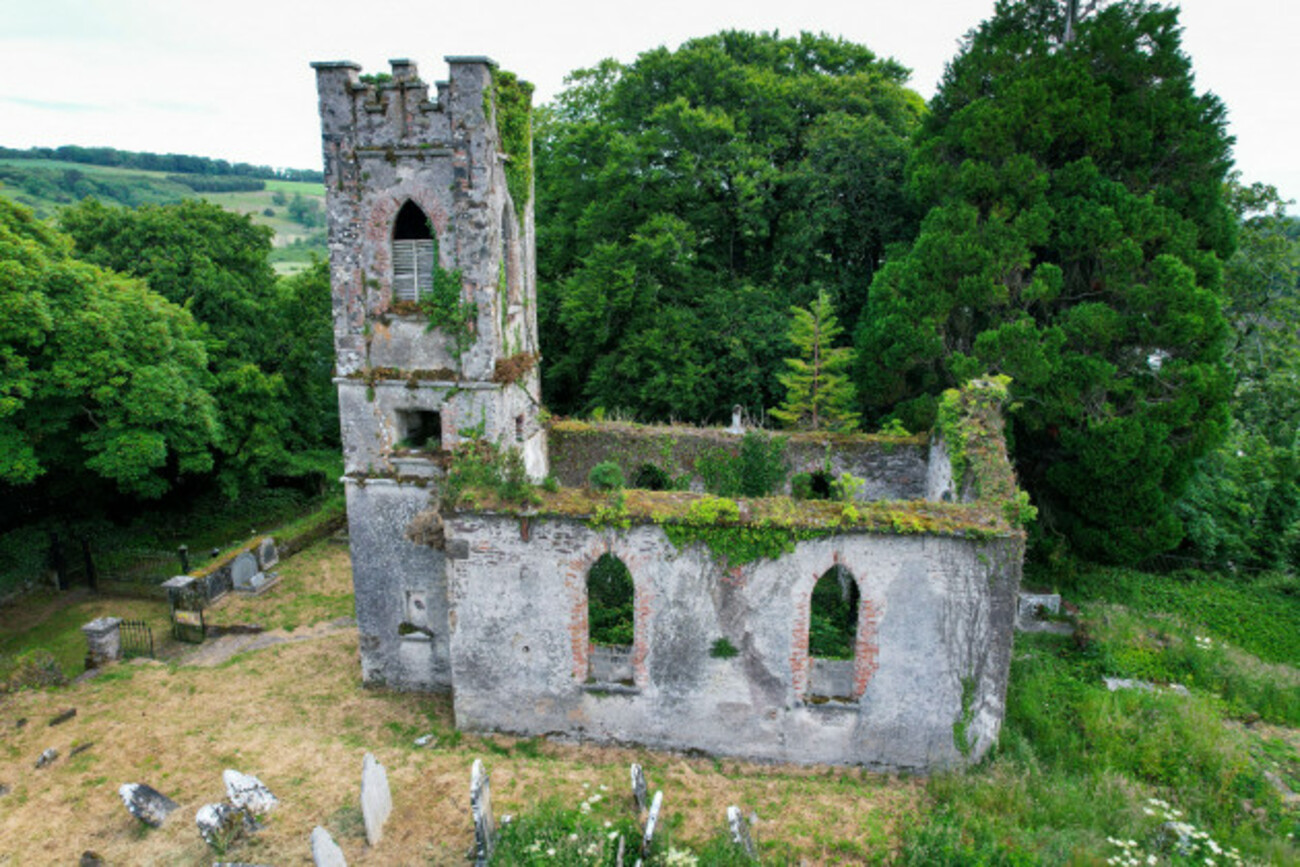
Templemichael Church and Castle
From the state of it, he’s not living there or holding parties in it — he has a grand manor nearby for that. I once made a trip all around Ireland, Dublin to Cork to Galway to Belfast and back again, and I loved stopping off at old ruins and soaking in the history. I don’t specifically remember stopping in Waterford, but I know my route passed through it. I may have left quickly, repelled by all the stinky billionaires moving in (Mark Zuckerberg bought a place near there, which would have made the stench quite thick). By what right does a man, and an English man at that, have the privilege to lock up a chunk of Irish history?
Well, money, I guess. The locals are not happy about this, but it won’t bother Master James, he wasn’t going to invite them to his house for a ball, anyway. He can just dance with Master Mark.

The suggestion to protect historical sites from entering private ownership comes to mind.
In North-Eastern Germany though, there are castles that are falling into disrepair and are apparently being offered for sale for symbolic amounts, the hope being that the new owner would keep them intact according to the regulations of monument protection.
But what good is an intact monument if you can’t visit it?
It is a shame about all these horrible global crises, for Europe has very many historical monuments that would need restoration and accessibility to the public.
Its probably one of the churches his Brutish ancestors laid waste to when they invaded Ireland 600 or so years ago. The British invaders stripped the lead off the church roofs to melt down for bullets to continue murdering the Irish. What really annoys me is that Ireland is a lovely country and I have a deep family connection. My father was named after an Irish patriot Terence McSwiney who was imprisoned by the British for writing poetry calling for Irish independence. He was born about the time his namesake died in a Brutish prison as a political prisoner. I’m angry the some upstart Englishman can move in and live there. My great grandfather migrated to Australia where my grandfather was born. Had he been born in Ireland I would have a right to return there.
Ah, Ireland and its decades-long efforts to bring “the right kind of people” to its shores after centuries of poverty and economic abuse (much resulting from internal squabbles — sure, the British were problems, but it was already tribalist chaos on its good days, and there weren’t many good days). It used to be just a right-of-residence-and-return-and-tax-breaks for those in the arts who had even a smidgen of Irish ancestry, but it started growing in the 1980s.
The Dyson/Zuckerbeast/etc “immigration” is a consequence of tax breaks offered to those who “bring jobs” to Ireland, directly or just by owning multinationals that have offices in Dublin. Plus decades of dubious travel/tourism publicity efforts. All of which have led to some serious “public-sector” deficits that end up entrenching, not reducing, class and ancestral barriers.
Don’t take this as a screed against Ireland in particular; I can name at least a dozen other nations (generally small-next-door-to-large economies) doing the same thing. It’s all about convincing “rich carpetbaggers” that they can find real-property bargains and tax breaks… ironically similar to how the “English incursion” worked up to the late 19th century (even prior to independence).
It’s not about heritage. It’s about greed. Surprise!
I don’t think that this is a new phenomenon – didn’t rich Americans buy up quite a few European properties in the late 19th and 20th centuries, in at least a few cases disassembling them and reconstructing them in the USA?
Of course, the fact that there is plenty of precedent for this doesn’t make it any better.
Answers my question – after your first billion what on earth would you do with a second billion?
Compare this man to his namesake, the late, great physicist Freeman Dyson (he would have shared a Nobel with Feynman if he hadn’t left to study the concept of a nuclear pulse jet rocket) -a genuinely kind and generous person.
Sure, Birger. Since you ask.
(https://www.scientificamerican.com/blog/observations/remembering-freeman-dyson/)
(https://physicsworld.com/a/freeman-dyson-the-visionary-thinker-and-maverick-scientist-who-challenged-authority/)
In contrast, James:
https://www.jamesdysonaward.org/news/the-james-dyson-award-celebrates-world-environment-day/
Also, https://en.wikipedia.org/wiki/James_Dyson#Philanthropy
@Gaz Smith #2:
The architecture suggests the church is more recent than that. Many Protestant churches were built in the 17th and 18th centuries, usually on estates of the English and Scottish landowning classes but sometimes on those of Irish converts.
Temple Michael was built in the 16th century and its current appearance is due to Cromwell. The Abbey ruins are far older, having been built in the 6th century.
I doubt it was Protestant.
In any case, it should be accessible to the public as it’s part of National Heritage.
https://en.wikipedia.org/wiki/Molana_Abbey
Apparently it was turned in an Augustinian Abbey after the Norman era.
Tethys, the site is not the featured ruined church, and you conflate them.
See for yourself: https://www.youghalonline.com/templemichael-church-graveyard-and-castle/
Ruins of the Abbey and Church are part of the estate John, but thanks for tracking down info on the youngest building on the estate. I expect there are multiple ruins dating back to the original Abbey complex and intervening 1500 years of time. It’s sad their library didn’t survive the dissolution of the Monasteries.
John Morales @7 and all. Dyson is a complex, and to me infuriating person. I have a 12 year old Dyson 360 Eye, used most days (carpet, tile, wood), and is still looking and working as if just out of the box. And it doesn’t insist on being connected to the internet. The engineering is, well, superb. But then, he (apparently) personnally hates Europe, and publically aided the Brexit campaign. Grrrr. The inverse happens with Jeremy Clarkson: sometimes he says things that I agree with…
Rich enough to own history. – Billioanire.
Rich enough to be made history! – Peasants with pitchforks and guillotines.
#6: Freeman Dyson was a frequent participant in John Brockman’s salons, I suspect there’s going to be an Epstein connection.
Also, he was a climate change denier. Fuck him.
There’s still a lot of memory (some history, some myth) in Ireland about the days of the absentee landlords. They got out from under them once, between about 1860 and 1922, though the immediate aftermath was not to be boasted about. With that backgound, it would behove Dyson to tread carefully, or take out a lot of insurance.