Found on a shelf of reagents while preparing a lab:
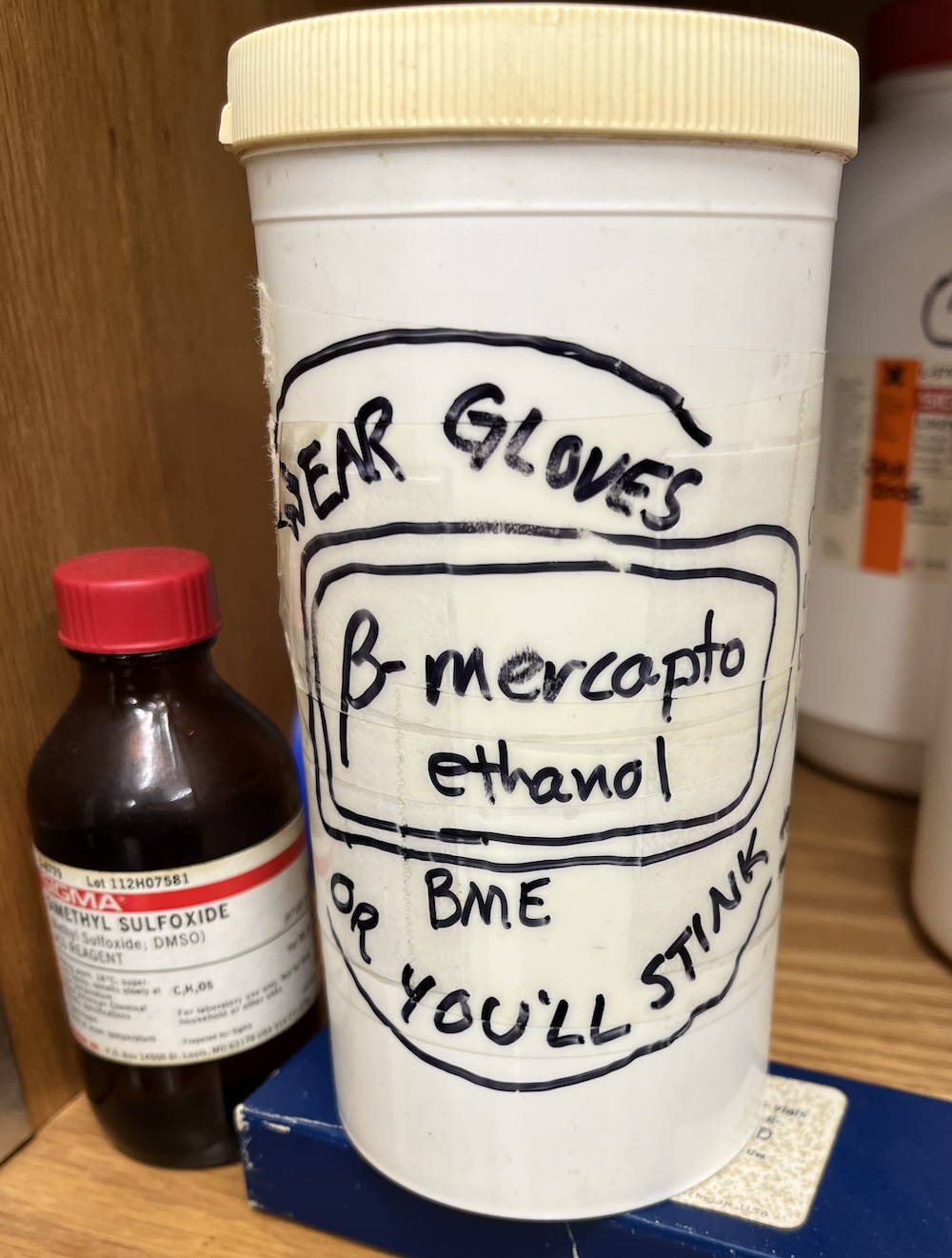
I trust that label. I didn’t open it or touch it.

Found on a shelf of reagents while preparing a lab:
I trust that label. I didn’t open it or touch it.

You must be logged in to post a comment.
i was working in a lab of a large company in minnesota. i need a solvent to clean some InP wafers.
i opened the solvent case, looked around. smelled something weird and sweet…
the bottle of trichloromethane did not have it’s cap on…
yes, i almost chloroformed myself by accident…
I can practically smell the picture.
One day in grad school another student (who stars in several of my lab cautionary tales) was trying to load a smallish volume of some protein on a column; for various reasons, the solution it was in had a high concentration of bME. They had the solution in a ~10 ml syringe that had 3 or 4 bits of Tygon and silicone tubing to change sizes to match the inlet for the column and for some reason, this jury-rigged system was resisting the appropriate gentle pressure on the syringe. I was looking through the tubing junctions and saying “don’t push too–” when one of the joins gave way, sending about half of their solution up my nose. I couldn’t smell anything properly for a week. [The person I was helping of course blamed me for losing their sample and didn’t ask me for help for quite some time, having told another student that they didn’t really think I knew much about what I was doing.]
If I remember correctly, BME is the odorant used in natural gas
You should have blown your nose in a kimwipe and handed that to him.
Robbo @1
Wikipedia – Chloroform, Criminal use
Dunno if that’s reassuring or not in your case.
NOOOOO!
Jean-Luc Picard aka Patrick Stewart has died!
😪
Everybody has a chemical horror story. Mine is from an old lab I worked in. The shelves in the acid store were rotten and the management refused to replace them until our annual OH&S inspection came around. The lab manger, a staff member and a management rep accompanied the inspector around. When we got to the acid store we expressed our concern about the state of the shelves. The inspector was more concerned about the container of sodium cyanide stored among the bottles of acid. We got new shelves. Nobody owned up to who put the cyanide there until years later when a former colleague confessed that he filled an empty sodium cyanide container with sodium carbonate and planted it there just before the inspection.
I couldn’t help but notice the bottle of DMSO in the background. The peptide of the 1980s! Good for whatever ails you!
Thioacetone has quite a reputation…
If you get some BME on your hands, or spill some, washing the area with concentrated Chlorox bleach straight out of the bottle helps a lot.
But, Bad Bart @3, I don’t see that snorting straight Chlorox up your nose would have done any good! Rather the opposite, eh?
But how bad is the smell really, on a scale from 2-Mercaptoethanol to Benzeneselenol?
Valeric acid bottles had STENCH in bold letters on them.
Thomas Scott @4
The Gas Co-op (Cochrane Lake Gas Co-op) that supplies my house has a “Tap” which extracts gas from the sales gas line of a gas processing plant and adds odorant. The tap is about 35 km northwest of the Calgary. They had an odorant leak one day and the odorant drifted down the Bow River Valley causing numerous false gas leak reports in Calgary.
The most exciting thing I ever saw happen in a chemistry lab was when someone was interviewing for a chemistry professor position and doing a demonstration, which my chem class got extra credit for attending. The guy put some sodium into a beaker of water but had underestimated the strength of the reaction- the beaker shattered and burning sodium landed on the table. I was coincidentally standing next to the fire extinguisher but the fire burned itself out before I could grab it.
He wasn’t hired.
I was present when somebody, I think the lab. steward, dropped a 2.5 L Winchester of Pyridine in the laboratory. The manager dumped two fire buckets of sand on the spillage and had it swept up very quickly.
Pyridine was the chemical I was always curious to encounter, since my A-Level chemistry teacher had told horror stories about its smell. However, it was not used in any of the compulsory chemistry practicals at university — the worst-smelling reagent I recall is merely cyclohexene. Being rather clumsy I ditched all org chem labs as soon as the option arose.
@ ^ x2 peacerich100water & submoron : Pyridine?
Sounds firey!*
Flammable I’m guessing? Stinky apparently.
Haven’t wiki-checked it yet..
I do recall white phosphorus kept in water filled jars and one chemistry lesson back in high school where we saw exothermic reactions of ..I think lithium in water .. & igniting a hydrogen filled balloon with a match on a ruler or pointer. Oh and we played with mercury and had fun there too. Good ole days. Wonder if they still let people do that?
Or was it found in the Pyrenees mountains? Were the Pyrneees named for fires being seen and common on them or volcanic activity there.. Hmm..Might have to wikicheck & see that too..
So.. having wiki-checked :
Source : https://en.wikipedia.org/wiki/Pyridine#History
Called it!
Source :https://en.wikipedia.org/wiki/Pyrenees#Etymology
Dóh! Did not call that.
Also eww how fucking awful! Poor girl. Hades ancient Greeks; what sick sorta legends you have! Altho’ sadly likely realistic~ish or believeable given human nature and kernals of truth.
Apt to have a solar furnace there tho’
Source : https://en.wikipedia.org/wiki/Odeillo_solar_furnace
Huh. I shoulda kept reading & scrolled down further :
Source : https://en.wikipedia.org/wiki/Pyrenees#Etymology
In my defense its 12.35 midnight here & also following the third test in South Africa w ABC online blog & radio so am distracted.
FWIW. They lead us by 200 runs in the 2nd innings now. Day 4, final session. Ouch. At least it looks like we’ll get a day 5 after all. A lot can still happen and it is a funny game.
@ ^ We need 5 wickets. Badly and hopefully soon without too many being added before we have a target to chase down. Rickelton & Mulder bating wellnow hgaving bated trgpugh most of today including all the 2nd session fromlunch to tea.