
Lately some “booktok” types have been baiting the ableists in the worst way, and I can’t blame them for biting. Content warning if you come to my blog to avoid ableist language, observe…
–
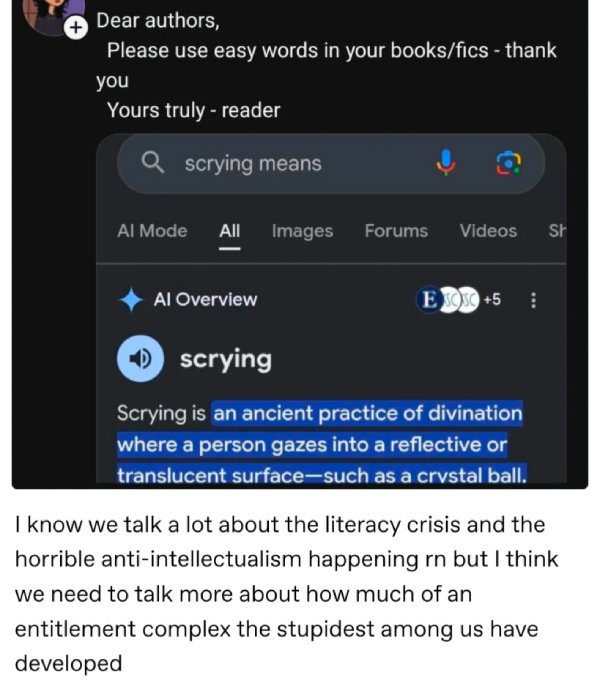
Says a poster on social media “Dear authors, Please use easy words in your books/fics – thank you … Yours truly – reader.” This includes a screen cap of them googling the word “scrying.” In response on another site, a commenter says “I know we talk a lot about the literacy crisis and the horrible anti-intellectualism happening rn but I think we need to talk more about how much of an entitlement complex the stupidest among us have developed.”
Hey commenter managed to insult OP’s sanity and intelligence in the same response, while calling for a global increase in ableist shaming. Pew pew. I’m obliged by the rarity of the position I’ve taken to oppose this, but I can see where the commenter is coming from. We’ve been living through increasingly frustrating times since we kicked off the millennium with the Misunderestimable Dub. And if grammar and vocabulary were stripped of even modest complexity, would reading hold any appeal for the people who can handle that? I don’t think so.
Might be fun to show an example of the improved world of literature OP is advocating:
Fortunato bugged me a lot. I tried to stay calm, but when he insulted me, I promised I’d get revenge. You know I didn’t tell him. It had to be secret. I was definitely gonna get revenge, but I couldn’t get caught. If I was caught it wouldn’t count. Same if he didn’t know I did it.
That’s repellent, but it occurred to me this still might be a good place to do a little disability activism. I’ve said before, I think the average person is far less intelligent than our society expects them to be, and this doesn’t cause them to rise to expectations – it just causes them to live in shame and secrecy. The original poster above seems to have missed out on the shame, but having gone out on this particular limb? It’s bound to find them.
And maybe they have a point. Classics like Cask of Amontillado do have simplified versions available for education, but why not just have simplified versions for people who lose enjoyment searching for definitions every other paragraph? I know they’ve made that wildly easy on e-readers, but bear with me. Should the reader have to be forced into an educational experience?
I know, you’re like, fuck that shit. Look up the word. Learn something. After OP gets burned to ashes over this post, they will never forget what scrying means. But still, what if there are a lot of people who just can’t retain the info of a vocabulary like yours or mine? What if they feel insulted by trying to read a popular book and getting reminded one line after the next about their limitations? Shouldn’t they be allowed to read a book that won’t make them feel bad about themselves?
And without limiting their options, right? The argument you’re naturally going to make here is that the reader shouldn’t be reading anything more advanced than Dr. Seuss if they don’t want to learn about scrying. But that’s precluding them from participating in society in a way that works for them, the same as saying wheelchair users should just deal with the shortage of accessible buildings in life. The buildings where the cool kids go don’t have ramps, but if you are on wheels, you should know your place in the world.
What’s more, making easier to read versions of books is trivially easy. Someone can just run that shit through an LLM and double check the results once, print, job’s a good ‘un. What does it cost us to make any given book more accessible? Not much.
The more complicated question that follows is this: How should this be labeled? The words you use matter a lot in disability activism. Probably this reader doesn’t think of themself as disabled and would feel put upon to get the book “A Court of Thorns and Roses (Simple English).” Single out the version for smart people? She gets aCoTaR and you get aCoTaR (Advanced Readers)?
I don’t know. There’s a tension between the need to accommodate and the need to not lower standards egregiously. Cornish College of the Arts, in Seattle, is an interesting case study in what happens when you let standards go. They had gotten good enough for accreditation right around 2010, and then immediately bent over backwards to make things easier for the slacker-ass rich kids their donors were shitting through the admissions process. Eventually there were no classes in freshman year, just like, bag lunches and finger painting. They went down in flames and their branding was bought by a christian university up the hill. Nellie Cornish has some grave rolling to do.
But I’m inclined to be nice to people who aren’t smart, if they aren’t hurting anyone. I’d accommodate ’em.
–
feel free to water down more examples from literature for amusement in these comments
Book Title
Perspicuous Edition
I think a simple solution is to make definition lookups completely frictionless. With e-reader apps you can highlight a word and immediately get a definition, this already seems pretty good. With an LLM you could probably go a bit further and explain larger stuff like grammar or implication.
I’m sure this isn’t enough for everyone, like I wouldn’t want to read a book in Spanish by laboriously looking up every fourth word. But at that point you probably gotta accept the “Simple English” label.
GPT-5.6 Luna
Here is a short telling in plain words.
In 1918, a man named Delapore came back to England from America. He had been away for many years. He bought an old house called Exham Priory.
The house had once belonged to his family. But long ago, people had driven his family away. They said the family had done very bad things.
Delapore did not care about the old talk. He wanted to live in the house with his son, Edward. He had the house fixed and made it warm and bright. He also brought two cats to live there.
At first, all seemed well. But soon Delapore heard a sound in the walls.
It was the sound of rats.
At night, he heard them run behind the stone. They scratched and bit at the walls. His son heard them too. Workers searched the house, but they could not find a way into the walls.
The sound grew worse. The rats seemed to run from room to room. They moved above the bed. They ran under the floor. They were always close, but no one could see them.
One day, the workers found a hidden room under the house. It had been shut for many years. In the room was an old place of prayer. On the wall was a picture of a man being killed by his own family.
Delapore learned that his family had lived at Exham Priory for a very long time. They had not been good people. They had kept people under the house. They had killed them and eaten them.
For many years, the family had lived on human flesh.
The old house was built above a deep place in the earth. Under it were rooms, stairs, and long dark paths. The paths went down and down.
Delapore could not stop thinking about the rats. He began to hear their sound even when he was far from the house. He slept badly. His mind grew weak.
Then his son Edward began to change.
Edward had always been kind and calm. Now he grew wild. He spoke in his sleep. He said that he could hear the rats. He said they were calling him.
One night, Delapore woke and saw Edward standing near his bed. Edward was not awake. He was looking at the wall.
Then Edward walked out of the room.
Delapore followed him through the house and down into the dark place below. They went through old rooms and narrow paths. At last they came to a huge room deep under the earth.
There, Delapore saw the truth.
The room was full of bones.
The bones were human. Some were old and white. Some were new. Many bodies had been tied to the walls. Some had been cut apart. There were signs that people had been kept there like animals.
The rats lived among the bones.
Edward stood in the middle of the room. His face had changed. He looked like the cruel men who had lived in the house long ago.
He turned toward his father.
Delapore saw that his son had become part of the old family evil. He was going to kill him.
Delapore picked up a heavy piece of wood. He struck Edward again and again. At last, Edward fell dead.
After this, Delapore was taken away. People said he had killed his son without reason. They did not believe his story about the rooms below the house.
While he was held in a place for sick people, he kept speaking of the rats. He said they ran inside the walls. He said they were waiting for him.
The doctors thought his mind was broken.
But one man, a police officer, went back to Exham Priory. He searched below the house. He found the great room, the bones, and the dark paths.
The house was pulled down. The deep place below was closed with stone.
Still, Delapore could not escape the sound.
At night, the rats ran in the walls around him.
They ran closer.
They ran faster.
And he knew that the old evil was not gone.
lol, reminds me of “scary stories to tell in the dark.” and thx for feedback sig.
Comparing it with the Wikipedia article it’s substantially changed the details of the plot, as well as simplifying the language.
well fooey, gpt luna. try harder next time!
It’s a sideways step, but what literature is taught in the UK for O levels (exams usually taken a 16) is being reviewed at the moment and there has been discussion of the fact that virtually the whole existing list of books, plays, and poetry are depressing. So that might be The Strange Case Of Dr Jekyll and Mr Hyde, Macbeth, and WWI poetry say. The argument some are making is that pre-16 all school reading should be for pleasure, while I rather like that idea it does leave those students with somewhat gothy or deeply Romantic hearts adrift
That’s quite a conundrum. How much is literature creative art? How much is it communication?
The author may, probably does, feel that their choice of words/language is important. They may have spent a lot of time looking for the mot juste, When the writing is simplified, that work, and possibly the feeling/meaning intended by the author, may also be lost.
Part of the pleasure in reading Gene Wolfe’s The Book of the New Sun is that he deliberately choses archaic words to convey a sense of deep time. Yes, a friend of mine commented that he was reading it with a dictionary at his side, but he found pleasure in looking up words he was unfamiliar with (not everyone would). A simplified version of The Book of the New Sun would lose that ambiance. I can’t even imagine what a simplified version of Joyce’s Ulysses would be like.
On the other hand, literature is often a school subject and every student is expected to read the texts and understand them. Even students who have no interest or whose reading skill is low. In my day we had cliff-note versions, and even classic comic versions of some of more common literature. I think I recall a classic comic version of The Count of Monte Cristo which distilled the 1000+ page novel into an illustrated 30-page comic book. IIRC, it missed a lot of nuance.
Even well educated readers can miss a lot of nuance in a work. Few readers are well enough versed in Elizabethan culture to understand all the references/jokes in Shakespeare (fewer still are familiar with it in the original Klingon). I know enough to know that I’m missing a lot of references, but I enjoy reading it anyway. I do find Shakespeare on stage easier to understand when it uses a lot of modern English, but is that a simplified version or an update which Shakespeare himself might have written if he was alive today? Theatre is supposed to be understood, so updating the language to improve the audiences comprehension should probably not be seen as simplifying it (if theatre is incomprehensible you might as well call it opera and be done with it), but I’m certain some people would disagree. I know people who argue that the cadence of Elizabethan prose is more important than the substance of the text.
Are translations simplifications or not? Is the highly accessible (i.e. simplified) David Wright prose version of Beowulf better than the (very dense) Howell D. Chickering dual-language verse translation? I’ve read both (many years ago), but only picked up the Chickering when an English teacher noticed and scoffed at my reading the David Wright version. Modern authors often work with their translators so that the sense/style they are trying to create remains. Does an unauthorized, simplified, version deface the author’s work?
At the end of the day, I suppose, this is a personal choice. Someone reading a simplified text could be doing so for a number of reasons, and making a value judgement about any of those reasons doesn’t seem necessary. Communication is imperfect in all mediums, so if the reader misses some of the message because it was simplified that may not be a problem. But even that view is flawed because of the potential of completely misunderstanding the message, or even cases of bad actors who not only simplify but modify the message. All of a sudden, Animal Farm is celebrating the success of the pigs, and not a cautionary tale about power, propaganda, and misplaced trust.
Would you trust Trump to simplify The Hobbit? It would be a eulogy to Smaug. “I knew a dragon, …big dragon, …strong dragon. A dragon who earned a pile of treasure from some dirty, weak, socialist, dwarves….. And those dwarves, you know what they did? They came back with a thief, …those underhanded dwarves did. A real, honest to God, thief. Because they were unhappy with the great deal this dragon made, they wanted to steal the gold back.”
I don’t have any problem with simplifying texts. If that helps people to read and understand them, then it helps expand their knowledge and experience. They may miss nuance, details, and even the beauty which the text contains, but if even a smidgeon of new experience enters their mind, it’s a net positive.
However, just like any wise person does with any translation, or text from another culture, or, in fact, any writing at all, the reader must have the humility to recognize that their understanding of the message from the author may be wrong. Communication is like that, it is necessarily imperfect (see Marshall McLuhan), and the further you are from the source, the more likely the message is garbled. That doesn’t mean the message you got is wrong, only that it may not be the message the author intended (See Kurt Vonnegut in Rodney Dangerfield’s Back to School). We all need to be humble about the knowledge and understanding we have, because it is all imperfect, fragmentary, and subject to revision as we gain more knowledge and understanding. We’ve all been subjected to the jerks who have identified one message from a piece of literature and adamantly proclaim that’s what the author intended to say. These jerks are often called English Teachers (I kid).
Simplifying a text is not a problem. Treating any text as inerrant gospel is.
Reportedly (I couldn’t find it in a brief online search), Henry Luce (founder & publisher of Time magazine, among others) told his writers:
There are plenty of books that are written for beginners and children available to accommodate those who have limited vocabularies or read at a grade school level. The entirety of books don’t need to cater to this demographic. Part of the point of reading literature in the first place is to broaden your mind and learn new words/concepts/cultures/topics/etc.
Lowering standards doesn’t improve literacy as evidenced by someone complaining that they had to look up a word, so they literally complained that books need to not include hard words. Wut?!
Scrying isn’t even a particularly hard word.
[I did wait]
Not every story book is gonna be accessible to everyone. Fact.
Can’t fix reality.
—
Regarding the featured example, the original is not particularly lexically or grammatically complex, so presumably the alleged problem is the subordinate clauses and indirectness and allusiveness and circumlocution.
Example nuance: the narrative mood is dark, tense, and ominous, the rhetorical strategy used by the narrator to the reader is intimate bonhomie.
Why people focus on those first two only eludes me.
Here is the original versus the mocking revision, showing that complexity does not require rare vocabulary or convoluted syntax:
“The thousand injuries of Fortunato I had borne as I best could, but when he ventured upon insult I vowed revenge. You, who so well know the nature of my soul, will not suppose, however, that I gave utterance to a threat. At length I would be avenged; this was a point definitively settled—but the very definitiveness with which it was resolved precluded the idea of risk. I must not only punish but punish with impunity. A wrong is unredressed when retribution overtakes its redresser. It is equally unredressed when the avenger fails to make himself felt as such to him who has done the wrong.”
&
“Fortunato bugged me a lot. I tried to stay calm, but when he insulted me, I promised I’d get revenge. You know I didn’t tell him. It had to be secret. I was definitely gonna get revenge, but I couldn’t get caught. If I was caught it wouldn’t count. Same if he didn’t know I did it.”
My point: much has been lost in that crude adumbration, of which not least is the the esthetic.
—
I put it to the bot:
Me: analytically contrast “You know I didn’t tell him.” with “”You, who so well know the nature of my soul, will not suppose, however, that I gave utterance to a threat.” ” to illustrate what has been lost
Bot: An analytical contrast of these two sentences reveals that the loss is not merely cosmetic; the revision systematically strips out the narrative voice, psychological manipulation, and architectural pacing of the original text.
## 1. Shift in Audience and Relationship
* The Original: “You, who so well know the nature of my soul…”
Montresor uses a highly intense, intimate subordination. He does not just state that the listener has information; he flatters the listener’s deep, almost spiritual understanding of his psyche. This immediately forces the reader into a position of complicity with a madman.
* The Revision: “You know I didn’t tell him.”
The relationship is flattened into a generic, transactional statement of fact. The listener goes from being an intimate confidant to a casual observer.
## 2. The Mechanics of Indirectness vs. Bluntness
* The Original: “…will not suppose, however, that I gave utterance to a threat.”
Poe uses intense circumlocution. Montresor avoids saying “I kept quiet” or “I didn’t warn him.” Instead, he uses the formal “gave utterance to a threat”. This choice of words highlights Montresor’s extreme pride and aristocratic refinement. He treats his upcoming murder not as a street crime, but as a calculated execution that requires flawless etiquette.
* The Revision: “I didn’t tell him.”
By reducing the phrase to a blunt negative verb, the character’s chilling composure vanishes. It reads like a defensive statement made by a schoolchild trying to stay out of trouble, rather than a sociopath outlining a perfect vendetta.
## 3. Structural Pacing and Delay (The Aesthetic Engine)
* The Original: The sentence structure is heavily fragmented by interruptions (“however”) and embedded parentheticals. This creates a slow, deliberate delivery. The syntax itself mimics the character’s cautious, calculated nature—he parses his words with the exact same precision he will use to lay the bricks in the catacombs.
* The Revision: The sentence is a short, rapid injection of monosyllabic words. The rhythmic delay that creates the original’s ominous, lingering atmosphere is entirely gone.
Siggy @3:
I had exactly that in the mid-late 1970s when i was in high school.
I ended up hating Shakespeare thereby.
See, the plays became text, and the text was most heavily laden with footnotes for many (but not all) the terms, wordplay, and allusions.
I used to think “what is the point”? Most of the cleverness and drollishness was lost, as was any topical resonance.
(I got it, years/decades later. They were plays and sonnets embedded in a particular milieu)
FWIW:
Shakespeare was never meant to be read. It’s theater, not literature. We were forced to listen to recordings of Romeo and Juliet, which led to lots of jokes about things being ban-ish-ed.
thanks for the thoughtful comments ye all! value added to my half-baked theses yet again
good lord a truckload of hogwash appeared somewhere in the neighborhood. i’ll have to look into that at some point.
[I saw that]
Quite the ironic claim from someone who has comments disabled.
@15, Tethys,
Oh, I agree. Shakespeare is best performed. But I’ve seen a number of performances where the actors not only read the lines in a rush, they also include their own interpretation of an Elizabethan accent. There have been a few times that I’ve been glad that I’ve read Dogberry’s lines from Much Ado About Nothing because my midwestern ear couldn’t distinguish one word of what the actor is saying (Michael Keaton springs to mind). Certainly it’s my listening skills which are probably at fault, but I am still missing out on the performance.
Which is why I don’t mind if the director decides to allow a more modern delivery or even adjusts a few words to keep the sense the same for a modern audience.
The clip Morales posted @14 was interesting. I’ve known for years that a jakes was an English slang term for a bathroom, but I would never have guessed that Ajax might have been pronounced as “A Jakes” in Elizabethan times. I don’t feel like I have been missing out. I got what I could at the time. The fact that the next time I see (if ever) Troilus and Cressida I’ll know a little bit more just adds to the enjoyment. I believe that I still have a lot to learn about every subject and that does not dismay me, it fills me with eagerness to learn more.
John Morales #18
Seriously?
Have you lost the link you posted to his comment section?
Ironic.
he’s right that’s a barrier to entry that speaks to someone shying away from open discourse, whatever the case.
chigau, I discussed that with him years ago. He also has an email address.
The post from which i specifically quoted, of course, is like every other post but that ‘open’ one.
One can for oneself see how much he likes to engage.
(I can’t lose what I never kept, by the way)
Point is, he’s passive-aggressively whining about not being given a forum here, in the comments.
Like only the Olympians (bloggers) can have a dialog, and that via blog posts.
(I am not clueless, you know)
My knee-jerk response would have been “why wouldn’t the text-heavy nature of the internet have increased literacy, tho?” as a semi-rhetorical question, knowing that it hasn’t. Though thinking through that a bit, I realized that I’m biased here. You don’t need to be especially literate to be on Facebook or Instagram or X or any of the other major social media sites, unless you go out of your way to follow people who use big words and/or complex language. Likewise, there are video-heavy and audio-heavy portions of the internet, much of which is dumbed-down (or just dumb). I just happen to be more on the text-heavy and more intellectual sides of it. Maybe during the 2000s when social media was less of a thing and video barely existed, but more likely people who were less literate simply interacted with it in less substantial ways.
Maybe rather than “translated for a less-literate audience” (though there’s certainly a place for that) we should have ratings for literacy level, in a similar fashion of how videos have age ratings? It might be difficult to do that without stigmatizing low literacy levels, but it’s a possibility.