
This is Thunderdome, the unmoderated open thread on Pharyngula. Say what you want, how you want.
Status: UNMODERATED; Previous thread

This is Thunderdome, the unmoderated open thread on Pharyngula. Say what you want, how you want.
Status: UNMODERATED; Previous thread

I’m sure you’ve all heard the tragic story of Amanda Todd, the teenage girl who killed herself after prolonged bullying. Normal human beings will read about her and be near tears; she was broken by callous sexual predators, her life made miserable, and she finally gave up on it.
The Amazing Atheist is not a normal human being.
Instead, The Amazing Atheist raged at the fact that this young woman was getting attention when other people have died, too. She was a well-off Western girl with plenty of privileges, so how dare we consider her story particularly tragic? There are so many other people who are worse off than she was!
Well, you know, we have a couple of choices in our lives.
We could, for instance, search the world for that one person who is in the worst circumstances of anyone; the person who is suffering the very most right now. We can do this while turning up our nose at each other afflicted individual who isn’t hurting enough for our standards; why, you’re a quadriplegic dying in a ditch? But you don’t have shingles! And both your eyes are intact! I’m sure we can find someone worse off than you. And then when we find that ultimate person in pain, we can promise to do everything we can to help them.
But I’ve noticed that people who make that kind of argument aren’t actually offering to help anyone. Their perversely inverted, demanding standards are really an excuse to turn away from the miserable they consider undeserving, to justify refusing to help…because that ultimate sufferer will never be found.
But you do have a choice. The other thing you could do is recognize deep pain in others and do what you can to help them. If one person had sincerely and honestly turned to Todd when she was being abused, and offered to help, maybe she’d still be here, and the world would be a slightly better place.
She wasn’t asking for much.

The Amazing Atheist begrudges her that much.
I don’t see any difference between him and the bullies who beat her up and mocked her on facebook and poured scorn on her in school.
And some people wonder why there is a growing rift in the atheist movement. All you have to do is look at people like the Amazing Atheist to see that some atheists, people who are convinced that there is nothing beyond ourselves, that we are dependent entirely on our fellow human beings and nothing more, lack that humanity that is our only source of unity and our only true reason for living.
Don’t be surprised that some of us want nothing to do with such sociopaths.

You know, this happens every time. I post something like that letter about ducks and evolution, and the cry goes up: “POE! POE! POE! Nobody could be that stupid!”.
Ladies and gentlemen, I give you…Todd Akin.
I’ve taken a look at both sides of the thing [evolution] and it seems to me that evolution takes a tremendous amount of faith To have all of the sudden all the different things that have to be lined up to create something as sophisticated as life, it takes a lot of faith.
I don’t see it as even a matter of science because I don’t know that you can prove one or the other. That’s one of those things. We can talk about theology and all of those other things but I’m basically concerned about, you’ve got a choice between Claire McCaskill and myself.
I could also give you Paul Broun. Or Bobby Jindal. Or Michele Bachmann.
Do you people know any creationists well enough to sit down and have a conversation with them? I guarantee you, bizarre illogical babbling about duck monogamy justifying anti-gay laws are the least of the inanity you’ll hear. When the country is electing flaming idiots to high office, it’s silly to argue that miseducated 14 year old girls couldn’t possibly believe in nonsense.

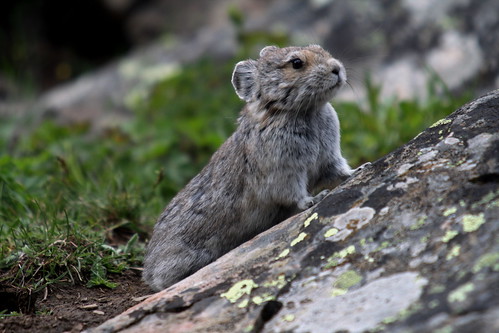
Any excuse to post a photo of a pika is a good one.
This is interesting: a new paper in Science purports to chart the cost of protecting what’s left of the world’s biodiversity, and the figure seems be eliciting gasps:
We estimate the cost of reducing the extinction risk of all globally threatened bird species (by ≥1 IUCN Red List category) to be US$0.875-1.23 billion annually over the next decade, of which 12% is currently funded. Incorporating threatened non-avian species increases this total to US$3.41-$4.76 billion annually. We estimate that protecting and effectively managing all terrestrial sites of global avian conservation significance (11,731 Important Bird Areas) would cost US$65.1 billion annually. Adding sites for other taxa increases this to US$76.1 billion annually. Meeting these targets will require conservation funding to increase by at least an order of magnitude.
I haven’t taken a look at the methodology, what with being on the wrong side of the JSTOR Curtain, but a reviewer quoted by Daniel Cressey in Nature’s article on the paper has said the work seems “smart,” though he does point out that its scope is limited.
Henrique Pereira, who works on international conservation issues at the University of Lisbon in Portugal, says that although there are uncertainties inherent in extrapolating from birds to all species, the work is an “extremely smart paper”. “For the first time we have an estimate of how much these targets will cost,” he says. “For any negotiations that occur over the next few years [on CBD targets], these numbers can be used as a reference.” But Pereira also points out that the figure is for just two of the 20 targets agreed by the CBD. “If you look at the range of targets for 2020, the total bill will be higher,” he says.
If the paper’s emphasis is on protecting habitat, as the abstract and the Nature coverage seems to indicate, then there are a few issues unaccounted for. The North American pika, for instance, is in trouble — and not because its habitat isn’t legally protected. Of course in the absence of a copy of the full paper I really can’t do anything but armwave on its possible limitations. [Edit: I now have a copy. thanks!]
But writer Daniel Cressey’s angle on the $76 billion figure in his news piece in Nature is interesting. His lede:
Protecting all the world’s threatened species will cost around US$4 billion a year…. If that number is not staggering enough, the scientists behind the work also report that effectively conserving the significant areas these species live in could rack up a bill of more than $76 billion a year.
Cressey does include a quote from study leader Stuart Butchart mentioning what we get back from protecting that biodiversity, including things like pollination services (estimated at $2 billion) and carbon sequestration ($6 billion), Butchart also mentions that $76 billion isn’t a huge amount given what we as a species spend on other things.
An example: the world plowed $1.74 trillion into military expenditures in 2011, according to the Stockholm International Peace Research Institute. $76 billion is a scoche more than 4% of that.
Or, for a less obvious example, $76 billion spent worldwide to conserve biodiversity is a significantly lower amount than tourists spent in California in 2011, according to one estimate. A person with access to surveys could tease out how much of that gross income would disappear if California lost its biodiversity; at least some of those tourists came to see the redwoods and the Joshua trees.

Some poor young girl, deeply miseducated and misled, wrote into a newspaper with a letter trying to denounce homosexuality with a bad historical and biological argument. She’s only 14, and her brain has already been poisoned by the cranks and liars in her own family…it’s very sad. Here’s the letter — I will say, it’s a very creative argument that would be far more entertaining if it weren’t wrong in every particular.

I’ve transcribed it below. I couldn’t help myself, though, and had to, um, annotate it a bit.
