Students are smarter than the administrators give them credit for

The FDA is about to approve the Pfizer vaccine, which is good news. The timid beancounters who run this place had announced that they were just waiting for that final bureaucratic hurdle was cleared to declare that vaccination was required to enroll, a silly piece of posing by a bunch of people who have all been vaccinated for weeks to months already. We were supposed to wait for a box to be ticked on a form before making common sense requirements to protect student health? That’s nuts. It’s also been frustrating.

Other universities have already been requiring it, without that legalistic seal of approval, like U-Va. Here’s what I found interesting in that story:

The campus unveiled its vaccine mandate in May and the overwhelming majority of the campus is in compliance, officials said. More than 96 percent of U-Va. students are vaccinated against the coronavirus and 335 students with religious and medical exemptions have been granted permanent waivers, officials said.

An additional 184 temporary waivers were granted to students who have had trouble getting vaccinated but plan to get their shots upon arriving to campus.

Less than 1 percent of students enrolled — or 238 students — are not in compliance, “but only 49 of those students had actually selected courses, meaning that a good number of the remaining 189 may not have been planning to return to the university this fall at all, regardless of our vaccination policy,” said Brian Coy, a school spokesman.

First, a religious exemption? Why? Prayer is not protection. Piety is not an excuse to be a superspreader. I support the medical exemption — some students are immuno-challenged, for instance — but anything else is pandering nonsense.

But secondly, look at those numbers. While the administration has been wringing their hands and moaning about how we shouldn’t impose barriers to students coming to campus, the students have been smart and sensible and getting off their butts and getting vaccinated as soon as they could. I’m confident that UMM students are just as competent as U-Va students, and we’re going to find next week, when classes start, that the overwhelming majority are going to want the precautions, like masking and vaccine requirements, so they can protect their health while getting the education they need. I suspect the hesitation from on high is driven entirely by Republican assholes in the legislature with power over our budgets.

That peculiar plural

There’s a quirk in creationist talk that has long been a tell. The say “evidences” instead of “evidence”, despite the fact that “evidence” is already plural. It’s not a big deal — Doug Theobald documented cases where serious scholars also used “evidences” — it’s just an odd affectation, maybe a holdover from theological writings, but it’s useful when you hear it because it’s a quick clue that you’re dealing with someone with an unusual background. Eugenie Scott even claimed “The only people who use ‘evidences’ (plural) are creationists or people who have spent far too much time reading their literature! ‘Evidences’ is a term from Christian apologetics …”, which isn’t quite true, but it’s a fine approximation.

So I was curious when Michael Harriot brought up another unusual plural used by a specific subset of people: “freedoms.

Whenever unshowered Americans are confronted with something they don’t want to do, they immediately begin blabbering about their “freedoms.” It’s like the “race card” for white people. While you and I know that the word “freedom” only makes one appearance in the Constitution, apparently there’s a second Caucasian Constitution that I haven’t seen that clarifies this murky terrain.

As you can see, it doesn’t even have to make sense. More importantly, they will never say exactly which specific freedom they are talking about. They won’t cite a specific law or clause in the Constitution that supports their position. That’s because there isn’t one.

Inserting “freedoms” into a random sentence makes one seem more patriotic, like randomly mentioning “the troops.” Basically, “freedoms” is a conservative dog whistle used to justify police brutality, pro-gun legislation and even blackballing Colin Kaepernick.

Weird. Now I’m suddenly seeing it everywhere, used almost exclusively by conservatives to, in some way, amplify the size of the affront to their privilege, and also to put themselves on a safely vague footing. They can’t say their “freedom” is being taken away, since they aren’t going to jail and don’t even seem to suffer any consequences, but putting that “s” on the end somehow implies a numerous and unspecified set of privileges are being taken from them. It’s a useful rhetorical trick, I guess.

And that’s exactly what creationists want to do, too — wave vaguely at some mysterious set of facts that they don’t have to detail.

I guess they possess great wisdoms and cunnings.

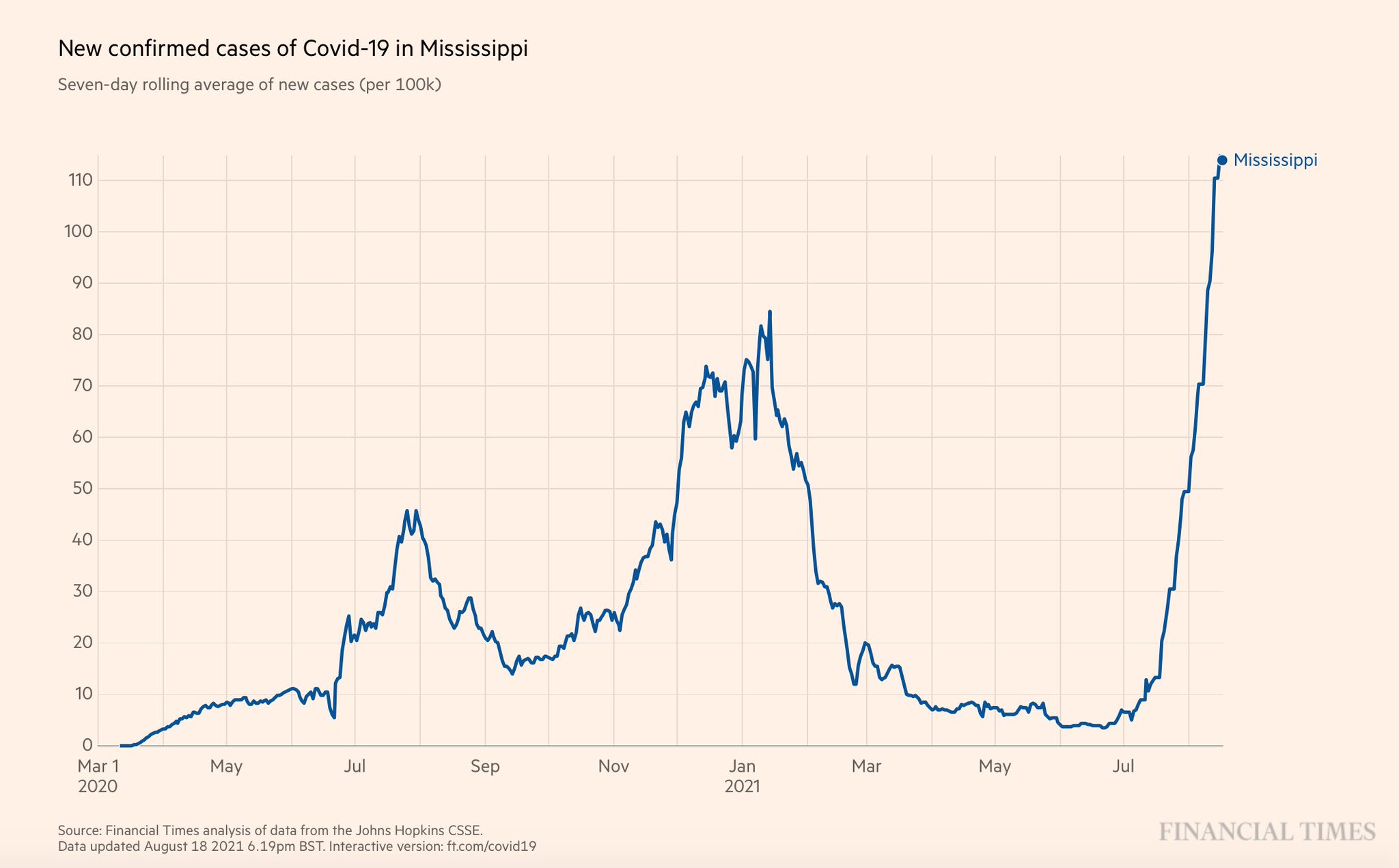
Look at Mississippi go!

Impressive statistics.

Remember how that slow rise in frequency back in March 2020 convinced all the universities to shut down and go entirely to online instruction? Good times.

Then how we went through that shocking peak in the summer of 2020, but that it started to show signs of a decline, so the universities all said, “Great! Back to school with masks and social distancing!”, despite the fact that it didn’t drop below the levels that shut everyone down in the spring? There’s something interesting going on in human psychology going on there.

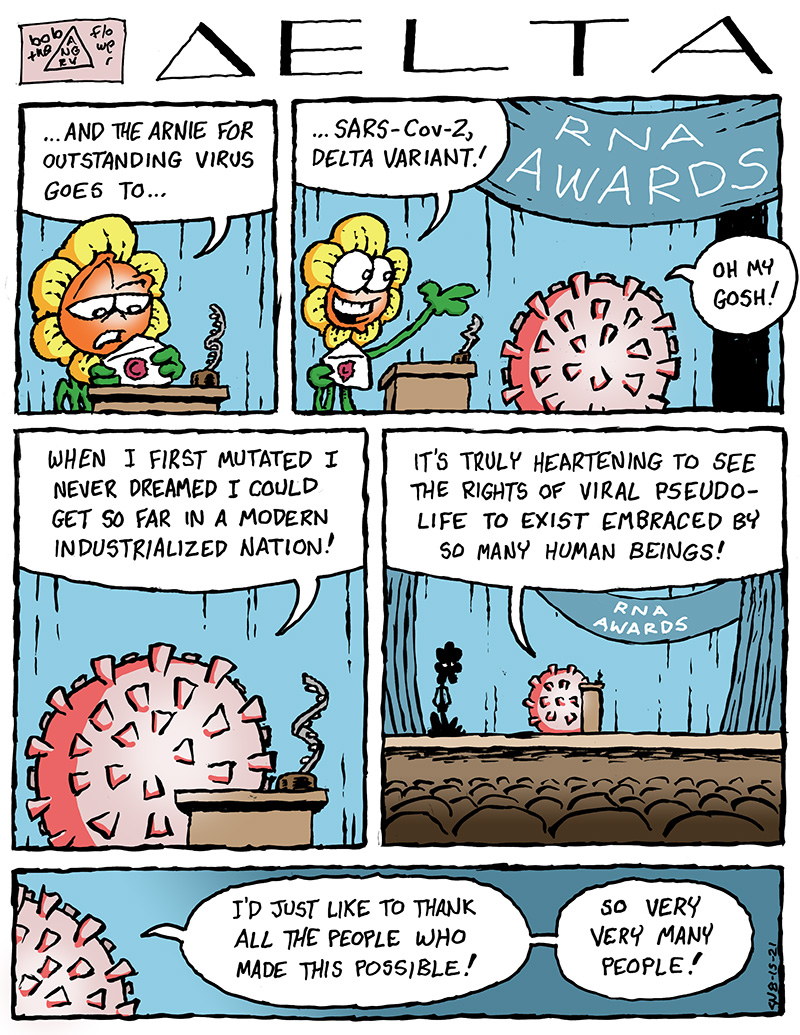
We got an even greater surge in the winter of 2021, but then we got the vaccine, and cases started to plummet, and we all got cocky and figured we got this licked, so the universities start planning to remove all the preventive measures they’d put in place, didn’t even consider requiring vaccination, but a significant proportion of the citizenry have somehow decided vaccines are bad, and then along came Delta.

And that’s how we get Mississippi in August of 2021.

Look at that graph: oscillations, with the peak getting higher each time. Every time numbers start to decline, we slack off so they come roaring back, worse and worse. You’d think someone at some point would realize that this says we’re losing, that the occasional breathers are just setting us up for a rebound. It’s like we have only a three month window of collective memory, only remembering the improvement in spring of 2021, while completely forgetting the peak in January.

Shut down Facebook, please

It’s a nightmare already. Where do the hapless goobers among our citizenry get their bad ideas? Facebook. The whole damn company is an engine of disinformation, and it wants to grow, like some kind of cancerous tumor. The latest great idea to come out of Zuckerberg’s stinking maw is an implementation of the metaverse. Sounds like it could be fun, right? If you grew up on Snow Crash and Jennifer Government and Ready Player One and failed to notice that those are all horrific dystopias. Zuckerberg read them and saw his future dream. He’s been putting together his version of the metaverse, or zuckerverse, or suckerverse, and some have seen it.

First floated in Neal Stephenson’s 1992 sci-fi novel Snow Crash, the Metaverse is an idealised immersive successor of the internet – a virtual space where billions of users will move, interact, and operate across myriad different but interoperable worlds and situations, always retaining their avatar identities, virtual possessions, and digital currencies. It is hard to pin the Metaverse down (more on this later), but the shape one can make out amid the cyberpunk mist is some version of Ernest Cline’s novel Ready Player One meets Fortnite, meets virtual reality, meets blockchain. A game-y galaxy that seamlessly fuses with the Meatspace. What matters is that Metaverse is now the buzzword du jour, and that Facebook wants a piece of it. The bad news is that Zuckerberg’s Metaverse ambitions sound boring as hell.

Time and again over the interview, Zuckerberg dropped language that seemed to have been cribbed straight out of some stuffy consultancy’s 40-page insights report. He waxed lyrical about the Metaverse’s ability to increase “f​​ocus time and individual productivity”. He coined the dreary formula “infinite office”, a supposedly desirable scenario in which Metaverse-dwellers conjure up multiple virtual screens on their Oculus VR headsets in order to multitask like pros. Zuck was “excit[ed]” (!) about the Metaverse’s potential for organising VR office meetings.

If anyone could make Zoom meetings worse, it’s Zuckerberg, the dead-eyed corporate zombie. It can’t be that bad, you might think, but then you just have recall the wasteland of ads and trolls and endless lies that he turned a social service to connect friends into. Or if you don’t believe that, see for yourself what the metaverse will look like if Facebook has its way.

Oh hell no.

You know, while Facebook is working hard on the VR interface that Satan will love, a right wing terrorist drove up to Washington DC with a truckload of, he claims, potassium nitrate and detonators, and parked by the Library of Congress, demanding to speak to President Biden, or he was going to blow everything up. The Capitol has been evacuated. He has been live-streaming his threats and rants over Facebook.

It has taken Facebook three hours to notice and shut him down.

That’s a rapid response from the company that has allowed fascists, quacks, conspiracy theorists, and anti-vaxxers to thrive for over a decade. They will not get better. This is what they do: provide a profit-making forum for the very worst, most sensationalist ideas, so don’t wait for them to do anything that might harm the bottom line.

We’re going to have to do something. The good news is that the FTC has reopened their antitrust case against Facebook.

“Facebook lacked the business acumen and technical talent to survive the transition to mobile. After failing to compete with new innovators, Facebook illegally bought or buried them when their popularity became an existential threat,” said Holly Vedova, Acting Director of the FTC’s Bureau of Competition.

Facebook did not immediately respond to request for comment, but the company said on Twitter that it was reviewing the case.

The filing is also the most high-profile action to date under the agency’s new Democratic majority, helmed by Big Tech critic Lina Khan. Khan inherited the Facebook case from the previous Trump-appointed chair, but her ability to see it to a successful conclusion could define her legacy as an antitrust enforcer.

Burn them down, please. And then nationalize a simple communications service that allows me to chat to family and friends without having to wade through the offensive glop the kooks flood everyone with.

A libertarian perspective on science funding

What a bizarre Twitter conversation. I have stirred up the Aubrey de Grey cultists who have been arguing at me that de Grey and his SENS foundation are doing great work and must be supported. When I ask why, there’s one point they constantly bring up: he recently got $25 million dollars of funding! Therefore, it must be worthy work.

If he’d received funding from NIH, then yeah, I’d be predisposed to suspect that there must be some core ideas that survived peer review by qualified scientists (peer review is not perfect, I hasten to add…it’s just better than no peer review). However, that $25 million came from some cryptocurrency donations called “Pulse Chain Airdrop, whatever that is, not scientific review, and all of the funding is coming from wealthy donors who have no scientific qualifications at all. So they’re trying to tell me that it is an unmitigated good that billionaires are supporting science — my concern is that this is about billionaires dictating what science gets done.

And then, this jaw-dropping statement:

As long as the scientists being paid to do the research are capable and knowledgeable, the scientific literacy of the funders themselves are pretty irrelevant.

Also realistically, the funders likely do understand the research on a basic level, otherwise, why would they find it?

Two points:

Scientists aren’t employees being paid to achieve a specific goal by a wealthy patron. This is a disastrous approach to funding science, especially since they admit that the scientific literacy of the people holding the purse strings is irrelevant. Right now science funding is weakly isolated from the ignorant with power; congress gives a block of money to scientific institutions that then determine by peer review how it is disbursed. Relying on authoritarian rich people to decide what science is worth pursuing is a huge step backwards.

I doubt the funders actually understand the research. Why would they fund it? Because some charismatic gomer promises them that their money will work to help them live forever. They don’t know how, but the con artists are good at babbling sciencey words. It is such a naive assumption that rich people only spend money on things they understand at a “basic level”, especially when you realize that Jeff Bezos is rumored to own a $400 million dollar yacht (at least, someone owns that beast). $25 million is a crumb, and for that, we want to allow billionaires to dictate what science should be done?

I think I spy a libertarian non-scientist who thinks expertise is irrelevant.

It begins

Last night was a bad night — I’m feeling rather battered and my face is sore. Where did they insert that endoscope again? Oh, right, there were some minor problems with anesthesia so I got manhandled a bit while unconscious. I’m feeling it. Bottom half is doing great, but the top half, back and face, were run through a mangler. The aches are already easing up, though, so I’m not worried about it.

I was also advised to go gently on meals, despite being ravenous. I was a good boy yesterday, so it was nothing but soup and toast. There are still strange rumblings and squelchy noises coming out of my guts, so that was a wise decision, but today I surrendered to my hunger and started the day with a mushroom omelette and giant cup of coffee. That should help.

Feeling better already, except…the university has begun its ominous slouch towards opening. Yesterday was the official opening convocation, which I missed for obvious reasons, but today begins with a two hour division meeting (we’re going to talk about budgets and assessment and other such minutiæ ; strangely, there is nothing on the agenda about the pandemic challenges we have to face), followed by a one hour biology discipline meeting, followed by me having to spend some time finishing the genetics lab cleanup so the next lab class can move in for the Fall.

Then I’d better get those class syllabi out to the students. I meet with my new advisees on Monday. They better be wearing masks!

So far, it looks like this school year is starting with an assumption of total normalcy, while ominous horror-movie music has begun rising in my head, and I just know we’re going to reach a crescendo with screeching violins next month. No way am I going to split up and go into the basement in the coming month.

I yet live

Colonoscopy done. All is normal. Feeling woozy from the propofol, may just take a nap.


Except there is one emergent side effect. The nurse warned me afterwards that there’d been one small hiccup: I stopped breathing.I guess that happens with propofol, and that’s one reason there’s an anesthesiologist present at all times. He got my breathing restarted, but had to clear my airways, and that involved grabbing my lower jaw firmly at the base and strongly pulling upwards. I was in no real danger, but the nurse cautioned me that I might be feeling some aches.

Boy, was she right. My jaw and upper back are just wrecked right now, and I’m ruined for even the easy work of sitting at the computer for a while. I think I’m going to have to lie down for a while.

But thanks, Anesthesiologist Jacob, I think I’d prefer some temporary joint aches over not breathing for an hour.

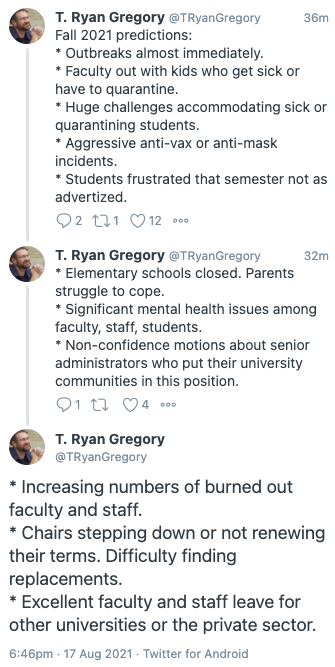
T. Ryan Gregory predicts the future!

This is my prediction, too. I have no confidence that we’ll make it through the semester without some radical revision in our plans.

I’ll testify to the burnout problem personally — the stress and uncertainty take their toll. Also, the declining confidence in university administrations is real.

Gregory, by the way, has announced that he’s on the market for a new position already, so if you’re at a university that isn’t saddled with an out-of-touch, blithering administration (are there such things) you might be able to snap him up.