As usual, First Dog on the Moon scores.
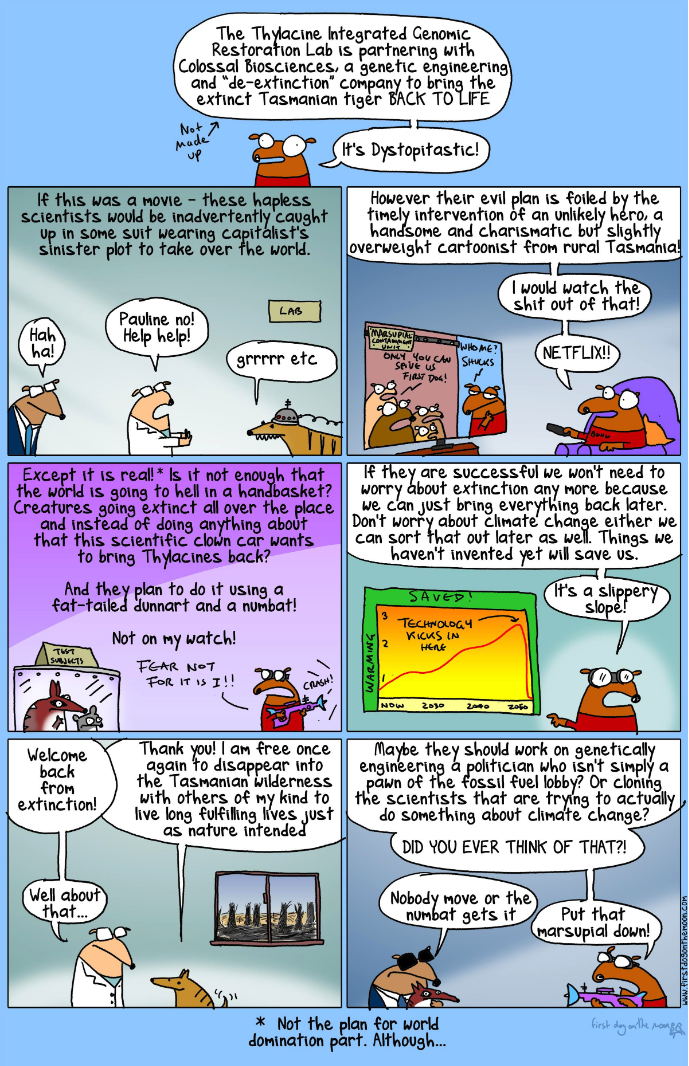
Oh yeah. This again. Some molecular biologists with no training in population genetics or ethics think they can go into a lab and resurrect an extinct species.
Almost 100 years after its extinction, the Tasmanian tiger may live once again. Scientists want to resurrect the striped carnivorous marsupial, officially known as a thylacine, which used to roam the Australian bush.
The ambitious project will harness advances in genetics, ancient DNA retrieval and artificial reproduction to bring back the animal.
They won’t succeed. At best, they’ll assemble a maladapted hybrid something or other to be exhibited in some freak show of a zoo. It won’t be a thylacine, it’ll be a Frankenstein’s monster of an extant marsupial with no home environment and no prospects for the future and no population of conspecifics with which to live and no history. So much bugs me about this story.
They talk about “the thylacine genome”. There’s no such thing. A living population has many genomes. How many individuals are they sampling? How many individuals will they generate? Where will they live? These are carnivores — what will they feed on? Or are they just planning on conjuring up a technology demonstration that they’ll put in a cage and then move on to some other “project”?
They make a token nod towards the problem of extinctions, but aren’t very convincing.
“We would strongly advocate that first and foremost we need to protect our biodiversity from further extinctions, but unfortunately we are not seeing a slowing down in species loss,” said Andrew Pask, a professor at the University of Melbourne and head of its Thylacine Integrated Genetic Restoration Research Lab, who is leading the initiative.
“This technology offers a chance to correct this and could be applied in exceptional circumstances where cornerstone species have been lost,” he added.
No, it won’t accomplish any of that. The species is extinct because their habitat is destroyed and people killed them. That’s where you start, by rebuilding their environment, not with PCR machines and microinjection apparatus and flasks in incubators. It’s no surprise who is behind this: a guy with impressive credentials in molecular biology who thinks every problem is a lab exercise.
The project is a collaboration with Colossal Biosciences, founded by tech entrepreneur Ben Lamm and Harvard Medical School geneticist George Church, who are working on an equally ambitious, if not bolder, $15 million project to bring back the woolly mammoth in an altered form.
Yeah, right. He was claiming that he’d be bringing back the mammoth within two years…five years ago. He was also working on a dating app to eliminate genetic diseases (I guess he never heard of eugenics?).
A geneticist at Harvard Medical School is working on a dating app that matches users based on their DNA. The goal: to eliminate all genetic diseases. @60Minutes reports, tonight https://t.co/H3cLE2McsX pic.twitter.com/xEAVrtNFEl
— CBS News (@CBSNews) December 8, 2019
Church has also speculated about resurrecting Neandertals. Nope. Not going to happen. If his thoughts on these matters were more than a millimeter deep, he wouldn’t be jumping onto high profile media to promote these sci-fi fantasies. It’s bad science.