Happy news from Kentucky

It’s sad to be leaving Skepticon, one of the best conferences around, especially since my time in Springfield had to be so brief this time around. Also, I think I broke some of the audience with my talk this year (comments afterwards: “You made my brain hurt.” “I didn’t understand anything you said, but I enjoyed it anyway.” “Rebecca Watson’s talk had more sex in it.”) But I do have happy news to report.

The Creation Museum in Petersburg, Ky., created quite an uproar in 2007 when it opened with exhibits showing early humans co-existing with dinosaurs. Five years later, the public fascination with that take on paleoanthropology seems to be fading.

This week, the museum told CityBeat that attendance for the year ended June 30 came to 254,074. That amounts to a 10 percent drop from last year’s 282,000 and is the museum’s fourth straight year of declining attendance and its lowest annual attendance yet. The $27 million museum drew 404,000 in its first year and just over 300,000 each of the next two.

Also, Answers in Genesis reported a net loss in 2011! I’ve mentioned before that their fund-raising to build the Ark Park is also stalling out. I don’t expect them to completely collapse and fold up, but I think they will follow the trajectory of most of the creation “museums” I’ve seen: they go static and dead and dusty, repeating the same stories over and over again, and the likelihood of repeat visits begins to fade away. The lack of substance tells; they lack the dynamism of real working museums and can’t bring up new data or substantively new exhibits.

They say the Creation “Museum” is still operating at a profit, but that profit is declining year by year. And if AiG itself is losing money, think about the consequences when their great big expensive-to-maintain-and-operate facility stops being a cash cow and becomes the dinosaur they’ve been saddled with — it could get interesting.

It may not be possible to underestimate the intelligence of the American public, but it’s still possible to bore them.

Around FtB

This is an easy one.

So…where are you? There will be a Freethoughtblogs party at the Farmer’s Gastropub in Springfield, Missouri tonight, stop by and say hello.

Oh, you aren’t in Missouri? You can watch the live stream instead.

Math keeps interfering with the Republican rationale

It’s like math has a liberal bias. One of the current common tropes from the people making excuses for Romney’s loss is that it was Hurricane Sandy’s fault: it broke Romney’s momentum, it gave an unfair advantage to the incumbent, it discouraged Republican voters.

Oops. Data!

No wonder they usually seek comfort in fantasy and lies. The truth hurts.

Learn your neuroanatomy lingo

Go study this and master the vocabulary. Everyone is so familiar with our brains with their parietal lobes and sulci and ganglia, but do people ever stop to contemplate the cephalopod brain? Nooooo. And it’s pretty cool.

Possibly the most obvious difference is that the nervous system of most invertebrates develops ventrally, rather than dorsally, like ours. Imagine that your nervous system formed on the other side of your throat, so that as the brain expanded, it had to wrap itself around your esophagus.

In which I join Michael Shermer in disagreeing with Jerry Coyne, and Coyne in disagreeing with Shermer

Although, to be fair, I think we’re mostly in agreement but talking past one another because of our prioritizing of certain premises.

Michael Shermer thinks that “the most any natural science could ever discover in the way of a deity would be a natural intelligence sufficiently advanced to be god-like but still within the realm of the natural world.”; Jerry Coyne claims that there could be, in principle, evidence for a supernatural god — there just isn’t.

My position is that we cannot find evidence for a god, that the God Hypothesis is invalid and unacceptable, because “god” is an incoherent concept that has not been defined. I could claim that a spumboodle exists, for instance, and we could go around and around with you presenting hypothetical examples and listing potential entities or forces that are spumboodles, but we’ll get nowhere if I never tell you what the heck a spumboodle is or what it does or even how I recognize a spumboodle. Without that, the whole concept is untestable and unverifiable. It really doesn’t count if I insist that something undefined exists, and then keep jiggling between vague realities (it exists in our dimension! It has a color!) and contradictory guesswork (it’s transdimensional! And completely invisible!) designed to keep moving the spumboodle away from any possibility of honest evaluation.

Coyne accepts the wobble. On the one hand, he is insisting on general principle in the possibility of existence of a divine being (I think a clear and unambiguous definition of “divine” is a prerequisite for that), but on the other he’s willing to substitute a mundane creature with only unexplainable abilities for “divine”.

Well, yes, we wouldn’t know whether a divine being was absolutely omniscient and omnipotent, or relatively more omniscient or omnipotent than us. But if the degree of, say, omnipotence and omniscience is sufficiently large (i.e, any miracle can be worked, all things can be foretold), then I think we can say provisionally that there is a God. I’ve previously described the kind of evidence that I’d provisionally accept for a divine being, including messages written in our DNA or in a pattern of stars, the reappearance of Jesus on earth in a way that is well documented and convincing to scientists, along with the ability of this returned Jesus to do things like heal amputees. Alternatively, maybe only the prayers of Catholics get answered, and the prayers of Muslims, Jews, and other Christians, don’t.

Yes, maybe aliens could do that, and maybe it would be an alien trick to imitate Jesus (combined with an advanced technology that could regrow limbs), but so what? I see no problem with provisionally calling such a being “God”—particularly if it comports with traditional religious belief—until proven otherwise. What I can say is “this looks like God, but we should try to find out more. In the meantime, I’ll provisionally accept it.” That, of course, depends on there being a plethora of evidence. As we all know, there isn’t.

And that’s where he loses me. What does it mean to be relatively omniscient or omnipotent? If our criterion is that the being has to be a certain amount more powerful than us to be defined as a god, what is that amount? The sun is much larger than us, and has far more power than we do…is it a god? Or will that suggestion be met by the sudden appearance of additional criteria to constantly exclude all entities from consideration that don’t also meet certain unstated requirements?

What I want is something like the Higgs boson: a description of a set of properties, inferred and observed, that can be used as a reasonable boundary for identifying the phenomenon. If you’re going to dignify it with the term “hypothesis”, there ought to be some little bit of substance there, even if it’s speculative. The god proponents can’t even do that. God beliefs are remarkably specific — belief in Jesus as an admission ticket to paradise, for instance — but somehow, when it gets down to saying who, what, where, when, and why, they all fly to pieces, and when it comes to saying how they know of its existence, all goes silent, or subsides into ritualistic repetitious chanting of words from a holy book.

The only way to win this game is to not play. Don’t concede the possibility that X might exist unless you’ve got clear criteria for defining the bounds of X’s existence, and it’s up to the advocates for X to provide that basic foundation. If they can’t do that, reject the whole mess before you brain gets sucked into a twisty morass of convoluted theological BS.

(By the way, I do agree with Coyne on one thing: I also reject Shermer’s a priori commitment to methodological naturalism. If a source outside the bounds of what modern science considers the limits of natural phenomena is having an observable effect, we should take its existence into account. If Catholic prayers actually affected medical outcomes, we shouldn’t reject it out of hand because of the possibility of a supernatural source. But it’s still not evidence for a god, unless you’re going to commit to defining god as a force that responds to remote invocation via standard Catholic ritual chants by increasing healing…in which case god becomes something we can disprove, and also faces the prospect of consolidation with other phenomena. Maybe god becomes the placebo response, for instance, in which case he’s been reduced to something feeble.)

‘Tis the season

Halloween is over, and you know what that means: it’s time to start peddling stuff for the Christmas season, and it’s also time to start up the War on Christmas again. You can do both at the same time!

Last year, we created the Happy Monkey greeting card set. You can still get them! And you should get them soon, because you don’t want to leave all your postal obligations dangling until the last minute, and risk Aunt Gladys getting her Happy Monkey card on New Year’s Eve, meaning that she spent all of Christmas dinner glaring at you for your neglect.

But this year, we are dialing the knob up several notches beyond Monkey, all the way up to Squid. Yes, it’s true: you can now confound and confuse and conniptulate your relatives by sending them Squidmas cards. Also, they’re adorable.

And if that’s not enough, remember that the Pharyngula store has plenty of baffling geegaws to stuff into Squidmas stockings.

What? You can just get a blog post published in a journal?

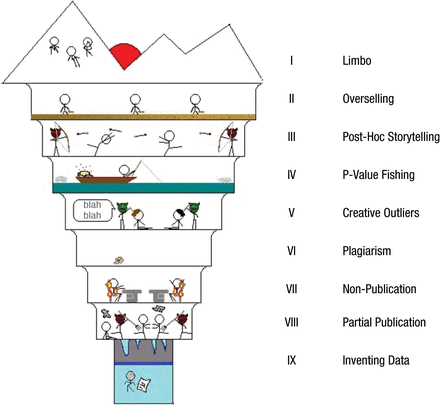
Especially a paper about scientific fraud that uses this clever figure? (It’s short and openly accessible, go ahead and read it.)

I’m envious. But then, it is a pretty good summary of the kinds of wickedness some scientists are up to. I’d have to put a few of the scientists in the ENCODE consortium in level II, and evolutionary psychology is definitely condemned to level III.

It’s titled the nine circles of scientific hell, so sorry, creationists don’t even register.