Frontiers in taxonomy

There are days when having a glass desk is a serious health hazard, because I run the risk of serious facial lacerations when I read certain things.

Take this extremely well-intended article at Care2.com:

Human-accelerated climate change is a disaster waiting to happen. We’ve already seen the superstorms and drought it can create. Although we can work to slow climate change, there’s no way to stop it completely. This reality means adaptation will once again become the most important strategy for survival.

One thing’s for sure: the Earth will continue to exist as it has for eons. The question is, what will be left behind to inhabit it? Below are five species known for their resilience and ability to survive in adverse conditions. They are the most likely to survive a climate change disaster.

If you’re going to write one of those web-traffic pandering List Posts — not a criticism: I’m writing one this weekend as it pays the bills — that’s not a bad topic to tackle. True, the fact that the article starts this way might cause an anticipatory eyeroll:

Survival of the fittest. This basic tenant of evolution explains why the dodo bird no longer exists and why humans have opposable thumbs.

I’m trying to imagine what a basic tenant of evolution looks like. Maybe a Sphenodon. She’s paid her rent on time since the Pleistocene, comes from a good family, never made noise or caused trouble. You know the type.

That said, if I start making fun of people for typos there’s about a decade and a half worth of mine online people can choose from.

And it’s a great idea for a post. What species are likely to survive the disastrous climate change we’re almost certainly facing in the next decades? Human-adapted pests, probably, like rock doves a.k.a. pigeons, Rattus norvegicus, German cockroaches, but those stories have been written over and over again. How about wild species? Western sagebrush, maybe: that complex of subspecies in Artemisia tridentata that’s only just gotten settled in the Intermountain West, and is busily evolving new regional strains since the end of the Pleistocene? Or invasive exotics in the wild? That’s be a good if not precisely new topic.

Nope. Here are the five “species” listed:

  1. Trees in the Amazon
  2. “Wolves and coyotes”
  3. Ants
  4. Algae
  5. Cockroaches.

We can call “species” 2 and 5 near misses: wolves and coyotes comprise two closely related species, and while there are about 4,500 species of cockroaches and five commonly found in human dwellings as pests, the author mentions one in particular, the American cockroach. Though that’s not the one you usually think of as surviving Armageddon.

But those others. “Trees in the Amazon” as a species? really? There’s not a single place on the planet you could have picked where there are more tree species. One estimate of species diversity for trees in the Amazon basin put the likely number of species in the Brazilian section alone as above 11,000.

There are an estimated 22,000 species of ants. The author says this, almost:

There are approximately 20,000 different species of ant, with colonies of millions located all over the world. They were here long before humans, and the odds are good that they’ll be here long after.

One has to wonder what the author thinks the word means, if a species can be made up of more than 20,000 species. “Taxon,” maybe? Hard to say.

And “algae.” The author says:

Once of the few species that has been around since the beginning of evolution (remember the primordial slime?), there are over 200,000 varieties [of algae] known to man.

A chance to use the word “species”  correctly, almost, but the author opts for “varieties” instead.

This is an inconsequential article and the author meant well. It’s a good thing to get people to think about. And Care2’s editors, if they have any over there, are really the people to blame here, if I were blaming rather than observing.  Which I’m not. Really.

But to quote the celebrated environmental scientist Rush Limbaugh, “words mean things.” Maybe it’s just PTSD from having spent most of my adult life editing prose by environmental activists. I may well have had a big red button pushed. But if you’re writing about saving the natural world, you need to know at least a little bit about the natural world. And when you write about threats to biodiversity, knowing the actual definition of the word that represents the basic unit of biodiversity is a good idea.

Lest you end up calling “algae” a species.

The Gumby Gambit

Tom Bethell is a fellow traveller with the Intelligent Design creationists of the Discovery Institute; he often publishes on their website, and he’s the author of quite a few books questioning the dogma of science. He also thinks he’s a polymath: he wrote Questioning Einstein: Is Relativity Necessary?, which claims that Einstein was wrong, and he also wrote The Politically Incorrect Guide to Science, which claims that radiation is good for you, there is no global climate change going on, Shakespeare didn’t write those plays, and evolution is bunk, among many other remarkable assertions.

He’s a gumbyesque crackpot, in other words.

His latest effort is a rant on l’affaire greenscreen in which he explains natural selection to us. Read on; you will be in awe as Mr Gumby bellows out his definitions and explanations. He gets everything absolutely backwards.

An analogous situation arises with varieties of bacteria that are immune to antibiotics. The immune varieties are suddenly “fit” and so they survive. But the word “adaptation” is misleading because the immune varieties have to appear first. They don’t “adapt,” or reshape themselves in recognition of the suddenly hostile environment. They are not like people who “adapt” to cold weather by putting on overcoats. They are like people who accidentally had overcoats on before the cold snap came.

NS is not supposed to be an explanation of how we get more of something; a dark moth, for example. It’s supposed to show how the moth itself arose. And that is what the Darwinists have never been able to demonstrate; not just with moths but with anything else. That’s why I hesitate to call NS “real.” Well, I guess it is, as long as it’s defined narrowly enough.

Read that last paragraph again. It’s a marvel. Tom Bethell doesn’t have even a basic understanding of the principle of natural selection; he doesn’t even understand it as well as Darwin, who wrote it up in 1859.

Natural selection is an explanation of how we get more (or less) of something; it describes one mode of change in the frequency of a trait in a population over multiple generations. It is not about physiological adaptation, but about changes in allele frequency. That’s all biologists have claimed for the concept, ever; it’s one of the things population geneticists have lots of math to describe.

Natural selection is not an explanation for how evolutionary novelties arise in the first place. For that, we have to look at mutations and subtler enabling changes that facilitate the emergence of new phenotypes, like recombination and genetic accommodation. The idea that variation in the environment can induce appropriate changes in heritable traits of organisms is the discarded notion of Lamarckian inheritance — we don’t see evidence of that.

He gets it all completely wrong. Even more remarkably, he gets it wrong after giving a useful analogy with his overcoat example.

Yes, natural selection works exactly like “people who accidentally had overcoats on before the cold snap came.” That’s Darwin’s key insight and Bethell’s key failure: natural selection isn’t about how individuals adapt, it’s about how populations adapt by winnowing out less fit individuals (those who don’t have an overcoat) and promoting the more fit individuals (those who happened to have an overcoat, and will pass it on to their children).

I really don’t understand how someone could write a whole book with chapters about evolution and not grasp that beautiful, simple, elegant idea. I suppose it’s the same way someone with no understanding of physics could write a whole book with no math in it disproving Einstein.

Isn’t it revealing, though, how the Discovery Institute promotes people like Bethell and Gauger who have no understanding of the field they aim to disprove? It’s as if the only people they can find who share their goals are all incompetents with delusions of understanding the science about as well as a reasonable high school student.

Oh, and speaking of ranting about nature

I mentioned in passing a while back that I moved my other blog Coyote Crossing to a brand new home. What I didn’t mention was that said move is part of plans to slowly put together a biodiversity-preservation-oriented blog network, inspired in no small part by the wonderful community at FTB, called Coyot.es Network. In addition to my joint, we’ve also got Madhu Katti moved in with his blog Reconciliation Ecology and Mojave Desert protection blogger Shaun G. (best known for the Mojave Desert Blog) with his new,  more general blog The ‘Not Essential’ List, and though hordeling Ron Sullivan’s taking a short break from writing aside from for money, her blog Toad In The Hole is there relaxing comfortably until she feels like writing there. We’ve got a couple other experienced bloggers strongly considering joining up, and coming soon, a new mystery blog by a couple of desert herpetologists which is simply awaiting a first post.

And as we’ve got the biggest of the new site bugs worked out, we’re interested in hearing from biodiversity, wildlife, natural resources, and other related issue bloggers who might be interested in coming aboard. If that sounds like you, check out the  about page and FAQ  and if you’re interested in exploring the notion more deeply, get in touch.

Fake eagles don’t sound like that

A-lHXbXCAAAAxTg

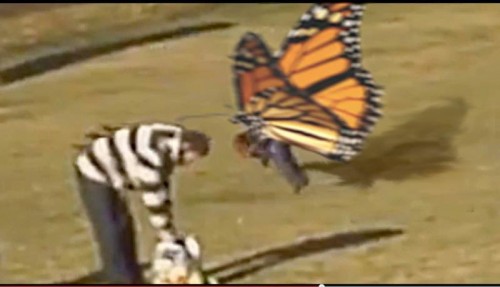
Probably also faked: the sweater looks completely ‘shopped. Via Ed Lam.

I held forth on the fake eagle video thing at some length over here at KCET yesterday, but there was something I didn’t mention there that irked me about the hoax: in the recap part, where the “amazing footage” of the “eagle” “catching” the “child” gets “replayed” in slow “motion,” the filmmakers dubbed in a bit of sound effect right at the moment where CGI talon hit virtual toddler.

And of course it was a red-tailed hawk call. It always is, It doesn’t matter what bird of prey is in a film: the SFX guys will always dub in a red-tailed hawk call. 

Not that the red-tail sound was a dead giveaway: during the 45 minutes or so in which I was somewhat taken by the hoax in I was prepared to grant that perhaps the videographers just did a clumsy, misguided dubbing job, for much the same reason that nature YouTubers always seem to want a horrible music track to cover up their occasionally interesting footage. But it was the same kind of mistake as inflating a CGI osprey to eagle size and calling it a golden and expecting birders to believe it for a second.

In case you’ve never seen a bird of prey represented in video and have no idea what I’m talking about, here is a red-tailed hawk’s call:

By way of comparison, here’s what golden eagle vocalizations sound like:

Bald eagles have calls you might well mistake for a gull’s:

[Update: in comments, otrame offers a more characteristic adult bald eagle call.]

Almost without exception, the red-tailed hawk call is what the sound engineers will use. I do know of one such exception. In the 2010 remake of Clash Of The Titans, which I suspect most people here watched solely for the Kraken and the releasing thereof, there was a scene where Zeus and Perseus were having a difficult father-son moment. Perseus is recalcitrant, whereupon Zeus transforms himself into an eagle and flies away. And that eagle doesn’t “keeeer” — he peeps. Like a golden. Honestly, that one moment of verisimilitude was worth the preceding hour. I was impressed that they got that one detail right. Though the Kraken did disappoint.

Exemplary efforts like Clash Of The Titans aside, it seems like there’s a secret world law governing natural sounds in TV and film that requires all raptors sound like red-tailed hawks. All rats squeak incessantly. Horses whinny while chewing placidly. Tropical rainforests in Africa and South America always have kookaburras in them. And as soon as you start to pay attention to how things actually sound in the real world, that kind of mistake unsuspends your disbelief pretty damned quickly. It’s a bit like having a scene where John Wayne is leading a wagon train westward to Oklahoma City, and they pass the Tetons on the way.

It’s the natural world version of illiteracy, and it makes those of us who know a few things wince.

Oh, no! Not Sweden, too!

It’s everywhere. Iris Classon is woman and a programmer in Sweden, and it turns out that some Swedish men are harassing jerks, too. It’s a painful read, and it all started with a nice newspaper article that published her picture and story … and of course, being a software geek and an attractive woman means you’re a target.

Don’t read it if you’re just tired of the constant drone of ugly misogyny everywhere, or just don’t want to be reminded of that familiar condition. I will highlight the summary she selected for her post:

If you EVER harass me you WILL be published on the blog, twitter, facebook and whatever media I have. I don’t back down, I don’t back of. And I’m sure my friends won’t either. And girl, if you have ANY problems with ANYBODY – please reach out to me. Now

Yeah. Don’t cross Iris Classon.

Which god, I wonder?

Hmm. Apparently, Donald Vroon thinks music is evidence of god, and he cites his emotional response to Easter music to back up his claim.

That’s right — a guy thinks that because his favorite music makes him burst into tears, his emotional experience is a sign that a god exists.

I can counter that, though. My son is home for the holidays, and I’ve been hearing a lot of death metal in the car and wafting down from the upstairs bedroom. I wonder if we threw Mr Vroon into the mosh pit at a Cradle of Filth concert, if he’d relate to the ecstatic experience of their fans? Would he burst into tears? What god would that demonstrate, I wonder?

moshpit
Rapture and ecstasy always indicate the presence of a deity, obviously.