I have no desire at all to visit Sedona, Arizona

But I think a movie about it could be interesting. If you’ve never heard of it, Sedona is kind of the epicenter of a whole webwork of New Age nuttiness — it’s what you get when liberals go full-on faith-head.

sedona

Carrie Poppy, Brian Thompson, and Adam Isaak are running a kickstarter to make an expose of the whole silly mess. If you’re feeling nice, it’s an opportunity to help them get a nice camera and some travel expenses; if you’re one of those mean skeptics, look at it as donating to send them off to get a colonic irrigation on camera. Win-win!


The United States is unsustainable

Sometimes, it’s the little things that just add up and fill me with rage. Like this report on bank employees.

Almost a third of the country’s half-million bank tellers rely on some form of public assistance to get by, according to a report due out Wednesday.

Researchers say taxpayers are doling out nearly $900 million a year to supplement the wages of bank tellers, which amounts to a public subsidy for multibillion-dollar banks. The workers collect $105 million in food stamps, $250 million through the earned income tax credit and $534 million by way of Medicaid and the Children’s Health Insurance Program, according to the University of California at Berkeley’s Labor Center.

We are all supplementing banks so that they can screw over their employees at the bottom, and throw more of their cash to the owners at the top. The plutocrats want it both ways: they want a complete absence of regulation so they can continue to plunder profits, and they want poor, desperate people to do their labor for a pittance, with government aid. You might argue that banks have faced all kinds of problems lately, so maybe they’re lean from top to bottom, but we know that’s not true.

Profits at the nation’s banks topped $141.3 billion last year, with the median chief executive pay hovering around $552,000, according to SNL Financial. In contrast, the U.S. Bureau of Labor Statistics pegs the median annual income of a bank teller at $24,100, or $11.59 an hour.

monopoly_banker

This cannot continue, and I’m getting too old to want to live through a revolution.

A little history of zebrafish research

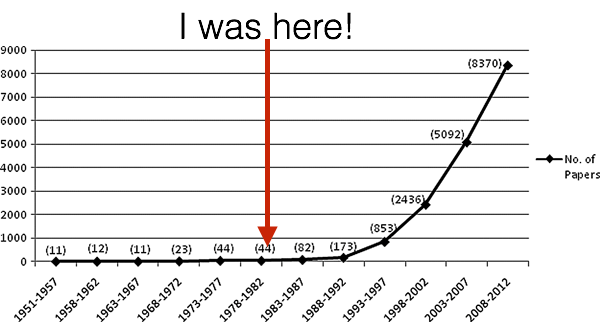
I was amused to see this review of the history of zebrafish publications. It describes some of the trends in the research (read: lots of developmental biology), and plots the number of papers published. I started working with zebrafish in 1979, so I’ve marked where I began.

zfpapers

You know, when I started out as a grad student in this field, the literature search was pretty easy. Almost all the people who had published on this model system were right there in this one collection of labs at the University of Oregon, with a few other former students scattered elsewhere, so I could just turn to all of the primary authors and ask them directly about anything. There were a few older papers, but as I recall, almost all of them had to do with zebrafish as guinea pigs in environmental toxicology studies.

It’s a little bit different now.

(Of course, that didn’t mean I didn’t have lots to read — the questions were all focused on neurobiological and developmental topics in other organisms. Even now you shouldn’t center your reading on just one experimental animal!)

Women and science on youtube

Emily Graslie asks where the women promoting science on youtube are, and then answers her own question: they’re out there, but youtube is not exactly an inviting environment, especially for women, because of (and she does not phrase it this rudely, but I will) all of the assholes infesting the place.

I’m not a woman (no, really, I grew the beard specifically to prevent confusion), but I’ve felt the same way — I tried to do a few things on youtube, clumsily and awkwardly, but the hostility and idiocy of the youtube commentariat were discouraging further efforts. Open comments meant that most of what I was seeing were knee-jerk twits who didn’t pay any attention to what I said, who flooded the thread with sexist and irrelevant stupidity; use the filtering tools to ban the more egregious offenders, and new idiots join in to scream about how you’re violating free speech, and besides, the same morons just come crawling back under new pseudonyms; shut off all comments as an intolerable waste of time and effort, and then the email comes pouring in accusing me of censorship.

I won’t claim that I was any good at the video medium — I didn’t even have an opportunity to try to get better, because it was all shrieking fanboys of certain popular misogynist babblers doing their best to drive me out. I can see how new talent, real talent, might want to run away from the climate there.

But some women have persevered! Graslie lists a number of good science youtubers, so I’ll steal her list here.

Science (biology):
Claire, Brilliant Botany: https://www.youtube.com/user/Brillian…
Sally Le Page, Shed Science: https://www.youtube.com/user/shedscience
Julia Wilde, That's So Science: https://www.youtube.com/user/wildesci…
Dr. Bondar: http://www.youtube.com/user/DrBondar
Lindsay Doe, Sexplanations http://www.youtube.com/sexplanations
Laci Green, Sex+: http://www.youtube.com/lacigreen
Annie Gaus, Pick your Poison: https://www.youtube.com/user/pickyour…
Vanessa Hill, BrainCraft: https://www.youtube.com/braincraftvideo
The Penguin Prof: http://www.youtube.com/user/ThePengui…
Amoeba Sisters: https://www.youtube.com/user/AmoebaSi…

Science (misc.):
Maddie Moate, Earth Unplugged: http://www.youtube.com/earthunplugged
Elise Andrew, I F*cking Love Science : https://www.youtube.com/user/IFLScience
Rebecca Watson: http://www.youtube.com/user/rkwatson/…
Alex Dainis, Bite Sci-zed: https://www.youtube.com/user/Lexie527/
Amy Shira Teitel: http://bit.ly/1dAXh9T
Joanne Manaster: https://www.youtube.com/user/joannelo…
Jessica King, FieldNotes: http://www.youtube.com/jessicasfieldn…
Meg Rosenburg, Tales from the History of Science: http://bit.ly/18rbhRF
Ella, Sci-Files: https://www.youtube.com/user/EllaC522/
Dr. Kiki, This Week in Science: https://www.youtube.com/user/ThisWeek…
Boonsri, Elemental: http://www.youtube.com/user/Elemental…
Eff Yeah Fluid Dynamics: http://www.youtube.com/user/fyfluiddy…
Allison Jack, Agricultural Science: http://www.youtube.com/user/AllisonLH…
Katie McGill, The Physics Factor: https://www.youtube.com/thephysicsfactor

Technology:
Amanda Aizuss, iTalkApple: https://www.youtube.com/user/iTalkApple/
Emily Eifler, BlinkPopShift: https://www.youtube.com/user/BlinkPop…

Engineering:
Jerri Ellsworth: https://www.youtube.com/user/jeriells…
Limor "Ladyada" Fried: https://www.youtube.com/user/adafruit/

Math:
ViHart: http://www.youtube.com/vihart
Saramoira Shields, Mathematigal: https://www.youtube.com/user/SqueakyM…
LookingGlassUniverse: https://www.youtube.com/user/LookingG…
Rebecca Thomas, Dead Bunny Guides: https://www.youtube.com/deadbunnyguides/

The Field Museum Women in Science group: http://fieldmuseum.org/explore/field-…

Now I have more to watch. Maybe I’ll get inspired and try again someday.

Prezzy!

It’s not even Christmas yet, and Mary and I got a present in the mail.

pillow

It turns out it has magical properties, too. All morning, this cat we’re fostering (want her?) has been pestering me, clambering about and digging her claws into me and nagging me to feed her, and I sat down next to the pillow, and she fled. I think she had presentiments of her fate if she persisted.

Thanks, Caine!

Media bias!

OK, so that Daily Mail piece that talked about my refutation of the MFAP hypothesis — the idea that humans are ape-pig hybrids — has been getting a fair amount of attention. The article actually did quote me tearing into the idea fairly thoroughly, although it did also give far too much attention to a crackpot, but here’s the thing: the media doesn’t care that much what I said, it’s all the kook nonsense driving the reporting.

For example, Jennifer Raff heard it on Alex Jones’ radio show. Jones is a wacky, hateful, loud-mouthed conspiracy theorist, and what is he talking about? Not that there are good explanations for human evolution, but that a kook with a ridiculous idea has demolished the theory of evolution.

What really drew my interest in the subject was the way Alex Jones discussed the news article. He called Eugene McCarthy a “top geneticist” and an “expert”, and while rightly dismissing the hypothesis as idiotic, he implied that it was in line with the current scientific consensus on human origins: that evidence was increasingly disproving evolution as an explanation. Instead, alternative ideas, such as an Intelligent Designer (Jones kept calling it “aliens” and mentioning the movie “Prometheus”) were becoming mainstream explanations for human origins, and this chimp-pig hybridization idea was yet another example. Framing the story in this way, he went on to say that “They (scientists) have no idea what they’re doing” (quote paraphrased from my memory), and therefore evolution is nonsense. And he’s not alone. The creationist/Intelligent Design site Uncommon Descent also dismisses McCarthy’s hypothesis while simultaneously dismissing “neo-Darwinism”

Raff goes on to list all the red flags thrown on McCarthy’s loony hypothesis, which ought to get any reasonable journalist to immediately question and reject the idea. But the lesson I’m seeing from the differential attention given to my explanation and McCarthy’s is that I clearly did not throw enough red flags.

So I’m pointing out that a Christian, conservative, dominant minority is conspiring to suppress my radical idea that evolution, a natural process, has generated all the diversity of life on earth, and that as a top expert authority I plan to lead a revolution in scientific thinking. I know that’s a wild claim and that I’ll probably be pilloried by the mainstream establishment, but I’ve just got to get past the scientific gatekeepers to bring this secret knowledge to the masses.

Alex Jones, call me. We’ll talk.

Higher order thinking

The one thing you must read today is David Dobbs’ Die, Selfish Gene, Die. It’s good to see genetic accommodation getting more attention, but I’m already seeing pushback from people who don’t quite get the concept, and think it’s some kind of Lamarckian heresy.

It’s maybe a bit much to ask that the gene-centric view of evolution die; it’s still useful. By comparison, for instance, it’s a bit like Mendel and modern genetics (I’ll avoid the overworked comparison of Newton and Einstein.) You need to understand simple Mendelian genetics — it gives you a foundation in the logic of inheritance, and teaches you a few basic rules. But once you start looking at real patterns of inheritance of most traits, you discover that it doesn’t work. Very few traits work as Mendel described, and one serious concern is that we tend to select for genes to study that behave in comprehensible ways.

And every geneticist knows this. Mendel was shown to have got some things wrong within a decade of his rediscovery: Mendel’s Law of Independent Assortment, for instance, simply does not hold for linked genes, and further, linkage turns out to hold important evolutionary implications. But I still teach about independent assortment in my genetics course. Why? Because you need to understand how to interpret deviations from the simple rules; it’s an “a-ha!” moment when you comprehend how Morgan and Sturtevant saw the significance of departures from Mendel’s laws.

Most of genetics seems to be about laying a foundation, and then breaking it to take a step beyond. Teaching it is a kind of torture, where you keep pushing the students to master some basic idea, and then once they’ve got it, you test them by showing them all the exceptions, and then announcing, “But hey! Here’s this cool explanation that tells you what you know is wrong, but there’s some really great and powerful ideas beyond that.”

That’s what’s fun about genetics: compounding a series of revelations until the students’ brains break, usually right around the end of the term. Over the years I’ve learned, too. Undergraduate genetics students usually collapse in defeat once I introduce epistatic interactions — the idea that the phenotype produced by an allele at one locus is dependent on the alleles present at other loci — but it’s always great to see the few students who fully grasp the idea and see how powerful it is (future developmental biologists identified!).

And that’s how I see the gene-centric view: absolutely essential. You must understand Mendel, and Fisher, and Wright, and Hamilton, and Williams, and once you’ve mastered that toolkit, you can start looking at the real world and seeing all the cases where it’s deficient, and develop new tools that let you see deeper. The new idea that Dobb’s describes, and that is actually fairly popular with many developmental biologists, is that phenotype comes first: that organisms are fairly plastic in response to the environment in ways that can’t be simplified to pure genetic determinism, and that the genes lag behind, acting to consolidate and make more robust adaptive responses.

I’ve written about genetic assimilation/accommodation before, and have given one lovely example of phenotypic change occurring faster than the generation of new mutants can explain. It’s always baffled me about the response to those ideas: most people resist, and try to reduce them to good old familiar genes. It’s a bit like watching students wrestle with epistatic modulation of gene expression when all they understand is Mendel, and rather than try to grasp a different way of looking at the problem, they instead invent clouds of simple Mendelian factors that bring in multi-step discrete variations. They can make the evidence fit the theory — just add more epicycles!

I’m seeing the same responses to Dobbs’ article — it’s still all just genes at the bottom of it, ain’t it? Oh, sure, but the interesting parts are the interactions, not the subunits. We need to take the next step and build tools to study networks of genes, rather than reducing everything to the genes themselves.

Now you too can pretend you were at Skepticon this year

Here’s my talk on the Cambrian from Skepticon 6.

Oh, hey, I just realized I could post the content of that text-heavy slide I flashed, showing the sources I used. So here you go:

Web reviews from Donald Prothero, Nick Matzke, Larry Moran.

Briggs, D.E.G.; Fortey, R.A. (1989). The early radiation and relationships of the major arthropod groups. Science, 246(4927), 241-243.
Budd, G. E., and S. Jensen. 2000. “A critical reappraisal of the fossil record of the bilaterian phyla.” Biological Reviews 75:253-295.
Erwin D and Valentine J (2013). The Cambrian explosion : the construction of animal biodiversity. Greenwood Village, CO, Roberts and Company Publishers.
Marshall, Charles R. (2006). “Explaining the Cambrian ‘explosion’ of animals.” Annual Review of Earth and Planetary Sciences. 34: 355-384.
Smith MP, Harper DAT (2013) Causes of the Cambrian Explosion. Science 341:1355.
Long M, Betran E, Thornton K, Wang W (2003) The origin of new genes: glimpses from the young and old. Nature Rev Genet 4:865.
Knoll AH, Carroll SB (199) Early Animal Evolution: Emerging Views from Comparative Biology and Geology. Science 284:2129.
Erwin DH, Laflamme M, Tweedt SM, Sperling EA, Pisani D, Peterson KJ (2011) The Cambrian conundrum: early divergence and later ecological success in the early history of animals. Science. 334(6059):1091.
Peterson KJ, Dietrich MR, McPeek MA (2009) MicroRNAs and metazoan macroevolution: insights into canalization, complexity, and the Cambrian explosion. Bioessays. 31(7):736.