Setting the bar low. Burying it, actually.

Penn Jillete defends Anthony Cumia. We’re all missing the important detail that exonerates him — sure, he went off for hours in a racist tirade, but don’t you all realize that Cumia is licensed to carry a concealed handgun?

Penn Jillette says that people are burying the lede in the alleged incident that led to SiriusXM’s decision to fire “Opie and Anthony” host Anthony Cumia. He also argued that he’s never seen any evidence that suggests Cumia is racist as many of his critics have alleged.

We are burying the lede of this story, which is that Anthony, who has a reputation for being a bit of a hot head, is carrying, comes up gets hit in the face and does not hurt the person back, Jillette said during his “Penn’s Sunday School” podcast this weekend.

That is incredible. If I am in the position where I cross somebody who is carrying a gun and who can defend themselves and hurt me, and their choice is to write angry stuff on Twitter instead of fighting me back — wonderful. Gandhi! That’s Gandhi! … That is Martin Luther King, he continued.

Seriously? He just compared a racist ranter to Gandhi and Martin Luther King because he didn’t shoot a black woman in the face?

Sure. This sounds exactly like something King or Gandhi would say.

Savage violent animal fucks prey on white people. Easy targets. This CUNT has no clue how lucky she was. She belted me 10 times. I had a gun

No,an ANIMAL BITCH used it’s instinctual violence on me. I restrained myself from putting it to sleep

It’s a jungle out in our cities after midnight. Violent savages own the streets. They all came 2 defend this pig. I had to yell like at dogs

Gosh. I’ve never shot anyone, and I’ve never even raged at minorities as animals. I guess that means I must be like Jesus!

By the way, the article strangely features a photo of Cumia’s concealed carry license…with a 2012 expiration date. I guess True Skeptics™ don’t give a damn about little details like that.

cumialicense

There’s the leak in the pipeline

We’re always talking about this curious phenomenon, that we see lots of women at the undergraduate and graduate level in biology, but large numbers of them leave science rather than rising through the ranks. Why is that? It seems that one answer is that elite male faculty in the life sciences employ fewer women, that is, the more prestigious, well-known labs headed by male faculty with great academic reputations tend not to hire women for the next level of training.

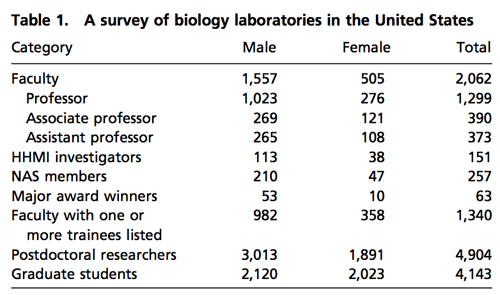
Women make up over one-half of all doctoral recipients in biology- related fields but are vastly underrepresented at the faculty level in the life sciences. To explore the current causes of women’s underrepresentation in biology, we collected publicly accessible data from university directories and faculty websites about the composition of biology laboratories at leading academic institutions in the United States. We found that male faculty members tended to employ fewer female graduate students and postdoctoral researchers (post-docs) than female faculty members did. Furthermore, elite male faculty—those whose research was funded by the Howard Hughes Medical Institute, who had been elected to the National Academy of Sciences, or who had won a major career award—trained significantly fewer women than other male faculty members. In contrast, elite female faculty did not exhibit a gender bias in employment patterns. New assistant professors at the institutions that we surveyed were largely comprised of postdoctoral researchers from these prominent laboratories, and correspondingly, the laboratories that produced assistant professors had an overabundance of male postdocs. Thus, one cause of the leaky pipeline in biomedical research may be the exclusion of women, or their self-selected absence, from certain high-achieving laboratories.

These statistics were obtained by sampling a large number of labs across the US. The leaky pipeline is rather obvious in this table: note that we have parity at the graduate student level, but that it falls off dramatically at the next level up.

surveytable

This is a problem. One (not the only one!) of the criteria used to select academic hires is the reputation of the lab they came from — some labs are just really good at cranking out the data, publishing publishing publishing, and new graduates coming out of those labs are likely to continue that pattern. Coming out of a well-known lab provides a real leg-up for an academic career. But what this paper found is that women were less likely to find themselves in those labs.

We found that female trainees were much less likely to work for an elite PI, particularly at the post-doctoral level. Combining faculty of both genders, men were about 17% more likely to do their graduate training with a member of the NAS, 25% more likely to do their postdoctoral training with a member of the NAS, and 90% more likely to do their postdoctoral training with a Nobel Laureate. Thus, the gender skew in employment results in fewer women being trained in the laboratories of elite investigators.

Get with the program, Nobelists!

My first thought was that maybe this was a product of an older generation — that more senior faculty are going to be much older and perhaps unfortunately traditionalist, so all we have to do is wait for them to die off and be replaced. No such luck. When the data are carefully dissected, the correlation isn’t with age, but with elite status (as defined by membership in prestigious organizations). Young male investigators are just as unlikely as old male investigators to hire women.

As expected, among male faculty, elite status was negatively correlated with the percentage of female postdocs in a laboratory (P < 0.0001). This relationship remained true even when several other explanatory variables were added, including faculty rank, years since a faculty member had received his or her PhD, and total number of trainees in a laboratory. As a single independent variable, years since PhD was moderately negatively correlated with the percentage of female postdocs in laboratories with male faculty members (P < 0.045), but this effect disappeared when other variables were included in the model. This observation suggests that a faculty member’s age is not a significant determinant of the gender makeup of their laboratory, and both young and old elite professors employ few women. Laboratory size was also negatively correlated with the representation of female postdocs both as a single variable and in multivariable models. Regression against the percentage of female graduate students in each laboratory revealed similar, although less robust, results. In multivariable models, elite status was associated with a significantly lower percentage of female graduate students trained by male faculty. However, years since PhD correlated with an increasing representation of female graduate students, whereas laboratory size was not significantly correlated in either direction. Finally, we constructed equivalent linear models for female PIs, but we failed to find a single variable that was significantly associated with differential representation of female trainees in these laboratories.

The paper is careful to point out that they don’t know the direct causes of the differences, whether it’s exclusion, conscious or otherwise, by faculty men, or reluctance of women to apply to those labs. We should probably try to figure that one out, since that’s how the problem gets fixed…but it’s probably a combination of all of these factors.

Irrespective of the cause of the gender disparities in elite laboratories, its consequences significantly shape the academic ecosystem. Our data show that these laboratories function as gateways to the professoriate: new generations of faculty members are predominantly drawn from postdocs trained by high-achieving PIs. However, these feeder laboratories employ a disproportionate number of men. According to the theory of cumulative disadvantage, persistent inequalities in achievement can result from small differences in treatment over a prolonged goal-oriented process. In controlled studies, women in academia receive less favorable evaluations, receive lower salary offers, and are ignored by faculty more frequently than men. Access to training in certain laboratories may be another level at which women are disadvantaged. The absence or exclusion of female trainees from elite laboratories deprives them of the resources, visibility, networking opportunities, etc. that could facilitate their professional development. These differences may contribute to the leaky pipeline by shunting women toward laboratories that provide fewer opportunities for advancement in academic science.

I’m certainly not at one of those elite laboratories, so I can’t do much at that level — but I am training swarms of undergraduate women and stuffing them in at the base of the pipeline. One thing we can do here is encourage our graduates to be ambitious and push hard to get into the labs they really want…and to prepare them for the institutional biases that will get in the way.

So confused

I got these pamphlets in the mail yesterday. People send me Bible tracts all the time — who needs to think when you’ve got Jack Chick to give you a Hallmark shortcut? — and I usually just flip through them and toss them. But these were weird. One was about a Ken Ham-like preacher ranting that God wanted you stupid and ignorant and receptive to his message; another was all about the necessarily literal truth of the first book of Genesis, and that the whole rest of the Bible falls apart if you don’t accept it; and the other one is about how Jesus was a failure, since almost everyone goes to Hell, and only the elect few get to join him on his motorcycle to heaven. They were evil Poes.

Apparently, you’re supposed to distribute these at bus stations and truck stops and other places more typically associated with cheap Jesusy crap. I could see how someone might pick these up and confuse them with genuine believer baloney. I’m going to have to keep my eyes open for Christians sincerely spouting the mockery from the True Bible Church.

A whole book of these things would be lethal, I think

Charles Pierce gives us another quote from Sarah Palin. I’m glad someone else is extracting these, because I can’t listen to her for more than 3 or 4 seconds.

Any interest in doing a political talk show, either on TV, radio or the Internet?

Maybe. But the politics would have to be interspersed with a whole lot of fun and real life and inspiration showcasing American work ethic, because those topics are all pretty much the antithesis of today’s politics, which I find incorrigibly disastrous! It’d be so much fun to shake it up taking on issues that make audiences objectively consider all sides, and I’d do it with my own real-life groundedness, candor and commonsense that I’m known for. Media needs that today, versus the condescension that oozes from TV and radio. I hear everyone recently got canned from The View, maybe a show like that needs a punch of reality and a voice of reason from America’s heartland to knock some humble sense into their scripts. You know, someone willing to go rogue.

Oh, gob. The arrogance. The incoherence. Urrk, my brain is seizing up!

I hope her speeches are never militarized.

Godless baseball

It’s that time again — for the third year in a row, Minnesota Atheists have adopted the Mr Paul Aints for their regular conference. Come out on Friday, 11 July to watch the game, eat hot dogs, drink beer, and shake your fist at the gods, and then join us on Saturday for the conference. They’ve got Susan Jacoby! Debbie Goddard! Dan Barker! Rebecca Watson! The comedian Elizabeth Ess! Some other guy who was cheap and local! You must participate!

What are you going to simulate?

The EU is sinking €1.2bn (and the US is proposing to spend more, $3 billion) into a colossal project to build a supercomputer simulation of the human brain. To which I say, “What the hell? We aren’t even close to building such a thing for a fruit fly brain, and you want to do that for an even more massive and poorly mapped structure? Madness!” It turns out that I’m not the only one thinking this way: European scientists are exasperated with the project.

"The main apparent goal of building the capacity to construct a larger-scale simulation of the human brain is radically premature," Peter Dayan, director of the computational neuroscience unit at UCL, told the Guardian.

"We are left with a project that can’t but fail from a scientific perspective. It is a waste of money, it will suck out funds from valuable neuroscience research, and would leave the public, who fund this work, justifiably upset," he said.

There is a place for Big Science. I’d suggest that when you’re at the preliminary exploratory stage, as we are with human brain function, it’s better to fund many small exploratory parties to map out the terrain, rather than launching a huge invasion with charts that are made out of speculation. We know a computer simulation is going to fail, because we don’t know what it’s going to simulate. So why are they doing this? Maybe it’s a question of who “they” are.

Alexandre Pouget, a signatory of the letter at Geneva University, said that while simulations were valuable, they would not be enough to explain how the brain works. "There is a danger that Europe thinks it is investing in a big neuroscience project here, but it’s not. It’s an IT project," he said. "They need to widen the scope and take advantage of the expertise we have in neuroscience. It’s not too late. We can fix it. It’s up to Europe to make the right decision."

I’ve noticed this, that a lot of gung-ho futurists and computer scientist types have this very naive vision of how the brain works — it’s just another computer. We can build those. Build a big enough computer, and it’ll be just like the brain. Nope. That’s operating on ignorance. And handing ignorant people billions of dollars to implement a glorious model of their ignorance is an exercise in futility.

Closure on the Obokata/STAP affair

I’ve been following the story of stimulus-triggered acquisition of pluripotency (STAP) cells with considerable interest, and there’s a good reason for that: from the very beginning, it contradicted how I’d always thought about cell states, and if it were true, I’d have to rethink a lot of things, which was vexing. But on the other hand, empirical results always trump mental models, so if the results held up, there was no question but that I’d have to go through that uncomfortable process of reorganizing my preconceptions. It would be OK, though, because there’d be a great prize at the end.

Well, it turns out that I don’t have to reboot my brain after all, because now that all the flailing about is over, STAP is a product of sloppiness and fakery, and is dead.

So here’s the controversy, and why I found it vexatious. We want to be able to specify cell states; in particular, we’d love to be able to take any cell from the human body, tickle it with a few specific signals, and see it throw away all of its historical constraints and become a different cell type altogether. In particular, the Holy Grail is to find the right combination of switches to cause any cell to become a pluripotent stem cell — the kind of cell we can then induce to become any other cell type we might need.

We know this can’t be impossible, and is probably even fairly simple, because we know that cells can do this already (well, to some degree; your body accomplishes this task by setting aside reserve populations of stem cells. It’s also likely that some cell types are so tightly locked in by the process of differentiation that their state is not reversible). The idea is that we just need to find the right combination of signals/genes — the right kind of key — and we can unlock the cell, and make it open to additional inductions that will allow us to manipulate it.

We have some idea of the shape of the key. Yamanaka identified four genes, Oct4, Sox2, cMyc, and Klf4, that when activated, switched cells into a pluripotent state, making induced pluripotent stem cells, or iPS cells. It works. The handicap right now is that we only have a kind of brute force method of switching those genes on, and two of them are oncogenic, so it’s as if we’ve got a rather clumsy key that opens the lock, but also damages it in unfortunate ways. The resolution to that problem, though, was learning how to finesse the genes — we need to figure out how to more delicately switch on the necessary genes by a way other than bluntly transfecting cells with copies of the genes that are always on.

Then along came Haruko Obokata, an investigator in Japan who announced that she could induce stem cells with simple, generic stress, such as by exposing them to acid or physically pushing on the cells. It was like saying she didn’t need a specific key, all you needed to do was shake the lock really hard, and it would spontaneously pop open. What, really? That just seems too simple. It would be phenomenally awesome if true, but it seemed unlikely. But then, I remember this one lab I worked in where all the publicly popular drugs, like ketamine, were kept locked in a drawer to which only the PI had a key…but the countertop wasn’t secured to the bench, so if you knew about it, you could just lift the top and get easy access. It was a backdoor to the goodies that was so stupid you couldn’t believe it existed, but it did.

Could it be that cells similarly had a stupid weakness that could be so easily exploited? The short answer is no; read the whole article by David Cyranoski.

But the paper1 that set out the fundamental technique was soon shot full of holes. There was plagiarized text in the article. Figures showed signs of manipulation, and some images were identical or nearly identical to those used later in the same paper and elsewhere to represent different experiments. More damning were genetic analyses that strongly suggested the cells were not what they were purported to be. And although deriving STAP cells was advertised as simple and straightforward, no one has yet been able to repeat the experiment.

Within the space of six months, Obokata was found guilty of misconduct by her institution; well-respected scientists, including RIKEN head Ryoji Noyori, bowed their heads in apology; and both papers were retracted. In the end, the evidence for STAP cells seemed so flimsy that observers began to ask where were the extra precautions and the ‘extraordinary proof’ that had been promised post-Hwang.

It sure would have been nice to have a simple technique for generating stem cells, but I have to confess to being a bit relieved. There’s the vindication of prior thinking and the value of incrementally improving our stem cell protocols, of course, but also, I’d personally rather that it weren’t trivial to switch my cells to a de-differentiated pluripotent state — that’s a recipe for easy cancer generation, too. It is somehow reassuring to think that evolution has shaped multi-cellular organisms to be somewhat resistant to spontaneously going all stem-celly under stress.