I hear that women are made of exotic matter

The Nobel in Physics has been awarded for research on exotic matter, but I think you’d be better off looking for a physicist to explain it. I’m sure it’s good work and that the three scientists are deserving, but I just have to leave this fact on the table.

No Nobel Prize has come close to being equitably distributed by gender, but physics has the worst record of them all. Zero women have won it in the past 50 years. Exactly two women have won it ever.

Again, this does not detract from the accomplishments of Thouless, Haldane, and Kosterlitz, but it does make one wonder how much further physics would have progressed if it didn’t have a culture that discouraged half of humanity from participating.

Can I come in and tell you about the cult of Danio?

Now I know how a Mormon or Scientologist or Baptist feels when some heathen tries to earnestly explain their religion. This video is well done, but gives me a bit of the heebie-jeebies.

I started working on zebrafish in 1979 (I wasn’t the first, or even particularly close — that honor goes to the crew in George Streisinger’s lab), and all through the 80s our lab group had a reputation: at every meeting in every talk, we’d recite what was called the Zebrafish Litany, a listing of all the virtues of this quirky new model organism that nobody else knew much about. In fact, at the Friday Harbor lab meetings in developmental biology there was a kind of tradition where the students would linger in the auditorium late at night and mock the speakers and professors with imitations on the podium, and one year a group made fun of us by having a series of students march robotically to the lectern and recite the exact same series of words. And those words are in this video. How dare the unbelievers speak our catechism!

The video doesn’t quite capture the true nature of the Cult of Danio, though. Everything in it is about how zebrafish research contributes to the study of human diseases, which is a nice perk of the system, but we study the fish because the fish are fascinating, not because we are wannabe human disease researchers. Also, the part where he explains the flaws of the zebrafish, that they have many duplicated genes (so do we) and that they have unique genes not found in humans? Those aren’t flaws.

It is nice to see, though, that our orison is now part of the general public awareness of the zebrafish. That’s why we were saying it so often. Soon, you too shall be a believer. All praise George!

Spooky evolved powers!

The Alien Disclosure group has discovered an alien starchild living in China with amazing powers. They have proof. It’s on video.

Ooh, spooky. His eyes aren’t brown! I bet you didn’t know that blue eyes give you the power to see in the dark, did you?

The description of this kid is pretty silly, too.

In the Chinese city Dahua lives child of a new human race. Little Nong Yousui has blue eyes with a deep neon glow in the dark just like the cat’s eye effect.

NONG YOUSUI CAN SEE IN THE DARK AS MUCH AS WE CAN SEE IN THE LIGHT

Such eyes are a familiar sight even for the inhabitants of the Nordic lands. The boy can see in the dark as we can see in the light.

Yes. We Nordics are familiar with the neon glow of our eyes. We have to wear blindfolds to bed so that the glare doesn’t keep are partners awake. We also have a tapetum, just like a cat.

Let’s bring the Science to bear.

After his teacher shared these unusual abilities on the internet, suspicious reporters from Beijing decided to check out the information with specialists. They concluded from a variety of tests and experiments including DNA analysis and chromosonal defragmentation, none of which hurt the boy, that indeed he had ‘evolved’ genes. Little Nong is the first living man that can see in the dark.

According to some specialists, it is not a random change. Namely, this change isn’t a mutation consequence but more of an evolution consequence.

How do you tell a mutated gene from an evolved one?

I’d also like to try defragmenting my chromosomes, especially since they say it doesn’t hurt.

Hate doesn’t pay, but it can be subsidized

Jim Rutenberg is concerned about the flood of hate speech that’s been accelerating over the last few years. He has examples, including himself — I guess you shouldn’t use Twitter if you have an obviously Jewish name. Or a woman’s name. Or a black name. It’s a medium that’s only safe for us True Aryan Males, I guess, and that’s a problem that’s affecting their bottom line.

Now that Twitter is contemplating putting itself up for sale, we can only wonder what lucky suitor is going to walk away with such a charming catch.

Twitter is seeking a buyer at a time of slowing subscriber growth (it hovers above the 300 million mark) and “decreasing user engagement,” as Jason Helfstein, the head of internet research at Oppenheimer & Company, put it when he downgraded the stock in a report last week.

There’s a host of possible reasons for this, including new competition, failure to adapt to fast-changing media habits and an “open mike” quality that some potential users may find intimidating.

But you have to wonder whether the cap on Twitter’s growth is tied more to that most basic — and base — of human emotions: hatred.

Yes. I suspect the answer is “HELL YES.” Twitter might look to their competition, 4chan, which is also experiencing problems and might be up for sale.

All good things must come to an end and as it stands now, 4chan will probably be gone before the end of the month. Or at least several of its boards will.

Ever since 4chan was sold by Christopher Poole (Moot) to Hiroyuki Nishimura about a year ago, the new owner has come to realize that paying several millions of dollars for an anonymous image board probably wasn’t a very good idea. 4chan is good for trolling, raiding, shit-posting and doing basically anything, it just isn’t a good business venture. No corporate brand wants to advertise their products on a website where users nonchalantly joke about rape, death and every other politically incorrect topic you can think off. Even as owner of 4chan, Moot has stated several times that 4chan was in several ways, a liability. It costs more to maintain the site than the revenue generated from it.

Heh. Surprise!

But don’t cry for 4chan. There might be a white knight riding to the rescue. Martin Shkreli. They belong together.

The problem is that we have advocated free speech, as in free from all responsibility, rather than free speech, as in free of political and economic restrictions. We want a medium where Exxon and North Korea don’t get to control what people say about them, but instead we have a medium where racists and misogynists and shitlords get to abuse everyone, and we don’t yet have a tool that strikes a balance between permitting criticism and permitting open hatred, or even between truth and lies. I’ve been watching the growth of so-called “satire” sites that follow the rule of anything goes — you can lie in a clumsy, ugly way about anyone or anything if you slap a “satire” label on it — and I’m not the only one who finds them to be a threat to the integrity of information on the net.

It is easy to be a free-speech fundamentalist. I’ve been one as long as I can remember without ever breaking a mental sweat. It requires belief in only two basic tenets, the one more feel-good than the other: that people are essentially decent and smart, and that truth always wins over lies in the long run.

The internet has proven both to be wrong. Social media shows that people are essentially a mob of thoughtless arseholes, and the “post-truth” political era shows that the dark side is, in fact, the more powerful.

The dark side is only more powerful if we uncouple free speech from incentives for honest speech, which is the status quo right now.

Unfortunately, that’s a very hard problem, and there is no easy solution. It is, however, easy to see that the balance is totally out of whack right now.

Autophagy wins a Nobel

Well, actually, Yoshinori Ohsumi has won the prize for his work on autophagy, a cellular process you may have never heard of before. The word means “self eating”, and it’s an important pathway that takes chunks of the internal content of the cell and throws them into the cell’s incinerator, the lysosome, where enzymes and reactive chemicals shred them down into their constituent amino acids and other organic compounds for reuse. What makes it interesting is that the cell doesn’t want to just indiscriminately trash internal components; there are proteins that recognize damaged organelles and malfunctioning bits and packages them up in a tidy little double membrane bound vesicle that fuses with the lysosome and destroys them.

At least, most of the time it’s selective. It was first characterized by Ohsumi in yeast, where, if you starve the cells, they start self-cannibalizing to survive. If you use mutant yeast that lack some of the degradative enzymes, they are unable to break down the materials being dumped into the lysosome, and the vacuoles just get larger and larger, making it relatively easy to screen for changes in the machinery for autophagy.

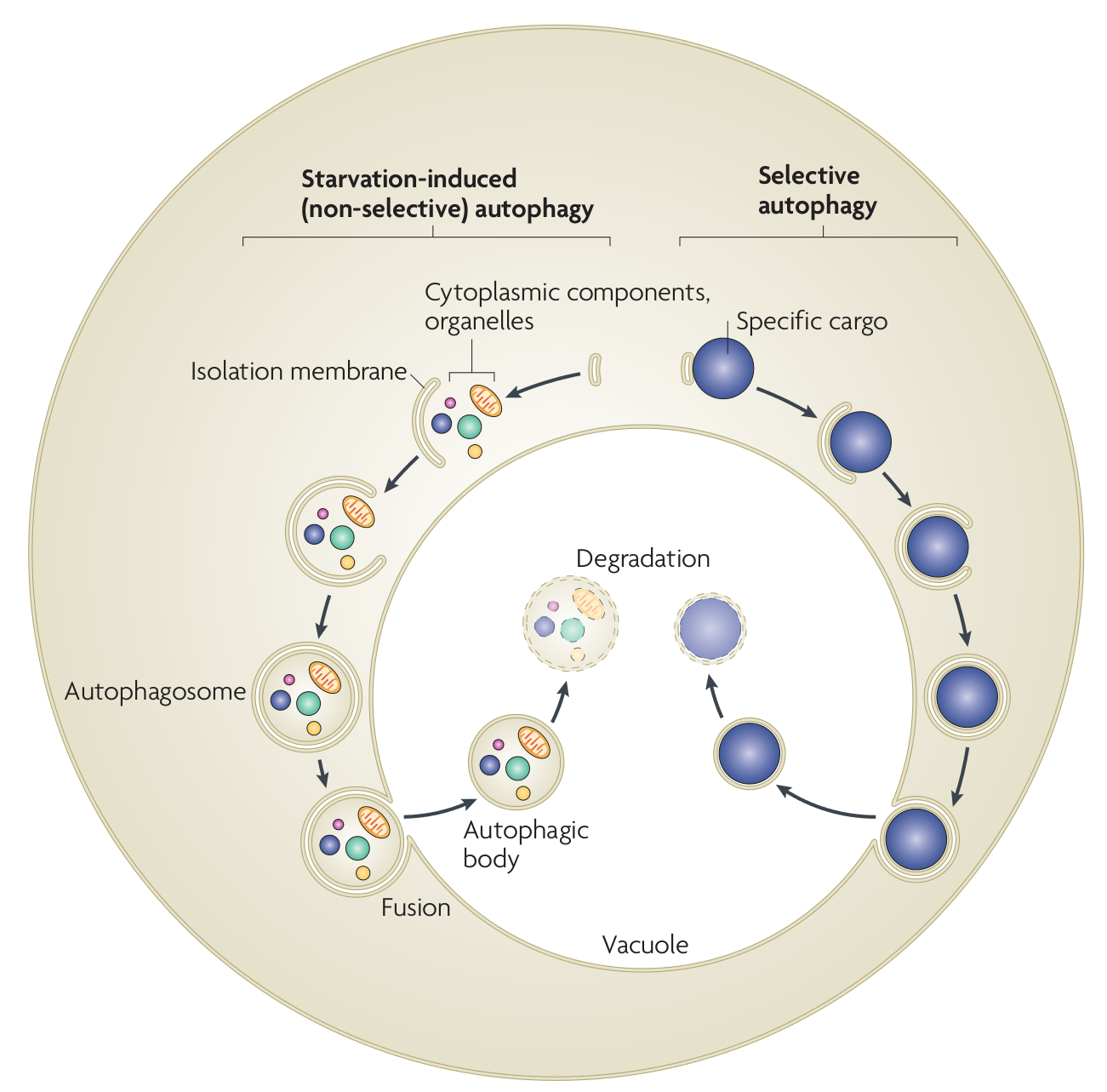
Autophagy in yeast. In starvation-induced (non-selective) autophagy,  the isolation membrane mainly non-selectively engulfs cytosolic constituents and organelles to form the autophagosome. The inner membrane-bound structure of the autophagosome (the autophagic body) is released into the vacuolar lumen following fusion of the outer membrane with the vacuolar membrane, and is disintegrated to allow degradation of the contents by resident hydrolyases. In selective autophagy, specific cargoes (protein complexes or organelles) are enwrapped by membrane vesicles that are similar to autophagosomes, and are delivered to the vacuole for degradation. Although the Cvt (cytoplasm-to-vacuole targeting) pathway mediates the biosynthetic transport of vacuolar enzymes, its membrane dynamics and mechanism are almost the same as those of selective autophagy.

Autophagy in yeast. In starvation-induced (non-selective) autophagy, the isolation membrane mainly non-selectively engulfs cytosolic constituents and organelles to form the autophagosome. The inner membrane-bound structure of the autophagosome (the autophagic body) is released into the vacuolar lumen following fusion of the outer membrane with the vacuolar membrane, and is disintegrated to allow degradation of the contents by resident hydrolyases. In selective autophagy, specific cargoes (protein complexes or organelles) are enwrapped by membrane vesicles that are similar to autophagosomes, and are delivered to the vacuole for degradation. Although the Cvt (cytoplasm-to-vacuole targeting) pathway mediates the biosynthetic transport of vacuolar enzymes, its membrane dynamics and mechanism are almost the same as those of selective autophagy.

Taking out the trash is a vital procedure for cells, as well as for maintenance of your household, and there are cases where autophagy is implicated in human diseases. For instance, mitochondria are intensely active metabolically, and experience a lot of wear and tear. Your cells take old, busted mitochondria, tag them with proteins, and recycle them with a specific subset of autophagy called mitophagy, or mitochondria-eating. Some forms of Parkinson’s disease seem to be caused by defects in the mitophagy machinery, causing defective mitochondria to accumulate in the cell and impairing normal function.

Autophagy also seems to have some complex roles in cancer. It can be a good thing, in that early on if defective proteins and organelles accumulate, they can be sensed and destroyed, so autophagy in that case is a defense against cancer. However, cancer can also subvert that machinery and route the cell’s defenses right into the trash.

But also, autophagy seems to be involved in every step in cancer metastasis. This shouldn’t be a surprise, since autophagy is used to regulate the activity of the cell in all kinds of behaviors.

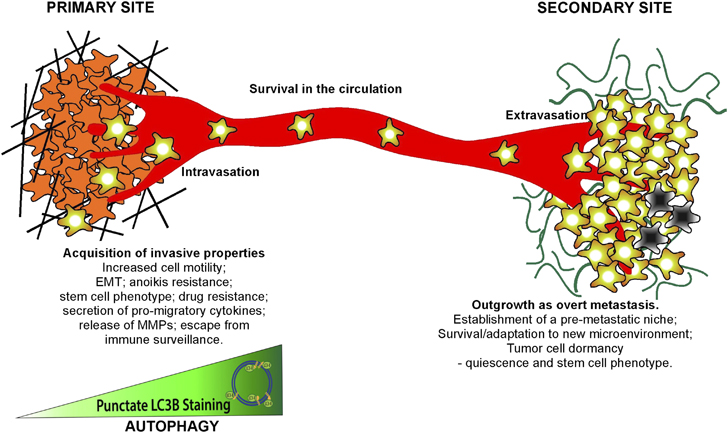
Schematic illustrating roles of autophagy in the metastatic cascade. Autophagy increases as tumor cells progress to invasiveness and this in turn is linked to increased cell motility, EMT, a stem cell phenotype, secretion of pro-migratory factors, release of MMPs, drug resistance and escape from immune surveillance at the primary site in some tumors. Many aspects of these autophagy-dependent changes during acquisition of invasiveness also likely contribute to the ability of disseminating tumor cells to intravasate, survive and migrate in the circulation before extravasating at secondary site. At the secondary site, autophagy is required to maintain tumor cells in a dormant state, possibly through its ability to promote quiescence and a stem cell phenotype, that in turn is linked to tumor cell survival and drug resistance. Emerging functions for autophagy in metastasis include a role in establishing the pre-metastatic niche as well as promoting tumor cell survival, escape from immune surveillance and other aspects required to ultimately grow out an overt metastasis.

Schematic illustrating roles of autophagy in the metastatic cascade. Autophagy increases as tumor cells progress to invasiveness and this in turn is linked to increased cell motility, EMT, a stem cell phenotype, secretion of pro-migratory factors, release of MMPs, drug resistance and escape from immune surveillance at the primary site in some tumors. Many aspects of these autophagy-dependent changes during acquisition of invasiveness also likely contribute to the ability of disseminating tumor cells to intravasate, survive and migrate in the circulation before extravasating at secondary site. At the secondary site, autophagy is required to maintain tumor cells in a dormant state, possibly through its ability to promote quiescence and a stem cell phenotype, that in turn is linked to tumor cell survival and drug resistance. Emerging functions for autophagy in metastasis include a role in establishing the pre-metastatic niche as well as promoting tumor cell survival, escape from immune surveillance and other aspects required to ultimately grow out an overt metastasis.

It may also affect Crohn’s disease and other inflammatory syndromes. There are mutated proteins associated with Crohn’s that are part of the autophagy pathway; macrophages carrying these mutations deliver bigger doses of inflammatory cytokines when stimulated. Selective autophagy plays a role in regulating the balance of exports from the cell.

Those are the mild diseases caused by defects in this pathway. Look up Vici syndrome, a heritable disorder that causes devastating problems for those afflicted. It’s caused by mutations in the EPG5 gene, which is an important regulator of autophagy.

It’s not just about human diseases, though. Autophagy is universal in eukaryotes: yeast have it, plants have it, animals have it. Genes in the pathway are studied in yeast and nematodes and flies and mice, so this is a common mechanism of regulating the internal traffic of the cell.


Jiang P, Mizushima N (2014) Autophagy and human diseases. Cell Res 24(1):69-79.

Nakatogawa H, Suzuki K, Kamada Y, Ohsumi Y (2009) Dynamics and diversity in autophagy mechanisms: lessons from yeast. Nat Rev Mol Cell Biol 10(7):458-67.

Mowers EE, Sharifi MN, Macleod KF (2016) Autophagy in cancer metastasis. Oncogene doi: 10.1038/onc.2016.333.

Behold, a political statement!

One of my university colleagues (two, actually: Jen Goodnough is also running for a seat) is campaigning for the school board in Morris.

img_0371

I’m impressed. This is one of those thankless jobs with little reward that is vital for our community, and is usually taken on by far right religious ideologues, so it’s good to see someone taking it on.

Don’t look at me. I have a reputation in this town, and I know how well I’d do if I tried to run myself. I’d probably drive up the Republican turnout.