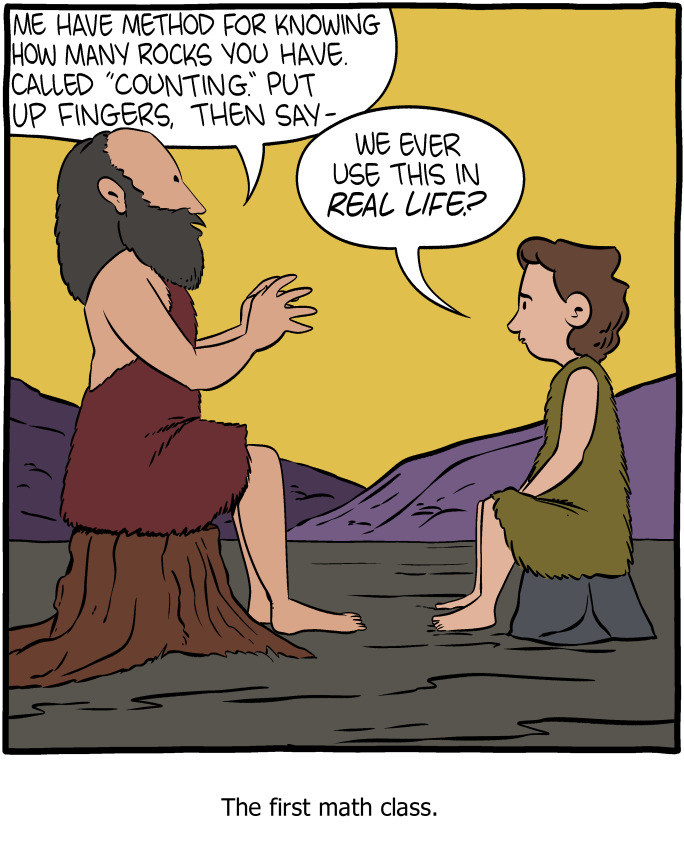
On my home planet, everyone learns basic algebra. Earth seems to be different.
People are actually discussing whether to remove algebra requirements from community college curricula. They don’t seem to be discussing the elimination of basic reading and writing skills, at least not yet. It seems to me, though, that passing algebra ought to be a really low hurdle to leap, but apparently it isn’t.
Algebra is one of the biggest hurdles to getting a high school or college degree — particularly for students of color and first-generation undergrads.
It is also the single most failed course in community colleges across the country. So if you’re not a STEM major (science, technology, engineering, math), why even study algebra?
I was a first generation undergrad. I didn’t take algebra in college…because I took it in high school. If you were on the college track, you took it early, because in your junior or senior year you’d take trigonometry/pre-calc. If you were an advanced math student (I wasn’t), you got calculus done right there in public school. 16 year olds can learn algebra. It really isn’t that daunting.
“Why even study algebra?” is a stupid question. If you’re not a history major, why study history? If you’re not an English major, why do you need to learn to write good? If you’re an American, why bother learning a foreign language? Algebra is a kind of minimum standard for elementary numeracy.
This interview with Eloy Ortiz Oakley is appalling in many ways.
You are facing pressure to increase graduation rates — only 48 percent graduate from California community colleges with an associate’s degree or transfer to a four-year institution within six years. As we’ve said, passing college algebra is a major barrier to graduation. But is this the easy way out? Just strike the algebra requirement to increase graduation rates instead of teaching math more effectively?
I hear that a lot and unfortunately nothing could be farther from the truth. Somewhere along the lines, since the 1950s, we decided that the only measure of a student’s ability to reason or to do some sort of quantitative measure is algebra. What we’re saying is we want as rigorous a course as possible to determine a student’s ability to succeed, but it should be relevant to their course of study. There are other math courses that we could introduce that tell us a lot more about our students.
No one decided that it was the only measure. People looked at the progression of math concepts that were taught — algebra, geometry, trigonometry, calculus — and set the standard on the most introductory of the math skills. Students who come into college not knowing algebra are totally screwed if they want to enter any STEM field, but even if they’re doing a non-STEM major, I’d argue that everyone ought to have that minimal level of math literacy.
I don’t see the problem here. If “relevance to their course of study” is the standard, I could see biology majors insisting that they don’t need to know psychology or literature (they’d be wrong). A college degree should not be a narrow certificate that says you’ve been exposed to a thin slice of knowledge, but here we are, arguing that it’s all about getting a job.
A lot of students in California community colleges are hoping to prepare for a four-year college. What are you hearing from the four-year institutions? Are they at ease with you dropping the requirement? Or would they then make the students take the same algebra course they’re not taking at community college?
This question is being raised at all levels of higher education — the university level as well as the community college level. There’s a great body of research that’s informing this discussion, much of it coming from some of our top universities, like the Dana Center at the University of Texas, or the Carnegie Foundation. So there’s a lot of research behind this and I think more and more of our public and private university partners are delving into this question of what is the right level of math depending on which major a student is pursuing.
Look. We get transfer students from community colleges at my university all the time. They do not and should not get a free pass on courses that our full four year students have to take — we don’t set standards arbitrarily. They need to take certain lower level courses because they’ll need those skills in upper level courses. If the community colleges set lower standards, it just means that they’ll have wasted two years as the four year colleges tell all those students entering in their third year that sorry, you have to go back and take all these courses your CC decided were unnecessary.
In a perfect world, students would learn algebra in high school; students who struggled or were not mature enough to engage in disciplined learning (which is a real problem) would attend a CC to get the prep they missed in high school, and the four year colleges would be able to assume a basic skill set on all entering students. If CCs are going to punt, what next? Do we just get unprepared students who enter college with 60 credits of unchallenging courses that do not prepare them all for the major curriculum?
And there are people writing about concepts of numeracy that may be different from what people have been teaching all this time. Do you have in mind a curriculum that would be more useful than intermediate algebra?
We are piloting different math pathways within our community colleges. We’re working with our university partners at CSU and the UC, trying to ensure that we can align these courses to best prepare our students to succeed in majors. And if you think about it, you think about the use of statistics not only for a social science major but for every U.S. citizen. This is a skill that we should have all of our students have with them because this affects them in their daily life.
I kind of agree with this — I would like to see more statistics-literacy in the general public. But this is a proposal to increase the amount of math students should know, and I don’t know how you teach statistics to students who can’t comprehend algebra. Again, there seems to be a relevance argument lurking here — if statistics awareness is good for every U.S. citizen, how can you suggest that art majors have no need of algebra? I want to see some minimal expectations for numeracy and literacy, and we don’t get there by trying to second-guess whether a student will ever find a particular fundamental skill “useful”. You just don’t know.