A Devonian hexapod

It always seems to be the case that there are gaps in the fossil record just where things get interesting — probably with good reason, that forms in transition will be relatively rare. One such gap is the period where insects first emerge and begin to conquer the terrestrial world, a period called the arthropod gap, between 385 and 325 million years ago. Here’s a new specimen from that relatively barren stretch of time, Strudiella devonica.
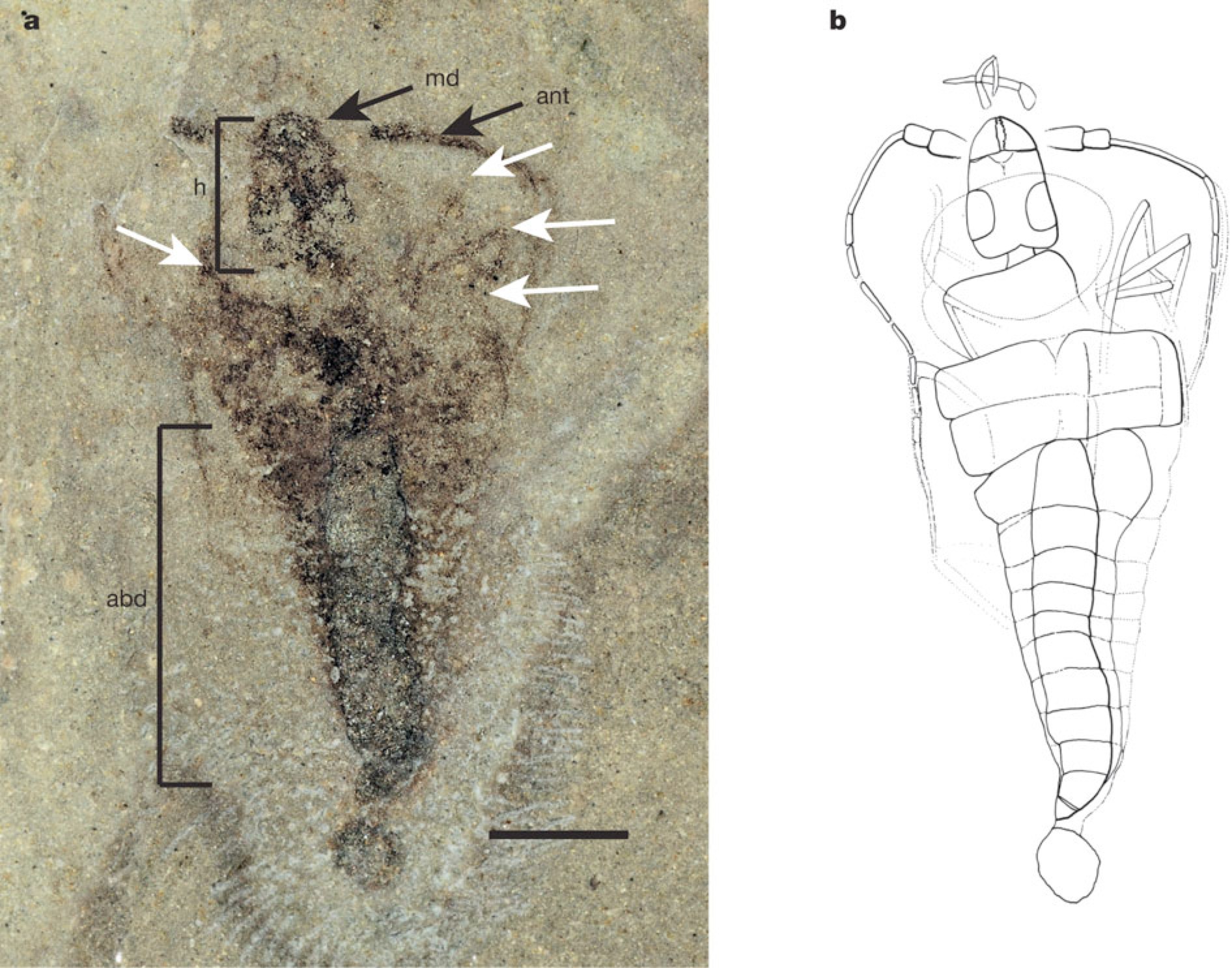

a, Photograph of the part. b, Reconstruction of general habitus. Scale bar, 1 mm. White arrows indicate legs visible on part. abd, abdomen; ant, antenna; h, head; md, mandible.

It’s a classic insect: a body divided into three regions (head, thorax, abdomen), six legs, a fairly general set of omnivorous mouthparts. It lacks wings, but the small size suggests it may be in a nymphal stage (also, the genitals at the tip of the abdomen didn’t make it), so that may not mean much.


Garrouste R, Clément G, Nel P, Engel MS, Grandcolas P, D’Haese C, Lagebro L, Denayer J, Gueriau P, Lafaite P, Olive S, Prestianni C, Nel A (2012) A complete insect from the Late Devonian period. Nature 488, 82–85.
(Whew, that’s a lot of authors for a short paper.)


That kind of wording scares me

There has been a new outbreak of Ebola in Uganda. This kind of stuff worries me, not in acute “oh-we’re-all-going-to-die-now” sort of way, but in a long term perspective. We’re all sitting here fat and happy and swarming, and what’s going to wipe out this species some day is a combination of resource depletion and new diseases — famine and plague, to name two of the horsemen.

But I thought this bit was bizarre.

Ondoa described the Ebola-Sudan strain detected as "mild" compared to other types of Ebola, noting that victims’ lives can be saved with intervention.

20 people infected.

14 dead.

“Mild.”

Another conversion story

Richard Muller used to be a doubter — he didn’t think global warming was a concern, and he didn’t think people were responsible for it. Now he has changed his mind, and he explains why.

Call me a converted skeptic. Three years ago I identified problems in previous climate studies that, in my mind, threw doubt on the very existence of global warming. Last year, following an intensive research effort involving a dozen scientists, I concluded that global warming was real and that the prior estimates of the rate of warming were correct. I’m now going a step further: Humans are almost entirely the cause.

My total turnaround, in such a short time, is the result of careful and objective analysis by the Berkeley Earth Surface Temperature project, which I founded with my daughter Elizabeth. Our results show that the average temperature of the earth’s land has risen by two and a half degrees Fahrenheit over the past 250 years, including an increase of one and a half degrees over the most recent 50 years. Moreover, it appears likely that essentially all of this increase results from the human emission of greenhouse gases.

You mean, sometimes evidence works? Wow.

The cables!

I saw this on @cstross‘s twitter feed and had to laugh. Audiophiles and other bewildered purchasers of high-end electronics can get thoroughly deranged and start throwing ridiculous sums of money at the most trivial components — like cables. How would you like this extra-special X-Box cable? I found one place selling it for $85; the non-elite cables without the virus protection are about $8.

If you really want an amazing deal, though, go for an AudioQuest K2 terminated speaker cable.

It’s only $8,450. And Amazon has 5 in stock! Order fast before they’re gone!

I don’t think they’re selling, though. The most wonderful thing about over-priced (or possibly typoed) cables are the reviews. You must read the reviews! Even the 5 star reviews are loaded with snark, but my very favorite is this one-star review. It’s a whole tragic story.

We live underground. We speak with our hands. We wear the earplugs all our lives.

PLEASE! You must listen! We cannot maintain the link for long… I will type as fast as I can.

DO NOT USE THE CABLES!

We were fools, fools to develop such a thing! Sound was never meant to be this clear, this pure, this… accurate. For a few short days, we marveled. Then the… whispers… began.

Were they Aramaic? Hyperborean? Some even more ancient tongue, first spoken by elder races under the red light of dying suns far from here? We do not know, but somehow, slowly… we began to UNDERSTAND.

No, no, please! I don’t want to remember! YOU WILL NOT MAKE ME REMEMBER! I saw brave men claw their own eyes out… oh, god, the screaming… the mobs of feral children feasting on corpses, the shadows MOVING, the fires burning in the air! The CHANTING!

WHY CAN’T I FORGET THE WORDS???

We live underground. We speak with our hands. We wear the earplugs all our lives.

Do not use the cables!

I want to read more of the author’s work. Alas, after that one flash of brilliance, most of Whisper’s work is pedestrian: shoes, exercise equipment, computer accessories. No audio gear, though, which is only to be expected if he has to wear earplugs all the time.

Not just Sally Ride

I had never heard of the Women in Space Program before, but apparently, after the Soviets sent Valentina Tereshkova into space, there was actually an effort to train American women as astronauts.

The participants of the Women in Space Program experienced tremendous success. “Nineteen women enrolled in WISP, undergoing the same grueling tests administered to the male Mercury astronauts,” Brandon Keim wrote in 2009. “Thirteen of them — later dubbed the Mercury 13 — passed ‘with no medical reservations,’ a higher graduation rate than the first male class. The top four women scored as highly as any of the men.”

The graduates were Geraldyn “Jerrie” Cobb, Wally Funk, Irene Leverton, Myrtle “K” Cagle, Jane B. Hart, Gene Nora Stumbough, Jerri Sloan, Rhea Hurrle, Sarah Gorelick, Bernice “B” Trimble Steadman, Jan Dietrich, Marion Dietrich, and Jean Hixson, called the “Mercury 13”.

I never heard of them before. They didn’t go into space, either. What happened?

Well, there were some revoltingly sexist attitudes at NASA.

In fact, one NASA official who declined to give his name to a reporter, said it made him “sick to his stomach” to think of women in space. Another called Tereshkova’s flight “a publicity stunt.”

A few did think of one use for women in space: “improving crew morale”. They nixed that because “such a situation might create interpersonal tensions far more dynamic than the sexual tensions it would release”. Yeah, they went there: the one thing a woman astronaut might be good for is getting her male colleagues off during long space flights.

So they come up with a lovely catch to prevent well-qualified women from joining the space program.

For a short while, it seemed that their quest to fly might advance. In 1962, the women were scheduled to continue testing at the Naval School of Aviation Medicine in Pensacola, Florida, but NASA declined to support their visit. Without official backing, the Navy canceled the trip. Cobb tried to save the program, flying to Washington and testifying before Congress. But NASA officials, John Glenn among them, told the Congressmen that women couldn’t be astronauts because they hadn’t flown jets, which were only available to the military, which also barred women.

This argument apparently proved persuasive and the Mercury 13 never got another chance to make their case for space, even after Tereshkova’s record-setting flight.

Would you believe I got a comment from a Thunderf00t acolyte on youtube just this morning?

FEMINISM IS A NON ISSUE. WOMEN ALREEEEEEEEADY HAVE EQUAL RIGHTS IN THE WEST. NO MORE NEED FOR FEMINISM IN THE WEST.

Nice to know these problems have all gone away already.

A poll on kitty experimentation

There is an extremely common sort of experiment to understand plasticity of the developing brain. These are important experiments to understand an important phenomenon: the brain does not simply unfold ineluctably to produce a fully functional organ, but actually interacts constantly with its environment to build a functioning organ that is matched to the world it must model and work with. This was one of the very first things I learned as a budding neuroscientist; my first undergraduate research experience was in the lab of Jenny Lund at the University of Washington, where we were given prepared slices of embryonic and infant human brains (the products of abortions, stillbirths, and childhood mortality) and counted dendritic spines in the visual cortex. The brain is constantly remodeling itself, and is especially doing so in young individuals.

Now in those old observations, we weren’t really manipulating either the brain or the environment: you don’t get to do that with human babies! All we were doing was documenting the natural progression of synaptic connection density — which, by the way, declines rapidly as the brain learns and refines. What we could see anatomically is that as young children adapt to their environment, the brain is busily pruning and shifting connections — but what we couldn’t see is what was causing those changes, or what effect those anatomical changes had on visual processing.

For that, you have to tinker. And since you can’t do that with human babies, you have to go to animal models.

And the most common animal models for studying the visual system in humans are mammals: cats (also ferrets, for technical reasons involving some of the pathways). And since we’re interested in the plasticity of the brain in young, developing animals, you can see where this is going.

Neuroscientists do experiments on kittens.

THE WHOLE KITTY-LOVING INTERNET EXPLODES IN OUTRAGE.

Actually, it sort of does. The Mirror just put up an article decrying kitten experimentation, with lots of quotes from celebrities moaning in horror.

Ricky Gervais: “I am appalled that kittens are being deprived of sight by having their eyelids sewn shut. I thought sickening experiments like these were a thing of the past.”

Why, no, Ricky. These experiments go on right now. It’s how we learn to understand the role of sensory input in shaping the function of the visual cortex.

Michelle Thew of The British Union for the Abolition of Vivisection: “This is unacceptable cruel research. The public will be shocked to learn of publicly-funded experiments where kittens have been subjected to this.”

Of course they will, because your organization will beat the drum of ignorance and lie about their practice and utility.

Dr Ned Buyukmihci, a vet: “The eyelid procedures would have been painful for the kittens. There are substantial ­differences in cats versus humans. There are ­established methods of obtaining information humanely.”

I’ve done experiments like these in the past, and even more substantial surgical manipulations. The investigators know how to do these experiments humanely: we know about anesthesia, for instance, and anything involving surgery on animals is tightly policed by Institutional Review Boards (actually, they tend to be discouraged by IRBs, but that’s a different complaint), which usually have veterinarians serving on them. If Buyukmihci has evidence that these surgeries were done in a way that did not minimize suffering, he should speak up, and the neuroscience community would join him in deploring them.

But these protocols went through Cardiff University’s ethical review process and the Home Office Animals in Science Regulation Unit. There’s no reason to think they were anything less than impeccable.

Ralph Cook, some politician or bureaucrat: “It’s an academic producing a paper which is meaningless and can’t be transferred to humans. Vivisection is completely wrong.”

No, actually, most of this research isn’t just an abstract pursuit of knowledge (although there’s nothing wrong with that, either). This is research that is directly applicable to alleviating human suffering. Treatment of visual system disorders in children is informed directly by these kinds of experiments: they tell us about the sensitivity of the visual system to abnormalities in inputs and long term effects of sustained aberrations. I had a child with ‘lazy eye’ at birth: the doctors (as well as the parents in this case) knew how important it was to correct this problem as quickly as possible, and gave us protocols (tested in cats!) that we could implement until she was old enough to get surgery.

Ingrid Newkirk, PETA’s fanatical nutball: “Not only is sewing shut the eyes of kittens ­ethically and morally abhorrent, it is so crude and cruel that it sets science back decades. The kittens will suffer from having their eyes sewn shut and will also experience psychological distress from being reared in the dark. We learn far more about what happens in humans by investing in state-of-the-art research methods that provide reliable data on human experience.”

Scientists don’t do these experiments to get their jollies torturing kittens. These are experiments that advance our understanding of the wiring of the brain.

I agree that there is an amount of suffering involved, and having done similar work, I also know that good investigators do their best to minimize it. My second job as an undergraduate was as an animal care assistant in a surgery, and one of the things I was paid to do was to spend a few hours a day just playing with post-op cats and kittens, and making sure that their housing was clean and comfortable. These were conscientious scientists. They needed to do these experiments, but they also cared about the animals. I was really impressed with their concern and respect for the animals they had to do experiments on.

(By the way, this was an animal surgery that was also used as a training unit for the medical school. One other thing I learned there was that while Ph.D. researchers were people with a deep affection for their subjects, M.D. students were assholes who didn’t give a damn. I hope they learned some humanity later in their careers, because I didn’t see it at the early stage when they were practicing on animals.)

So, after doing a hatchet job on the research and quoting lots of ignorant celebrity wankers and cranky nobodies, the Mirror has a poll. This will be a challenge: you’re going to have to go up against the whole kitty-loving internet to shift this one.

Is the scientific experiment on kittens acceptable?

Yes 7.44%

No 92.56%

Good luck with that one.