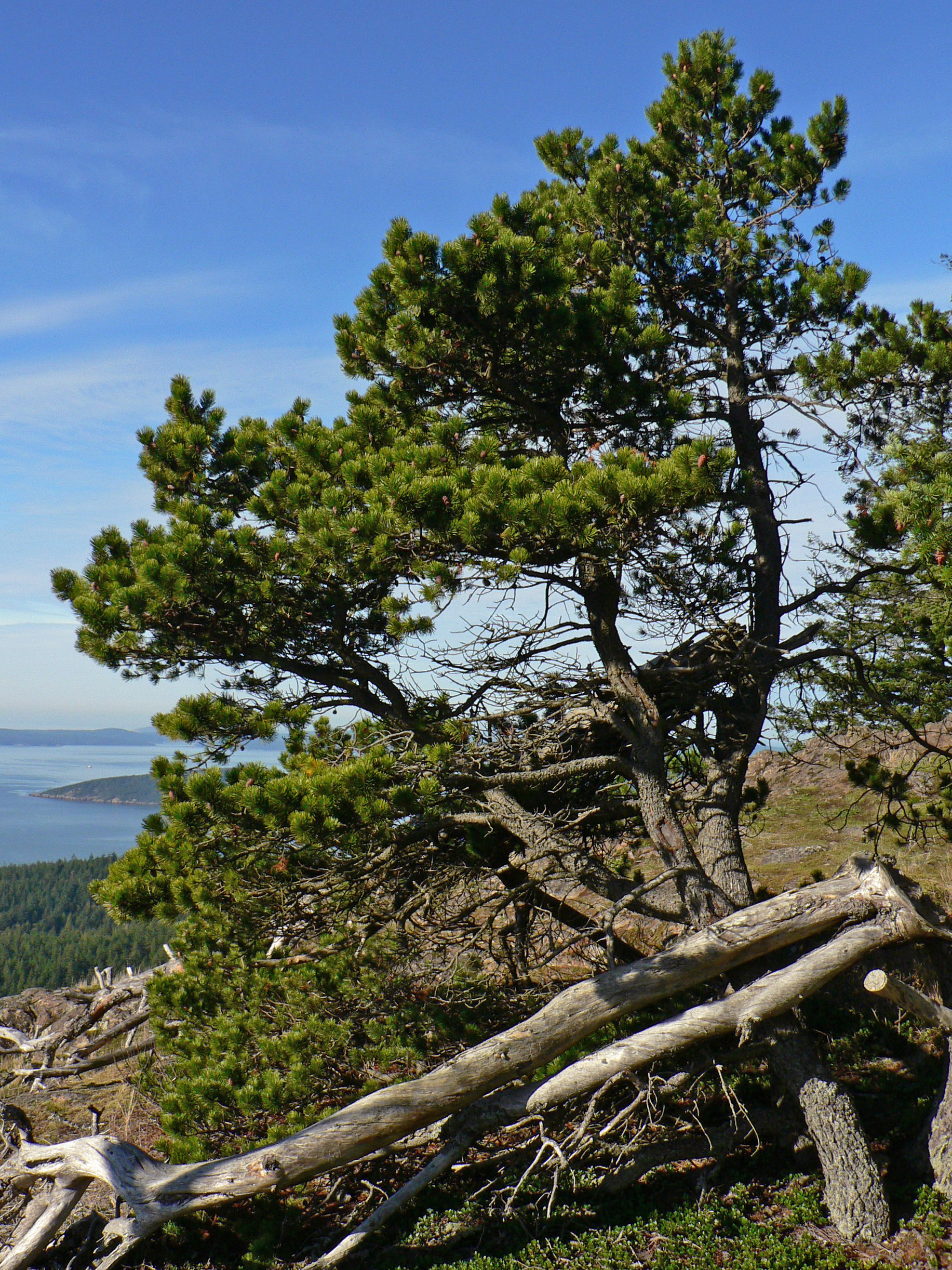
Botanical Wednesday: A rugged old tree


The Vampire Squid, Vampyroteuthis infernalis has the most bad-ass name and has the coolest, creepiest appearance of all the cephalopods — who doesn’t see it and think Halloween? But it’s a little known fact that it actually drifts in deep and nearly anoxic layers of the ocean, surviving by maintaining a very low metabolism, and from what I’ve heard has a soft, flaccid, jelly-like texture (which actually fits with a vampire: have you ever noticed how people in the movies can easily punch crude wooden stakes right into their hearts?)
But now, further disillusionment from an analysis of their diet. It turns out that the vampire squid literally eats shit to live.
Vampyroteuthis infernalis – literally the "vampire squid from hell" – has a pair of thin, retractable filaments. It uses them like a fishing line, letting them drift and collect bits of waste. Wiping the filaments across its arms, the squid combines the waste with mucus secreted from its suckers to form balls of food, which it gobbles up.
Next they’re going to tell me it doesn’t even sparkle. <throws self on bed, weeps into pillow>

A while back, I read Hamza Tzortzis’ “paper”, Embryology in the Qur’an: A scientific-linguistic analysis of chapter 23: With responses to historical, scientific & popular contentions. It was terrible and painful: a 58 page treatise (with big print and lots of white space) expanding obsessively on two sentences from the Quran, claiming that it revealed deep insights about embryology that could not have been known without magical, supernatural insight. It was total bullshit.
Now, get ready for this: a couple of scholars have ripped into the Tzortzis paper at length. Embryology in the Quran: Much Ado about Nothing: A Refutation of Hamza Tzortzis’ Embryology in the Qur’an: A Scientific-Linguistic Analysis of Chapter 23.
It’s 149 pages long.
I haven’t read the whole thing, but did a few spot checks, and it looks solid so far. I’m just worried that now we’re in an escalation spiral, and Tzortzis will reply with a badly researched refutation of the refutation that will be 500 pages long.
The letter I was sent about the paper points out that it’s an important perspective, though: it’s not just Western scientists dismissing an Islamic perspective, but the authors are ex-Muslims who grew up steeped in Islamic culture, so it’s an internal criticism.
While it most probably is the case that you are thoroughly bored with Hamza Tzortzis and his fraudulent claims about Embryology in the Quran, there is a new document recently uploaded that does serious damage to the image of Hamza Tzortzis and at the same time, provides a definitive debunking of the unfortunately popular Islamic Embryology claim that has been touted for the last 30 years; spouted and spread so well, that children growing up in Islamic families take it as just another accepted fact and treat it just the same way they treat the fact that the Earth is round. As an Ex-Muslim, I can attest to this as I too for several years took it for granted that the Quran contained modern embryological facts (even when I knew nothing of the subject as a kid).
The embryology claim is one that has been unfortunately drilled deep into the psyche of most Muslims. The name “Keith Moore” is pretty much a house hold name for many Muslims. It is for this very reason that ex-Muslims like myself consider this new document titled “Embryology in the Quran: Much Ado about Nothing” very very important.
While yourself and many others have refuted Hamza’s hogwash, it is also true that the refutations so far were quite generalized . They very well do appeal to Skeptics (esp. those from the Christian background), however they were never enough to convince most of the Muslims and even ex-Muslims as they grew up knowing every detail of apologetics regarding this claim like the back of their hand.
This is where the new paper stands different. It takes a somewhat “James Randian” approach and uses the exact sources and methodologies used by Muslims to disprove definitively the embryology claim. The arguments in there have such a depth that even Muslims won’t be able to ignore them (or at least not without maintaining a cognitive dissonance).
Good. More voices and more perspectives are always helpful.


Mohave ground squirrels at a camera trap bait pile. Not shown: “Free Skwirl Fud” sign. Photo by U.S. Army Engineer Research & Development Center
It’s a year old, but I just read a paper on one of those species that pops up pretty frequently in environmental impact reports — the Mohave ground squirrel, Xerospermophilus mohavensis — whose conclusions add a little bit more depth to the Deep Time perspective of the desert around here. And by “depth” I mean “epic stories.”

I can take it no more. I wanted to dig deeper into the good stuff done by the ENCODE consortium, and have been working my way through some of the papers (not an easy thing, either: I have a very high workload this term), but then I saw this declaration from the Electronic Frontier Foundation.
On September 19, the Ninth Circuit is set to hear new arguments in Haskell v. Harris, a case challenging California’s warrantless DNA collection program. Today EFF asked the court to consider ground-breaking new research that confirms for the first time that over 80% of our DNA that was once thought to have no function, actually plays a critical role in controlling how our cells, tissue and organs behave.

Yeah, sorry, but at the vertex of all those slimy tentacular columns lies this hard, knife-edged, pointy, shiny, muscular beak.

(via Naturetrek)

Beneath the mysterious waters of the Sea of Japan, strange symbolic artworks have been spontaneously appearing — intricate mandalas, six feet in diameter, dot the sandy bottom. What could they mean?

Perhaps the aliens have been making these all along, at the same time they’ve been sending secret messages in crop circles. Perhaps they are manifestations of the Universal Consciousness, erupting into expressions of cosmic beauty. Maybe their meaning is their mystery, telling us to appreciate more what we do not know.
Nah, I don’t go for any of that mumbo-jumbo. Scientists put video cameras underwater, and caught the creator in the act. It’s this little puffer fish, a few inches long.
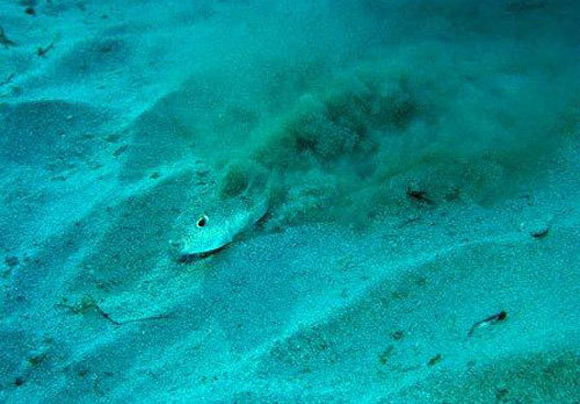
Using underwater cameras the team discovered the artist is a small puffer fish only a few inches in length that swims tirelessly through the day and night to create these vast organic sculptures using the gesture of a single fin. Through careful observation the team found the circles serve a variety of crucial ecological functions, the most important of which is to attract mates. Apparently the female fish are attracted to the hills and valleys within the sand and traverse them carefully to discover the male fish where the pair eventually lay eggs at the circle’s center, the grooves later acting as a natural buffer to ocean currents that protect the delicate offspring. Scientists also learned that the more ridges contained within the sculpture resulted in a much greater likelihood of the fish pairing.
I don’t believe in cosmic consciousness, but I do believe horny little animals will go to great lengths for sex.

I spend a lot of time paying attention to threats to the organisms that live in the desert, and what with all the environmental bad news available online these days that can be pretty damned depressing. This past weekend, though, I was reminded that there is actually hope for the future. Centuries from now we may well find that desert plants, especially those that now live within a day’s drive of Los Angeles, have a vital role to play in making yet-undiscovered planets habitable.
I was reminded of this while re-watching a set of documentary films describing the terraforming of an entire complex system full of dozens of more or less habitable planets, in many cases using entire vegetative suites once native to the California desert. I’ve gone back and taken some screenshots of these films to illustrate some of the ways in which the terraformers used desert plants, and they — along with discussion of the terraformed vegetation –are below the fold.

About a year ago I was exploring the desert east of Joshua Tree National Park, looking for a good spot to hold a desert camping meetup for readers of Coyote Crossing, and I stopped at a little open spot not far from a mature desert ironwood tree.
It had rained a week or so beforehand, catastrophically so in some places. The storm series that came through closed major roads through the park for some months afterward. Where I stopped there was about a ten-foot earthen flood-control berm put in place to protect the (LA) Metropolitan Water District’s buried aqueduct from storm damage, and a flash flood had taken a slice out of that ten-foot berm that was as straight-sided as if it was a cake recently attacked by a knife.
The ground had recently been very wet, in other words. And when the desert soil gets wet in the late summer, interesting things happen. Winter rains are more predictable, and after a wet winter you can predictably get a pretty damn nice bloom across the desert; yellow primroses and pink desert verbena and white ghost flower covering entire bajadas that are usually shades of brown desert varnish.
But summer rains are sporadic, unpredictable, and usually very localized. A given valley in the desert might go fifty years without a good summer rain. When that valley does get a summer rain, annual plants that have been waiting in the soil seed bank for decades can come up within a few days, flower within a couple weeks, set seed and disperse that seed and die back within a month and a half. My desert botanist friends watch the weather carefully in summer, ready to plan trips out into the backcountry with the plant presses within two weeks of the drop of a hat.
The North American deserts are essentially terra incognita for botanists. There are a few things that are quite well known, because they grow and bloom during the more comfortable parts of the year within a few miles of pavement. And then there are the valleys that are a difficult day’s hike from the hearest two-rut 4WD road, and we generally don’t know what blooms there when it’s 115°F during the day because botanists are not that much more insane than the rest of us. That’s true of herpetologists and entomologists as well, and so we don’t really know some of the smaller fauna of the remote parts all that thoroughly either.
Jim André of the Sweeney Granite Mountains Desert Research Center in the Mojave Preserve tells me that if you look out at a typical Mojave Desert landscape, 10% or more of the species in your field of view aren’t known to science. He says that just about every time he goes out in the field he finds either a species or subspecies not formerly known to lie in that area, or even new to science. I’ve been in places relatively easy to get to, the California Black Hills for example, and noted plants that had not been recorded by any botanist whose records are available to the Calflora database: this tiny little cactus being one inconspicuous example:
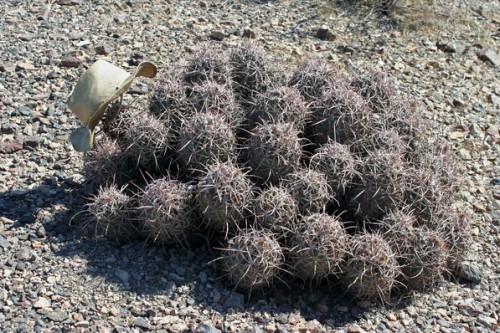
Echinocactus polycephalus with Size XL Scala hat
But you find totally expected things too, like for instance on that day on which I was scouting out possible meetup campsites. A week or so after a drenching rain, in an area in which a mature ironwood tree had been dropping its leguminous seeds for some centuries, it wasn’t at all surprising to find that a couple had sprouted.
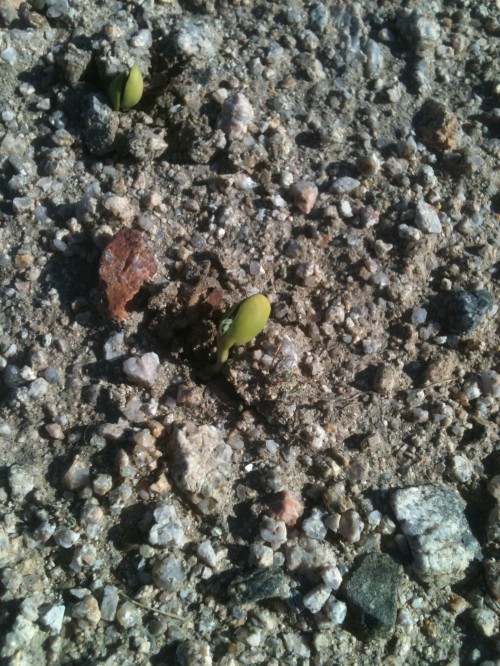
Olneya tesota seedlings
I don’t know how long the seeds had lain there before sprouting. Unlike a lot of other hard-coated desert tree seeds, ironwoods will sprout without scarification — without scratching the seed coats to let moisture in. They might have been there for six months or a century, waiting.
Ironwoods are likely my second favorite desert tree, possibly third if you count saguaros as trees. They fix nitrogen, always in short supply in the desert. They grow slowly, When they die, the wood they leave behind is — in the words of Phillips and Comus’ A Natural History of the Sonoran Desert,“rich in toxic chemicals and essentially non-biodegradable.” It’s supposed to be the second densest wood known after lignum vitae, and it’s a gorgeous chocolate color when carved and polished, which trait southwestern gift shops use to their full advantage. (The Seri Indians pioneered the art of ironwood carving using fallen wood, but the art proved so popular that others appropriated it and started cutting live trees to meet demand.)
It was a little hard to imagine that these tiny seedlings, first true leaves just starting to peek out from between the waxy cotyledons, might within a few months become some of the toughest, most enduring organisms the desert knows.
It’s been a year: I’ll have to go back and check on them.