DEVELOPMENTAL BIOLOGISTS RULE ALL THE THINGS

I keep telling you guys this, but some of you non-developmental biologists dare to disagree — but it’s true, I’ma gonna tell you, developmental biology is the greatest scientific discipline of all time. We have confirmation, too: The Nobel Prize in Physiology or Medicine for 2012 has been announced, and it goes to two developmental biologists, John Gurdon (about time) and Shinya Yamanaka. It also goes for research in stem cells.

Gurdon carried out the initial crucial experiment years ago. He sucked the nucleus out of an adult frog skin cell and injected it into an enucleated frog egg. What happened next was that in some cases, the nucleus was reprogrammed into a pluripotent state — instead of being a skin cell with its specific suite of active and inactive genes, it was transformed into an egg cell equivalent, and went on to divide and dutifully create a genetic copy of the donor frog…a clone. This was the precursor to all the animal cloning experiments that have gone on since.

Gurdon’s experiment worked, but we didn’t know how — we knew that the environment of the cytoplasm of the egg cell somehow reset the epigenetic state of the skin cell nucleus, but we were blind to what was actually doing the work.

Enter Yamanaka and his colleagues. What they did was figure out what genes constituted the reset button of the cell, and by expressing them could force adult cells to revert to a pluripotent state. Their approach is a kind of brute force global activation of the four genes identified as key triggers in mammalian cells, but it works: adult mouse cells have been transformed, and then go on to develop into clones of the donor, and it also works on human cells, although no full human clones have been produced — just tissue collections in a dish, or teratomas in mouse hosts.

These are important steps in developing tools to allow us to sculpt adult cells into tissues and organs and whole organisms. Notice that the work was done at Cambridge and Kyoto which, for the geographically challenged, are not American universities. There is good stem cell work being done in the US, but it’s hampered by regulations and restrictions that European and Asian universities do not suffer from. Unleash all the developmental biologists, because we must rule all the things everywhere!

The Balance of Nature

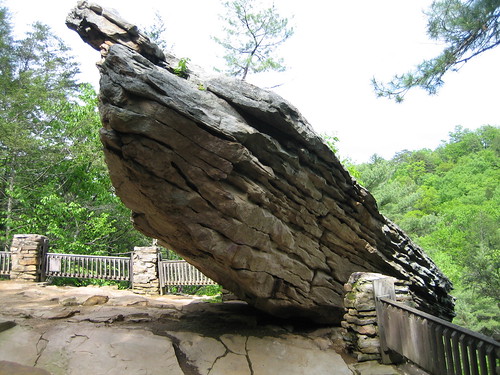
Balanced Rock, Trough Creek State Park

One of the things that bugs me most about some of my fellow environmentalists, aside from the patchouli, is the near-religious adherence — even among those enviros who eschew religion — to the notion that natural ecological systems have an innate and emergent self-repairing property. It’s a dangerous idea that breeds complacency, and it’s really widespread.

[Read more…]

The Oblivion Bridge

Early last month I threatened all of you that I might be moving some of my old posts from Creek Running North / Coyote Crossing  to this joint, assuming they’re appropriate for the venue. I see it’s been a month since I did so. Somewhat coincidentally, I’ve been a little mopey for the last couple weeks over the sixmonthiversary of having to say goodbye to my friend Thistle, and a post I wrote six months ago last week seemed very much appropriate for Pharyngulizing. So here is is, slightly edited, with special bonus photo.

[Read more…]

Ed Abbey, White Courtesy Phone

chollas

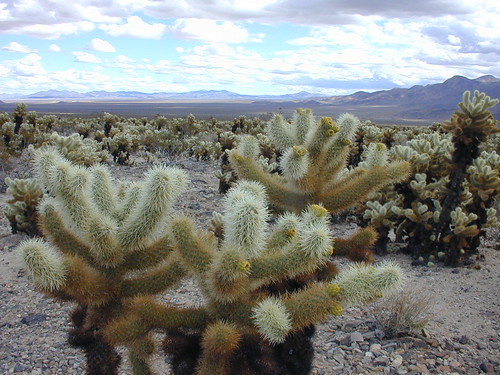
Cholla Garden, Joshua Tree National Park

Here’s one of those little “slice of political life in the desert” things. There’s a road through Joshua Tree National Park called Pinto Basin Road that’s seen better days. It washed out rather badly a year ago, in a series of monsoon storms, and it was closed for months — leaving most of the park inaccessible to Winnebagos. Winnebagi? I can never remember which declension that is.

Anyway, the road was in rough shape even before the storms. It’s on alluvium and generally just a couple inches thick, which means that each time a passing Winnebagus rolls slightly off the edge of the pavement the roadbed deteriorates just a little. Some of the road’s stretches have limited sight distance due to going around alluvial fans and down into washes and such. It’s perfectly safe if you drive the posted limit, which never gets higher than 45 miles per hour, but no one ever drives the posted limit because it’s out in the middle of the godforsaken desert with “nothing to look at” except at the sanctioned pullouts, where you’re encouraged to pull out and look at a sign that explains to you that you’re in the middle of the godforsaken desert. So people try to drive at 55 mph or more, and every so often a speeding Winnebagum catches the edge of the road and rolls over into the desert. A few fatal accidents have resulted.

So the Park Service has been meaning to upgrade the road for a while: the 2011 storms merely made it mandatory.

The road, by the way, is perfectly wonderful as is. A few days before the storms broke it last year Annette and I drove it in her Mini Cooper, which has approximately seven ångströms of road clearance, and we did just fine. It was late at night — we’d been in the Park watching the Perseids — and we were the only people on the road for miles, driving at 35 mph, blocked from cell service and radio contact, finally able to bring in an AM radio station from the Navajo Reservation. It was a nice night.

Anyway: they’re widening the road by two feet, increasing the sight distance in some places, and presumably making the roadbed a bit more robust. I’d known about that for a few months.

What I didn’t know is this.

One of the sanctioned pullouts along the stretch of road is the Cholla Cactus Garden — a gorgeous patch of teddy-bear cholla (Cylindropuntia bigelovii) that’s one of the most-visited spots in the Park. I took the photo above there 12-odd years ago. Annette and I went there on one of our first dates back in 2008, went for a walk through the cacti, and returned to find my (late lamented) Jeep full of hundreds of angry bees. (“This date is going well,” I thought to myself at the time.)

Since the spot is so popular, there’s a large-ish dirt parking lot there. And as part of the road project, they want to improve the parking lot. They’re going to pave it and stripe it, which is just and fitting. It’s way the hell out in the stinking desert, but the dictates of civilization must be obeyed.

But the Park Service also wants to “upgrade” the parking area. The plan is to bring it up to 20-30 auto spaces and add an area for drivers of Winnebagae to moor their crafts.

So they are going to expand the parking lot to allow people to get out and enjoy the cholla. In order to do so, they are pushing the parking lot about 30 feet into the Cholla Cactus Garden. And due to the Cauly Exclusion Principle, which states that a Winnebago and an arborescent cholla cannot occupy the same space simultaneously, the chollas have to move.

Which means that in order to facilitate tourists’ ability to get out and look at the chollas, the Park Service is putting a parking lot where the chollas are.

The park service starts digging up an acre of chollas October 15. They’re going to be replanted in another area of the cholla patch that the Park Service has declared in need of revegetation. According to the local magazine the Sun Runner, about 800 mature chollas will be moved out of the way of the Winneba[suffices], and as many as 600 of them are expected to survive replanting.

The National Park staff includes super-smart botanists who are very likely as competent to keep transplanted Cylindropuntia bigelovii alive as anyone on the planet. And I’m guessing those botanists didn’t come up with this idea.It’s not the biggest evil in the world, and the road project is definitely being paved with good intentions. But still.

Anyway: you have a week to see the Cholla Cactus Garden as it once was. When you park on the dirt, roll up your windows so the bees don’t get in.


Hasn’t changed a bit in half a millennium

Archaeologists are digging up a Tuscan convent and have found some skeletons that might include the remains of Lisa Gherardini del Giocondo, also known as Mona Lisa. She’s still lovely after all this time.

One investigator has been going through the bones, trying to identify the dead woman, so they can apply forensic reconstruction to her skull.

Wait…why?

I mean, we already know what she looked like. I can understand general historical research on Renaissance remains, but pawing through the graveyard to find one famous person simply to reconstruct a face we’re already familiar with seems peculiarly ghoulish — nothing but a sensationalistic game. What question does this answer, what do we learn from this pointless exercise?

Fortunately, I’m not the only one who wonders about that.

But not all experts are convinced by the claims of Dr Vinceti and his team. Dr Kristina Killgrove, an anthropologist at University of North Carolina at Chapel Hill in the US, said on her blog: "Although the excavation is being carried out in a professional manner, Vinceti’s quest to dig up the ‘real’ Mona Lisa is not grounded in scientific research methodology." She added: "The news media’s breathless coverage of it threatens to signal to the public that archaeologists are frivolous with their time, energy, and research money."

Maybe, once they identify the skull, they can send it off to the Louvre and mount it on the wall next to the painting. <sarcasm>That’ll be informative.</sarcasm>