Mary’s Monday Metazoan: Ol’ Three-Eyes

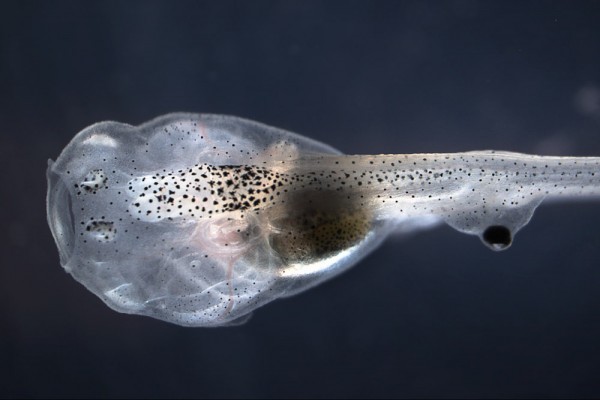
It’s a frog tadpole with an eye surgically grafted to its trunk!
ol3eyes

Wait, this is an old story — similar experiments were done at least 20 years ago. You can transplant developing eyes to the tadpole, but the cool thing is that the donor optic nerves will grow into the sensory tracts of the dorsal spinal cord and grow anteriorly to the optic tectum, where they will make functional connections. Not, as I recall, adequate for image formation, but at least good enough that the tadpole will startle if a light is flashed at the eye in its tail.

I did kind of go “ugh” at the spin the story put on it, though: that it could lead to a medical breakthrough that would allow blind people to see! Nope. Frogs already readily accept eye grafts and regrow the connections; there are lots of experiments where, for instance, you cut out the adult frog eye, severing the optic nerve, and reinsert it upside down, and the nerves grow back and build new, functional connections. That’s the hard part, getting operational regrowth. Planting ectopic eyes is trivial.

More lies from the Discovery Institute

Oh, christ. Another book is coming from those frauds at the DI, Darwin’s Doubt: The Explosive Origin of Animal Life and the Case for Intelligent Design. It’s Stephen Meyer’s unqualified, incompetent take on the Cambrian explosion.

Casey Luskin has already given us three reasons we’re supposed to buy it. 1) It’s going to contain the best arguments for intelligent design creationism EVAR; 2) it’s going to be packed full of reviews of the work of the “ID research community”; and 3) we’re living in a “post-Darwinian world”, where all the evolutionary biologists are already deserting the sinking ship of neo-Darwinism. Those aren’t reasons to buy the book; those are reasons the book is going to be total crap.

And why should you read it anyway? You want to know about the Cambrian, read books by real scientists. They’re out there already. One excellent resource is James Valentine’s On the Origin of Phyla; it is not light reading, but if you want to know about the paleontology and systematics of the invertebrate phyla of the Ediacaran and Cambrian, it really is the book to read.

And then to my surprise, while I was digging up the link to that book, I discovered that Douglas Erwin and James Valentine have a new book out as of January: The Cambrian Explosion: The Construction of Animal Biodiversity, which the reviews say is less technical than the Phyla text, but highly rated as an excellent overview. I can’t say I’ve read it yet, but I instantly ordered it.

I think it might be an interesting summer project to compare Erwin & Valentine side-by-side with Meyer. Well, “interesting” in a Bambi Meets Godzilla sort of amusing sense.

But if you want to know what caused the Cambrian explosion, I can give you the short answer. Not intelligent design; that doesn’t even make sense. What it was was environmental changes, in particular the bioturbation revolution caused by the evolution of worms that released buried nutrients, and the steadily increasing oxygen content of the atmosphere that allowed those nutrients to fuel growth; ecological competition, or a kind of arms race, that gave a distinct selective advantage to novelties that allowed species to occupy new niches; and the evolution of developmental mechanisms that enabled multicellular organisms to generate new morphotypes readily. Read the real books if you want to know more, and ignore the uninformed babble the charlatans of the DI will try to sell you.


By the way, Joe Felsenstein is asking for help: he’d like suggestions for what Stephen Meyer ought to have in his book.

The perils of anthropology…and other scientific disciplines

I’m beginning to get geared up for the summer research season, and I have to count myself as fortunate. I’m one of those bench guys; I’ll be fussing over embryos and computers in an air-conditioned lab, and mostly sitting in front of a microscope. The field researchers will be out hiking, and facing other privations: heat, humidity, man-eating mosquitos, ticks, summer rainstorms, sexual harassment, assault, and rape.

Oh, wait, those last three…not a problem here at UMM, we’ve got a good group of faculty we can trust to respect the students. But elsewhere, in fields like anthropology where groups of men and women might be out in remote areas for long periods of time, Kate Clancy reports that they are big problems.

We heard many reports of women not being allowed to do certain kinds of field work, being driven or warned away from particular field sites, and being denied access to research materials that were freely given to men (and men who were given access were the ones telling us these things). Ultimately, not being able to go to certain field sites, having to change field sites, or not being able to access research materials means women are denied the opportunity to ask certain research questions in our field. This has the potential to limit the CVs of women and given them permanently lesser research trajectories. This can lead to not getting jobs, or getting lower-tier jobs. It also means certain research questions may get primarily asked by one gender, and reducing the diversity of people doing research has been shown to reduce the diversity and quality of the work.

Don’t be discouraged from going into anthropology if that’s the field you love, but just be prepared: women have an extra duty piled on top of all the research work, to slap down privileged offenders…who may be their superiors.

Hey, wait a minute: Clancy is focused on the field work situation, but even in my cozy climate-controlled environment, there is the possibility of harassment — I’ve even heard tales of faculty (at other universities, of course) who were dirty old men who made life hell for their women students. Is anyone doing work similar to Clancy’s in places like medical schools? Maybe we should be sending teams of anthropologists in to study the indigenous cultures of the biomedical establishment. I fear it would be scary stuff, but at least you wouldn’t have to deal with mosquitos.

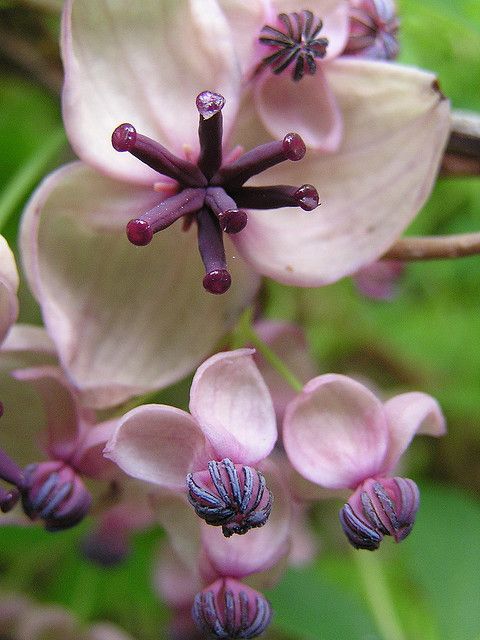
Botanical Wednesday: One, two, three…ha ha ha…four, five, six, SEVEN. Seven purple tentacles, ha ha ha!

Sorry, I was looking at this Akebia flower, and for some reason I felt a compulsion to count the number of carpels, and I did it out loud in the voice of Sesame Street’s Count. It’s been a long day of proofreading and I’m home all alone, and I think I’m getting punchy. I should probably just go to bed.

akebia

(via Scienceray)

Joe Barton has data!

The Rethuglican from Texas wants us all to appreciate the diversity of causes behind climate change. It might be natural, it might be human-caused, and it might just be magic.

I would point out that if you’re a believer in in the Bible, one would have to say the Great Flood is an example of climate change and that certainly wasn’t because mankind had overdeveloped hydrocarbon energy.

Don’t just blame Big Oil! It could also be God’s fault!