Disaster in Oklahoma

Moore, Oklahoma has been completely flattened by a tornado. Homes and businesses have been destroyed, but also a couple of schools and a hospital.
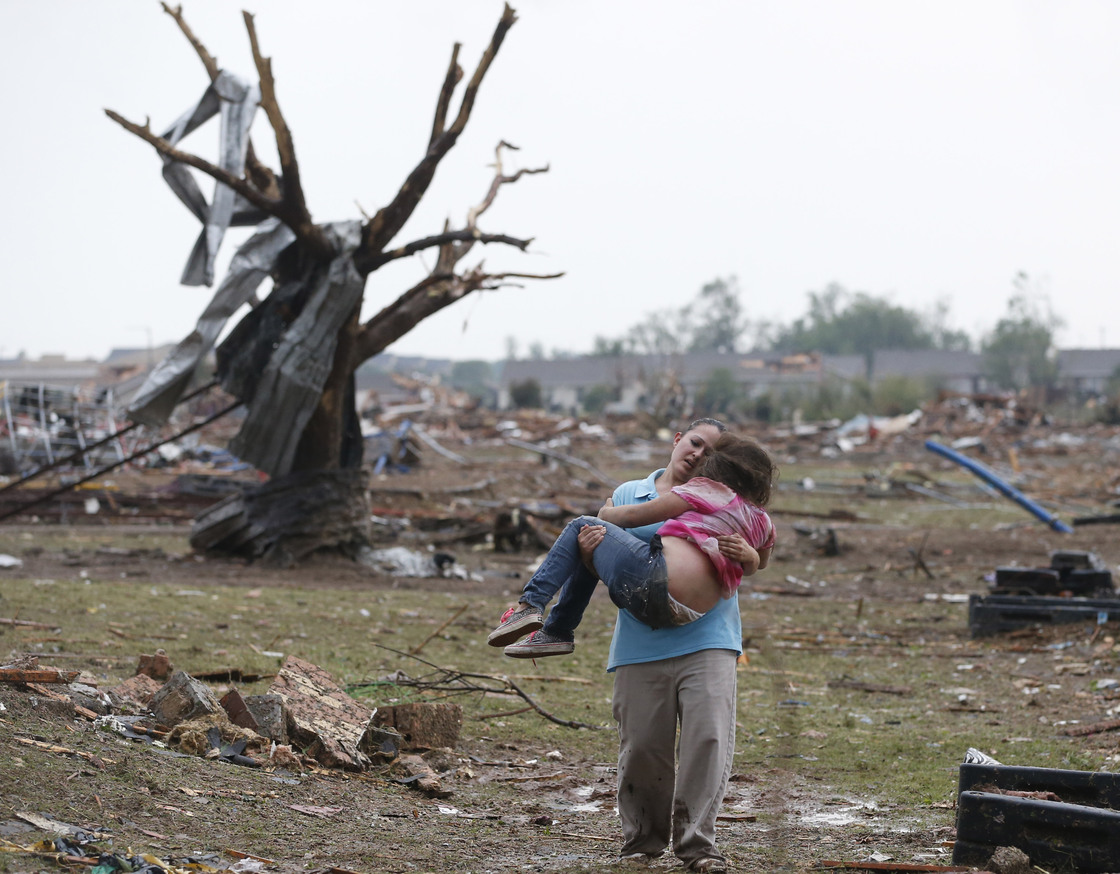
ap789530311235

And here’s a time-lapse video of this monster ripping through the countryside.

What can we do? I mentioned it to Foundation Beyond Belief — go to the “Crisis Response” link and tell them you want to contribute to the relief efforts. If enough of us do that, they’ll set something up to take your godless donations and send them to where they’re most needed. And then send them money!


Zingularity also has a post on the catastrophe.


Foundation Beyond Belief now has a crisis response page. You can make charitable donations there.


The death toll is at 51 and rising, with at least 20 dead children.

Angeline Jolie just became an even more interesting person

Wow. Jolie is a beautiful woman who makes a living as an actress, where looks can be important, and she discovered that she carried an allele of BRCA1 that puts her at a very high risk of coming down with breast cancer sometime in her life. She looked at her situation rationally — she is an atheist after all — and made the decision to get a preventive double mastectomy. She chose to maximize her chances of living a long life over preserving a secondary sexual characteristics.

That’s strong and smart. She hasn’t lost anything of any importance.

Jolie also took an important next step and came forward with the news to encourage other women to make good choices.

I choose not to keep my story private because there are many women who do not know that they might be living under the shadow of cancer. It is my hope that they, too, will be able to get gene tested, and that if they have a high risk they, too, will know that they have strong options.

Life comes with many challenges. The ones that should not scare us are the ones we can take on and take control of.

The only glitch in this story is that this is America: if you’re not a mega-millionaire movie star, you’re not likely to be able to afford the expensive genetic testing, or the extensive surgeries. But maybe Jolie’s openness will encourage politicians to correct that, too.

Do you need another reason to despise Facebook?

Here’s one. Mark Zuckerberg is pushing for more oil drilling and pipelines.

Two major tech leaders have resigned from Mark Zuckerberg’s new political group, FWD.us, in protest of the organization’s controversial decision to bankroll ads supporting Keystone XL and drilling in the Arctic National Refuge.

The Zuckerberg group publicly says its top priority is immigration reform. But through two subsidiary organizations it has quietly spent millions on ads advocating a host of anti-environmental causes. The ads were created in support of Sen. Lindsey Graham (R-SC) and Mark Begich (D-AK), and although neither ad mentions the issue, both support immigration reform.

I can understand the importance of political compromise and coalition building, but sleeping with the devil is just going too far.

Reality constrains the possibilities

Gary Marcus, the psychologist who wrote that most excellent book, Kluge: The Haphazard Construction of the Human Mind, has written a nice essay that tears into that most annoying concept that some skeptics and atheists love: that without a proof, we’re incapable of dismissing certain especially vague ideas. It’s a mindset that effectively promotes foundation-free ideas — by providing an escape hatch from criticism, it allows kooks and delusional thinkers, who are not necessarily stupid at all, to shape their claims to specifically avoid that limited version of scientific inquiry.

Marcus goes after two representatives of this fuzzy-thinking concept. Schmidhuber is an acolyte of Kurzweil who argues for a “computational theology” that claims that there is no evidence against his idea, therefore the universe could be a giant software engine written by a great god-programmer. Eagleman is a neuroscientist who has gotten some press for Possibilianism, the idea that because the universe is so vast, we should acknowledge that there could be all kinds of weird possibilities out there — even god-like beings. “Could be” is not a synonym for “is”, however, and science actually demands a little more rigor.

Some people love to claim that an absence of a single definitive test against an idea means that it is perfectly reasonable to continue believing in it. Marcus will have none of that.

In particular, Eagleman, who drapes himself in science by declaring to “have devoted my life to scientific pursuit,” might think of each extant religion as an experiment. Followers of many religions have looked for direct evidence of their beliefs, but (by Eagleman’s own assessment) systematically come up dry. And, crucially, statisticians have shown decisively that a collection of failed efforts weighs more heavily than any single failed effort on its own. The same thing happened, of course, when scientists looked for phlogiston, and cold fusion, too. Nobody has proven cold fusion doesn’t exist, but most scientists would assign a low probability to it because so many attempts at replicating the original have failed. Any agnostic is free to believe that his favorite religion has not yet been completely disproven. But anyone who wishes to bring science into the argument must acknowledge that the evidence thus far is weak, especially when it is combined statistically, in the fashion of a meta-analysis. To emphasize the qualitative conclusion (X has not been absolutely proven to be false) while ignoring the collective weight of the quantitative data (i.e., that most evidence points away from X) is a fallacy, akin to holding out a belief in flying reindeer on the grounds that there could yet be sleighs that we have not yet seen.

That’s why I’m an atheist. Not just because there is no evidence for any god, but because all the available evidence points towards natural processes and undirected causes for the entirety of space and time. I wish people could get that into their heads. When we atheist-scientists go off to meetings and stand up for an hour talking about something or other, we generally aren’t reciting a religious litany and saying there’s no evidence for each assertion; rather, we go talk about cool stuff in science, how the world actually works, what the universe really looks like…and our explanations are sufficient without quoting a single Bible verse.