My future tattoo

I, for one, welcome our glorious future of ubiquitous computing. Researchers have come up with a temporary tattoo that functions as a computer, complete with processing power, data storage, and wireless data reception and transmission. Also, drugs.

The researchers constructed the device by layering a package of stretchable nanomaterials — sensors that detect temperature and motion, resistive RAM for data storage, microheaters and drugs — onto a material that mimics the softness and flexibility of the skin. The result was a sticky patch containing a device roughly 4 centimetres long, 2 cm wide and 0.003 millimetres thick, says study co-author Nanshu Lu, a mechanical engineer at the University of Texas in Austin.

They’re not talking about recreational drugs (but maybe in a future update!), but that the purpose of this device is continuous physiological monitoring and delivery of therapeutic drugs in response, so a specific and very useful initial goal.

Give it a few years, though, and forget the iPhone and iWatch and iWhatever — I just my hands and forearms covered with fancy circuitry that does cool stuff.

Unfortunately, the article mentions one serious limitation: we’re waiting for the development of a thin, flexible battery to power all this gadgetry. Once that’s all worked out, though, it’ll be a wonderful fashion accessory to go with my transparent cranium.

Cosmos upstaged!

Last night on Cosmos, Neil deGrasse Tyson explained how we know the universe is immensely old, and even took a sharp poke at that nonsensical idea that the earth is only about 6,000 years old. I figured there’d be some indignant squawking on the internet this morning, but no…the creationists are all quiet about it. Why? Well, some of them might have been tuned into the Walking Dead finale, since zombies and their theology are so copacetic. But the real reason is that they’re too busy freaking out over Noah.

The Discovery Institute is really pissed off (wait, you’re saying, why should they care about a movie that plays fast and loose with the Bible? Aren’t they a secular organization? Yeah, right). Their angle is that the movie is anti-human, because that’s all environmentalism is about, hating people.

Bottom line: Noah pushes hard on the modern environmentalist meme that — as I reported in The War on Humans — we are a terrible plague on the living Gaia. That message sells among a small group of progressive elites and misanthropic neo-earth religionists. But most of us do not consider ourselves to be cancers on the planet.

I’m sorry to have to tell you this, Discovery Institute, but yes you in particular are cancers on the culture and the planet. And have you considered the likelihood that the very worst destroyers do so confident that what they are doing is right and good, and that our personal narcissism is not exactly the most reliable measure of our worth?

They are also quite happy that humans exterminated entire species of megafauna. They deserved it, don’t you know, and had to go to allow people to live.

Whatever our role in the demise of megafauna, we should not look back in shame.

Early humans’ successful fight for survival gave us the chance to thrive. I am not upset with them: I am grateful.

For a bunch of anti-evolutionists, they sure are happy to cite ‘survival of the fittest’ as a justification for slaughter. You know, it wasn’t always a fight for survival.

Roman emperors curried favor with the public by upstaging their predecessors in killing more animals and producing more spectacular displays of slaughter (Morris 1990).  Emperor Titus inaugurated the Roman Coliseum by declaring 100 days of celebration, during which enormous numbers of animals were speared by gladiators.  On the opening day, 5,000 animals were slaughtered, and over the next two days, 3,000 more were killed (Morris 1990).  The caged animals were kept underground in dungeons where they were not fed, and on the day of the festival, they were hauled in their cages onto lifts that brought them into the center of the arena.  As the crowd roared with excitement, drums were beaten, trumpets blown, and the terrified animals were set loose (Attenborough 1987).  Sometimes the animals were goaded to attack one another, and at other times, men armed with spears and tridents pursued them around barriers made from shrubs in imitation of hunts in the wild (Attenborough 1987).  One arena hunt resulted in the killing of 300 Ostriches and 200 Alpine Chamois (Morris 1990). 

Lions, Tigers, bears, bulls, Leopards, Giraffes and deer died after being tormented, stabbed and gored (Morris 1990).  Big cats that had been starved were released into the ring where a human slave or prisoner of war was lashed to a post; the animals clawed at the person before they themselves were speared and stabbed by gladiators (Attenborough 1987).  In some of the larger slaughters, 500 Lions, more than 400 Leopards, or 100 bears would be killed in a single day (Morris 1990).  Hippos, even rhinoceroses and crocodiles, were brought into these arenas, and sometimes gladiators employed bizarre methods of killing such as decapitating fleeing ostriches with crescent-shaped arrows (Morris 1990).

Still grateful?

I grew up with farmers and ranchers, and I can tell you this, too: the slaughter continues. They tend to be ruthlessly intolerant of anything perceived as compromising their income. I’ve seen songbirds shot because “it was their farm, they can do what they want”.

And the big threat is habitat destruction — the prairies are almost all gone here in Minnesota, and the wetlands are being plowed over. It is not anti-human to want to preserve some natural beauty and protect biodiversity, because this is our planet and we should aspire to maintain it as something better than a giant sewage treatment plant for Homo sapiens. We are a lesser world for the absence of giant ground sloths and European lions and black rhinos — did we really have to kill them all so we could merely survive?

Do you have to shove your awful little holy book in everything?

I had thought that Minnesota had a state fossil: it was the giant beaver, Castoroides ohioensis. But then I discovered that it wasn’t on the official list of Minnesota State Symbols, but was on the list of proposed symbols. So it never made it into law, although we do have a state photo (it’s awful) and a state muffin (blueberry).

I wonder if the same thing happened to the giant beaver that happened to South Carolina’s state fossil proposal. Olivia McConnell, an eight year old girl, had the bright idea to propose that the Woolly Mammoth ought to be the South Carolina state fossil, and she wrote a letter to the legislature suggesting it, and even giving good reasons for it.

1. One of the first discoveries of a vertebrae fossil in North America was on an S.C. plantation when slaves dug up wooly mammoth teeth from a swamp in 1725.

2. All but seven states have an official state fossil.

3. “Fossils tell us about our past.”

“Please work on this for me,” McConnell wrote to Ridgeway, signing her letter, “Your friend, Olivia.”

Nice idea. Good rationale. But then, along come the sanctimonious bible-floggers.

Sen. Kevin Bryant, a pharmacist and self-described born-again Christian who has compared President Obama with Osama bin Laden, voted to sustain a veto by Governor Nikki Haley of funding for a rape crisis center, and called climate change a “hoax,” proposed amending the bill to include three verses from the Book of Genesis detailing God’s creation of the Earth and its living inhabitants—including mammoths.

Bryant told The Daily Beast that the intent was never to hijack the bill. I think it’s a good idea to designate the mammoth as the state fossil, I don’t have a problem with that. I just felt like it’d be a good thing to acknowledge the creator of the fossils.

Bryant’s proposed amendment was originally ruled out of order by Lt. Governor Glenn McConnell (no relation to Olivia) because it introduced a new subject. Bryant has since submitted a more on-topic amendment, describing the Columbian Mammoth as created on the Sixth Day with the beasts of the field.

The bill is now on hold. Olivia has apparently been following the legislative process as it moves along, and now has first-hand experience with stupidity, and has learned a valuable lesson in cynicism. Jeez, I’m a cynical old guy, and I’m pissed off.

I hope Olivia can retain some enthusiasm for science, even if she has lost faith in politics.

Can we get it as a cosmetic surgery option?

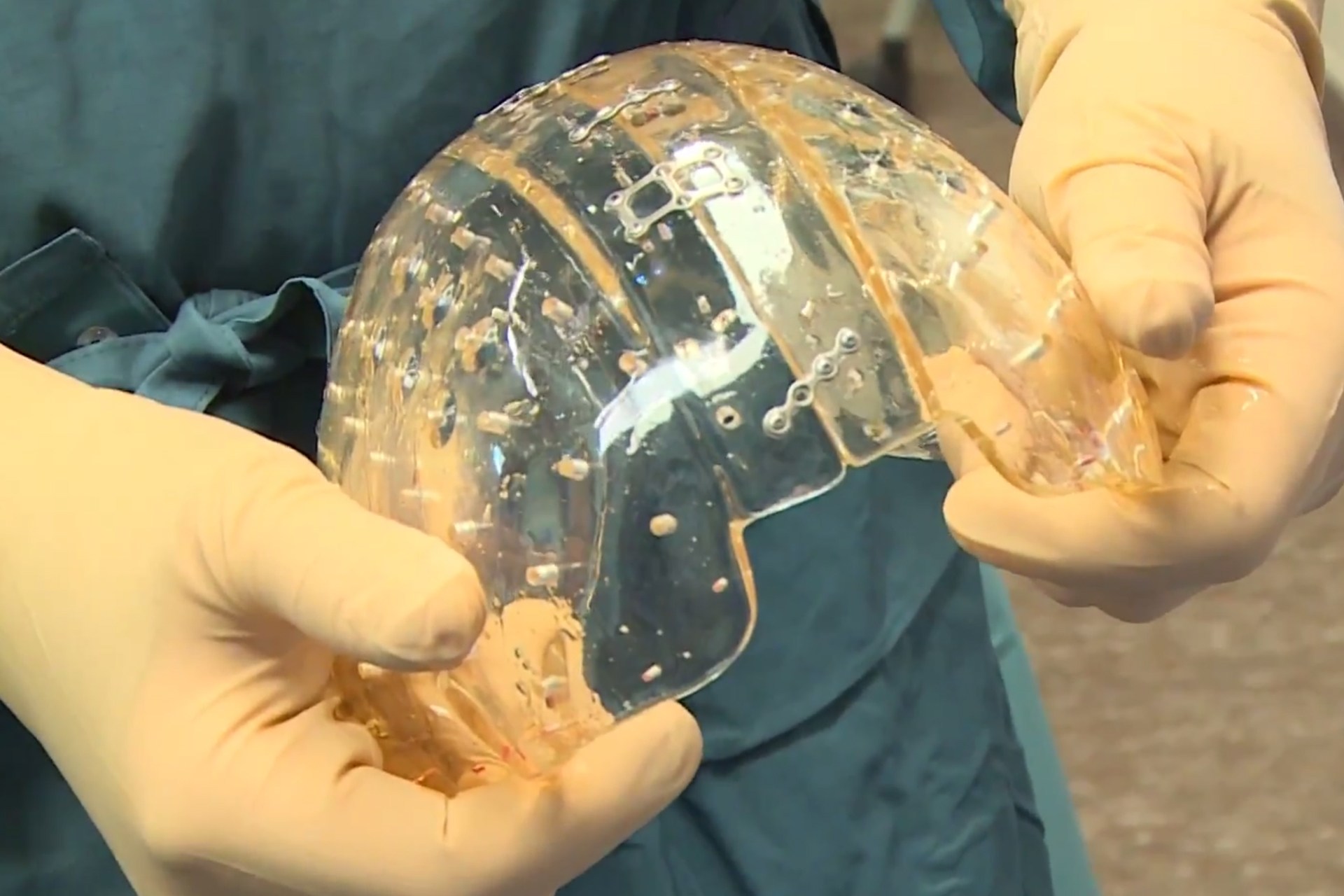
This poor woman in the Netherlands had a bone disorder that caused her skull to continuously thicken, pressing on her brain — so the doctors had a copy of her cranium made out of plastic on a 3-D printer, cut off the top of the skull, and replaced it. It worked, and she’s apparently feeling much better now. So the medical result was awesome.

But awesomer?

skullcap

It was made out of transparent plastic. Now the doctors, of course, covered it up with her scalp and neatly stitched it all together so you can’t even see a scar anymore, but I was thinking, if I had it done, the best thing would be to simply remove all that skin and have my brain pulsing beneath a transparent dome. I’d even pay extra to have some LEDs inserted in patterns in the plastic. Can you imagine how cool it would be to teach neurobiology with your brain hanging out, decorated with little blinking lights?

Maybe someday. A guy can dream.


Here’s a video of the procedure.

Wow, but her skull was really thick. She would have been a master of the Glasgow Kiss, I think.

Epigenetics ain’t magic

I just got a notice of an Epigenetics Conference in Portland, Oregon. It made me cringe. It’s infuriating because epigenetics is actually a very important concept in development, but there’s this terrible misperception among the public that it’s a magical shortcut for evolution. I was also a bit primed for it by the mention of epigenetics on Larry Moran’s blog.

The Humanists of Greater Portland™ is supporting the 2014 Epigenetics Conference being held on Saturday 5 April 2014. Epigenetics is a relatively new field of science that looks at how the environment affects one’s genetic make up. In former times, it was thought that it took generations to change one’s genetic make up but studies now suggest it can happen over a matter of weeks or months. What one eats, their environment, their activities etc. all can alter ones genetic make up and this can greatly affect one’s health. Even the environment of the mother can affect the genetic make up of the baby in the womb.

No, it’s not new. Conrad Waddington coined the term “epigenetics” in the early 1940s. He was explaining how development is modulated by gene regulation, and that there is a multigenerational pattern of restriction of cell fates within a lineage…and that’s a concept that’s at least as old as Wilhelm Roux.

It’s broader than just environmental effects. We can talk about epigenetic modification within an embryo, as a consequence of a clocklike sequence of switches, for instance. It really is a well-known, long studied developmental process.

It does not change the “genetic makeup”. Epigenetics affects the expression of genes without modifying any sequence information. Thinking that it represents rapid evolutionary change is the major misconception that leads people to think the timing is somehow radical. It isn’t. A mutation changes the “genetic makeup” of a cell — for realz — in a fraction of a second. Get up and run a lap around the room, and you’ll get a rapid change in your physiological state in a fraction of a minute. Move from your flatland home to Denver (or vice versa) and you’ll get long term changes to the constitution of your blood in a matter of weeks. None of these represent a revolution in how we think about evolution.

You want to greatly affect your health, quickly? Don’t drink any water for a day. Or drink a couple of Big Gulps worth of sugar water. That’ll have about the same effect on evolution as epigenetic modulation.

Fortunately, it’s just the general blurb for the conference that set my teeth on edge. The descriptions of the presentations sound much more focused and of reasonable and appropriate scope. It should be informative. But please, pop culture summaries of epigenetics make PZ cry.


Some people are thinking I’m denying any role for epigenetics in evolution. No — it’s just not the role some less informed people think it is. What epigenetic modification does is broaden the range of phenotypes produced by a given genotype, allowing more genetic variation to persist in the population. That surely does have some effect on evolution, but it’s somewhat more indirect than the Lamarckian mode pop culture assigns to it.

It’s one thing that allows genetic assimilation to occur, for instance. But if you think people misunderstand epigenetics, just wait until you hear what they say about genetic assimilation.

If you’re still baffled, I wrote up an introduction to epigenetics a while back. I’ve also got a couple of examples of genetic assimilation.

Potential disasters pimpling the whole country

Your must-read article for the day is When the Rivers Run Black, the story of the Kingston, Tennessee coal ash spill. The walls of a gigantic reservoir pond containing toxic waste produced by a coal-fired power plant ruptured, pouring 5.4 million cubic yards of coal ash into the environment. It was the largest industrial accident in US history.

I was reading it and thinking about where my power is coming from — about half of Minnesota power comes from coal plants — and feeling grateful that none of those plants are anywhere near me. We like it when North Dakota builds their monster coal-burning plants over there in their weaker regulatory environment, and we just reap the benefits of cheaper electrical power over here. And then I read about the Kingston cleanup, and what they had to do with all the slimy sludge.

For months, train cars lined up to be loaded with sludge dredged from the river. The sludge was then carted down to Uniontown, Alabama, a mostly poor, mostly black county, where an enterprising commissioner decided that taking the waste was an economic opportunity. The county ended up taking about 4 million tons of it and dumped it in a landfill—for the price of just $4 million.

It is not unusual that a place like Uniontown ended up with the Kingston waste: Coal ash is almost always dumped in communities that don’t have the political or financial muscle to reject becoming other communities’ trashcans. According to a 2012 report, of the nearly six million Americans who live within three miles of a coal-fired power plant, 39 percent are minority, and the average per capita income is $18,400.

Damn. I am a privileged person, all right.

Fortunately, Minnesota is improving energy efficiency and regulating power plants more, so at least we’re slowly getting better. Although I notice now something in that happy report that was also discussed in the Kingston article: all that’s getting mentioned is emissions, not the accumulating solid waste from the plants. That waste is loaded with heavy metal poisons, but the EPA is dragging its heels, reluctant to even classify it as hazardous.

The paper they don’t want you to read!

The climate change denialists are a bit thin-skinned; they’ve also been exposed as a bit on the wacko side. The journal Frontiers in Psychology is about to retract a paper that found that denialists tend to have a cluster of weird beliefs (NASA faked the moon landings, the CIA was in charge of the assassination of political figures in the US, etc.) because the denialists screamed very loudly.

This outrage first arose in response to a paper, NASA faked the moon landing–Therefore (Climate) Science is a Hoax: An Anatomy of the Motivated Rejection of Science (pdf) which analyzed voluntary surveys submitted by readers of climate science blogs, in which the respondents freely admitted to having a collection of other beliefs, in addition to climate change denial. That paper found something else interesting, and was the primary correlation observed: a lot of denialists are libertarians. Are you surprised?

Rejection of climate science was strongly associated with endorsement of a laissez-faire view of unregulated free markets. This replicates previous work (e.g., Heath & Gifford, 2006) although the strength of association found here (r ~.80) exceeds that reported in any extant study. At least in part, this may reflect the use of SEM, which enables measurement of the associations between constructs free of measurement error (Fan, 2003).

A second variable that was associated with rejection of climate science as well as other scientific propositions was conspiracist ideation. Notably, this relationship emerged even though conspiracies that related to the queried scientific propositions (AIDS, climate change) did not contribute to the conspiracist construct. By implication, the role of conspiracist ideation in the rejection of science did not simply reflect “convenience” theories that provided specific alternative “explanations” for a scientific consensus. Instead, this finding suggests that a general propensity to endorse any of a number of conspiracy theories predisposes people to reject entirely unrelated scientific facts.

Oh, how they howled. Even libertarians seem to be embarrassed at being affiliated with libertarians, I guess. And conspiracy theorists, too? Why, the accusation itself is clearly evidence that there’s a conspiracy out to get them. They protested that because the respondents to the survey all found it through mainstream science blogs, all the responses were false flag operations put out by Big Climate.

What they didn’t realize was that they were generating more data to support the hypothesis. The authors of the first paper then wrote a second paper, the one that is now being retracted by the cowardly publisher, called Recursive Fury: Conspiracist Ideation in the Blogosphere in Response to Research on Conspiracist Ideation, in which they scanned public posts and comments on the first article, and analyzed the text for evidence of conspiracist tropes (it’s a nefarious scheme, they’re out to get us, it’s an organized movement to defeat us, etc.) and found that yes, conspiracist reasoning was quite common on climate change denial blogs.

They also rebutted some claims. The claim that the authors never bothered to contact the denialist blogs to host their survey was shot down pretty easily: they had the email, and further, they had replies from denialists who later claimed they never received any request to host the survey.

Initial attention of the blogosphere also focused on the method reported by LOG12, which stated: “Links were posted on 8 blogs (with a pro-science science stance but with a diverse audience); a further 5 “skeptic” (or “skeptic”-leaning) blogs were approached but none posted the link.” Speculation immediately focused on the identity of the 5 “skeptic” bloggers. Within short order, 25 “skeptical” bloggers had come publicly forward9 to state that they had not been approached by the researchers. Of those 25 public declarations, 5 were by individuals who were invited to post links to the study by LOG12 in 2010. Two of these bloggers had engaged in correspondence with the research assistant for further clarification.

Those emails were also revealed in a Freedom of Information Act request.

The squawking reached a new crescendo. Steve McIntyre wrote a strongly worded formal letter demanding that the defamatory article be removed, and accusing the authors of malice. Further, they complained that analyzing the content of blog posts and comments, public, openly accessible work, was an ethics violation.

Ludicrous as those claims are, Frontiers in Psychology is apparently about to fold to them. For shame.

You know, my university had a meeting with our institutional lawyers yesterday — I was called in to attend the information session for some reason, like having a reputation as a trouble-maker or something — and I was impressed with their professionalism and their commitment to actually defending the faculty and staff of the university. I guess not every organization is lucky enough to have good lawyers of principle.

Oh, well. All I can say is that, thanks to the denialist ratfuckers, now everyone is going to be far more interested in reading the two papers by Lewandowsky and others. I recommend that you read Motivated rejection of science (pdf) and Recursive fury(pdf) now, or anytime — they’re archived on the web. You might also stash away a copy yourself. You make a denialist cry every time you make a copy, you know.


The first author on the papers, Stephan Lewandowsky, has a few comments.

The strategies employed in those attacks follow a common playbook, regardless of which scientific proposition is being denied and regardless of who the targeted scientists are: There is cyber-bullying and public abuse by “trolling” (which recent research has linked to sadism); there is harassment by vexatious freedom-of-information (FOI) requests; there are the complaints to academic institutions; legal threats; and perhaps most troubling, there is the intimidation of journal editors and publishers who are acting on manuscripts that are considered inconvenient.