Pharyngula
Evolution, development, and random biological ejaculations from a godless liberal


Last night, as promised, I watched Gasland. It’s an excellent documentary presented in a jarringly low-key style — jarring because every place visited that had extensive fracking was a horror. There were landscapes where farmers and ranchers were trying to make a living, and everywhere you looked, there were drilling rigs and condensate tanks, clouds of toxic vapor, and the water from local wells was coming up yellow to brown to black, fizzing off flammable gasses and saturated with chemical sludge. In some cases, water wells would actually explode.
Josh Fox, the documentarian, had to struggle to get any interviews with the corporate slugs who were greedily promoting this abuse of the environment. The most honest of them said, essentially, that there were always going to be compromises and a tiny bit of pollution was the price we have to pay for our energy; the worst would flat out deny that fracking could be causing any contamination of the water. Right. They snake pipes a mile or two under the ground, and then pump many thousands of liters of water loaded with organic solvents, a witch’s brew of carcinogens and teratogens and greasy poisonous crap, into the rock under such intense pressure that it cracks the confining geology, all to tap into trapped oil and gas, and there’s no way it could possibly leech into aquifers. And they pay desperate affected individuals some small sum, tens of thousands of dollars, to shut up and accept the damage.
This map was shown several times in the movie. All the red areas are deep shale beds, natural gas reservoirs, that are likely candidates for drilling.
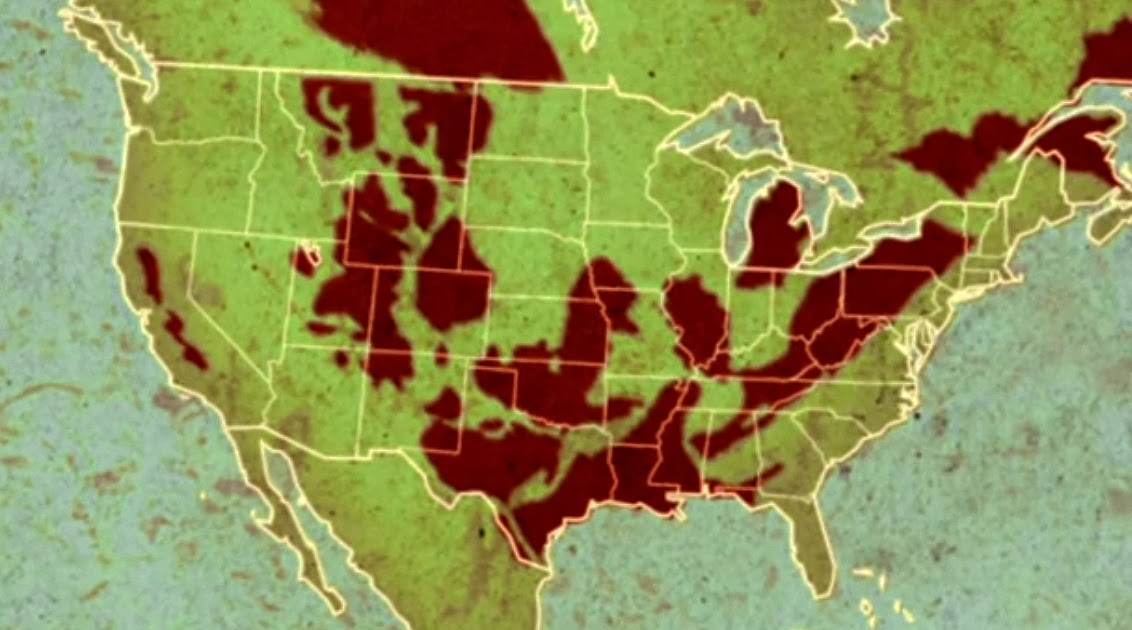
Do you live in any of those places? You should worry. If they aren’t drilling now, they want to soon.
We also got to meet the greatest villain of this century, Dick Cheney. He’s the architect of the legal exemption of fracking companies from the restrictions of the Clean Water Act (among all the other things Ol’ Dick has done to advance the United States of Halliburton). Our government has washed its hands of any responsibilities, and an employee of the Environmental Protection Agency came right out and said the EPA was consciously avoiding getting into dealing with the consequences of fracking.
It’s one of the most depressing movies I’ve seen in years. We’re doomed, aren’t we?
At least there were a few nods to the gallant heroes are actually doing something to try and stem the flood of oil money: the movie has an interview with Theo Colborn, who really deserves wider recognition. It also features the real hero, the planet, with lots of lovely shots of Fox’s home in a secluded bit of the Delaware River basin — a place I remember well, having taken my kids camping and on scouting trips in the lush deep woods of Pennsylvania. That’s what prompted the movie, that that area is threatened with fracking development. All it would take is one neighbor to sell out to a natural gas company, and because the government is dragging its feet on protecting the environment, everyone could enjoy a river filled with benzene and 500 other killer chemicals.
By the way, today Google is celebrating Rachel Carson’s birthday.
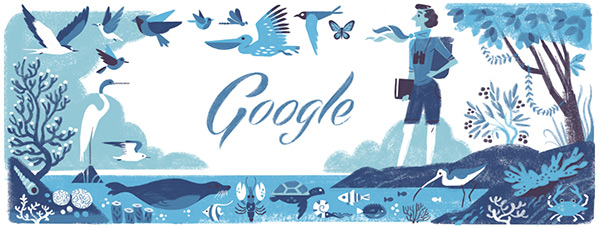
We haven’t learned a thing.


In case you’re wondering how they get that way…

I was reading a summary of Amazon’s bullying of Hachette — basically, Amazon used it’s near-monopoly power to shut out an independent publisher — and that, on top of it’s labor practices, tells me I need to find a way out of the Amazon trap before they become a full monopoly.
But here’s the catch: I live out in the boondocks. The nearest bookstore is a 50 minute drive away. I am addicted to the Kindle app — I can use my iPad to click on a title and get it zapped into my hands in 30 seconds, like magic. So I went searching to see if any other bookseller has similar functionality. Barnes & Noble has an app that will let you search their inventory and find a nearby store (I looked. Two hours away.) Powell’s is even worse: it assumes you will show up at their door in Portland, Oregon, and their app provides an interactive map to help you find your way around their store.
These are not useful for me.
Does Amazon already have an effective monopoly on e-books? To rebuke Amazon, am I going to get off my e-book addiction and start reading those old-fashioned things with ink and paper again?

O’Keefe, who has made a career of stunts to mislead people about the Left’s political goals, has screwed up again. He tried to entrap an environmentalist documentarian, Josh Fox, by having one of his accomplices pose as an agent for a Saudi sheik, and trying to get Fox on tape accepting money from Big Oil interests. O’Keefe then appeared triumphantly on Fox News with a tiny sliver of a recording that has Fox saying one sentence that sounds like he’s willing. That was it.
We are familiar with what creationists do all the time, aren’t we, boys and girls? You know what we should immediately suspect Mr O’Keefe of doing, shouldn’t we? Quote-mining. Blatant editing. Unfortunately for him (although this won’t hurt his reputation, since everyone knows that if you look up Bumbling Sleazebags in the Yellow Pages, you can get O’Keefe’s number), Josh Fox recorded the full ten minute phone conversation. You can guess what’s on it: Josh Fox refusing to work for anyone without full transparency, and just generally finding the whole discussion suspicious and weird. O’Keefe tried to play gotcha, and instead Fox got him right back.
But there is good news. O’Keefe’s stunt and backfire got one happy result: I am now aware of Fox’s movie, Gasland, which is available on NetFlix right now for streaming. I’m going to watch it this weekend.
Say…if I were Alex Jones, I’d be wondering if James O’Keefe was a secret agent for the environmental movement who had just carried out a successful false flag event to raise awareness of the perils of fracking.


Well, I’m exaggerating a bit — he hedges on it being a good possibility that might produce a good show.
Experts are predicting we may be in for quite a show: a brand spanking new meteor shower that will peak on the evening of Friday, May 23, 2014! Folks in the United States and Canada have the most favored viewing locations for this event (but that doesn’t mean you should forget about it if you’re elsewhere). Predicted rates for this new shower are quite high, about 100–400 meteors per hour, far higher than normal showers. And they’ll appear to be coming from an area of the sky near the north pole, so they should be visible raining down all over the sky!
I checked the weather report for my area, and it’s supposed to be “mostly sunny”, so I imagine that means patchy clouds in the evening, so not perfect viewing conditions. However, where I live, I can drive a mile out of town and find perfect darkness and a total absence of any artificial lighting, so that might offset the lack of flawless weather. I might give it a shot.
And if it doesn’t pan out, I can wag my finger at Plait on Saturday morning.

Jerry Coyne reviews Genie Scott’s talk at the Imagine No Religion conference. It’s mostly positive — Genie always gives a thoughtful talk — but there are obvious points of disagreement.
In the talk, Genie said several times that if you want to change people’s minds—about either climate-change denialism or evolution—the most effective way to reach them is through someone who has a similar “ideology,” be that religious or political. In other words, to make a creationist Christian accept evolution, the best way is for an evolution-accepting Christian of the same denomination to convince them that evolution isn’t inimical to their religious beliefs. (That’s what the “Faith Project” of the NCSE is about.) I suppose this wouldn’t work very well for fundamentalist believers, since no other fundamentalists accept evolution!
I vaguely recall some psychological research showing that people are more convinced in the “lab” under such circumstances, and certainly Dan Barker, in his talk, began his road to apostasy by pondering statements by fellow Christians. But I’m still not sure Genie was right.
I’m not so sure either. I don’t think it’s true that the person doing the convincing has to share the same ideology — it’s messier than that. And what do you know, I had just read a very good article on why people persist in believing things that just aren't true. I suspect that the psychological research Coyne vaguely recalls is the work of Nyhan and Lewandowsky.
False beliefs, it turns out, have little to do with one’s stated political affiliations and far more to do with self-identity: What kind of person am I, and what kind of person do I want to be? All ideologies are similarly affected.
It’s the realization that persistently false beliefs stem from issues closely tied to our conception of self that prompted Nyhan and his colleagues to look at less traditional methods of rectifying misinformation. Rather than correcting or augmenting facts, they decided to target people’s beliefs about themselves. In a series of studies that they’ve just submitted for publication, the Dartmouth team approached false-belief correction from a self-affirmation angle, an approach that had previously been used for fighting prejudice and low self-esteem. The theory, pioneered by Claude Steele, suggests that, when people feel their sense of self threatened by the outside world, they are strongly motivated to correct the misperception, be it by reasoning away the inconsistency or by modifying their behavior. For example, when women are asked to state their gender before taking a math or science test, they end up performing worse than if no such statement appears, conforming their behavior to societal beliefs about female math-and-science ability. To address this so-called stereotype threat, Steele proposes an exercise in self-affirmation: either write down or say aloud positive moments from your past that reaffirm your sense of self and are related to the threat in question. Steele’s research suggests that affirmation makes people far more resilient and high performing, be it on an S.A.T., an I.Q. test, or at a book-club meeting.
Normally, self-affirmation is reserved for instances in which identity is threatened in direct ways: race, gender, age, weight, and the like. Here, Nyhan decided to apply it in an unrelated context: Could recalling a time when you felt good about yourself make you more broad-minded about highly politicized issues, like the Iraq surge or global warming? As it turns out, it would. On all issues, attitudes became more accurate with self-affirmation, and remained just as inaccurate without. That effect held even when no additional information was presented—that is, when people were simply asked the same questions twice, before and after the self-affirmation.
Still, as Nyhan is the first to admit, it’s hardly a solution that can be applied easily outside the lab. “People don’t just go around writing essays about a time they felt good about themselves,” he said. And who knows how long the effect lasts—it’s not as though we often think good thoughts and then go on to debate climate change.
I think the simpler version of that is that if you’re trying to persuade a religious person to accept the truth, you can’t come at it with the approach, “Religious people are stupid. You must accept evolution, or you are stupid.” They resist. They don’t think of themselves as stupid, so they immediately know you are wrong. Or alternatively, they immediately identify with religion, and what they hear you saying is confirmation that religious people do not accept evolution, therefore you have just told them what position a good religious person must accept in this argument.
To address this concern does not require that the evolutionist also be a Christian. I don’t usually go all barking attack dog on creationists, one on one, either — the art of persuasion involves finding common ground, and then showing that to be consistent with their own values, they should recognize that one position is wrong. (Note that the sole value some Christians hold is that the Bible is authoritative and literally true — I can’t really find common ground with them, they’re too far gone. But the majority just have vaguely sympathetic feelings for God and church — they can be reached.)
Coyne also has some ire for the theistic evolutionist perspective, as well. So do I. I think it distorts the science in an ugly way. It’s effective with some soft creationists in the same way the approach I mentioned in the last paragraph works. You find common ground: “I believe in God, too!” Then, unfortunately, to bring them around to your side, what you then do is produce a mangled, false version of evolution — “It’s guided by a higher power!” — in order to get them to accept “evolution”. A gutless, mechanistically compromised version of evolution.
No thanks. Darwin’s great insight was that you don’t need an overseer guiding evolution — that local responses to the environment will produce efficient responses that will yield a pattern of descent and diversity and complexity. To replace “intent was unnecessary” with “God provided intent” does deep violence to the whole theory, and completely misses the point.

After that short post yesterday pointing out the abuse of photoshop to distort women’s bodies, I was briefly harangued by a loon who announced that I obviously did not understand the concept of sexual selection.
women’s bodies today are changing due to sexual selection whether you like it or not. Humans use tools to sculpt their bodies into appealing forms, so it’s not just left to inherent biological changes. And, women are abiding our wishes whether you like it or not. As biologists say, evolution is merciless. So why all the whining?
Actually, I do understand sexual selection quite well. I fail to see how making images of bodies plastic with photoshop is an example, or how you leap from manipulating pixels to how we can “sculpt…bodies into appealing forms”. Perhaps he thinks it is a kind of sympathetic magic, that if you paint a picture of a woman with balloon breasts and a wasp waist, women will simply comply with your wishes?
I am also impressed with the obliviousness. Sexual selection works both ways — has he ever wondered why some men are obsessed with women’s body parts, wanting them to be a certain size and shape? Exactly who’s brain is being sculpted by nature here?
I should also introduce him to the concept of the supernormal stimulus, the idea that a species can evolve to respond to a triggering stimulus that can be inappropriately strengthened by an exaggerated stimulus. This isn’t necessarily a good thing; for instance, Lorenz found that birds would enthusiastically nurture large fake eggs at the expense of their normal-sized real eggs, which at least isn’t a serious concern in nature, usually (although cuckoos can take advantage of it). There’s also the serious concern about human diet: give a person the choice of a twinkie or a carrot, and guess which one will be most attractive?
Or we could talk about RealDolls, these “life-like” (more like corpse-like) full-sized rubbery plastic dolls with conveniently compliant orifices. Is that an example of “sexual selection”? I suppose you could make a case for it, although it’s not affecting women, but rather selecting out males who waste their time in futile coupling with an infertile assortment of artificial stimuli — futile in both the sense that reproduction will not occur, nor will any bonding with another human being.
Besides, apparently those RealDolls are over-engineered. Simpler models will do the job just fine.
According to a Murfreesboro Police Department report, an officer was dispatched to the bar, where a witness said that Hutton walked to the ATM and “pulled down his pants and underwear exposing his genitals.” Officer M. Rickard added, “Mr. Hutton then attempted to have sexual intercourse with the ATM.”
After his encounter with the ATM, Hutton “then began to walk ‘nude’ around the bar thrusting his hips in the air,” Rickard reported.
Behold the latest generation of sexbot!

Is that an example of selection? Or just a case of drunken disinhibition exposing the simpler driving machinery of the male sexual urge?