
NOAA

NOAA

I was a bit disappointed with this video.
Some might not know just how diverse teratology is… How might your scientific research fit in? We're guessing, pretty well. Find out why in this video. #IamTeratology #science #research #professionaldevelopment pic.twitter.com/hrXRsw11jy
— Teratology Society (@TeratologySoc) September 6, 2018
Some of us see teratology as a tool to probe normal developmental processes — it’s been that way for centuries. Teratology is the science that studies the causes, mechanisms, and patterns of abnormal development. It’s much more than just figuring how to prevent or correct human developmental disorders…not to belittle that extremely important aspect of the discipline.

If I were to write a diet book (not that I’m at all qualified to do so), it would be one page long and that’s what it would say, and it wouldn’t sell. What you need for a successful diet book is a gimmick, a distraction to keep your mind away from the awful, impossible mantra of “Eat less, exercise more”, because that’s what people will pay for. “Oh, I can eat all the bacon I want as long as I avoid asparagus? That’s the diet for me!”
Yvette d’Entremont takes on the keto diet, which is the latest incarnation of a long line of wish-fulfillment diet strategies. The Atkins diet, the Paleo diet, and now the Keto diet are all rationalizations for consuming all the high calorie, fat-rich foods we crave with the magic trick of shunning one other kind of food. The scientific studies show they don’t work, or at least don’t work the way their proponents think they do. The simple formula is still the hard truth.
You could pick any of the countless diet books on the market, follow their plan to the last calorie, and lose weight. This is because — as study after study has shown — calories and dietary adherence matter more than anything for weight loss. You can gain or lose weight on any combination of foods. People have lost weight on twinkies, McDonalds, juice, plants, and obscene amounts of meat.
It’s important to remember weight loss alone doesn’t necessarily cause all health markers to improve, and a diet causing weight loss does not mean it’s appropriate and healthy for everyone. Some foods are better than others at making weight loss and maintenance easier for different people, so balancing a diet is a fairly personalized thing. If your doctor gives you the green light and keto works for you, do it. If low fat works for you, do it. If plant-based, paleo, Mediterranean, or one of the zillion other diets help you improve your health and your relationship with food? Do it. There’s no one right way to eat for everyone, just as there is no miracle diet plan for weight loss.
Also — here’s an article by a woman who got to experience a metabolism chamber and actually measure directly how food intake affected her caloric output. It’s got lots of solid, basic information on human physiology, and concludes much the same thing.
When it comes to diets, the researchers have also debunked the notion that bodies burn more body fat while on a high-fat and low-carb ketogenic diet, compared to a higher-carb diet, despite all the hype.
“We could have found out that if we cut carbs, we’d lose way more fat because energy expenditure would go up and fat oxidation would go up,” said Kevin Hall, an obesity researcher at NIH and an author on many of these studies. “But the body is really good at adapting to the fuels coming in.” Another related takeaway: There appears to be no silver bullet diet for fat loss, at least not yet.
That “not yet” is optimistic. I think we’re just going to have to face the fact that our cellular metabolism has been optimized by billions of years of evolution to be flexible and responsive to the environment…as if that isn’t a good thing.

Uh-oh. I just submitted my first grant application (a small, in-house grant to do pilot studies) for spider research. This might be getting serious.
In more routine news, I added a new fellow to my stable today: Larry. He’s now savoring a meal before I throw him to the loving mercies of the lady spiders.
In case you were curious about how to identify spider sex, I’ll explain below the fold.

Or drive a car. Or a truck. Just stay home and cower. These are lessons I learned from the footage of Typhoon Jebi.


Yeesh, but a lot of people send me piteous complaints if I post a photo of my little spider friends, so from now on I’ll either confine them below the fold, or as in this case, not have any photographs at all. I still want to give an occasional status, though.
So my tiny colony currently consists of four females and one male spider.
As I last mentioned, Sara is expecting — she was impregnated by some unknown wild male before I brought her into the lab. She’s got a voracious appetite and has sucked two crickets dry in the last 5 days.
Amanda has also been eating well. Last time, I introduced her to our one male, Harry, who was not at all subtle and jumped right on her. She didn’t seem to mind, since Harry survived the encounter.
Since Harry was so eager, I moved him to Emma‘s vial. He’s still there, still alive, but kind of curled up and looking exhausted. Emma is looking great, and was smacking her chelicerae over a fresh cricket corpse.
Xena — poor Xena, I’ve been worried about her. She doesn’t eat. There’s a juicy cricket wandering about in her vial, taunting her, and she does nothing. But today Xena made an egg sac! I guess she had her priorities.
The Nameless Swarm of spiderlings seem to be doing well. I throw a few fruit flies into their dish, and a few hours later they’re all dead. I’m going to have to clean up the charnel chaos of their home tomorrow — it’s littered with the dessicated husks of their victims. The babies are so cute.
So that’s 5 adults and three egg sacs in less than two weeks, and an uncountable horde of spiderlings. That’s a pretty good volume of animals spawned fairly quickly, which is good news for my interest in getting embryos.
I’m optimistic that I’ll have a reliably propagating colony soon, if mortality isn’t too high among the spiderlings (I’ve read that there is a lot of death to come, but there are so many I’m hoping I’ll get plenty surviving to adulthood).
I’m impressed at how easy these are to raise, so far. You ought to try it!

A nudibranch shows us how it’s done.

I am not deep in the lore of statistics, but even I find this appalling.
It's a sign of how bad things have got that researchers think it's acceptable to write this in a Nature journal: "we continuously increased the number of animals until statistical significance was reached to support our conclusions." https://t.co/iaLadZaxom
— Adrian Barnett (@aidybarnett) September 2, 2018
No, really? And this is published in Nature, and not one reviewer threw a flag on the play? I had to double-check.
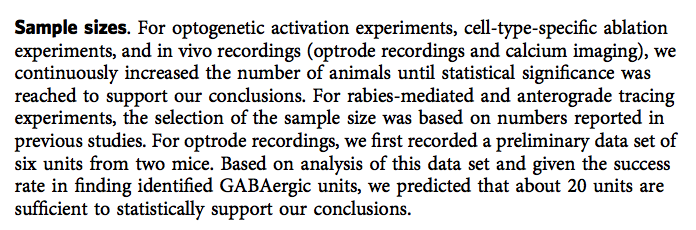
Yep, there it is. Wow. Why even bother with statistics if you’re just going to do the experiment until you get the answer you want?
Here, go read this: A Tutorial on Hunting Statistical Significance by Chasing N.

I say this as someone with a great deal of sympathy for veganism, who has been progressively cutting more and more meat out of his diet, but this video that I’m seeing so many people rave about is bad. Bad arguments. Bad ideas. Ick. Made me want to kill a cow and eat its heart raw (no, not really, I’m still committed to vegetarianism as a personal choice).
The naturalistic fallacy is always a fallacy, and that’s where this thing goes wrong. The first half is entirely an appeal to a false idea of what is “natural”.
All the natural animal eaters in the wild kill their prey using what they are biologically given. He presents them with a thought experiment: if he brings in a live pig, could the audience kill it with their bare hands? That they can’t (actually, they probably could, but it would be messy and ugly and people would be hurt, too) is evidence that killing animals isn’t “natural”. Nonsense. Hominins have been using tools for millions of years; we have physically co-evolved with tool use. When the Trumpopocalypse comes, and civilization collapses, what are the survivors going to do? They’re going to sharpen sticks and pick up rocks. It’s what we “naturally” do.
We are not effective predators. Well, fuck, that’s just stupid. Ask all the animals we’ve hunted…oh, wait, you can’t, because they’re all dead.
Are you going to eat the raw meat? No, I’m going to cook it. We’ve been using fire since the days of Homo erectus, and the consumption of processed foods has almost certainly contributed to our morphology — our small teeth and faces. Fire is “natural”. In the rubble of the Trumpopocalypse, people will be rubbing two sticks together so they can roast the cockroaches they catch.
Are you going to eat the organs? All that nasty stuff? Uh, yes? It’s not nasty. I’ve eaten livers and pancreases and intestines and brains and hearts and tongues. It really depends on what cuisine you’ve been brought up with whether you find it repulsive or not. Again, he’s mistaking a conditioned cultural response with what is “natural”. I once saw my grandmother bring a bucket of leftover scraps from a slaughterhouse into the kitchen. She could make good meals out of offal. Offal isn’t awful if you’ve been brought up with it.
When people see these parts of animals, they always say “it puts them off their food”. Oh, it’s yucky and bloody and unfamiliar. It’ll make you nauseated. I sympathize, a little bit. People are all different, and it depends on what you’ve been brought up with. Most of us don’t experience the whole gory splatterfest of processing dead animals, so you get freaked out about it, and that’s OK — but it’s not about what’s natural, it’s about what you’re acculturated to.
This is really just an appeal to the emotions.
One of the reasons I do most of the cooking at home is that my wife does not want to deal with blood and dead animals. Once, when we were first married, I had a plan to cook some Cornish game hens for dinner, and I got held up late at work, so I called my wife and asked her to get them ready and into the oven, and gave her instructions. I came home to find her in tears and practically gagging, and obviously with no appetite at all. I’m comfortable with blood and guts and the “nasty stuff”. I’m not bothered at all. (This argument is irrelevant now that we’ve mostly switched to vegetarian meals, but it continues out of historical precedent.)
If you were naturally meant to eat animals, not only would you be able to watch them being killed, you’d be able to kill them yourself. OK, then: I have killed animals. I’ve gutted them afterwards, cooked them, and eaten them with great pleasure. I guess by this argument that I am naturally meant to eat animals. Maybe I should introduce him to Ed Brayton, who not only has no qualms upon seeing an eviscerated hunk of cow, he starts drooling (it could be he’s an atavism.)
I’m also living out in farm country. These are people who are accustomed to the idea of going out to the chicken yard with a hatchet and coming back with dinner. They look at these kinds of arguments for vegetarianism like the speaker has suddenly grown two heads…this just makes no sense at all.
Now once this guy leaves his “natural” argument, I think he starts making good points. I agree with what he says next.
You see a pig abused, killed, and beaten in front of you. Do you object? There is no justification for abuse. So let’s take that off the table. Can we justify killing a large mammal like a pig for food? I could turn the “natural” argument right around on him: that’s what our ancestors have been doing for millions of years, so to argue suddenly that in these last few generations our past behavior has become abominable is “unnatural”. In the ruins of our crumbling civilization, the ones who will survive are those who can slaughter a squirrel or the family dog for a meal.
But also, I can respect the personal decision that no, killing a conscious animal is immoral. Making an animal suffer so we can extract milk or eggs from it is immoral. We’re starting to get on tricky ground here, though, because you could argue that our existence, especially in our current numbers, is totally immoral, because we sustain ourselves with the suffering of other organisms. I can see that, but I have to make a moral compromise, and make an effort to minimize harm, while aware that I can’t totally end it.
Let’s say that pig being abused in front of you is now being abused behind a wall, where you can no longer see them. Does that now make it moral? Oh, these damn philosophers with their tricksy questions! No, it doesn’t make it moral, and if your moral framework says that killing and eating animals is wrong, you should be working to end all kinds of farming and slaughterhouse practices. You go, guy! I’ll just ask that you stop making dishonest arguments for your cause.
Now as a vegan I eat all the foods that I used to enjoy, but now I do so without harming animals. This is true. There are many vegan alternatives that you can turn to, and you don’t even need to use meat substitutes — plants taste good. Especially when you use “unnatural” practices like cooking them, and did you know that if you gave an audience a bushel of wheat that they wouldn’t have the slightest idea how to extract the protein to make seitan, and if they did, they’d need to use tools?
Going vegan encouraged me to reinvent the ways that I cooked. Yeah. I rediscovered spices when we started making vegetarian meals. And also fire. Did you know that raw potatoes taste terrible? It’s true! Our distant ancestors did all kinds of artificial processing of those tubers they were gathering out on the savannah. Every culture around the world has developed techniques for improving the flavor of those natural foods they collect, whether it’s a vegetarian curry or a Texas barbecue.
He does not make one argument that I find important: meat-eating is not a sustainable practice. There are so many of us on this planet that simply skimming off the top of the food chain is wasteful and inefficient and damaging to the ecosystem.

