I can only read Plantinga for the lulz

In a review of a new book by Alvin Plantinga, Christopher Tollefsen claims that Plantinga, “one of the most influential philosophers of the twentieth and early twenty-first centuries”, has “systematically dismantled…the claims of the new atheists”. I think we can take that about as seriously as his assessment of Crazy Alvin’s status as a philosopher.

I have zero interest in Plantinga’s “philosophy” — what I’ve read of it convinces me that it’s nothing but deranged Christian apologetics gussied up in academic dress, and the words of Plantinga himself pretty much have persuaded me that I couldn’t address him without frequent invocations of the frolics of shithouse rats. But I am interested in how these gyring rodents see the New Atheists — it’s always such an easy confirmation that they don’t know what they’re talking about.

The claim of the new atheists is that Darwin’s “Dangerous idea,” as Dennett calls it, proves that there is no divine agency responsible for the world. As Dennett explains, “an impersonal, unreflective, robotic, mindless little scrap of molecular machinery is the ultimate basis of all the agency, and hence meaning, and hence consciousness, in the universe.” But the claims of Darwin show no such thing: even if Darwinism accurately identifies the mechanism by which evolution has occurred, Plantinga notes, “It is perfectly possible that the process of natural selection has been guided and superintended by God, and that it could not have produced our world without that guidance.”

The emphasis is there in the review; the first sentence just sings with ignorance. Here they are, carping at those New Atheists, and the first thing they say about them is blatantly false: no New Atheist claims to have a disproof of any god. We’re extremely forthright about saying it, too: Richard Dawkins explicitly laid out a scale of belief in The God Delusion, and it seems that every ferocious critic of that book never bothered to read it, because they were all stunned when Dawkins repeated the same thing on television: we don’t have absolute certainty about the nonexistence of a deity. We’re very confident that you might as well go on about your life as if gods don’t exist, but that’s about it.

Plantinga’s reservations at the end of that paragraph are also very silly. Evolution is the mechanism by which species have been shaped throughout the history of the world, and that is a fact; we can concede that there are other mechanisms besides natural selection (and in fact, we study them), and that one possibility, offered so far without evidence, is that intelligent entities have manipulated our ancestors. We don’t think it’s likely or necessary, but OK, it’s possible that one could find evidence supporting such a scenario.

As for Plantinga’s assertion that intelligence was required to create the diversity of life we have, well, please Alvin, at least wipe your filthy feet before spasming out on the carpet.

But there are things that I, as a New Atheist, am certain about, even if I remain open to the possibility of evolutionary interventionists of an undefined nature.

I am certain that “god” is a useless term. It’s utterly incoherent; some people babble about the god of the Christian Bible, which is an anthropomorphic being with vast magic powers and the emotional stability of an 8-year-old on meth. Others talk about an all-pervasive force in the universe, or use meaningless phrases like “the ground state of all being”, or chatter about a reified emotion like “love”. The really annoying thing about discussions with these people is that they’ll cheerfully switch definitions on you in mid-stream. Getting battered because the whole concept of an omnipotent being existing in the form of an Iron Age patriarch in the sky is silly? No problem! Just announce that god is everywhere and in you and that god is love. Trying hard to justify your regressive social policies using an amorphous principle like love, and finding the atheists turning the whole principle of benignity back on you? No problem! Just announce that god so loved us that he became a man, and if you’re opponents reject that concept, they’ll be thrown into Hell by God the Judge.

Plantinga is an excellent example of this theological muddle. On the one hand, he wants to argue for a cosmos-spanning Mind; on the other, a bigoted narrow being with a chosen race and a preferred position for sexual intercourse, who wants to be cosseted and praised for all eternity. Pick a clear definition for god, and be consistent about it, please. And then persuade all the other theologians that your definition is the correct one. Then come argue with the atheists when you know what the hell you’re talking about.

I am certain that theists have no credible evidence for their claims. Oh, sure, they can say their holy book says so, which is a kind of weak evidence; they can recite anecdotes; they can point to people who believe. But that’s about it, and it’s not adequate. I want to see independently verifiable empirical evidence that can be assessed independently of one’s sociocultural background; I want to see the stuff that would convince a Christian that Islam is an accurate description of the universe, or vice versa, and that would persuade a scientist that here’s some preliminary support for a phenomenon that is worth pursuing. Theologians don’t have that. They’ve never had that.

Religions have grown most often by the sword, or by fostering fear and emotional dependency, or by hijacking secular institutions and forcing beliefs on others, but they never expand by right of reason. Why isn’t a specific god-belief a universal, like mathematics or physics? Because unlike math or physics, religion doesn’t actually deliver on its promises. The power of religion has always been in psychological manipulation of the human mind, empowering a priesthood at the expense of genuine human advancement and understanding.

I am certain that evolution occurred. The evidence is in; the process occurred and is occurring, there are no known barriers to natural processes producing modern life from proto-life/chemistry over the course of 3.8 billion years, and all the evidence we do have shows modern forms being incrementally modified versions of earlier forms. We don’t know all the details, of course, and just maybe someone somewhere could discover a real hurdle that could not have been overcome without intelligent aid, but I know for a fact that no creationist has ever come up with a defensible objection, and that nearly all the creationists who pontificate so ponderously on the impossibility of biology, Plantinga among them, always turn out to be profoundly ignorant of the science. There’s a good inverse correlation between knowledge of biology and certainty that evolution can’t work.

So Plantinga-style arguments, that evolution cannot occur without intelligent guidance, therefore god, leave me cold. They begin with a false premise, easily refuted by the evidence, and therefore the credibility of their entire line of reasoning collapses. This true of all of the Intelligent Design creationism arguments that rest on showing natural selection (it’s the only mechanism they’ve heard of, sadly) doesn’t work, therefore you have to accept the only other alternative they offer, which is godly intervention. Not only is it bad science, it’s bad logic.

Unfortunately for them, the alternative to taking potshots at an explanation that works is to provide specific positive evidence for design, and they can’t do that. For instance, they could say, “My designer enhanced human brain performance by introducing a specific allele of microcephalin into select populations 37,000 years ago”, but then they’d have to face those awkward, demanding questions from scientists: “How do you know? What’s your evidence? Why couldn’t natural mechanisms of genetic variance have produced that specific allele?” And we know they can’t cope with those questions, because their only reason for believing that is that they wish it were so.

That’s all Plantinga has got: a peculiar historical myth-figure that he can’t define without making his whole enterprise look ridiculous, a total lack of reasonable objective evidence to support his myth, and a reliance on criticizing a science he doesn’t understand in the hope that if he stirs up enough doubt, people will cling to his myth rather than all the other myths swirling about in the confusion of his own creation. It’s pathetic. And this is from “one of the most influential philosophers of the twentieth and early twenty-first centuries”? How sad that would be for philosophy, if it were true.

Faith is all about acquiescence to the intolerable

What are you going to do if you’re trapped in a loveless marriage with a physically or emotionally abusive spouse? For me, the answer would be straightforward, if not easy: get help to protect yourself, and leave.

If you’re a Christian woman, though, you can do something different: you get to be strong and take the abuse, because you can find refuge in the Lord.

You too, can find contentment, despite the fact that you may be living in an emotionally abusive situation. You can find contentment in the Lord and in yourself.

No one wants to be in an abusive marriage, but if you are a Christian woman the decision to leave or stay is not yours alone. The Lord has a plan for you and if you seek His wisdom, He will show you the way. Just know that if He leads you to remain in the marriage, He will be your strength. In “Our Daily Bread” by RBC Ministries, this sentence brings it home. “Assignments from God always include His enablement.”

Isn’t that sweet how religion complements the patriarchy so well? Abused wives will not resist their degradation, because they’ll have an imaginary friend who will tell them to stick with it and give the abuser everything he wants.

Hey, but I’m being gentle here. Vyckie Garrison tears into it, and she’s not nice at all.

Get with the 21st Century, Strib!

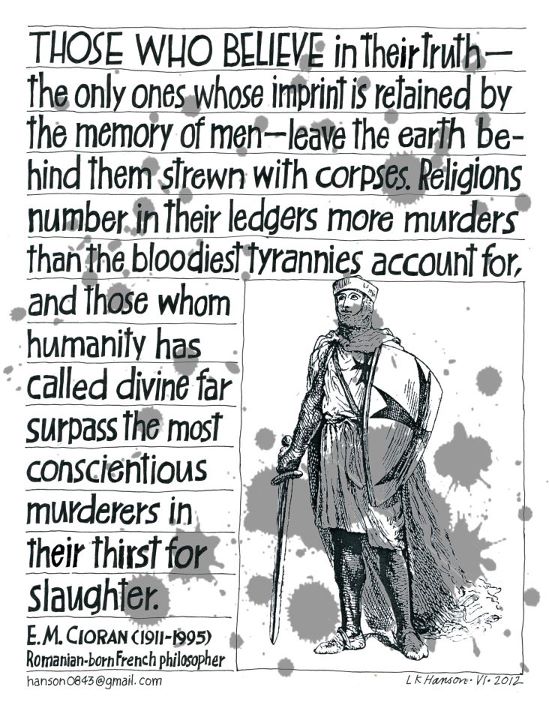
This is an annoying thing about newspapers: I discover browsing through yesterdays paper at the coffee shop that there is an excellent editorial cartoonist at the Star Tribune — he had a surprisingly anti-religious cartoon in the 11 June newspaper. I get online to look it up, and discover that the Star Tribune effectively buries everything other than the today’s newspaper, so I can’t find it! Can anyone out there help me out? It’s by L.K. Hanson, 11 June, on page A13 of the Opinion section — I’m looking forward to the outraged letters to the editor that will follow.

I can find examples of Hanson’s work on the web, but I wanted this specific cartoon…although it’s true that the more of his work I see, the more I like it. So why does the Strib make it so hard to see it?


Found, on Hanson’s Facebook page!

I like it.

Keep Sanal Edamaruku out of jail

The Catholic church is up to their old tricks again, this time in India. They’re trying to get a skeptic imprisoned for exposing a phony “miracle”.

Sanal Edamaruku, President of the Indian Rationalist Association, has for decades been a tireless campaigner for science and against superstition. He is widely known for his exposure of the tricks used by self-professed ‘God-Men’ and gurus and has often been on Indian television explaining the everyday science behind supposed miracles.

After one such exposure – he pointed out that the “blood” oozing from a statue of Christ at the Catholic Church of Our Lady of Velan kanni in Vile Parle, Mumbai was in fact water from a leaky pipe – the Catholic Church of Mumbai made a formal complaint about him to the Mumbai police. He stands accused of “deliberately hurting religious feelings and attempting malicious acts intended to outrage the religious sentiments of any class or community”, an offence under Section 295(a) of the Indian Penal Code. No arrest warrant has been issued but the case is "cognisable" meaning the police can arrest without warrant at any time. He is being harassed daily by the Mumbai authorities who, under pressure from Catholic groups, are insisting that he turn himself in. His petition for “anticipatory bail” was turned down on 3 June 2012 on the bizarre grounds that he would be safer in custody. If he is arrested he will therefore most likely be detained in jail until court proceedings are concluded, which could take several years. Fearing arrest, he dares not stay long at home or work.

Go sign the petition.

The hypocrisy, it burns

Sanctimonious Cardinal Timothy Dolan has been on a crusade against immorality: he opposes gay marriage, and was extremely irate that we might expect the Catholic church to cover its employees with insurance that pays for contraception. How dare we ask the church to pay any benefits to sluts?

It seems, though, that he’s perfectly willing to compromise the church’s high moral stand in one case:

Cardinal Timothy M. Dolan of New York authorized payments of as much as $20,000 to sexually abusive priests as an incentive for them to agree to dismissal from the priesthood when he was the archbishop of Milwaukee. […]

But a document unearthed during bankruptcy proceedings for the Archdiocese of Milwaukee and made public by victims’ advocates reveals that the archdiocese did make such payments to multiple accused priests to encourage them to seek dismissal, thereby allowing the church to remove them from the payroll.

So, on the scale of sins the church will close its eyes to, raping children in the name of the Lord rates very low, but using contraception? Unforgivable.

Anyone know any Amalekites?

Hey, did you know that the schools have the job of teaching our children morality now? They’re having a tough enough time teaching reading and math, but now we’re supposed to add right and wrong. It’s nice in principle, but now there’s another problem: the powers that be believe the right way to do this is to teach them Christianity, a notion which opens the door to the Child Evangelism Fellowship (CEF) and their Good News Clubs. Look at one of the examples of moral thinking they teach in schools.

The CEF has been teaching the story of the Amalekites at least since 1973. In its earlier curriculum materials, CEF was euphemistic about the bloodshed, saying simply that "the Amalekites were completely defeated." In the most recent version of the curriculum, however, the group is quite eager to drive the message home to its elementary school students. The first thing the curriculum makes clear is that if God gives instructions to kill a group of people, you must kill every last one:

"You are to go and completely destroy the Amalekites (AM-uh-leck-ites) – people, animals, every living thing. Nothing shall be left."

"That was pretty clear, wasn’t it?"the manual tells the teachers to say to the kids.

Even more important, the Good News Club wants the children to know, the Amalakites were targeted for destruction on account of their religion, or lack of it. The instruction manual reads:

"The Amalekites had heard about Israel’s true and living God many years before, but they refused to believe in him. The Amalekites refused to believe in God and God had promised punishment."

The instruction manual goes on to champion obedience in all things. In fact, pretty much every lesson that the Good News Club gives involves reminding children that they must, at all costs, obey. If God tells you to kill nonbelievers, he really wants you to kill them all. No questions asked, no exceptions allowed.

Asking if Saul would "pass the test" of obedience, the text points to Saul’s failure to annihilate every last Amalekite, posing the rhetorical question:

"If you are asked to do something, how much of it do you need to do before you can say, ‘I did it!’?"

"If only Saul had been willing to seek God for strength to obey!" the lesson concludes.

Oh, yes, we now have after-school programs to tell the children that not only is it OK to kill people if god tells you to, but that having different religious beliefs is sufficient cause to justify mass murder, and that the only mistake you might make is in being insufficiently thorough in executing your foes.

We can thank the Supreme Court for this state of affairs, in a decision that said schools could not discriminate against organizations they lease their facilities to after hours (a lie; watch what would happen if the KKK tried to organize a White Supremacy Club in the schools), and worse, that teaching bible stories was a good way to instruct children in morals.

In the majority opinion that opened the door to Good News Clubs, supreme court Justice Clarence Thomas reasoned that the activities of the CEF were not really religious, after all. He said that they could be characterized, for legal purposes, “as the teaching of morals and character development from a particular viewpoint”.

I don’t expect the Supreme Court, much less Clarence Thomas, to be capable of deciding what is a proper moral lesson for my kids. I also think it’s quite clear to everyone that the Bible is a highly unethical text — it’s all about justifying evil in the name of tribal self-interest.

(via Ophelia)

I had a better impression of Canadians before I read that tripe

Stop me if you’ve heard this before: “Atheism is another religious belief”. “I don’t have enough faith to be an atheist.” “Someone curdled the contents of my brain pan and replaced them with a thurible.” Yeah, familiar nonsense, isn’t it? And now a Canadian “legal philosopher, writer, professor and practicing legal consultant”, Iain Benson, is forcefully regurgitating them again, with the added bonus of amazingly false claims.

“Atheists, agnostics and religious of all forms are believers and all have faith. The question is not whether they are believers but rather, what they believe in,” he says and insists the “new atheists” such as the late Christopher Hitchens or Richard Dawkins, who pride themselves on “not having any beliefs,” are wrong.

“Atheists are men and women of faith. Their faiths are different but they are still faiths and their beliefs still beliefs, no matter how much Dawkins and those like him wish it was different. Humans are stuck being believers, and that’s all there is to it,” he says.

We pride ourselves on not having any beliefs? Really? I have lots of beliefs, and I question them whenever necessary; I also expect my beliefs to be supported by evidence. I believe the earth orbits the sun, and I have evidence for that. I believe the earth is 4½ billion years old, and I have evidence for that. I believe life evolved, and I have evidence for that.

I don’t have faith, though, unless you’re willing to redefine “faith” to such a degree that it has no relationship at all to what theists mean by the term.

Here’s the problem: it’s not belief, because of course everyone has beliefs. It’s false beliefs. It’s beliefs that contradict reality, or are internally self-contradictory, or dogmatic beliefs that cannot be revised in the face of new evidence. Atheists try their best to get rid of those (although even there, we’re not perfect), while theists like Benson embrace such nonsensical jibber-jabber enthusiastically, and try to use their demonstrably false beliefs to guide public policy.

We all have a body of common beliefs: you’ll die if you jump out of a tenth story window, you should have a competent mechanic check out that used car you’re planning to buy, we can learn more about the world by observing and testing it. These are the set of pragmatic beliefs that allow all of us to function from day to day.

Then there are the set of entirely bogus and nonsensical religious beliefs layered on top of the useful common beliefs: you will live after death, a god cares about what you do in the privacy of your bed, we’re all damned sinners who will go to hell unless we belief in a zombie blood sacrifice. Sensible people reject those.

Although “dogmatic” doesn’t necessarily mean being rude, common usage helps prevent any real understanding of what dogma is. “Which is why so many atheists and men and women in the street think, like Dawkins and Hitchens, they don’t believe in anything. But they do.”

But a lack of understanding has enabled contemporary atheists to present their belief system as the only one that should have public recognition, forcing their own so called “non beliefs” on others.

No, you can believe whatever you want. What you can’t do is determine public policy by your dogma, which poorly reflects the realities of the physical world, nor can you use the state to indoctrinate children into your set of falsehoods.

Contrary to Benson’s freaky views, atheists aren’t trying to demand that politicians and teachers be atheists — we insist that they be secular. Big difference. Use secular principles to work out what is best for people in the material world. Weirdly, Benson seems to understand what “secular” means.

“We need to reclaim the true meaning of the ‘secular,'” Professor Benson says, pointing out that the word is misunderstood in today’s world and taken to mean “non-religious” when its real meaning, and legal definition is derived from the Latin word “saeculum” meaning “world.”

“Secular was used historically to distinguish between those things that were deemed to be ‘in the world’ and those that were expressly and technically ‘religious,'” he explains using the Catholic tradition to distinguish “secular priests” or those who work “in the world” from “religious” for those men and women who have taken specific religious vows and may live a cloistered life.

Yeeeeeessss? Atheists know what “secular” means. Perhaps Mr Benson should talk to a few sometime — his babblings reveal a profound ignorance.

According to Professor Benson, religious believers have as much right as anyone else to function in society according to these beliefs.

“Likewise religious institutions have as much right as non-religious institutions. Everyone has a belief system of some sort and those who draw on religious sources should not be put at a disadvantage,” he insists.

His support of equality for religious and secular institutions is commendable. Then I suppose he’d agree with me that the special privileges of tax exemptions and lack of regulatory oversight for changes should be abolished?

Since both religious people and atheists can share secular values, I don’t think it’s depriving the religious of their rights by insisting that everyone should be competent at their secular role; the special knowledge of religion/spirituality ought to have as much relevance to secular positions as knowledge of the rules of Dungeons & Dragons.

Do we have to read the Bible?

There’s a scheme at work to put a Bible in every school in England, and Richard Dawkins approves. I do too, sharing one opinion:

I have an ulterior motive for wishing to contribute to Gove’s scheme. People who do not know the Bible well have been gulled into thinking it is a good guide to morality. This mistaken view may have motivated the "millionaire Conservative party donors". I have even heard the cynically misanthropic opinion that, without the Bible as a moral compass, people would have no restraint against murder, theft and mayhem. The surest way to disabuse yourself of this pernicious falsehood is to read the Bible itself.

The Bible really is a great evangelical tool for atheists. It is such a wicked book of lies and bad advice that it handily discredits Christian claims of righteousness.

He goes a little too far, though, declaring it a great work of literature, and I have to disagree with that. Fragments of the book are excellent, but the bulk of it is simply awful, incoherent stuff, on a par with Twilight novels and fascist propaganda. It’s simply been hallowed by tradition and history, but really…we should be able to do better.