How dare the APA refuse to recognize that men and boys are violent creatures of instinct

Jeez. Jordan Peterson really hates human rights and gender issues. Those things really fire him up, which suggests there’s something deeply wrong with him. So he’s been meeting with Doug Ford to complain, and it’s disturbing that Ford thinks Peterson is providing credible input, especially when Peterson is raging about basic human decency.

Oh, yeah, he also hates education. But that’s nothing: man, is Peterson pissed off about the American Psychological Association.

The American Psychological Association (APA) recently released its Guidelines for Psychological Practice with Boys and Men. It manages to be simultaneously predictable, reprehensible, infuriating and disheartening — no mean feat for a single document. Make no mistake about it: this document constitutes an all-out assault on masculinity — or, to put it even more bluntly, on men.

The coup of the APA undertaken by the ideologues is now complete. The field has been compromised, perhaps fatally. And the damnable guidelines provide sufficient, but by no means exhaustive, evidence of that.

He’s very upset that the APA argues that traditional masculine roles can do harm (I imagine they’d say the same thing about traditional feminine roles, but this document focuses on men and boys), and translates their words to be men who socialize their boys in a traditional manner destroy their mental health. How horrible! Except it’s true. “Traditional” here means narrow and limited, and they are quite right to say that wedging kids into a predetermined role can be damaging. Why should this be considered controversial? Here’s the specific quote from APA Guidelines for Psychological Practice with Boys and Men (pdf):

Boys and men have historically been the focus of psychological research and practice as a normative referent for behavior rather than as gendered human beings (O’Neil & Renzulli, 2013; Smiler, 2004). In the past 30 years, researchers and theorists have placed greater emphasis on ecological and sociological factors influencing the psychology of boys and men, culminating in what has been termed the New Psychology of Men (Levant & Pollack, 1995). For instance, socialization for conforming to traditional masculinity ideology has been shown to limit males’ psychological development, constrain their behavior, result in gender role strain and gender role conflict (Pleck, 1981, 1995; O’Neil, 2008; O’Neil & Renzulli, 2013), and negatively influence mental health (e.g., O’Neil, 2008, 2013, 2015) and physical health (Courtenay, 2011; Gough & Robertson, 2017). Indeed, boys and men are overrepresented in a variety of psychological and social problems. For example, boys are disproportionately represented among schoolchildren with learning difficulties (e.g., lower standardized test scores) and behavior problems (e.g., bullying, school suspensions, aggression; Biederman et al., 2005; Centers for Disease Control and Prevention, 2015). Likewise, men are overrepresented in prisons, are more likely than women to commit violent crimes, and are at greatest risk of being a victim of violent crime (e.g., homicide, aggravated assault; Federal Bureau of Investigation, 2015).

Those are facts: boys exhibit more learning disabilities, men are more likely to commit violent crimes. Why? The APA argues (and backs up with literature citations) that one source of conflict in the lives of boys and men is the social constraints we place on them — that we socialize boys to belittle education and to deal with conflict with violence. Peterson knows this is true; he’s bragged about wanting to beat people up. These are also real problems that, if you are genuinely concerned with the welfare of boys and men, you ought to want to address.

So what is Peterson objecting to? He wants to insist that the nature of boys is instinctively aggressive.

First, there is no scientific evidence that aggression, per se, is learned. Like fear, pain, hunger and thirst, rage is instinctual. The biological evidence for this is crystal clear and unshakeable.

Whoa. It is definitely true that anger has biological correlates — sure, take blood samples from people in fights, their adrenaline is way up, as is their blood pressure, etc. I don’t even know what he means by “instinctual”, but he seems to think it implies a response that is ungovernable by reason. But that isn’t true! If someone steps on your foot, do you instantly ball up your fists and punch them in the face, in the same way that you’d pull your hand back from a hot stove? You might “instinctively” feel anger or distress, but normal men and women don’t respond automatically with aggression…and you probably also cool quickly if the offender expresses remorse and an apology. You know, those learned responses we have to help diminish aggressive reactions, so we don’t end up in jail or in a bloody melee. I think it’s crystal clear that most of us have social and psychological mechanisms for reducing violent responses, which is a good thing to encourage.

But let’s play Peterson’s game. Let’s give him the idea that males are naturally, biologically, fixedly aggressive, and that you can’t unlearn it. Then where’s the harm in raising them in an environment that encourages peaceful resolution of conflicts and teaches alternative methods for cooperating? If he’s right, it won’t make a bit of difference, that boys will be battering each other and assaulting the girls, and he and his culties will be standing smugly aside giving the thumbs up to all the helter-skelter viciousness. Boys will be boys, you know, and if the APA wants to try and civilize the little thugs it won’t change a thing.

But Peterson wants to also argue that better behavior can be taught — it’s just that the only way to do that is via traditional masculinity, taught by men, and that the real problem is all those fatherless families where the boys are being let down by their mothers.

So the idea that aggression is learned is not only wrong, it’s backward. Aggression is easy. Civilized behaviour is difficult. It is the integration of aggression that is learned. And it is primarily men who teach it, particularly to aggressive boys.

To back that up, he points to the elevated rates of social problems in fatherless families, which is true. He doesn’t seem to appreciate the compounding factors involved here: that these families are often also produced by economic stress and disruption, that fathers are often the ones responsible for the abandonment of their families and failure to teach that “integration of aggression”, and that he doesn’t show how enforcing traditional norms somehow corrects the problems. Nope, none of that. Blame for any problem of learning disabilities or increased incarceration rates falls only on those single mothers — the ones who typically step up and take the majority of the responsibility for raising the kids in those fractured families, for which the fathers are blameless.

And also the APA is the problem. Look at the venom frothing in this characterization:

The primary axiom of the ideologues who generate this kind of propagandistic discourse is that Western culture is to be regarded as an oppressive patriarchy: unfairly male-dominated, violent, racist, sexist, homo-, Islamo- and trans-phobic — and as uniquely reprehensible in all those regards. There is no doubt, to give the devil his due, that human history as such is a blood-drenched nightmare — and that is also true of Western civilization. However, to view humanity in general or the West in particular as solely characterized by its pathology is indication of a profound and fatal failure to discriminate good from bad.

Wait. The APA guidelines are some horrible propaganda that blames all of Western culture, and only Western culture, for oppression, and that it holds all men at fault for this “blood-drenched nightmare”? Wow. I’ve gotta read this dramatic story of feminist accusations against the whole of Western civilization. So I did.

I was disappointed.

Rather than raging against the patriarchy, the document is strongly and appropriately centered on the welfare of men and boys. It’s a set of reasonable suggestions for how psychologists ought to regard the role of men and boys in their lives, and it’s essentially entirely positive. This is a pro men paper, that encourages professionals to respect and treat the unique problems of men and boys. I read it looking for any hint of a “kill all men” attitude, or any sign of victim-blaming, and it just isn’t there. There also isn’t anything about blaming only Western culture.

It’s a long document, so I’ll just pull out the 10 short guideline recommendations. You tell me where this looks anything like Peterson’s mischaracterizations. I tried hard to find the all-out assault on masculinity or the reprehensible, infuriating and disheartening content.

  1. Psychologists strive to recognize that masculinities are constructed based on social, cultural, and contextual norms.
  2. Psychologists strive to recognize that boys and men integrate multiple aspects to their social identities across the lifespan.
  3. Psychologists understand the impact of power, privilege, and sexism on the development of boys and men and on their relationships with others.
  4. Psychologists strive to develop a comprehensive understanding of the factors that influence the interpersonal relationships of boys and men.
  5. Psychologists strive to encourage positive father involvement and healthy family relationships.
  6. Psychologists strive to support educational efforts that are responsive to the needs of boys and men.
  7. Psychologists strive to reduce the high rates of problems boys and men face and act out in their lives such as aggression, violence, substance abuse, and suicide.
  8. Psychologists strive to help boys and men engage in health-related behaviors.
  9. Psychologists strive to build and promote gender-sensitive psychological services.
  10. Psychologists understand and strive to change institutional, cultural, and systemic problems that affect boys and men through advocacy, prevention, and education.

OMG. Boys and men have multiple aspects to their social identities? Horrendous. Everyone knows we should make The Hulk our ideal at all times and in all situations.

“Encourage positive father involvement…”, how evil. Oh, wait. Except that’s what Peterson thinks is good, too.

They want to reduce aggression, violence, substance abuse, and suicide? WHERE DOES THIS INSANE ANTI-MEN AGENDA COME FROM? Probably feminists.

We apparently need a stronger call for gender insensitive psychological services. Men thrive when treated insensitively. Because we’re tough.

I think the real objection Peterson has is that the APA doesn’t endorse the reductionist biological determinism that he, a non-biologist with a demonstrable ignorance of biology, wants to assign to human behavior. The APA doesn’t subscribe to his crackpot theories, imagine that.

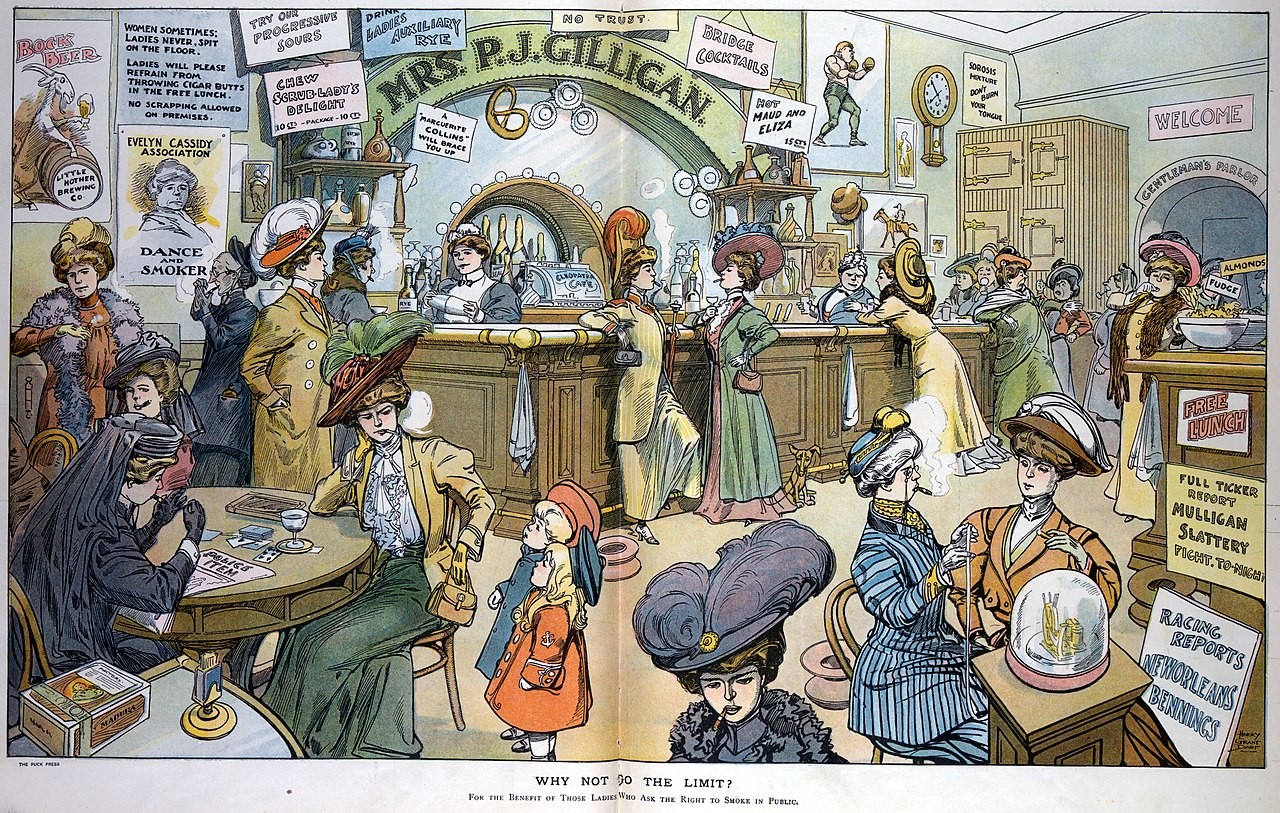
Drinking, smoking, hanging out in saloons, following sports and the stock market — it’s a nightmare world!

In 1908, Harry Dart was commissioned to produce an image of what horrors would be produced by the suffrage movement. I guess he succeeded?

Apparently, the worst thing he could imagine was that women might do the very same things men did all the time. I’m supposed to recoil from this unthinkable future…but it’s just fascinatingly detailed.

What do biologists really think of sex and gender?

I was recently berated by someone telling me that they were surprised that a biologist, who does things like determining the sex of a fly, a fish, or a spider, actually agrees with people who see gender as fluid and variable, and not necessarily in alignment with sex. All I can say is…there are an awful lot of people out there with a seriously mangled version of scientific concepts. Worse, they use their misunderstanding of basic terms to argue that they have a scientific foundation for their bad ideas.

Just to help you out, here’s a succinct definition of some fundamental concepts, as written by an ecologist in the PLOS Ecology Community blogs. Your expectation that biologists share the narrow, bigoted views about sex and gender that you have are probably totally wrong — so you might want to hesitate next time you think it’s a good idea to lecture professional biologists on biology.

The words “sex” and “gender” are often used interchangeably in colloquial contexts, but they have different meanings that are relevant to our work in ecology.
Sex” refers to categories based on a combination of biological and physical characteristics, such as body organs, chromosomes, and hormones (WHO 2011, APA 2015). Sex is commonly assigned on the basis of external genitalia at birth and is often assumed to be only male or female, but scientists have identified at least five different groupings of human sex chromosomes, anatomy, and hormone physiology (Fausto-Sterling 1993). Other terms that relate to sex include intersex, freemartin, and hermaphrodite. (Note that hermaphrodite is a term currently used for animals but considered outdated and rude when used to describe humans; the preferred contemporary term for humans is intersex.) (“Sex” can also refer to activity among one or more individuals that may or may not result in sexual arousal and/or genetic recombination. I’m not addressing this meaning of the word in this piece.)
Gender” refers to identities and categories based on social or cultural characteristics (WHO 2011, APA 2015). Gender is both internal (gender identity, which is each person’s innate sense of their own gender), and external (gender expression, which is how each person expresses their gender identity). Woman, man, masculine, and feminine are all terms that can refer to gender. Transgender is a term used to describe a person whose gender identity is different from the sex they were assigned at birth. Gender is primarily a human and social term, and it is not usually relevant for non-human animals or plants.
When we observe biological and physical aspects of our study organisms, those observations tell us about the sex of those individuals, not the gender.
When we interact with other humans, we usually know more about their gender rather than their sex: for example, we often know about their clothing and hairstyles but not very much about their body organs, chromosomes, or hormones. (Furthermore, and this fact may be obvious, but clothing and hairstyles are not necessarily signifiers of any particular gender identity.) Among humans, sex and gender may be related, but they are not equivalent. In other words, female and woman are often thought to be synonymous, but in reality, female refers to different characteristics than woman does.

Also good was this bit:

If you (a) are talking about scientists and (b) interested in categories such as “women” and “men,” it’s more polite to use gender rather than sex categories. Why? In professional contexts, we may think we know what gender our colleagues present themselves as (e.g., women, men), but probably don’t know very much about the biological sex of our colleagues (e.g., chromosomes, body organs, hormones). It’s odd and inappropriate to make assumptions about other people’s bodies, especially in a professional context.

This. When I meet people, I don’t know anything about their sperm count or their chromosome arrangement or even what their genitals look like (you don’t have to show me), so all the sex details are irrelevant to our interactions. Gender matters because we have a huge amount of social capital, some good, some bad, invested in how people present themselves, and also because those gender signifiers are diverse and do a better job of reflecting how people see themselves in society, and how society sees them.

You know, when a population is identified as a discrete binary of two kinds of individuals, male and female, my usual thought is that the next step is to pair up individuals in bottles and do a genetic cross. That’s not how we treat human beings in our communities.

I think we can safely say #gamergate is dead

It wasn’t that long ago that being a gamer meant you were a regressive asshole. Here’s the segment of hbomberguy’s long twitch stream in which Alexandria Ocasio-Cortez shows up to talk about the importance of trans rights while the gamer bounces a gorilla around the screen. I know, that part seems weird, but hey, AOC is taking this opportunity to make a clear statement, so you can’t complain.

I have no idea what’s going on on the screen, but the words make sense.

I don’t understand 2019, and that’s OK

If you’d told me in my youth that someone named hbomberguy would raise over $340,000 for a trans charity called Mermaids by playing Donkey Kong online, I would have said that I’ve heard of Donkey Kong, but could you repeat the rest slowly and explain what each of the words mean, and could you possibly tell me how it all works? Donkey Kong is that big box in the arcade that you push quarters into.

If you then told me that major political figures (like Alexandria Ocasio-Cortez) were dropping in to talk to hbomberguy about the cause…well hang on a moment, this is getting silly.

Then to learn that what motivated this whole episode was that an Irish television writer had become obsessive about denying trans people rights, that’s just too much, I’m going to have to go lie down for a bit.

Sometimes it’s nice how the future turns out to be nothing like what you expected. Although sometimes it’s not so nice. This is one I’m happy to have seen.

By the way, I have met Graham Linehan. He was at a talk I gave in Dublin, and joined the bar crowd afterwards. He seemed nice, but didn’t say much — maybe he hated the talk. I would never have expected him to become such a flaming asshat over trans rights.

By the way, the stream is still ongoing and still accepting donations, although that lazy hbomberguy has taken a break to sleep. And I hope, shower.

Purity pizzas taste of self-loathing

I know this kind of argument won’t have any effect on the proponents of purity culture, who are resistant to the whole idea of evidence, but the evidence says the abstinence movement didn’t work. If anything, it had the opposite effect, and people are dealing with the fallout now.

For example, in the early 2000s, Dr. Tina Schermer Sellers began noticing an alarming trend. A clinical sex therapist, family therapist, and associate professor at Seattle Pacific University, she would ask the grad students in her human sexuality class—most of them aspiring therapists—to write the stories of their own sexuality. After years of asking the same questions, she suddenly saw a sharp uptick in students describing feelings of humiliation and disgust toward their bodies and sexual identities. These students all seemed to share a sense of general ignorance and naiveté about sex and relationships, as well as a deep discomfort with natural sexual urges. “This dramatic increase in self-loathing was really heartbreaking for me to see,” says Schermer Sellers. When the trend continued into a third year, she decided to investigate what was behind it.

Digging deeper, she found that many of her students had been involved in youth groups that taught them not only to abstain from sex before marriage, but also that they should not feel any sexual desire at all. “They learned that if you feel [desire], you’re compromising your relationship with God or with your future partner,” she explains. She heard story after story of teenagers circled up in youth group meetings. “They would pass around a slice of pizza, and tell everyone to take one bite out of it, explaining that if you give your heart away while you’re growing up, it’s like giving pieces of yourself away,” she says. “The piece of pizza would go around the circle, and all that would be left was the crust—and this is what you’d give your future partner.” She heard similar tales about shiny pieces of foil being crumpled, or flowers with petals ripped off, or a cup everyone was asked to spit into.

I remember the purity balls and chastity rings and all that other crap that was being pushed off on young kids — it was extreme and bizarre. I wasn’t hoping that my kids were virginal until marriage, which seemed like demanding that they never exhibit any symptoms of illness while not worrying whether they were actually healthy or not. Rather, I was hoping that they developed strong relationships of mutual respect, and what they did with their bodies was their decision, not mine.

I hoped they understood that pizza was something you made fresh, and that it was a bad idea to save the pizza you made at puberty and give it to your partner ten years later. Yuck.

When reality conflicts with wish-fulfillment fantasies

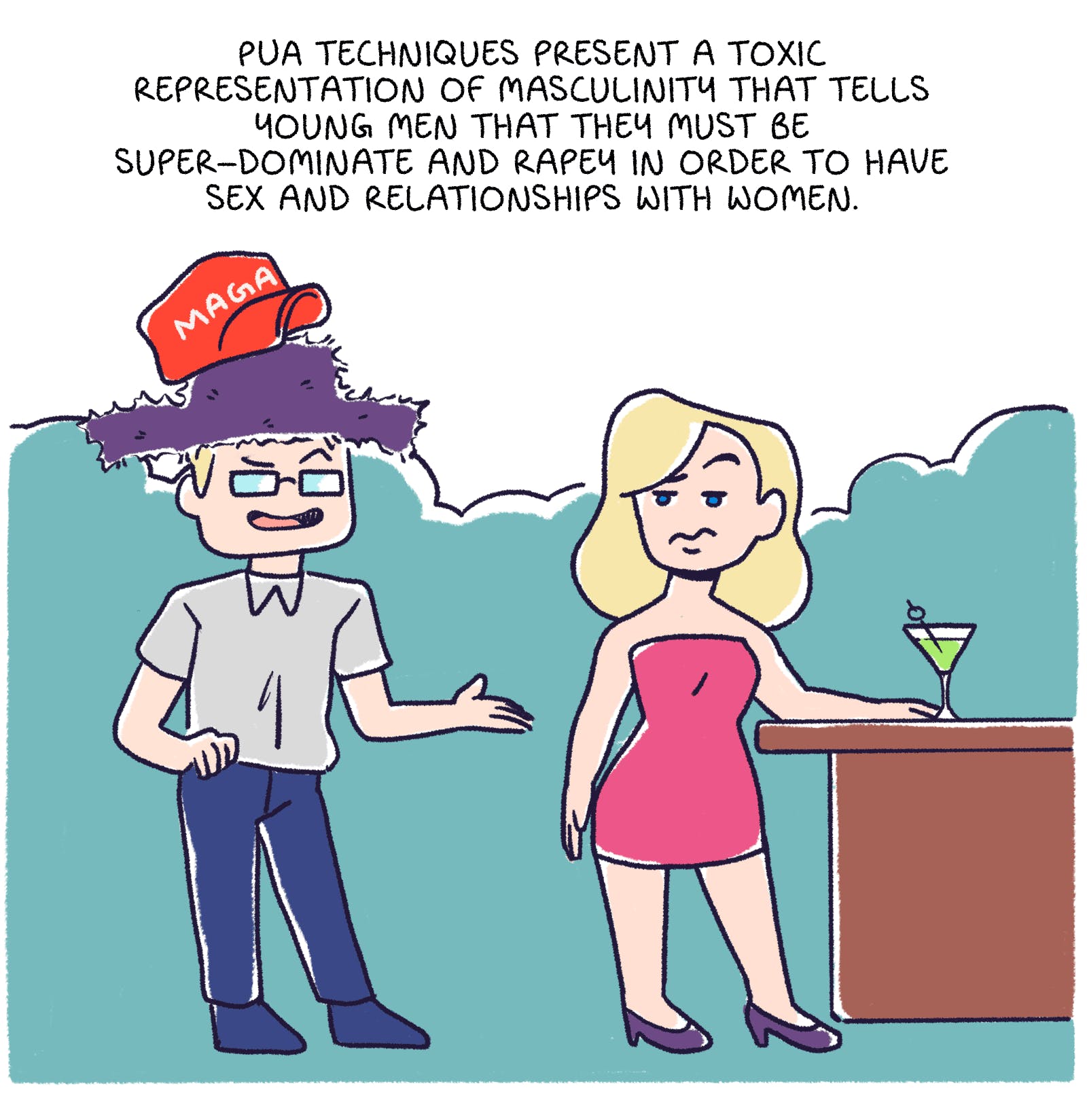
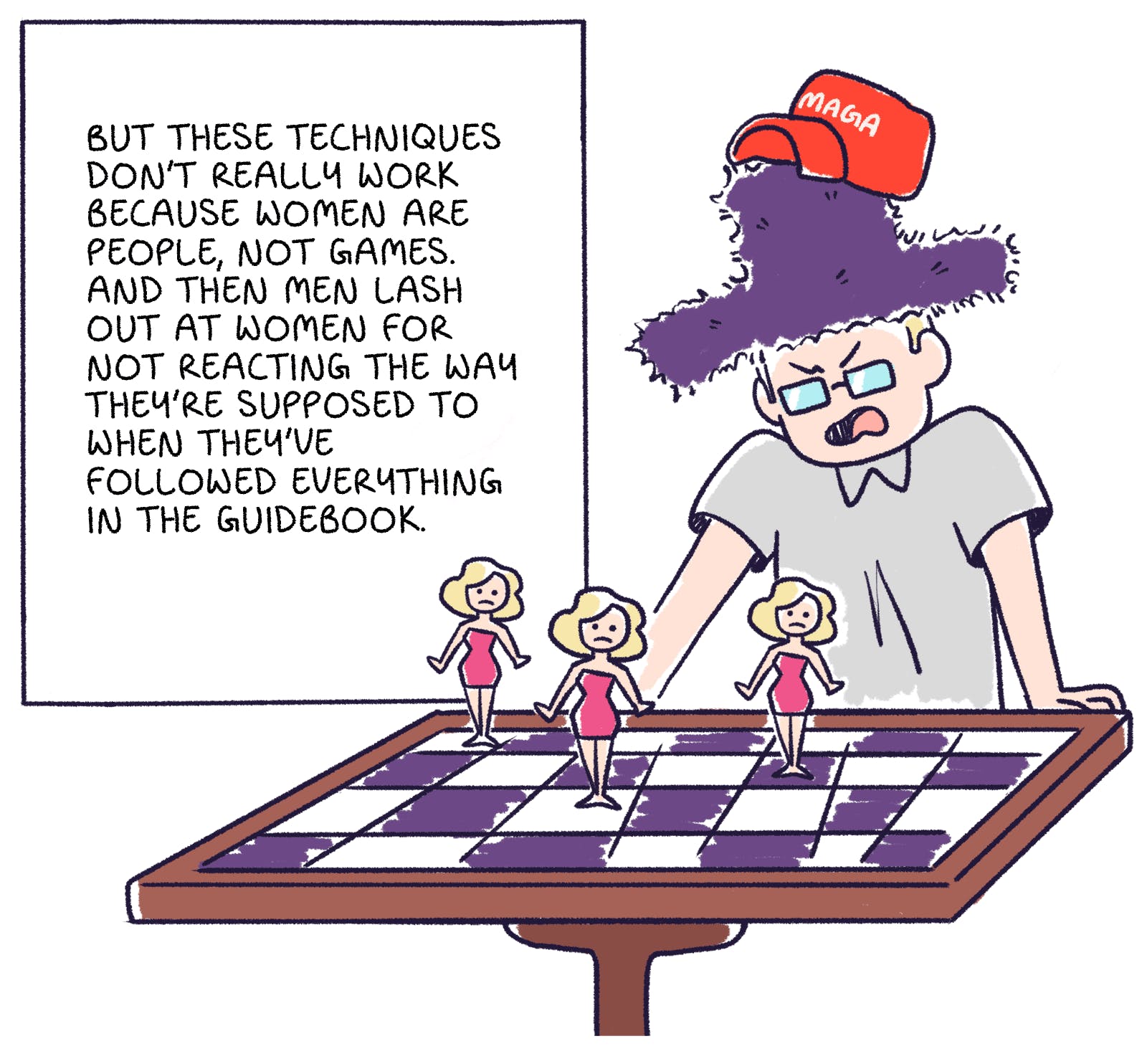
I’d almost forgotten alt.seduction.fast! That was one of those pariah newsgroups back in the 90s that I filtered against because you knew anything emanating from that quarter was going to be poisonous garbage that needed to be alt.kill.it.quick. It makes a brief appearance in this comic about how pick-up artists morphed into the alt-right, which rings true. Yeah, online misogyny rapidly evolved into the whole toxic stew that afflicts us today.

These two panels struck me as particularly insightful.

Damn you women for not fitting into the ridiculous playbook developed by stupid PUAs! It’s all your fault!

The Singal problem

You might want to read this Twitter thread by Siobhan points out how Jesse Singal delicately carves up his sources to only allow views that align with his own perspective through.

Short version: Singal reported that the controversial “conversion therapy” lab of Kenneth Zucker was shut down for purely political reasons by omitting the words of scientists who pointed out that he was far out of the mainstream of clinical practice.

That kind of slanted reporting is why transgender individuals, you know, the people most endangered by his biases, consider him to be shady and untrustworthy.

The miracle of selling razors

This is a really good commercial.

Without saying a single outrageous thing, by presenting a purely optimistic message, it has generated a huge amount of controversy and has everyone talking about it (gosh, I just put it on my blog). It’s selling razor blades, and it doesn’t show any razors — none of the male models in the ad are lathered up, or even in need of a shave or a trim. Nobody is shaving. I’m impressed with how neatly capitalism can exploit both good and bad sentiments to serve the cause of selling stuff.

From another perspective, it’s also cool how it has maneuvered a lot of men into whipping out their manly six-shooters and blasting away at their feet. The message is that bullying, sexual harassment, and condoning bad behavior with silent assent are bad, but that good men can and will oppose such behavior, which has provoked the peculiar, guilt-ridden response of “how dare Gillette accuse me of bullying and harassment!”, completely missing the opportunity to identify with the good-looking, well-groomed men who are stopping bullying and harassment. You’ve got a chance to see yourself mirrored in commendable behavior, or oppressive behavior, and thousands of men are screaming, “How dare you criticize my choice to catcall, or mansplain, or punch people!”

And now everyone is selling razors for Gillette. It’s a marvel.

Piers Morgan. Can he get any more repulsive?

That’s a challenge. I’d like to see him try. He and Tucker Carlson have this thing going where they screw up their faces and pretend to ignorance, as if it were to their credit, and the routine is getting old fast.

His latest schtick is to declare that women are disgusting if they don’t shave off all their body hair.

Morgan and co-host Susanna Reid were discussing the new campaign ‘Januhairy‘, which encourages women to not shave their armpits and embrace their natural hair.

But Morgan was repulsed by the idea, and after being shown images of celebrities who have decided not to shave – including Lady Gaga, Madonna and Julia Roberts – the GMB presenter said he died inside.

Reid asked Morgan if he shaved his pits, to which he replied a firm, No.

“Is that laziness?” Reid then asked.

No because women don’t have a problem with that. But men don’t fancy women who let it all out in January.

Apparently, someone needs to urgently inform Lady Gaga, Madonna and Julia Roberts, and all other women, that it is their duty to satisfy Piers Morgan’s sexual kinks. I think they need to grow even more body hair, because if a few tufts of armpit hair make him die inside, a bit more fuzz might make him die the rest of the way, which would be nice.

Also curious if women out there really want to know anything about Piers Morgan’s armpits, because I didn’t. I could have lived a long, contented life without ever considering Morgan’s body hair, and I feel like him forcing me to think about it was a terrible violation.

Here’s something even worse: Kate Smurthwaite appeared on Susanna Reid’s show (Morgan is just the dull sidekick there) to talk about why women shouldn’t feel compelled to shave, and he got totally sidetracked with the revelation that Smurthwaite is polyamorous…so he had to jack up the creepiness quotient by pestering her with prurient little questions.

Kate Smurthwaite, a comedian, was describing how her hairy armpits have never stopped her from finding a lover, and Piers was desperate to get back to his conversation.

He asked her: Can I talk about your polyamorous thing for a minute, because I’ve never heard of this thing? What does that mean?

Oh god. He’s never heard of this thing. Right. That was just an excuse to continue to probe into a woman’s sex life, in public.

Why does this horrible little man appear on television? Promise me, English-type persons, you’re not going to someday elect him to be prime minister, are you? Because that seems to be a common trajectory in our little colony, rising from cheap bigoted ‘entertainer’ to high office. I’d hate to see it happen to you.


If you’d like to see the whole episode, here it is. Morgan was more of a sleazy prat than I imagined, and Smurthwaite was smart, classy, and funny.