Your state’s report card

The Fordham Institute has released their annual evaluation of state science standards. They are very tough graders — Minnesota got a “C”. Ack! Mom & Dad are going to be pissed, how will we ever get into a good college at this rate?

The Institute does a fairly thorough breakdown, so there are some bright spots: Minnesota is doing a good job in the life sciences, but where we got dinged hard was on the physical sciences, which are “illogically organized” and contain factual errors. Here’s the introduction to their evaluation of our life sciences standards:

Important life science content is presented quite minimally, but the flow and logic are such as to convey an understanding of the concepts rather than coming across as a list of topics to check off. The inclusion of examples from Kindergarten through eighth grade helps to further explain what students should know and be able to do.

Minimal is OK, as far as I’m concerned; it think it’s more important to get across a solid conceptual understanding. Of course, given that some teachers do a very poor job of getting those concepts across, more specific guidelines might be useful.

What’s really awful about our C, though, is that that’s the same grade Texas got. Oh, the ignominy!

I think we got robbed, though. The detailed breakdown says that a major problem is inconsistency: some bits of the Texas standards are stellar, others are terrible; different grade levels get variable quality of coverage. Texas gets slammed for life science standards that are “woefully imbalanced, with poorly developed material in the early grades and strong, sometimes excellent, content in the upper levels.” The major flaws are entirely predictable.

Perhaps the biggest problem with the middle school standards, however, is their coverage of evolution. For instance, the seventh-grade standards mention the Galapagos finches, giving the impression that the Darwinian paradigm is being presented. Unfortunately, it is not. Instead, the example of the finch Geospiza fortis apparently refers to studies by Peter and Rosemary Grant on beak size in this species, made widely known by Jonathan Weiner’s Pulitzer Prize-winning book, The Beak of the Finch. Creationists often distort these important findings to argue that Darwinian macroevolution does not occur—instead, microevolution does. In addition, the word “evolution” is never used in any of the middle school standards, and the term “natural selection” is never explained.

What’s really telling, though, is the reactions. I just told you I’m disappointed with Minnesota’s “C”; we can do better, and I hope the next round of standards will improve ours to an “A”. In Texas, creationist kook Don McLeroy was happy with his “C”.

McLeroy told the Texas Independent he is “very pleased” with the study and believes it only serves to validate the role he and the conservative bloc played in crafting the standards.

“The work of religious conservatives has been vindicated,” he said, pointing to the report’s positive review of high school evolution standards. When asked about the poor evaluation of middle school standards, McLeroy said blame could fall on the writing teams and review committees and/or the whole board who could have stepped up to improve them. “In the end, what we wrote was legitimate, sound science and the study proves it.”

That is so completely backwards. The weaknesses in the standards are the direct result of the meddling corruption of science pushed by the religious conservatives on the board; everything the Fordham Institute said was bad about their standards were the points the creationists pushed. The strengths are the product of the motivated, hard-working scientists and educators who fought against the religious conservatives. McLeroy can take credit for that “C” in the sense that it could have been an “A” if he and his fellow travellers in superstition had been kicked out of the process…and that’s nothing to be proud of.

(Also on Sb)

…and South Dakota follows suit

There was no opposition to a bill that encourages South Dakota public schools to study the bible. This one is as sectarian as they come.

Scripture study and science projects? That’s the prospect some students in South Dakota may face after a substantial majority in the state’s House of Representatives helped pass a resolution to encourage public school districts to incorporate Bible education into curricula. The House passed the resolution last week by a vote of 55-13 after a short floor debate during which no member from either party voiced opposition.

The sponsor of the bill, Steve Hickey, is a pastor, of course. This is clearly a law intended to promote Christianity and Christianity alone in the schools.

Hey, let’s not forget Pennsylvania in the roster of bad, lazy state legislatures. They passed a resolution declaring this the “year of the bible”. That one is just plain dumb: citing vague “great challenges” that the US is facing, it wants Pennsylvanians to turn to an ancient magic book to find strength. They won’t. Real problems need to be confronted with real solutions and hard work, not superstition and a retreat into fairy tales.

Indiana takes another step towards lunacy

Remember how Indiana managed to get a creationist bill through their Education committee? Crank up the dread, dismay, and disgust another notch: it has now passed the Indiana Senate, and is awaiting the approval of the house.

This is the bill that tries to avoid accusations of sectarian religious teaching by encouraging science classes to teach “Christianity, Judaism, Islam, Hinduism, Buddhism and Scientology”. They really don’t get it. None of them are science, and they shouldn’t be taught as if they were.

Word.

I’m a fan of Yo, Is This Racist? even if the answer is almost always “YES”. This particular Q&A seemed particularly appropriate.

Anonymous asked: Is it racist that my science teacher sucks balls?

Yo, science education in the US is a fucking political mess of a tragedy, but it’s worth sticking around and at least trying to learn how to apply evidence and logic, because bastardizations of science are basically the favorite tool of the modern racist.

(Wait, is my choice of a common black american slang term for the title of this post racist? Dammit, it is, isn’t it?)

Death to Elsevier!

You already know my feelings about that exploitive science publisher, Elsevier; I’m not the only one, and there’s been a long, long history of anger over their publishing model — and it’s not just scientists, but scholars in other disciplines who have been peeved.

Now a boycott has coalesced. If you publish, edit, or review Elsevier journal articles, make your opinion known and sign the petition.

(Also on Sb)

The comparison to jabberwocky is inevitable

Lots of people have been sending me this paper by Erik Andrulis, and most of you have done so with eyebrows raised, pointing out that it’s bizarre and unbelievable; some of you wrote asking whether it was believable, at which point my eyebrows went up. Come on people: when you see one grand cosmic explanation that is summarized with cartoons, which the author claims explains everything from the behavior of subatomic particles to the formation of the moon, shouldn’t you immediately sense crankery?

It’s also getting cited all over the place, from World of Warcraft fan sites to the Discovery Institute (those two have roughly equal credibility in matters of science), so I had to skim through it. I read it with rising concern: Erik Andrulis is a young assistant professor at Case Western Reserve University, and he’s published entirely sensible papers on RNA processing. This paper is so weird and out there that it is either an attempt to Sokal the field of origins of life research, or the man is seriously mentally ill. Either way, this is not going to help his career in the slightest.

The paper is titled Theory of the Origin, Evolution, and Nature of Life, and just the sweeping grandiosity of that title should set off alarm bells. Here is the abstract:

Life is an inordinately complex unsolved puzzle. Despite significant theoretical progress, experimental anomalies, paradoxes, and enigmas have revealed paradigmatic limitations. Thus, the advancement of scientific understanding requires new models that resolve fundamental problems. Here, I present a theoretical framework that economically fits evidence accumulated from examinations of life. This theory is based upon a straightforward and non-mathematical core model and proposes unique yet empirically consistent explanations for major phenomena including, but not limited to, quantum gravity, phase transitions of water, why living systems are predominantly CHNOPS (carbon, hydrogen, nitrogen, oxygen, phosphorus, and sulfur), homochirality of sugars and amino acids, homeoviscous adaptation, triplet code, and DNA mutations. The theoretical framework unifies the macrocosmic and microcosmic realms, validates predicted laws of nature, and solves the puzzle of the origin and evolution of cellular life in the universe.

Having skimmed through all 105 pages of this thing, I can tell you with confidence that it answers none of those questions. Just the fact that it is entirely non-mathematical and non-empirical (there aren’t any observations or experiments described at all), and that the entirety of the theory is built around diagrams sketched out by the author, should also tell you that this is not a useful or predictive theory.

It does not have an auspicious beginning. In addition to being constructed around cartoons and being a non-mathematical Theory of Everything, it has to introduce an elaborate collection of neologisms that make the whole paper painful to read.

In the theory proposed herein, I use the heterodox yet simple gyre—a spiral, vortex, whorl, or similar circular pattern—as a core model for understanding life. Because many elements of the gyre model (gyromodel) are alien, I introduce neologisms and important terms in bold italics to identify them; a theoretical lexicon is presented in Table 1. The central idea of this theory is that all physical reality, stretching from the so-called inanimate into the animate realm and from micro- to meso- to macrocosmic scales, can be interpreted and modeled as manifestations of a single geometric entity, the gyre. This entity is attractive because it has life-like characteristics, undergoes morphogenesis, and is responsive to environmental conditions. The gyromodel depicts the spatiotemporal behavior and properties of elementary particles, celestial bodies, atoms, chemicals, molecules, and systems as quantized packets of information, energy, and/or matter that oscillate between excited and ground states around a singularity. The singularity, in turn, modulates these states by alternating attractive and repulsive forces. The singularity itself is modeled as a gyre, thus evincing a thermodynamic, fractal, and nested organization of the gyromodel. In fitting the scientific evidence from quantum gravity to cell division, this theory arrives at an understanding of life that questions traditional beliefs and definitions.

Here’s a partial copy of his lexicon. It goes on quite a bit longer than what I’ve copied here.

Table 1. Gyromodel Lexicon

Alternagyre A gyrosystem whose gyrapex is not triquantal
Dextragyre A right-handed gyre or gyromodel
Focagyre A gyre that is the focal point of analysis or discussion
Gyradaptor The gyre singularity—a quantum—that exerts all forces on the gyrosystem
Gyrapex The relativistically high potential, excited, unstable, learning state of a particle
Gyraxiom A fact, condition, principle, or rule that constrains and defines the theoretical framework

Gyre The spacetime shape or path of a particle or group of particles; a quantum
Gyrequation Shorthand notation for analysis, discussion, and understanding gyromodels
Gyrobase The relativistically low potential, ground, stable, memory state of a particle
Gyrognosis The thermodynamically demanding process of learning and integrating IEM
Gyrolink The mIEM particle that links two gyromodules in a gyronexus
Gyromnemesis The thermodynamically conserving process of remembering and recovering IEM
Gyromodel The core model undergirding the theoretical framework
Gyromodule A dIEM particle in a gyronexus
Gyronexus A polymer of dIEM particles linked by mIEM particles
Gyrostate The potential and/or kinetic state that a particle occupies in its gyratory path
Gyrosystem A gyromodel with specific IEM composition, organization, and purpose
IEM Information, energy, and/or matter

I can’t help myself. You knew this was coming.

Twas brillig, and the slithy toves
Did gyre and gimble in the wabe:
All mimsy were the borogoves,
And the mome raths outgrabe.

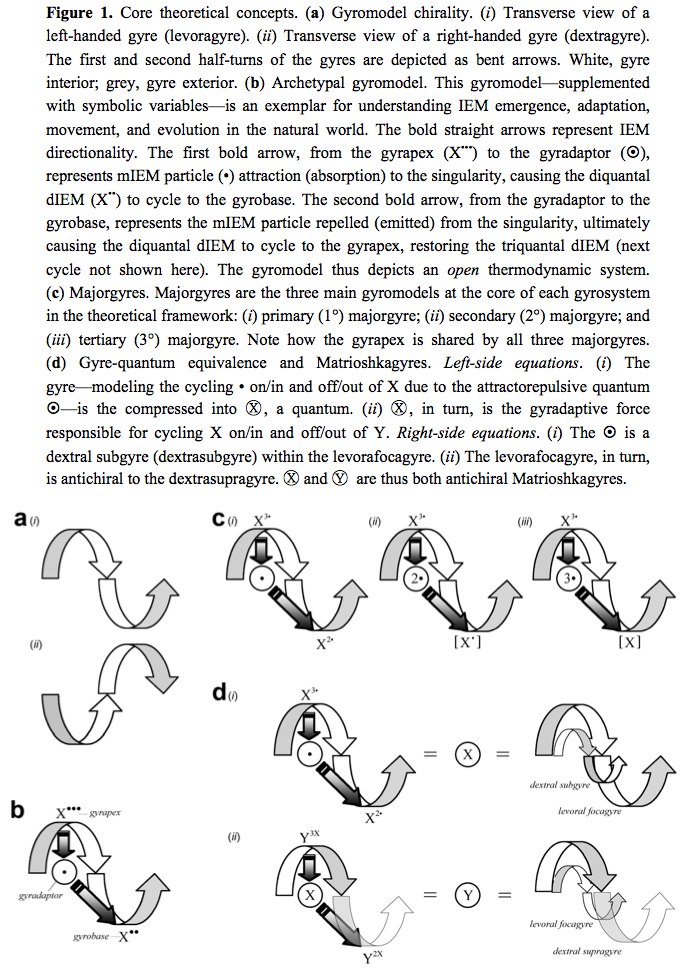
Now I know that you are in lexical shock right now, but I’m about to make it worse. Witness the use of these terms in figure 1 of the paper, which will also reveal the kinds of diagrams he’s using.

“The levorafocagyre, in turn, is antichiral to the dextrasupragyre” is a nice sentence that about sums up the experience of reading this thing. Don’t believe me? Here are more excerpts that illustrate the grand, cosmic, and entirely uninformative nature of gyroexplanatory gyrobabble. Andrulis purports to explain everything from learning and memory (learning and memory by gyres, not the poor people trying to understand his paper):

The ultimate state of gyromnemesis is the stably adapted particle or gyronexus in the gyrobase. A particle thus adapts through learning and memory by completing one full cycle—a revolution— around the singularity. Taken together, gyrognosis defines IEM integration and assessment whereas gyromnemesis defines IEM storage and recovery. Finally, although a diquantal IEM (X”) undergoes gyrognosis as the gyrobase of a primary majorgyre, it undergoes gyromnemesis as the gyrapex of an alternagyre. Thus, gyre learning and memory are relative to the gyradaptive singularity.

To the formation of Earth’s moon:

Lunar Formation. The favored hypothesis for the formation of Earth’s Moon is from planetesimal impact on a proto-Earth proceeded by matter ejection, accretion, and gravitational capture [189,190]. However, the question of lunar origin has not been settled since there are competing, albeit antiquated hypotheses [191,192]. I also discovered the stunning admission that, “…shamefacedly, [astronomers] have little idea as to where [the Moon] came from. This is particularly embarrassing… [193].” The oxygyre models the Moon as a macroxyon that has a macroelectron within itself; this simple gyrosystem accounts for the known chemical composition of the Moon surface, oxides [194]. Regarding lunar origin, the macroxyon that is the Moon emerges from the macroelectron that is the Earth, concomitant with the emergence of Earth’s macroxyon [195,196].

Several additional points can be derived from this gyrosystem. First, the oxygyre explains water on and in the Moon [197-199]. Second, the gyrating effects of the macroxygyre model the rotation of the Moon on its axis. Third, the path of a less exergic macroxyon (Moon) around more exergic one (Earth) follows an ohiogyre path, or lunar orbit. Fourth, this oxygyre provides insight into how tidal cycling is linked to lunar orbit and axial rotation [200] since the Earth’s oceans (macroxymatrix) and Moon itself (a macroxyon) exert complementary attractorepulsive forces. Fifth, this theoretical union also helps clarify short-term chronobiological ([201]; see 3.8) and long-term geophysical [202] relationships. Sixth, the craters that cover planetary, lunar, and satellite surfaces [203-205]—most if not all of which are near-perfect circles—bear the signature of the macroelectron singularity and its strong thermodynamic force on the oxygyre [206].

You know what? That doesn’t explain anything!

While the strange terminology and nonsensical claims could be clues that this is an elaborate Poe of some sort, the story I’ve heard from some other sources is that Andrulis is not getting tenure and will be leaving Case next year, and that he seems to have a history of tuning in and out — so what this most likely is is a developing personal tragedy. I hope he gets the care he clearly needs; his other work suggests that this is an intelligent mind that is currently going off the rails.

Setting Andrulis aside, though, there are other problems here. How did this paper get published? It’s terrible: unreadable, incoherent, bizarre, and completely lacking in evidence or mathematical support. This is from the very first issue of a new journal, Life, which also contains a perfectly reasonable general summary of origins of life research by Stuart Kauffman alongside Andrulis’s ghastly dreck. There seems to be a complete lack of editorial discrimination at the journal; this is not the way to build a reputation. Or rather, it is, but not a desirable one.

And then there is Science Daily, which seems to be the source where most of my correspondents found this paper. Science Daily is an incredibly annoying source: all they do is republish, without any kind of intelligent assessment, press releases. They suck. What good is mindless regurgitation?

And finally, there’s Case Western Reserve University, which must bear a share of the blame. Where did the press release come from? Why, from the Media Relations office at CWRU. Somebody wrote the press release that begins like this:

The earth is alive, asserts a revolutionary scientific theory of life emerging from Case Western Reserve University School of Medicine. The trans-disciplinary theory demonstrates that purportedly inanimate, non-living objects—for example, planets, water, proteins, and DNA—are animate, that is, alive. With its broad explanatory power, applicable to all areas of science and medicine, this novel paradigm aims to catalyze a veritable renaissance.

It’s madness stamped with the Case Western Reserve University School of Medicine seal of approval. If Andrulis did Sokal the journal, he also Sokal’ed the institution that employs him. Who wrote that bullshit? Do they have anyone competent review their press releases before they mail them out to the whole wide world? Was there anyone thinking in all the steps from crank professor to PR department to journal editor to reviewers? There were so many points where this crackpottery should have been detected and rejected, and it didn’t happen.

(Also on Sb)


Science Daily has informed me that they have removed the press release from their site, and that it should never have made it through in the first place.

Also, apparently Case Western has removed the press release from their listings.

Indiana fails

Indiana is preparing to promote creationism in their science classrooms. A legislative committee has advanced a bill that endorses creationism and “alternative theories” to the vote of the full senate. So it’s not a law yet, but it’s advancing down the path.

Here’s the horrifying part: it was approved 8:2 by the Republican-controlled Senate Education Committee. This is a group that is supposed to be the gatekeeper for good educational practices; you’d think their job was to screen out the random wacky garbage that individual, ideologically motivated members of the senate might poop out. But in the state of Indiana, they’ve handed that job over to goddamned Republicans in a calculated effort driven by their Republican governor, Mitch Daniels, to overhaul the state’s educational system.

It’s practically Republican gospel to destroy the system of public education in the US. It’s always going to lead to tears when you put those bastards in charge.

(Also on Sb)

Today is Shawn Otto day at UMM

We’re having a visit today from Shawn Lawrence Otto, a fellow who has been fighting against the un-American war on science on the web and in a book, Fool Me Twice: Fighting the Assault on Science in America. He’s speaking on campus tonight at 7:30 Central, in the HFA Recital Hall — I urge local community members to show up, he has important things to say about education and climate change — and that talk is going to be streamed live, so all you distant strangers can also watch the show.

It was a little strange, though, to get messages from the university administration telling me I’m expected to go to dinner with him. It turns out, I’m in his book — there’s actually a substantial 4 or 5 page section in there where he discusses an interview he had with me (I’m getting old, and I’ve done so many interviews that they all bleed together), so I had to run out and get a copy of the book to find out what I was getting into. It all sounded a bit Chris Mooney-like.

Fortunately, the book is good — if the topic is a bit Mooneyish, it’s the Mooney of The Republican War on Science, and not the batty, Nisbet-bespelled Mooney of Unscientific America, and his stuff on me isn’t a hatchet job. Otto doesn’t come out and declare me the absolutely correct master of all I pontificate on (I’ll have to bend his ear and make suggestions for the second edition), but at least he recognizes that there are many different angles to take in fighting ignorance. You are allowed to read the book and listen to the talk without feeling outraged.

(Also on Sb)

For shame, London School of Economics

The London School of Economics has decided to replace critical thinking as a common element of a university education with simpering, po-faced homilies that ban satire and ridicule. It’s a sad situation; their student union is stamping their collective feet and demanding that the local atheists remove a cartoon that portrays Jesus and Mohammed at a bar. To their credit, the atheists seem to be the only ones standing up for principle.

The London School of Economics Student Union (LSESU) has instructed the London School of Economics Student Union Atheist, Secularist and Humanist Society (LSESU ASH) to remove cartoons featuring Jesus and Mohammed from their Facebook page. LSESU ASH is not complying with the instruction and has appealed to LSESU to withdraw it.

The reactions have been amazing. Would you believe the student union called an emergency meeting, and are now tarring the portrayal of Jesus and Mo as “racist” and “bullying”? It’s absurd. This is a university, for dog’s sake — it’s precisely the place where ideas of all sorts get openly criticized, with far more ferocity than an innocuous caricature of two religious figures at the pub. And yet these pompous wankers who claim to defend religious freedom are all about silencing criticism.

Are there any grown-ups at the LSE? Any of them going to stand up and slap the ridiculous edicts of the student union down?