
It’s an election day, but still CNN managed to post a lengthy article titled “Scientists say they’ve found the strongest evidence yet of red blood cells in a dinosaur bone”, which is nice. I like to see more science presented to the public. Most commendably, though, I read the entire article and nowhere does it question the age of the Earth, nor does it go scurrying to some dumbass creationist to get a quote. That’s very good and a journalistic step up!
I’m still trying to figure out why we should care — what soft tissue they find is grossly degraded and very little information can be extracted from it. It’s also contentious because of that great degradation. The blobs they identify as red blood cells are seriously deformed, and make me wonder how they identified them as cells in the first place.
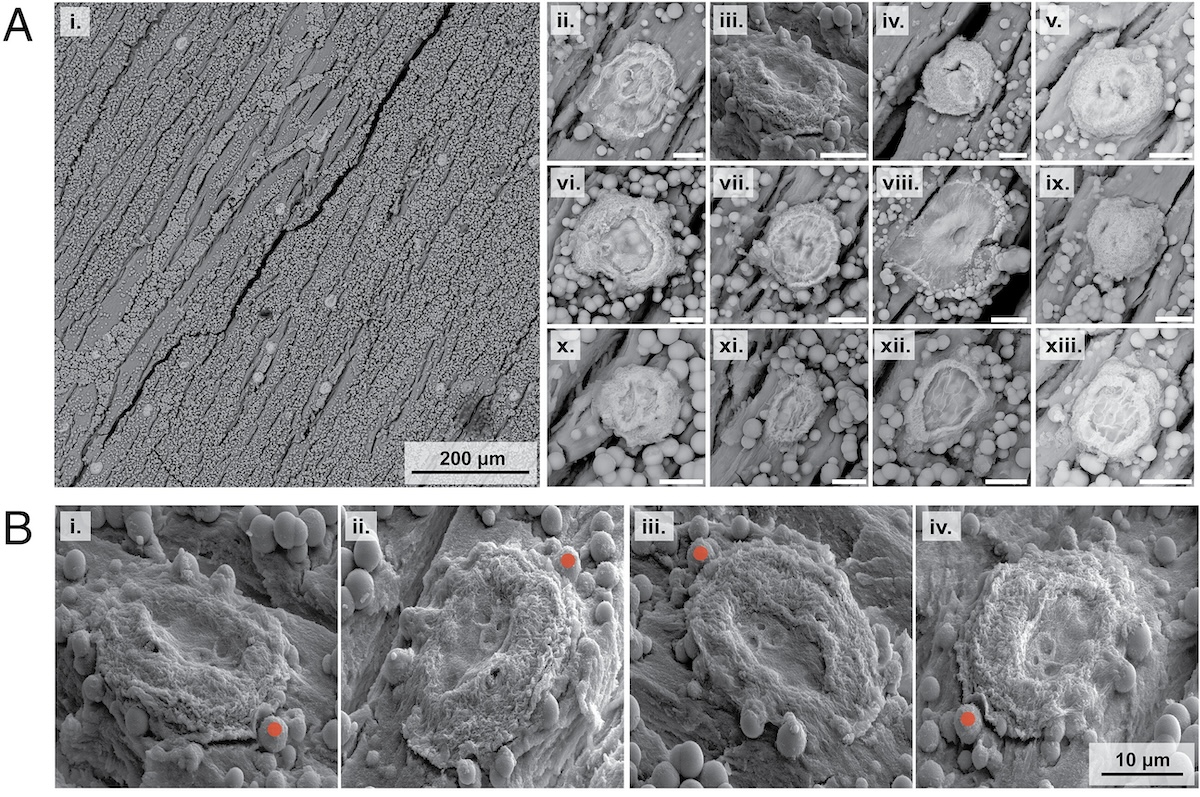
(A) SEM image of 24 h HCl treated bone; and ii to xiii, SEM images showing selected RBC-like structures (Scale bar, 10 μm); (B) Photogrammetric 3D reconstruction of a selected RBC-like structure, generated from 72 SEM images
OK, those could be red blood cells. Maybe. I could be persuaded. But the CNN article also consulted Mary Schweitzer, the one person most associated with finding soft tissue in dinosaur bones, and she has reservations.
It’s also possible that the structures might not be remnants of red blood cells at all.
The findings do not meet established standards for identifying fossilized blood cells, said Mary Schweitzer, professor emeritus in the department of biological sciences at North Carolina State University. She was not involved in the study.
She questioned whether the structures’ shape and size sufficiently match red blood cells in living relatives of dinosaurs as well as the significance of hausmannite, the type of manganese oxide the study authors predominantly found. Schweitzer noted that this substance is not detected in living red blood cells.
So it’s a big maybe, but still, these are issues worth pursuing. The authors of the source paper are similarly cautious in their conclusions.
Mineralized RBCs from dinosaurs have not previously been reported, and their fossil morphology remains unknown; this work provides evidence for their appearance in this preserved form. These findings support the identification of the oldest known mineralized dinosaur RBCs containing molecules derived from heme.
Saying “containing molecules derived from heme” is a rather weak interpretation. It’s not surprising that there were chemicals in the living bone (of course!) and that they deteriorated over many tens of millions of years into modified chemical products — they didn’t evaporate or dematerialize — which is exactly what anyone should expect.
What do we do next with this corrupted information? I don’t know yet.

“What do we do next with this corrupted information? I don’t know yet.”
Corrupted information is exactly what one feeds to an LLM, amirite?
“Dinosaur blood on CNN” – Wolf Blitzer had an on-air accident? : )
@Snarki #1:
I’m not sure it makes any difference.
OK its dinosaur bone mineralised after deposition. All sorts of elements could have come in and formed minerals during fossilisation so hausmannite is not unreasonable. Of course what is interpreted as evidence of heme could also have infiltrated from elsewhere and selectively concentrated in the proposed RBCs. Also these RBCs are surrounded by much smaller spheres. What are they? Could the RBCs just be a larger version of those? Perhaps formed during fossilisation in a cluster of smaller spheres but a slight difference in chemistry or size allowed them to grow larger relative to the others.
Shweitzer noted also that the “cells” were double concave in shape, not with a bulge in the middle like you’d expect from reptiles. A pr3mature paper it seems.
[dinos?]
I prefer this story: https://www.reuters.com/science/strange-beaked-hell-chicken-is-first-fruit-eating-dinosaur-2026-10-30/
↓
WASHINGTON, Oct 30 (Reuters) – While dinosaurs ate a lot of different things, including each other, fruit long seemed to have been absent from their menu. But scientists now have found fossils of a turkey-sized and toothless dinosaur possessing a parrot-like head that exhibited multiple adaptations for a specialized fruit diet.
This first-known frugivorous dinosaur, named Infernogallus jamesi, lived about 66 million years ago during the Cretaceous Period at the twilight of the age of dinosaurs and displayed traits on its beak and jaws for mashing soft food like fruit. It is known from fossils unearthed in Montana and North Dakota.
The name Infernogallus means “hell chicken,” a nod to its bird-like appearance and the fact that its fossils were found in the Hell Creek rock formation, which spans the US states of Montana, North Dakota, South Dakota and Wyoming and has yielded the remains of some of the most famous dinosaurs.
It would have eaten fruit and other soft plants in the subtropical coastal floodplain ecosystem it shared with the likes of apex predator Tyrannosaurus, three-horned herbivore Triceratops and tank-like armored plant-eater Ankylosaurus.
Don’t worry, Ken Ham will soon have an article out claiming Science is super wrong and that everyone should give him all of his money and do whatever the hell he tells them to.