
It looks like it’s Nobel season


The winners of the Nobel in Physiology or Medicine have been announced: it’s Karl Deisseroth, Georg Nagel and Peter Hegemann, for their work in optogenetics.

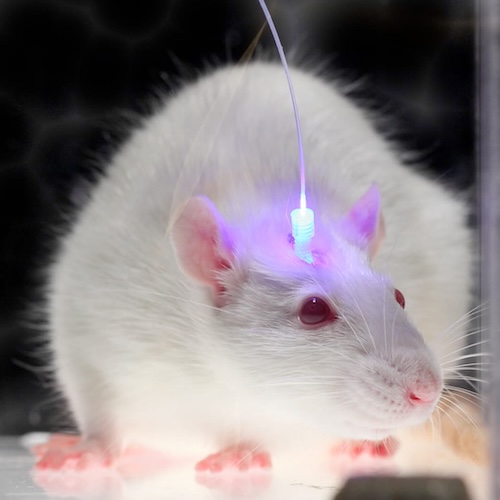
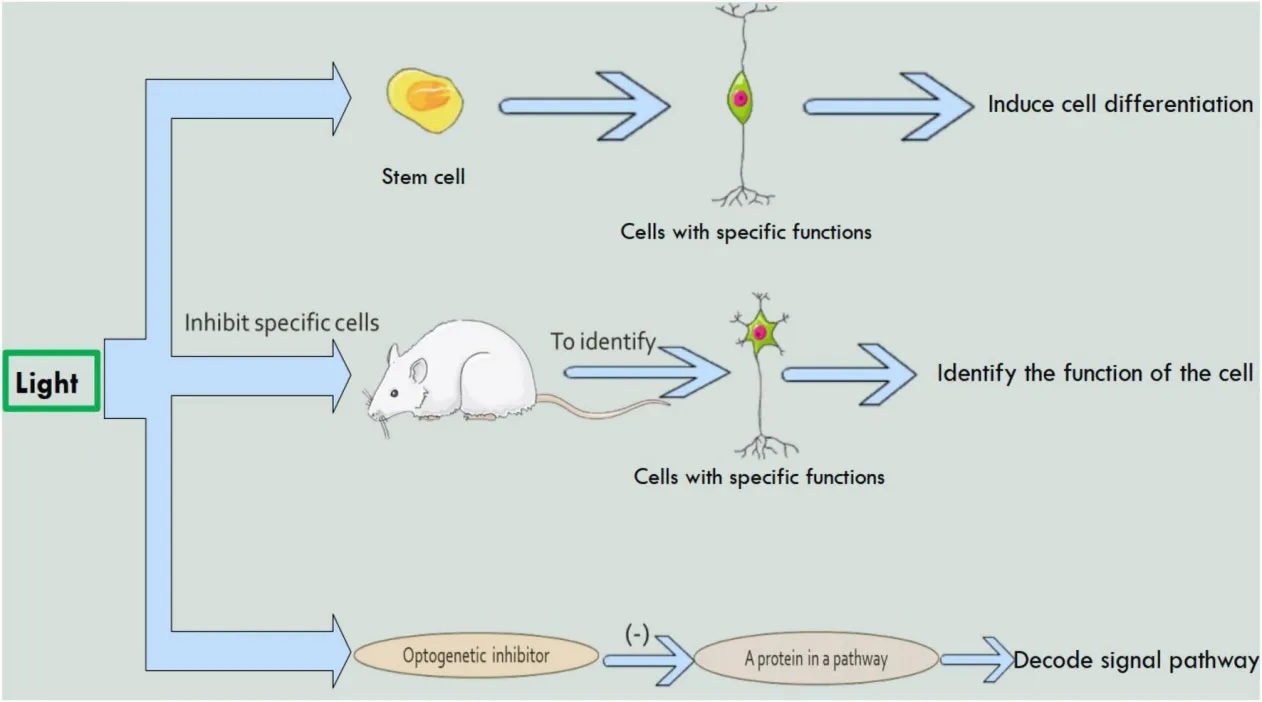
Back in my day, we’d have to pull a fine glass electrode and jab it into a cell to put an electrical current in it, and see what twitched or secreted or changed gene expression in response. It was admittedly a bit clumsy and had side effects: most of the cells I stabbed would die in response. Optogenetics lets a researcher modify the genetics of precursor cells so that they would produce a novel channel, a light sensitive rhodopsin derived from algae, that lurked in the membrane, and would only open when a light was shone on it. Instead of a needle, you could aim a laser at the cell, and trigger a current across the membrane non-invasively.

It’s a neat trick. You can have a whole nervous system laid out on your microscope, loaded with inherited copies of this rhodopsin, and cruise around zapping cells with a beam of light, and see what happens when those cells are stimulated. Or put a fiber optic in a brain and switch on neurons with a pulse of light. There are so many fun things to do!
Comments

  1. robro says

    Dumpster is sure to win all the rest. His uncle was a college professor at MIT, as you know, and Donald is a genius, which you also well know. The Peace prize will be announced Friday. He’s sure to win it this time because of all the peace he’s created, and if he doesn’t get it then he may have the US army invade Norway.

  2. StevoR says

    The Nobel for Physics has now been announced:too :

    “This Nobel Prize is about a giant ice cube positioned at the South Pole of our globe. The ice cube enables the detection of neutrinos,” Professor Eva Olsson, a member of the Nobel Committee for Physics, told reporters.

    The prize money this year is 12 million Swedish kronor, ($1.718 million), whether for an individual, a small group of laureates, or an organisation.

    “It was a great surprise, and I obviously didn’t expect it,” Mr Halzen told the news conference by telephone shortly after the prize was announced.

    … (Snip)..

    Francis Halzen has won the Nobel Prize in Physics for his contributions to the IceCube Neutrino Observatory at the South Pole and his discovery of high-energy neutrinos of astrophysical origin. Born in Belgium, the 82-year-old scientist is affiliated with the University of Wisconsin–Madison in the US.

    “This year’s prize is about ghostly messengers from space,” Ellen Moons, secretary general of the Royal Swedish Academy of Sciences, told a news conference, on Tuesday morning, local time.

    The Academy noted that Mr Halzen’s “vision and scientific leadership” had been fundamental for the observatory, which it described as “a cubic kilometre of ice that is equipped with light sensors”.

    Source : https://www.abc.net.au/news/2026-10-06/francis-halzen-wins-2026-nobel-prize-in-physics/107236382

    See also (8 mins long) yt clip on this here – Neutrino, measuring the unexpected–IceCube by the IceCube Neutrino Observatory channel.

    Plus this 9 mins long yt video by
    Joe Spins the Globe – The IceCube Neutrino Observatory – High-energy physics at the South Pole!

  3. StevoR says

    Now the Nobel for Chemistry of this year has become known too :

    Henri B. Kagan and Kenso Soai have won the Nobel Prize in Chemistry for their discovery of non-linear effects and autocatalysis in asymmetric organic synthesis.

    “Henri Kagan and Kenso Soai have provided a solution to a chemical mystery that is over a century old: how homochirality can emerge spontaneously,” Heiner Linke, chair of the Nobel Committee for Chemistry, said in a press release. “The chemical reactions they have developed are spectacular.”

    …(Snip)..

    .. The duo’s research into molecules’ mirror images has “been decisive for chemists who design reactions for the manufacture of pharmaceuticals”, the press release said.

    Many molecules of life come in versions that look alike but are not exactly identical, like right and left hands. One mirror-image of the chemical carvone smells like mint, for example, while the other has a whiff of caraway.

    When designing drugs to treat diseases, scientists want to be selective about which mirror-image they are getting. They want the version of a molecule that will treat a cold, not the kind that will make the sniffles worse. Dr Kagan and Dr Soai found ways to make chemistry pick a side, designing and manipulating reactions to produce the desired mirror-image.

    Source : https://www.abc.net.au/news/2026-10-07/nobel-chemistry-prize-2026-non-linear-effects-autocatalysis/107240878

Leave a Reply