
The world, and especially the United States right now, sucks. So I have little rituals to keep me somewhat balanced by, for instance, reading a set of webcomics every morning. Of course, I still have to complain about them, but the intent is there.
The Far Side frequently cheers me up with comics featuring spiders. There’s one today:
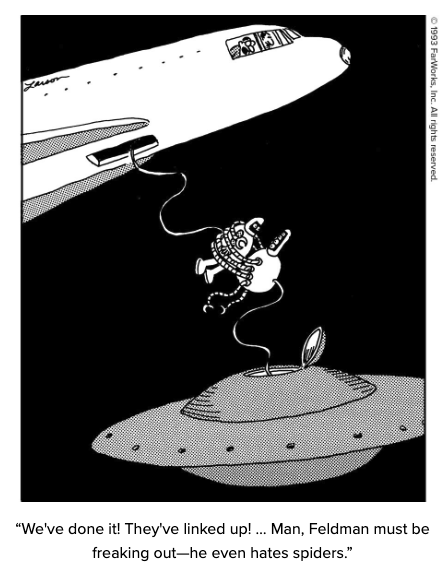
Has anyone else noticed a fondness for multi-limbed aliens in recent SF? It only makes sense, since humans are chronically under-supplied with limbs, and the ones we’ve got are over-specialized to specific functions. Or maybe it’s just my taste in SF.
Although…the newest Andy Weir book, Project Hail Mary, is being released as a movie, with a cute 5-armed alien, and I’m not going to watch it. I’ve detested all of Weir’s books since The Martian, which I wanted to throw at the wall and then set on fire. In general, I’ve grown to dislike novels about rescuing all of humanity with some guy in a spaceship, and I especially dislike Weir’s style of episodic cliffhangers resolved with epically unlikely instances of plot armor.
Wait, I’m supposed to cheer myself up with this stuff.
OK, come on xkcd.
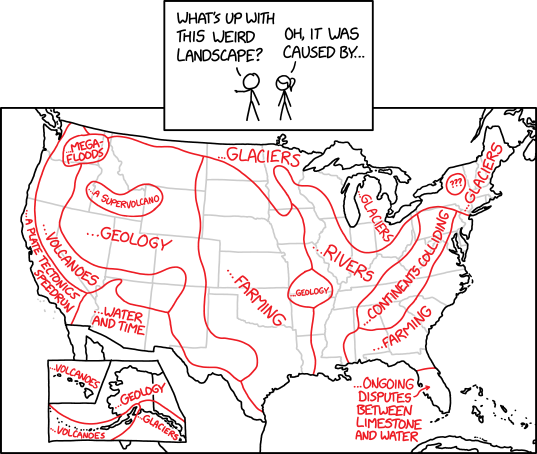
Naturally, the first spot I looked at was my home on the map. I’m in the western part of Minnesota, in what is called the prairie pothole region, surrounded by shallow lakes scoured out by glaciers. So that part is kind of right, but incomplete. I’d say the dominant force on the landscape around me is agriculture. We’ve only got tiny patches of native prairie left. The boundary waters farther north are pristine, so far, but the Republicans are scheming to open that up for copper mining. I’m going to have to redo that map and replace most of it with the legend “PEOPLE”.
One last attempt to salvage some optimism. I bought myself a Kobo e-book reader, and another ritual I have is to read something non-political every night before bed. I got this Kobo with a special deal: it came pre-loaded with every book Terry Pratchett ever published. Can’t go wrong there!
I recently finished Men at Arms, which is pure escapist fantasy. It’s got dragons in it. It’s also about a policeman who takes his civic duties as a servant of the people seriously. I know, dragons? I can suspend disbelief for that, but Sam Vimes is stretching credibility. Also, this book is about the importance of diversity, and efforts to widen representation in the city watch, another ridiculous fantasy element.
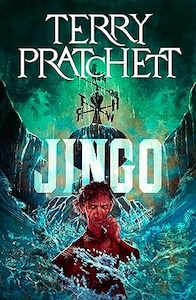
I’ve just started on Jingo, a very timely choice, since it’s about the vaguely Western medieval city of Ankh-Morpork going to war with the vaguely Middle Eastern empire of Klatch over a small island in the ocean separating them. It’s disturbingly relevant. It was reassuring to see Sam Vines resist militarizing the City Watch (they’re not a military authority, he says, they’re fellow citizens), but Pratchett better salvage some hope from this situation. I need it.

I hope you didn’t skip “Feet of Clay”, the book between “Men at Arms” and “Jingo”. The best city watch book in my opinion however is “Night Watch”.
i like the ‘geology’ labels, that clears it up XD
The “Great Unconformity” And Earth’s Missing Billion Years May Have A New Explanation
That is an understatement.
This morning, I heard screaming in the background.
It was my 401(K) plan. Again.
The Dow is down 8% in a month and it is looking like Trump is going to crash the economy.
Oh well, it isn’t like I/we needed that money for retirement or anything.
Bush did the same thing in 2008.
I noticed a few decades ago that most science fiction and fantasy is dark and dystopian.
It reflects the zeitgeist (spirit) of our time, which is dark and dystopian.
One of my favorite authors was Iain M. Banks with his Culture novels. They were upbeat about the future and the good people always won in the end.
I discovered him late, liked his Culture novels so much I promptly read them all, and within a year, he was dead.
The most unbelievable thing in Discworld is Havelock Vetinari – the absolute ruler of Ankh-Morpork, who is fully aware of the practical limits of power and genuinely dedicated to the improvement of the city. I have to admit I’d be happy to trade democracy for a despot like that these days…
i was wowed by the wess’kar series by Karin Traviss, about our attempts to colonize an alien planet. Kind of like an anti-Avatar. Human characters are a bit underdeveloped, but the various aliens are satisfyingly alien in appearance and thought, and they are serious deep ecologists. There’s some great worldbuilding and genetics stuff (PZ alert!) in the book, and some thoughtful ethics / philosophy quandaries. And yes the main aliens do have a coupla extra arms.
First one is City of Pearl.
Pratchett is heavily political but wrapped in such brilliant whimsical humour that it’s easy to swallow.
The US sucks. Majorly.
Been watching Starfleet Academy lately to help with the mental load, but I don’t know how long I can keep this up; I’m looking into canceling Paramount+ over the WB bullshit. Transformers? I haven’t been watching the newest series and I don’t want any more live action films; Paramount has mentioned bringing Michael Bay back and I want him nowhere near the franchise. Most of the things that have helped me mentally feel tainted now.
Oh, and Hasbro is gonna produce Harry Potter toys. So Joanne is gonna get paid by the manufacturer of Transformers, which makes me absolutely want to scream.
Currently, I’m playing through Pokémon Shield and next year we’re getting Pokémon Winds and Waves for Switch 2. I’m sticking with that. It feels safer than a lot of other things.
You might like “Spaceman,” with Adam Sandler. It’s about a lone guy in a spaceship rescuing humanity, but it has an intelligent friendly spider helping him. A really BIG intelligent friendly spider.
MY late wife had a phrase for those books that didn’t quite rate being thrown against the wall; “I don’t care WHAT happens to these people.” After that, she would but the book down and never pick it up again.
raven@4– The “good guys” don’t always win in the Culture novels, partly because Banks was allergic to black-and-white characters, and partly because the repeating concern in the Culture novels is how far a utopian society should go to protect itself from threats. Overall the stories tend to resolve in relatively good outcomes, I agree, but I can’t read Use of Weapons as good people winning.
I can’t believe nobody has made a movie or TV show out of Player of Games, which is imho the most exuberant and entertaining novel of the series.
raven@4– The “good guys” don’t always win in the Culture novels, partly because Banks was allergic to black-and-white characters, and partly because the repeating concern in the Culture novels is how far a utopian society should go to protect itself from threats. Overall the stories tend to resolve in relatively good outcomes, I agree, but I can’t read Use of Weapons as good people winning.
Oops. Accidental double post. Sorry, all.
I loved Jingo. My all time favorite though is “Small Gods”. Currently reading Making Money as it has sat on my bookshelf since I bought it in 2015 and I am now getting back into reading after a long pause…
Shortly after the 2024 election I reread some Pratchett books. While reading Guards! Guards! I realized the people of Ankh Morpork are MAGAs. They see a dragon take over their city, they think it can be a foreign policy asset, while almost entirely ignoring the risk to themselves, who are right there.
@14 killyosaur
What a coinkydink, in my current Pratchett re-read I’m also at “Making Money” right now.
If you are game for more comedic fantasy novels I can recommend the Zamonia-series by Walter Moers, especially “The City of Dreaming Books”. I can’t vouch for the quality of the English translation, but he’s the best German literature has to offer in that genre.
From one dyed-in-the-wool scifi curmudgeon to another, please do give Project Hail Mary another chance.
I, too, started reading it from the beginning and immediately threw it against the wall, set it on fire (the book, not the wall). Panspermia! Bah! Humbug! Hie thee hither to a monastery.
However, I tried another approach that worked much better. I searched in iBooks for “Rocky,” the cute, little puppet spider-ish alien, and started from there, skipping around but reading the ending, that was oddly satisfying. Once I had a comfortable base of what was going on I expanded toward the beginning ingesting small quantities of panspermia like acclimating to poison.
In the end, the book holds together and makes sorta sense.
So, move it, soldier! Get back on that horse and CHARGE!
It’s got panspermia in it, and you think that will persuade me to give it a second chance? Nope. No way. Another gripe I have with Weir is his glib, confident way of presenting nonsense as science. Yeah, right, all I need to survive on Mars is a few potato scraps. Yuck.
I will only get on the horse to trample it further into the mud.
SF authors playing games with well-established science is always a bit of a stumbling block. I love Ursula K. Leguin, but no: humanity evolved here from other primates; we’re not the descendants of humanoids who got dropped here by the Hainish a million years ago. (Ditto Larry Niven’s Known Space series — we’re neotenous Pak, in need of thallium to mature — but unlike LeGuin, Niven can be casually dismissed as a hack).
chrislawson, @ #11:
Not only that, but a lot of the time he’s tangling with genuine moral complexity, where it’s really not clear where the lines are – after all, the books mostly deal with Special Circumstances, who deal with situations that are “the moral equivalent of black holes”, where all of the normal rules break down. And he’s far too good a writer to just hit you over the head with his own answers – if you just read the novels, its entirely possible to come away with the view that the Culture aren’t nearly as good as they believe themselves to be. You’ve got to read the meta stuff he wrote to get a really good idea of Banks’ own views of the matter – and even then, he’s pretty clear that it’s not entirely black-and-white.
@19 stevewatson
Agreed. He has great ideas, but he’s not a good enough author to actually write good stories around them.
@ stevewatson, # 19, lasius, #21: “Larry Niven a hack?” I disagree. I’ve read most of his stuff and never had a problem with any of it. I’ve also read Ursula K. LeGuin-she’s a brilliant writer, but has an incredibly morbid streak.
@21: I was into Niven back when I was an engineering undergrad, because the way he plays with physics appeals to young STEM nerds. But he’s really only got one protagonist who just keeps showing up as different characters in different centuries. And the female characters are mostly there to get fucked by the protagonist. (At one point Louis Wu even says as much).
My fave landscape feature in Mexico is the ongoing dispute between limestone and water, mediated by a GIANT METEORITE.
@22 christoph
You can argue about taste and all, but you never had a problem with Niven’s blatant sexism?
Iasiua @ 21
“He has great ideas, but he’s not a good enough author to actually write good stories around them.”
This can sadly be said about many of the great SF writers. The opposite can be said of Stephen King – his ideas and stories have holes in them, but he is such a skilled storyteller you don’t mind.
I forget the titles, but in biological SF you can find the very sympathetic character Stevland, a plant-based intellect spread across a large area.
.
I have a soft spot for the somewhat dry but excellent stories by Eastern SF like Stanislaw Lem or the Strugatsky brothers.
.
Brian Aldiss wrote about the “dreaming pole” vs the “thinking pole” of science fiction.
Closer to the dreaming pole we have the ‘tierworld’ novels by J S Farmer. They are worh a read.
.
If you want fireworks and shootings mixed with very clever writing, Neal Asher is your guy. AIs, both good and bad. Tech transcending the line of ‘biological’ and ‘natural’.
Hostile aliens with believable motivation for their biologically driven aggression. Monsters behaving like monsters for a reason.
@26 birgerjohansson
I’ve seen many misspellings of my alias (even though it’s only 6 letters), but this has to be the most creative yet.
It’s L-A-S-I-U-S.
PZ, I’m in the process of reading all the Discworld novels. I started 5 years ago. I only have 4 more to go (out of 41). They’re uneven, but the good ones will make you LOL for real (too many people use LOL but don’t really mean the actual act of laughing out loud…).
My favorite, up to now, was “Going Postal”. It’s a gem. Runner ups are “Small Gods” and the Tiffany Aching sub-series.
It looks like Iasius on your comments. I will assume the final A was just a typo.
——
I too am a fan of Terry Pratchett, although his Death/Grim Reaper was clearly inspired by the ‘On a Pale Horse/Incarnations of Immortality’ series by the very sexist Piers Anthony. (I remember enjoying them decades ago). I have rarely considered burning a library book, but seriously considered it after reading his ‘Shade of the Tree’. Ugh, it’s glorified pedophilia.
“I discovered him late, liked his Culture novels so much I promptly read them all, and within a year, he was dead.”
Coincidence, or MURDER?
@19 stevewatson
I have made my peace with the insight that most SF is fantasy that knows the world is round. If one was to list the unscientific nonsense in your average SF story, starting with faster then light travel and working down to say the magic drug shitting worms in Dune that seem to exist without an ecology, one would have to admit they are all of a piece with a magic sword in a stone granting kingship. Plot devices needed for the story to work that feel right in the culture of the story. Humans have a special creation from space creatures is just echoing the first couple of chapters of the bible and just shows how deep that nonsense is in our culture.
stevewatson:
Clueless, you are.
Different aspects.
You’re ostensibly comparing two writers who aren’t even operating in the same mode.
Fantasy and science-fiction, not the same thing.
I know ‘sci-fi’ is a blend, but no.
Niven is scientific, Le Guin mythopoetic; Le Guin works in anthropological myth; Niven works is actual science fiction.
(I find the one entertaining and the other kinda boring; I am sure you can guess which is which)
Ultimately, all SF is fantasy.
I just saw a review by Mark Kermode of PHM — he compared it to Silent Running, which almost convinces me to maybe go see it. He makes the point that the science of SR is total rubbish (which is true!), and that similarly PHM is is not about the science…even though he seems to think the science is OK.
I have little patience for the stupid science in these movies, which means I’ve become increasingly intolerance of most of the movies that have been coming out. It’s rough for a guy who really likes SF.
I’m tellin’ ya it’s a reasonably good yarn if you disregard the panspermia nonsense and all the biology. And physics. Oh, did I say “all the biology?” My bad. My pet peeve is communicating with an alien which we will NEVER be able to do because of, drum roll, evolution! Different psychologies (if there is even a thing of alien psychology) and the entire evolutionary sequence of life experiences. That said, “I am Rocky! Amaze! Amaze!” is a Sesame Street level of scifi that I’ll enjoy. Hey, I thought Barbie was good and Ken in Space, what could go wrong?
Yeah.
Niven’s “For a Foggy Night” that was totally scientific
and “Man of Steel, Woman of Kleenex”
and Louis Wu teleporting in the wrong direction on his birthday
and “Convergent Series”
and the “Magic Goes Away” series
and everything with Svetz
such actual science
chigau, oh yeah. Oldie but a goodie.
https://www.rawbw.com/~svw/superman.html
Alas, he’s gone funny and is in his dotage these days. :(
(Kinda like Pournelle’s Chaos Manor/Mail did)
What about the rest of the “science”?
FTL
teleportation
How is “scientific” teleportation with big things bouncing up and down in the ocean more plausible than magic?
Pratchett was a cat person, as all great people are, so my favorite has to be The Amazing Maurice and His Educated Rodents.
Hard sci-fi? For me the classics: Asimov, Heinlein, van Vogt, Kornbluth, Frank Herbert, Kim Stanley Robinson, John Wyndham…
… oh, and A C Clarke, of course.
It is the distinction between ‘hard’ and ‘soft’ SF, ignoring the science fantasy that’s called ‘sci-fi’ by the paps.
Here, for you: https://sf-encyclopedia.com/entry/hard_sf
Basically, in SF that its speculative elements must be treated with consistent scientific extrapolation even when they begin from an impossible premise.
In Niven’s case, the Tasp or organ-legging as examples.
Point is that it’s fiction, but it’s supposed to be scientific fiction.
I know, you then got and other shit, but the core of SF is still that.
BTW, I am mildly amused you focus on those rather than his use of PSI.
(Also, he too wrote mythopoetic fantasy, such as Magic Goes Away books; diff being, he was not boring)
“Hard sci-fi” involving interstellar travel is Fantasy.
seversky, my favourite of his by far are the early SF style fantasies The Dark Side of the Sun** and *Strata.
I remember being disappointed by the first discworld book, with it’s silly anti-protagonist.
I didn’t get it was jocular and allegorical at the time.
““Hard sci-fi” involving interstellar travel is Fantasy.”
Any and all fiction is fantasy, chigau.
(Stupid attempted quibble, there)
If what you want is science, read that.
I like science fiction, myself.
Fictional science, sort of.
Again: “Basically, in SF that its speculative elements must be treated with consistent scientific extrapolation even when they begin from an impossible premise.”
[addendum — not just my opinion]
https://sf-encyclopedia.com/entry/hard_sf
I’m mildly amused that you didn’t notice that I mentioned the Magic Goes Away in my #36.
Yeah I missed Gil Hamilton in my quick-and-dirty list.
and I learned of the “definition” of SF directly from Saint Harlan at an SF convention at the UofC in 1970something.
sucks to your abomination of a 90s-style web-site
I do remember your kind from that time.
What was your opinion about the writings of James Tiptree Jr.?
@32. francesconic :
Really? The book & sequels actually explictly went into the ecology and built it up pretty well in my view. With an ecologist Liet Kynes (or Planetologist as Herbert called him /her) a major secondary character.
Source : https://daily.jstor.org/the-ecological-prescience-of-dune/
Dune was both based on and inspired people to study ecology as noted here :
&
Source : https://theconversation.com/how-dune-became-a-beacon-for-the-fledgling-environmental-movement-and-a-rallying-cry-for-the-new-science-of-ecology-225156
The book and ‘verse contains its own carefully studied ecology as noted in this 11 mins long yt clip – The INSANE Ecology of Dune among other places.
It may not be scientifically perfect and flawless but its certainly there at least in the fictional ‘verse of the book and isn’t supernatural or magical even if the Fremen percieve it as such at times. Its science albiet extrapolated and hypothetical / speculative.
“What was your opinion about the writings of James Tiptree Jr.?”
Only read a couple, but since you ask: boring.
Not for me.
Lol.
Here’s another perspective (mostly on the movie, but also the book):
https://www.slate.com/blogs/bad_astronomy/2015/10/10/the_martian_scifi_blockbuster_is_about_the_science.html
Plait correctly points out that whether the science is “real” or not is almost beside the point.
The whole ethos is an ode to science. More than any other mainstream movie, science is presented as a reliable functional way of solving problems. I can hardly think of any era in US history when this message should be more welcomed.
KSR’s Aurora might just about be an exception there, since the whole point is that generation ships are a terrible idea, both practically and morally, and that attempting to colonise other worlds is almost certainly doomed to failure.
I know this thread is about books and reading, but for anyone who didn’t know, “The Watch” tv series (BBC) was, in my opinion, quite well done. I’ve been a Discworld fan for years.
@52 j100111
HERESY!
Johnny-Troll @33:
1. Yes, LeGuin is writing, as you say, mythopoetic and anthropological, as opposed to Niven’s “hard” STEM-oriented science fiction. However, it remains the case that the Hainish Cycle is generally categorized as science fiction, and I’m pretty sure you know that. So take your “clueless” and shove it up your ass.
2. I’m still allowed to find the taking of scientific liberties a small or large (as the case may be) speed bump on willing-suspension-of-disbelief. YMMV.
3. I begin to see why some people around here don’t like you.
Yeah, the idea that there’s a hard and soft SF has been around for a long time. As near as I can tell, hard SF involves a novel gadget, soft SF involves a novel culture. It’s not a particularly interesting distinction.
The speed bump analogy is a good one. When I wrecked my back, I also became incredibly sensitive to bumps and potholes when driving, to the point that my wife became annoyed with all my moaning and squeaking. As I’ve gotten older, I’ve become much more sensitive to those unscientific bumps. Strangely, hard SF is also harder to take, because it always has something ridiculous (like faster-than-light travel) to annoy me, while soft SF often builds on a more plausible difference.
I’m also far more touchy about biology than physics. FTL, maybe, as a premise, I’ll swallow; Greg Bear’s Darwin’s Radio had me yelling swear words at the walls.
@55: And I’ve gotten more touchy about telepathy and psychic powers in general since studying phil of mind, and generally becoming a hard physicalist about consciousness. We know current physics is incomplete, so I suppose I’m willing to chalk up FTL to physics we haven’t discovered yet (though an actual physicist might not be so forbearant), but I think we know that the mind is what the brain does, and it’s all happening inside the skull, even if a lot of details remain to be filled in. Similarly with biology and evolution.
Perhaps how much of a speed bump it is may depend on how central to one’s world view the particular piece of science is.
stevewatson: hard vs soft was to chigau.
Your contribution was:
Clueless, you are.
They are both fine writers. Neither is a hack.
You can casually dismiss him all you want, but it is stupid.
Look. I get you don’t like Niven. I don’t like le Guin.
But I don’t therefore call her a ‘hack’, even is she does the technobabble thing.
(Bah)
—
re “Johnny-Troll @33:” — what the fuck, Stevie?
I find it irritating when people such as you use such stupid attempted insults.
@42. chigau (違う) : “Hard sci-fi” involving interstellar travel is Fantasy.”
Strongly disagree since it depends how it is done. Frex if they use relativistic methods & physics eg Poul Anderson’s Tau Zero which is :
Source : https://en.wikipedia.org/wiki/Tau_Zero
Plus some of Arthur C Clarkes books like ‘Songs of Distant Earth’ among others.
Also some of those involving Generation ships aka asteroid arks eg a recent (umm, okay 2015) Kim Stanley Robinson one ‘Aurora’ and some tangential references in some of Stephen Baxter’s novels.
There are no doubt quite a few other examples. Point is the ability / mechanism for interstellar travel can be explained well and done well in hard (er) SF altho’ this then has consequences for the story and often FTL isn’t the point and therefore gets glossed over and taken for granted and used like the Heisenberg compensators in Star Trek – How do they work?
<i>"Very well thanks."</i>
So anyhow different hypothetical ships and methods mean interstellar travel can be handled well and made at least reasonably plausible in my view.
@ ^ PS. Just becoz its rarely done – usually becoz it ain’t the point of the story – doesn’t mean it can’t be done or done well.
StevoR, ahem.
Source : https://en.wikipedia.org/wiki/Tau_Zero
(Everybody likes a happy ending, no? ;)