Responsibility is not just a word

Tom Levenson responds to yet another gun ‘accident’, in which a pregnant woman was shot in the head by a friend showing off a gun. I think this is a very good take on the issue; no responsible gun owner (and they all are, right?) could possibly disagree with this:

Responsible means that whatever happens with your gun is your fault.  Period.  You accidentally discharge it and no-one gets hurt? How’s this:  big fine, confiscate the weapon involved, lose the right to bear arms for a year for the first incident, forever if you repeat.  Someone gets hurt or dies?  Jail. Civil liability.  Loss of gun rights for life.  That’s responsibility.

But of course, I dream.  That’s not how we roll.  Instead, we’ll just  water the tree of liberty with a newlywed, and celebrate life by burying her fetus — and wait (not long) for the next red harvest.

Being responsible should actually mean something — it’s not just a word you use to escape the consequences of your actions. But that’s how the gun fondlers all seem to use it — they will flaunt their assault rifles, take great risks with their lives and the lives of others, and hide under the NRA-approved label of “responsible gun-owner”.

Real responsible gun owners know that they are deadly tools and would keep them locked up and treat them like they would a stick of dynamite — extreme hazards that warrant extreme precautions.

We can always find a reason to kill something

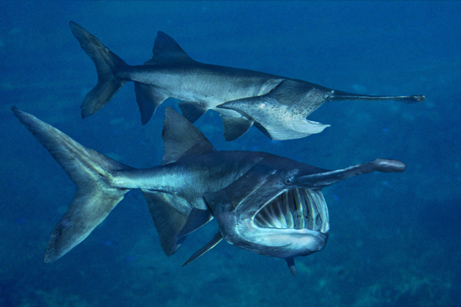
I have never seen a paddlefish in the wild, although I’ve seen young adults and embryos in the lab — they are quiet, secretive beasts, cruising gape-jawed through our regional rivers to dine on plankton, and growing to immense size without ever troubling anyone. They are gloriously weird animals. But they are in danger of extinction because they also produce voluminous quantities of eggs, also known as caviar. A large female can carry $40,000 worth of eggs, so they are fished up, ignominiously slit open and disemboweled, and left to rot on the river bank.

It’s a real shame. Once again, we hunt a spectacular North American native species to extinction, all because of greed.

paddlefish

Dr Willie Parker, the only abortion doctor in Mississippi

I hope this excellent profile of Dr. Willie Parker doesn’t make him a target, but that’s the sad state of American life right now. He’s a good man doing good work, and he also happens to be a Christian…but don’t hold that against him.

After medical school, he bought a big house and a nice car and overstuffed his refrigerator the way people from poverty do, but those satisfactions soon seemed empty. He dated but never quite settled down. Inspired by Gandhi’s idea that the Gospel should appear to a hungry man in the form of bread, he went to work in a food pantry. But gradually, the steady stream of women with reproductive issues in his practice focused his mind. He thought about his mother and sisters and the grandmother who died in childbirth and began to read widely in the literature of civil rights and feminism. Eventually he came across the concept of "reproductive justice," developed by black feminists who argued that the best way to raise women out of poverty is to give them control of their reproductive decisions. Finally, he had his "come to Jesus" moment and the bell rang. This would be his civil-rights struggle. He would serve women in their darkest moment of need. "The protesters say they’re opposed to abortion because they’re Christian," Parker says. "It’s hard for them to accept that I do abortions because I’m a Christian." He gave up obstetrics to become a full-time abortionist on the day, five years ago, that George Tiller was murdered in church.

He also has a rational perspective on development, in which it’s the woman who is the important one.

Growing reflective, he continues to study the parts. "The reality is we’ve disrupted a life process. There are recognizable fetal parts, right? The capacity for this development is always there. After five weeks, you just have the sac. At six weeks, you have a fetal pole with cardiac activity. At seven to eight weeks, it’s just a larger fetal pole. By nine, it’s differentiated."

But here’s the vital question: Is it a person? Not by the standards of the law, he says. Is it viable outside the womb? It is not. So this piece of life—and remember, sperm is alive, eggs are alive, it’s all life—is still totally dependent on a woman. And that dependence puts it in the domain of her choice. "That’s what I embrace," he says.

But it’s hard not to look at those tiny fingers, no bigger than the tip of a toothpick.

Does that ever disturb him?

"When I recognize whole fetal parts? No. Because I’m not deluded about what this whole process is."

It’s a long article. You should read the whole thing, though.

“In a time of universal deceit, telling the truth is a revolutionary act”

Lenar Whitney, Republican congressional candidate from Louisiana, dared to use that line from Orwell while accusing virtually every climate scientist in the world of lying.

Practically every word in that monolog is a lie, or a product of exceptional ignorance. And the terrifying thing is that she knows it.

… when I pressed Whitney repeatedly for the source of her claim that the earth is getting colder, she froze and was unable to cite a single scientist, journal or news source to back up her beliefs.

To change the subject, I asked whether she believed Obama was born in the United States. When she replied that it was a matter of some controversy, her two campaign consultants quickly whisked her out of the room, accusing me of conducting a “Palin-style interview.”

Unbelievable. But these are the people dominating the Tea Party right now.

By the way, here’s the summary of the recent IPCC report (pdf), if you want to see the data that Whitney pretends doesn’t exist.

You should be afraid

This could be bad. For years I’ve been hearing about the nightmare scenario of global ocean warming rising to a level that triggers the release of methane hydrates locked up deep in the ocean, which then lead to a major accumulation of greenhouse gases. It basically tips over the rate of warming from one regime into another, faster period of heating, very abruptly.

Well, guess what

Vast methane plumes have been discovered boiling up from the seafloor of the Arctic ocean on the continental slope of the Laptev Sea by a dream team of international scientists. Over the last decade a warming tongue of Atlantic ocean water has been flowing along the Siberian Arctic ocean’s continental slope destabilizing methane ice, hypothesize the team of Swedish, Russian and American scientists. The research team will take a series of measurements across the Siberian seas to attempt to understand and quantify the methane release and predict the effect of this powerful greenhouse gas on global and Arctic warming. Because the Siberian Arctic contains vast stores of methane ices and organic carbon that may be perturbed by the warming waters and Arctic climate, Arctic ocean and Siberian sea methane release could accelerate and intensify Arctic and global warming.

It’s like humans are blithely giving the little nudges that start an avalanche, and then afterwards we’ll look at each other and say “I didn’t do it, it was deep ocean methane!” Or rather, we’ll try to say that while struggling to keep from drowning or cooking.

Please, taunt me some more

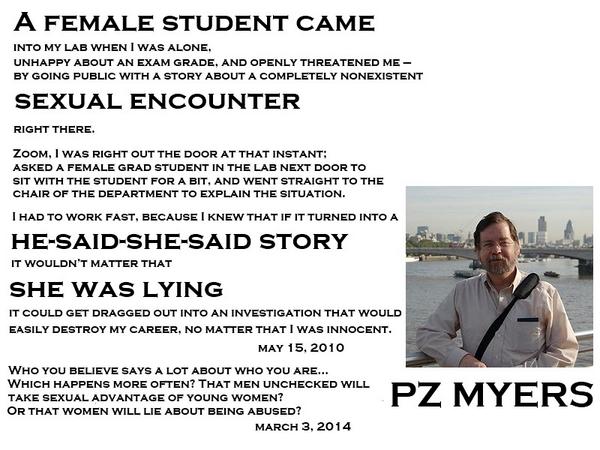
The latest gloating meme clotting up my email is this one; a lot of MRAs seem to think this is an irrefutable argument against feminism by a man who supports feminism, me.

sexualharassment

The incident actually happened, and those are my words. I have no problem with that. However, it’s not making a point in their favor.

  • That the incident occurred does not refute anything I’ve ever said; false rape accusations do occur. But notice the last point; they’re relatively rare.

  • In over 30 years of teaching, this was the only time a woman attempted to extort me. Once. In 30 years. At the same time, every year I have heard of rapes and/or attempted rapes on my campuses. Final point stands confirmed.

  • One thing not mentioned in the story: when I went to immediately report this incident, I was not questioned. No one asked me if I’d led her on; no one thought I was making up a story to hurt a young woman; I was taken seriously and the complaint was addressed seriously. In part it was because I acted promptly and got witnesses, but let’s have no illusions — as a man, my word counts for more.

  • Perhaps the most important lesson, that my smirking taunters ought to learn, is that I did not come away from this unpleasant occasion with the idea that all women are conniving “bitches”. I was able to recognize that this was an unusual circumstance with a desperate young woman who was not plotting against me, but on the spur of the moment tried an unlikely ploy to save her grade.

So yes, please do keep trying to strike against me or my reputation with these kinds of games. Only an MRA would think this anecdote is somehow damning.

Oh, so that’s what “cultural appropriation” means

A middle-class British white guy who worked in a mayonnaise factory has retired to pursue his dream of being an Indian — the kind of Indian he learned about by watching spaghetti westerns. So now he makes fancy feathered headdresses and elaborate wooden pipes, just like real Indians do.

You know, I do sympathize with the idea of admiring and respecting other cultures, and I think it’s a good hobby to read about and study diverse people. Indian history actually is interesting, and often tragic, and complex. Maybe he digs deeper, but this story presents his obsession as being more about the idealized exotic Western image of the Indian, rather than, say, the kind of Indian Sherman Alexie or Leslie Marmon Silko writes about.

So this promise is rather horrifying:

The 65-year-old is hoping to take his talks to schools and museums to eradicate some misconceptions there are about Native Americans.

“Eradicate” is not a synonym for “propagate”.

How we got here

It’s been 25 years since Gould’s Wonderful Life: The Burgess Shale and the Nature of History crystallized the debate over the importance of contingency in evolution, most famously illustrated by his metaphor of “replaying the tape of life”. If we could roll back the history of life on earth and restart it in the pre-Cambrian, would we see the same forms arise again? Would we have dinosaurs a few hundred million years later, and bipedal intelligent apes after a half billion years?
Gould’s answer was no — that the role of chance was too great, and because the forms of life do not represent optimum ideals built by perfectly plastic forms, but rather are kludges built atop limiting and enabling prior adaptations. Some people, like Simon Conway Morris, argue otherwise that there are ideal forms (including us bipedal anthropoids) upon which life will tend to converge. I favor Gould’s view rather strongly — it’s absurd to talk about evolution without an appreciation that all organisms are the product of history, and that what traits we have now are almost entirely contingent on what traits our ancestors had.

My favorite example of the error of limited thinking about adaptive ideal forms is a comparison of bony fish and squid. Both are fast swimming, active predators that are torpedo shaped in motion (physics constrains that!), but in detail everything is completely different. If the pre-Cambrian ancestor of all chordates were accidentally squashed, there is no reason to assume that the pre-Cambrian ancestor of all molluscs would then evolve a line of torpedo-shaped predators with brainy skull at the front and an undulating muscular body for propulsion. Why should they? They have a demonstrated capacity in our universe to evolve into torpedo-shaped predators with tentacles at the front and propulsion via a jet of water squirted out of a muscular mantle cavity.

The body plan of the ancestor dictates what capacities the descendant will have. There is no reason to assume that the world as we see it now was inevitable — that’s simply a failure of imagination and reason.

An article by Zach Zorich explores other examples of evolutionary contingency. Much of it is dedicated to that fascinatingly concrete example of actually being able to roll back the tape of life, the Lenski experiments, in which populations can be frozen and restarted at any time. In that case we seen on a molecular level that the evolution of specific biochemical problems is not inevitable at all, but depends entirely on the presence of prior mutations. History, and your parents, matter!

But I also like this example.

“Not everything is possible,” no matter the process, Wake explains. “Organisms evolve within the framework of their inherited traits.” Organisms can’t pass on mutations that kill them or prevent them from reproducing. In the case of Hydromantes salamanders, their ancestors had to overcome a serious limitation: To acquire their ballistic tongues they had to lose their lungs. That’s because their tongue partly derives from muscles that their predecessors instead used to pump air into the lungs. Now, that formerly small and weak muscle is much larger and stronger. It wraps like a spring around a tapered bone at the back of the mouth, and when the muscle squeezes, the bone generates the force that fires the tongue along with its bones out of the mouth. So, Hydromantes’ ancestor did not simply acquire a mutation and evolve a fast ballistic tongue. Instead, the adaptation followed a series of mutations that first enabled the creature to overcome its reliance on lungs for oxygen and buoyancy control. Each change was contingent on the one before it.

Chameleons, on the other hand, retain their lungs. Instead of re-tooling their lung anatomy, they have evolved a piece of collagen that allows them to catapult their tongues at prey. On the surface, salamander and chameleon tongues converge, but not upon closer inspection. It takes a chameleon 20 milliseconds to shoot its tongue at its prey, a positively glacial pace when compared to the Hydromantes’ five-millisecond firing time. Why are chameleons stuck hunting with such slow tongues? The answer is that they have encountered a kind of obstacle to convergent evolution. The chameleon’s tongue is fast enough to ensure their survival, but they lack the “framework of inherited traits” to evolve the salamanders’ deadlier ballistic anatomy. The chameleons have reached what biologists call an “adaptive peak.”

Before anyone says that ballistic tongues represent an example of convergence, too, I’ll agree…but with the caveat that this is an example of modifying extant traits in the tetrapod toolkit. Two vertebrates evolved ballistic tongues, because they share the trait of having tongues. Squid also have a high speed prey capture mechanism, only lacking tongues, they use a pair of arms.

As D’Arcy Wentworth Thompson put it, “Everything is the way it is because of how it got that way.” You can’t appreciate evolution unless you also recognize the path it takes…it’s all about the trajectory.