What does your fourth trip to Lake O’Hara look like?
The East side of the valley is dominated by Oesa Valley and Opabin Plateau, arguably the best hikes in the Rockies. Both are a mere six kilometres there-and-back, though, so you can bliss out over both in one day. There are a few alternative routes through each, but that only burns off another day. Lake McArthur is quite good, but it’s eight kilometres there/back and you can’t wander around nearly as much. Mary Lake’s emerald green waters would be an irresistible draw elsewhere, but here they’re merely worth a glance on your way up to Opabin Plateau. That’s maybe three days’ worth of hiking, four if you take your time.
The West side doesn’t offer much. Odaray Grandview does live up to the name, but you have to sign a book before you’re allowed to cross prime grizzly bear habitat, and the trail disappears up a step slope of loose rock well before you reach the Grandview. There are great views hidden on the shelves of Cathedral Mountain, but the cost of entry is grinding through twenty kilometres of dense forest. A ridge of Mount Odaray creates a nice wall behind Morning Glory Lakes, but said dense forest presses you in too close to properly enjoy the view. There’s another half dozen forgettable lakes scattered amongst the trees. Only those desperate for something new on their fourth trip in would wander the West in summer.
But I’m guilty of a lie of omission. I made a big fuss over how exclusive this place is, but that’s only true over the summer months. In winter, the shuttle busses no longer run and so the O’Hara Valley empties out. Some cross-country skiers might venture in, but steep mountains and tonnes of snow turns the East side into a death trap. The West’s dense forest, in contrast, shelters you from the elements and those lakes become clearings of pristine snow. Winter camping can easily turn deadly, but the Elizabeth Parker Hut‘s comfy beds, spacious kitchen, and infinite supply of propane make it luxuriously easy. With room for two dozen, a solo skier should have no difficulty laying out a sleeping bag.
It took a while for the phone operator to convince me the hut was booked solid that weekend. I reluctantly hung up, while a plan B slowly started to form. It was an eleven kilometre ski to reach the temporarily-closed campground; I could then snowshoe for about eight kilometres around Linda and Morning Glory Lakes, eventually climaxing with the always-beautiful Lake O’Hara; and then I only had to snowshoe a kilometre back down the road to return to my skis. Twenty-eight kilometres would be longer than I’d ever hiked during the summer, and snowshoeing takes more effort than hiking, but the eleven kilometre ski out was all downhill. I could do that in a day.
Like all plans, this one began perfectly. I’d been warned about an avalanche chute that crossed the bus route, but one glance had me feeling sorry for it instead. I tossed my skis aside at the spot I’d marked on my GPS, slapped on my bulletproof snowshoes, and headed down the trail to Linda Lakes. The snow cap over them sparkled like diamonds in the winter sun, and I was completely in my element. A local animal must have felt the same vibe, as our tracks were running parallel to one another.
Gradually, I realized the plan had been challenged. Those tracks were from a wild cat of some sort, no doubt on the hunt. That was a rare treat, as the First Nations people of this region considered these felines to be solitary ghosts of the forest. Like all cats, they’re ambush predators. They quietly slink into position, then pounce on their prey from behind and rip out the back of their neck. While it panics and crashes through the bushes, the cat silently purrs along at a distance and waits for their prey to bleed to death.
Hmm. I knelt down closer to the track. Those cute lil’ toe beans had made a razor-sharp impression in the snow. I wasn’t even an amateur tracker, but even I knew that meant the tracks were pretty fresh. How fresh depended heavily on the local weather conditions, and I had only arrived hours earlier. That cat could have trotted by two days ago, or two hours ago. I started looking around the wall of trees surrounding me; the area was pretty flat, but there were still subtle hills and dense brush to hide in. I was, thankfully, not a prey-shaped object to a kitty that would rub up against my knees, buuuuut a hungry ol’ cat might get desperate in the lonely winter months. I didn’t stop casually rubbing the back of my neck until I was well past Morning Glory Lakes and descending into the meadow by the Liz Parker Hut.
Had rabbits booked the place? Scattered across the meadow were human-sized holes, but they seemed too shallow and exposed to act as emergency shelters. Some random trinkets of technology were peppered in and about, with no obvious purpose. A peek in the windows revealed an empty hut, while a glance down the path to O’Hara revealed an embarrassment of snowshoe tracks. Very strange.
I followed both the trail and trails to the picturesque dock at Lake O’Hara that always demanded a photograph. Alas, that beautiful vista had been tarnished: the parade of rabbits had trampled a line into Lake O’Hara’s frozen sparkle, in the direction of the East route up Opabin Plateau.
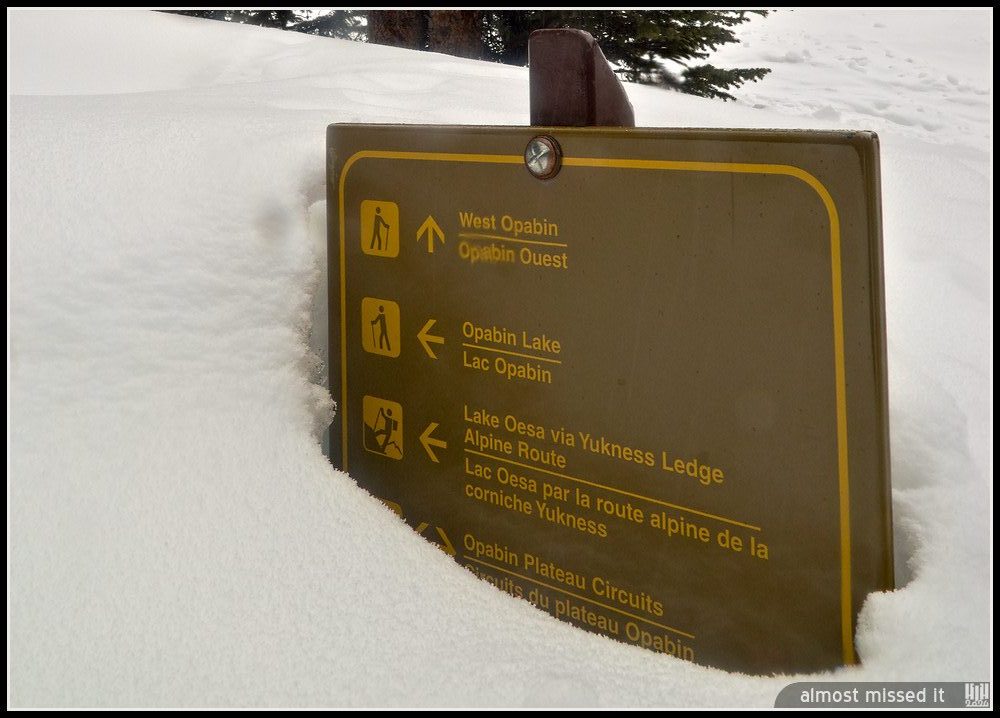
The traditional West route curls around exposed rock under cliffs and then cuts up one, making it nigh impassible in winter. Years earlier a new route had been cut through the trees to the North-West of the Plateau, to the delight of tourists. This “East” route had steep switchbacks, but was shorter and more gradual than the traditional route, plus the dense forest protected it from rock slides and avalanches… except for the very end, where the trail marched right through a Yukness Mountain avalanche chute. I had thought both routes were death traps in winter, but did the rabbits know something I didn’t? I was supposed to turn back and head to my skis at this point, but I had plenty of stamina left, so my inner cat pounced on the opportunity. I took off over Lake O’Hara in pursuit of my prey.
The bunnies’ secret knowledge were the creeks running out of the Plateau’s many lakes. In summer they were a rocky mess of logs, but in winter you could hop between them and the trail to avoid the worst bits and reach a part that opened up into lumps of snow-covered rocks on a steep slope. While this still led into the avalanche chute, you now had the option of tiptoeing around the edge to reach the safety of the Plateau’s treeline. The tangled tracks bounded up and down this steep slope, so the snow bunnies clearly weren’t worried about an avalanche roaring down the creek. It seemed safe enough, provided I had enough stamina to clamber up steeper terrain than I’d ever snowshoe’d up before. I needed frequent breaks, but nonetheless I was soon walking across the Plateau in winter. I headed West, where I knew of a cliff that would net me an excellent view of the O’Hara valley while I took a short break and reassessed.
My situation was much worse than I had realized. I was down to two handfuls of trail mix, and maybe a quarter of a cup of water. That had to last for what was now a good fifteen kilometres of distance, four of which were snowshoeing over rough downhill terrain. The ascent had drained my “infinite” stamina, and it had barely recovered after the rest stop. But my GPS said I had maybe three hours until the sun set, and the mountains can subtract an hour off that. I had to average more than seven kilometres per hour, while tired and with no food or water to fuel me, if I was heading back to the car. Even if I pulled off that feat, my reward was over two hours of night-time driving while exhausted and barely able to focus.
Alternatively, I could head to the Elizabeth Parker Hut. Yes, that meant crashing someone else’s party, but this was turning into a survival situation. They’d almost certainly forgive my trespass, given the circumstances, and I’d probably enjoy swapping tales from the trail over some donated tea. The wilderness is always safer as a group activity.
My choice was obvious. I collected my backpack, grabbed my poles, and headed back to the car.
We’re still in the early days of researching how LLMs effect loneliness. Nonetheless, I think a picture is coming into focus.
Overall, the analyses showed that students who use chatbots are more socially disconnected than their peers. However, we also found that students who engage in casual conversations and seek emotional support from chatbots are even more socially disconnected than peers who do not use chatbots and more than those who use chatbots for utilitarian, goal-oriented purposes. The more socially disconnected students were more inclined to use chatbots upon situational feelings of loneliness, when in bad mood, and when feeling a need to self-disclose.
Arthur Bran Herbener and Malene Flensborg Damholdt, “Are Lonely Youngsters Turning to Chatbots for Companionship? The Relationship between Chatbot Usage and Social Connectedness in Danish High-School Students,” International Journal of Human-Computer Studies 196 (February 2025): 103409.
That is the best-conducted study I can find on the subject, and it finds chatting with a general-purpose LLM is associated with increased loneliness, not decreased. Whoops, but the evidence is the evidence, is it not?
Third, we preregistered hypotheses concerning why youngsters initiate conversations with chatbots. We hypothesized that loneliness predicts chatbot interactions intended to counteract loneliness (H3a), whereas low perceived social support predicts chatbot interactions intended to discuss one’s feelings (H3b). …
In other words, the findings suggest that individuals with higher levels of loneliness are more inclined to seek out chatbots when experiencing a situational feeling of loneliness. Likewise, students experiencing less social support are more inclined to start conversations with chatbots when feeling a need for self-disclosure. A similar pattern was observed in the total group of chatbot users (…).
Ibid.
Alas, “correlation is not causation” has something to say here. Does chatting with general-purpose LLMs make people more lonely, or do lonely people gravitate to using general-purpose LLMs to alleviate their loneliness? Both would show up as a correlation, and yet both have vastly different implications.
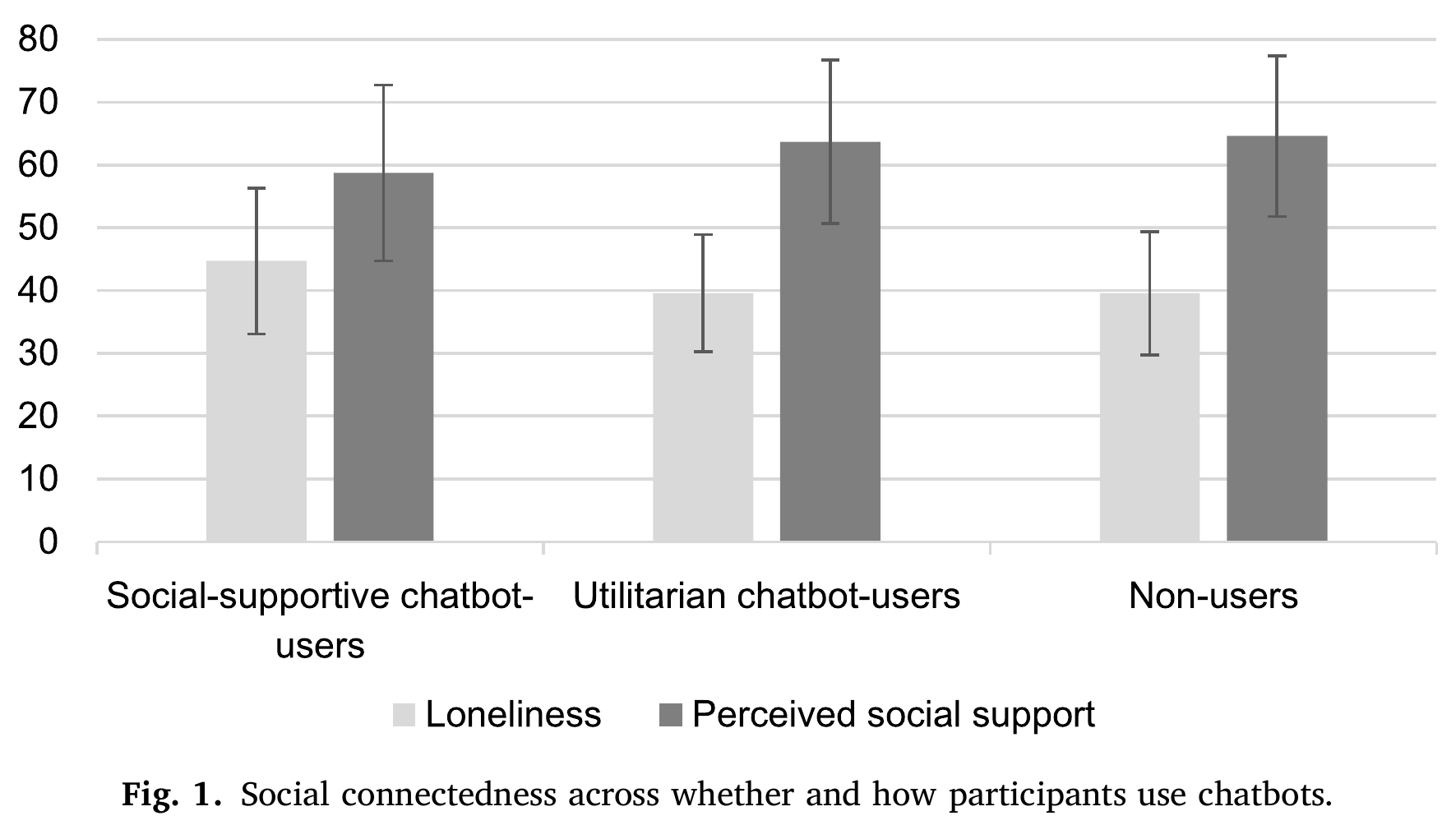
We’ve also got to be honest about the scale of the effect, it’s really not all that large. “Socially-supportive chatbot-users” means those students who treated the LLM as a social partner or called on it for emotional support, according to these researchers, and only a grand total of 39 students fit in that category. 174, in contrast, were “utilitarian” and only used the LLM like an encyclopedia or servant, and there were 1,365 “non-users” who hadn’t touched the things. Data was collected between December 2023 and March 2024, and to put that in context ChatGPT 4 was released March 2023 and 4 Turbo in November 2023. This was a golden period for LLMs, and yet we’re looking at minuscule changes that could easily be swamped by noise. Has there been a more recent study that better accounts for causation?
We found that increases in emotional isolation predicted significant increases in chatbot use 4 months later (…), consistent with the hypothesis that feeling lonely leads people to seek out chatbots. Importantly, after people increased their chatbot use, they reported increased emotional isolation 4 months later …
Dunigan Folk and Elizabeth Dunn, “How Does Turning to AI for Companionship Predict Loneliness and Vice Versa?,” Psychological Science 37, no. 4 (2026): 276–86.
There has, and it found using an LLM for emotional support is indeed linked to increased loneliness, not decreased. But again, the effect size is small. Interestingly, there was no statistical correlation between LLM usage and social isolation, “although the relationship was in the right direction” to suggest precisely that. More interesting for me, though, was Table 1 from the paper. The researchers looked at four distinct “waves” of cohorts that lasted four months, the first starting in November 2023 and the last ending in February 2025. Over that time, there’s very little change in the number who used it for social support. The number who never used it for that may have dipped to 70% in the last wave, but there’s no clear trend down. The fraction who turned to an LLM for that support multiple times a month, or more frequently, has remained stuck at 9% the entire time. It’s a common claim that LLMs only get better over time, and presumably that also means at least minor improvements in their ability to provide emotional support. So why wasn’t there a matching increase in those relying on it for that support?
Perhaps these things aren’t getting better, after all.
Participants were invited to the lab in small groups, where they completed a consent form and a pre-study survey, before being randomly assigned to one of three conditions. … In the human condition, participants were randomly paired with another participant in the session and instructed to begin texting each other daily for 14 days, starting the following day. … In the AI condition, participants were added to a private Discord chatroom with the chatbot Sam, sent one message to confirm the setup worked, and were instructed to begin interacting with Sam daily for the next 14 days. … In the control condition, participants were placed in a private chatroom alone and instructed to write a one-sentence summary of their day each day for 14
days.Ruo-Ning Li et al., “Is a Random Human Peer Better than a Highly Supportive Chatbot in Reducing Loneliness over Time?,” Journal of Experimental Social Psychology 125 (July 2026): 104911.
I got that previous study from the citations mentioned in this one. This one seems rigged; didn’t we already discover that group Cognitive Behavioural Therapy was the most effective approach towards loneliness, and one-on-one interventions did poorly?
Participants who messaged with human partners reported significantly lower post-study loneliness (M = 1.85, SE = 0.03) compared to those in the control condition (M = 2.00, SE = 0.04), and compared to those in the AI condition (M = 1.98, SE = 0.04). In contrast, participants who texted with the chatbot did not report significantly different levels of loneliness than those in the control condition …
As an alternative measure of loneliness, we assessed perceived isolation (…). We found the same pattern as the loneliness results: only participants in the human condition reported significantly lower perceived isolation than those in the control condition (…), with no significant difference between the AI and control conditions (…).
We also assessed positive and negative moods both daily, as well as pre- and post-study (…). For positive mood, we again
found the same pattern. Only participants in the human condition showed greater increases in positive mood relative to the AI and control conditions (…), which did not differ from each other (…). For negative mood, however, we found that participants in both the human and AI conditions showed greater improvements compared to the control condition (…). We also assessed social support at the end of the study, which did not significantly differ across conditions (…).Ibid.
And yet the LLM could not even perform poorly. The researchers also checked how empathetic the LLM was (more so than the humans, on average), and how engaged everyone was in their tasks (the LLM again had the greatest average level of engagement, while the humans usually engaged more with other humans than the LLM), though they also stress there’s a lot of noise and variance in those findings.
Can I find a study that suggests LLMs could help people become less lonely? Certainly!
In short, interacting with an AI companion improved their baseline loneliness levels on par only with interacting with another person, whereas a common technological alternative did not. Furthermore, participants underestimated the degree to which AI companions improved their loneliness relative to their true feelings after interacting with such AI.
Julian De Freitas et al., “AI Companions Reduce Loneliness,” arXiv:2407.19096, preprint, arXiv, July 9, 2024.
Small- or zero-effect sizes imply you’re going to get scientific studies with contradictory outcomes entered into the record, so I shouldn’t have difficulty finding studies which show LLMs help with loneliness. And yet, I do; the one I linked to above was the only clear-cut single study I could find, and it’s authored by economists with some serious methodological problems. Even that can only find that the equivalent of GPT-3 was about as effective as reducing loneliness as a one-on-one chat with a stranger, which again is one of the least effective treatments.
Findings indicate a generally significant positive correlation between AI use and loneliness (…). Specifically, interactions with physically embodied AI are marginally significantly associated with decreased loneliness (…), whereas engagement with physically disembodied AI is significantly linked to increased loneliness (…). Among older adults (aged 60 and above), AI use is significantly positively associated with loneliness (…), while no significant correlation is observed (…) in younger individuals (aged 35 and below).
Xu Dong et al., “A Meta-Analysis of Artificial Intelligence Technologies Use and Loneliness: Examining the Influence of Physical Embodiment, Age Differences, and Effect Direction,” Cyberpsychology, Behavior, and Social Networking 28, no. 4 (2025): 233–42.
This meta-analysis does show an LLM can reduce loneliness, provided you put it in a human-like puppet or toy that can be physically interacted with. The typical chatbot experience, in contrast, seems to make people more lonely instead, and that’s the picture that seems to be coming into focus.
How could that be?
What you do and where you are after you run out of water can dramatically shift your expected lifespan. Andreas Mihavecz’s was longer than eighteen days, but he was sitting in a room with a comfortable temperature and enough humidity for a tiny bit of water to condense on the walls. Add some activity, push the temperature to the extremes, lower the humidity, and your time can be up within ten hours.
I was two hours from my car and surrounded by enough aerated frozen water to bury me up to my mouth, in some places. Dying of thirst was technically possible, but only with effort.
The forty days without food meme assumes plenty of water and sloth, which didn’t apply to me, and again: two hours. No, my primary concern at that point was a lack of cognition. Those hungry leg muscles needed fuel, so my body would starve my brain to satisfy them. But that meant I had a poorer grasp on reality, and was more prone to making terrible decisions, and those can be fatal even under the best of circumstances. You can mitigate that by bouncing your bad ideas off of others, but I was alone.
Cognition is kind of my thing, however, and I knew the area well. I could cope with a bit of self-inflicted stupidity. And so I headed back to the car.
As I swiftly strode back along the open Plateau, I finally ran into some of the bunnies! The four of us casually clomped towards each other, and I learned these “rabbits” were actually university students performing a hydrography study. It made me seriously reconsider my chosen area of expertise. My clock was ticking, alas, so I only enjoyed the companionship for a few minutes before I broke off to resume my thoughtless dash.
Half way down the access road, though, I noticed the front of my legs were moving funny. I had been generating a tonne of heat snowshoeing through the trees, but now that I was standing in a headwind those lightweight Nike trackpants weren’t enough insulation for my bare legs. My skin was starting to freeze. I pulled to the side of the road, carefully popped off my skis, removed half the contents of my backpack in small increments, and struggled to cover my thin trackpants with a thinner pair of snowpants.
By this time, exhaustion had been chewing away at me. I was seeing spots and feeling lightheaded, which meant slowing my descent to prevent injury. But I’ve never been a good skier, so that took a fair bit of physical and mental effort to accomplish, which in turn aggravated my vision and balance issues. Slowing down would also rob me of precious daylight. Balancing all that, after the equivalent of downing a few beers, took most of my concentration. The pause to insulate let me recover a bit, and rub some sensation back into the front of my legs, but it also lightened my cognitive load enough to allow for a proper assessment of the situation.
Would I live? Probably, but the sky had already dimmed noticeably and I was behind schedule. Would I have enough daylight to get to my car? Just barely, if I picked up the pace a bit. Would I encounter any wildlife? Some animals became more active at dusk, but if I kept my eyes up and periodically shouted a warning that shouldn’t be a problem. Would I enjoy the rest of the trip down? No, and I cursed the pause that had let me realize that.
I spent at least fifteen minutes sitting in the car, letting myself warm up a bit and puzzling out how to stay awake when every instinct told me to take a nap. That task would be much easier if I drove half an hour to Lake Louise, which had gas stations where I could refuel myself on expensive snacks. By the time I backed the car up to leave, it was pitch black out and impossible to navigate without headlights. I got damn lucky in Lake Louise, the attendants were debating whether to close early for the night when I pulled up to a pump. They instead got to listen to a tale of miraculous survival, while I stuffed myself with overpriced beef jerky and guzzled Gatorade.
I hope your fourth trip to Lake O’Hara looks a little less exhausting.