Who are these people?

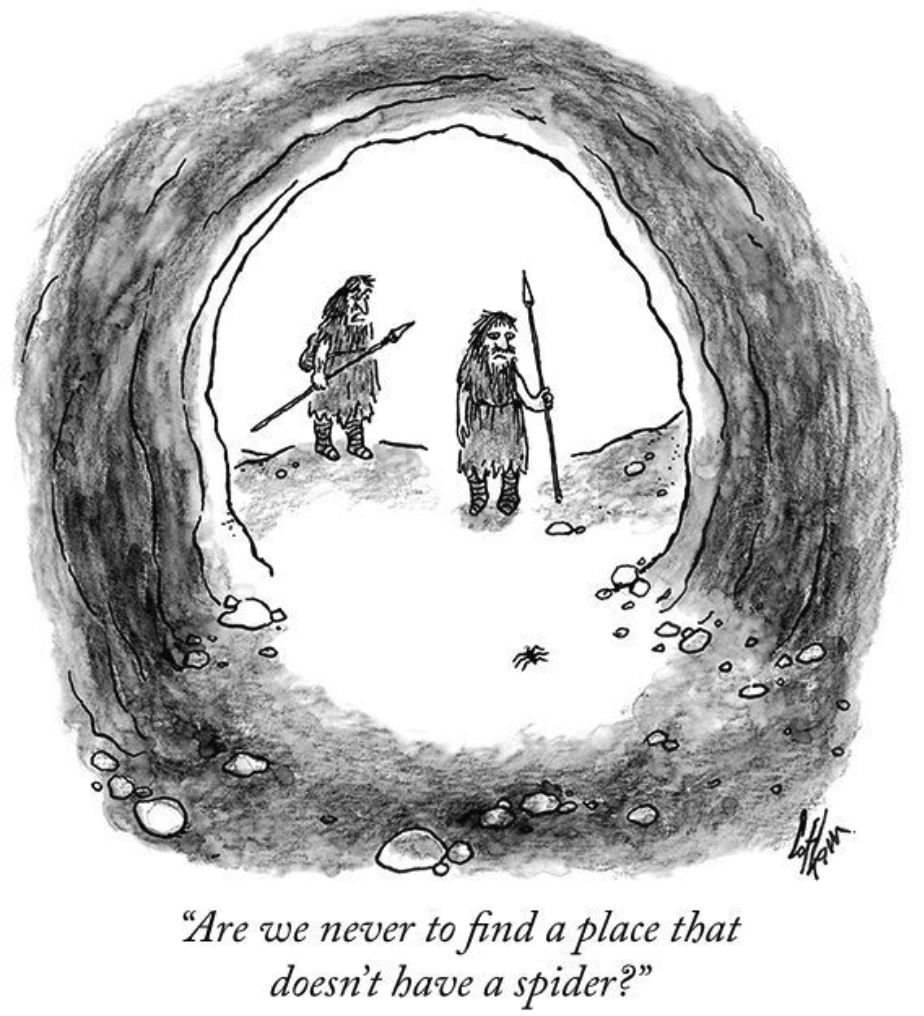
I know their names — Adam Brown, Chris Kemp, Christine Peterson, Gaia Dempsey, Metaculus and Robin Hanson — but I don’t understand why anyone would listen to them babble about subjects they can’t possibly know anything about. So I started listening to this video of a panel about The Far Future & Space Tech Tree: Space & Longtermism, only to have to frequently yell, “how do you know that?” at the screen. None of it made any sense. They’re building castles in the sky on weird presuppositions.

The first guy is Robin Hanson, certifiable whack job, babbling about the risk to his vision of the far future. He’s worried that we’re going to get a world government that is too centralized and too darned successful at making people happy, and that means we’ll lose interest in taking risks, so we won’t expand to fill the galaxy out of fear of encountering big bad aliens.

Think about that. 1) There’s no evidence that a government is taking over the world, and 2) he has no grounds for psychoanalyzing trends over millions of years (yeah, he’s extrapolating over a span that’s probably longer than our species will exist), and 3) he doesn’t like the idea that humans might develop contentment and stability. That would be bad.

It’s nice in a theoretical, principled sense that the professoriate allows people to lounge about and daydream about humanity’s fantasy future, but sometimes you feel like there ought to be at least a token grounding in, you know, evidence of some kind. How could this happen? Hanson is at George Mason University, a place that has been bought lock, stock, and barrel by extremist capitalists of the very far right. The Kochs basically own the place, and it’s become a locus of power for the Federalist Society. You know, the wellspring of the very worst sort of judicial influence.

Documents obtained by alumni and students through the Virginia Freedom of Information Act (FOIA) over the past year and one half reveal that George Mason University’s public law school has been taken over by the conservative Washington DC based Federalist Society for Law and Public Policy. Since April 2016, the Federalist Society has been influencing faculty and student placement, recommending and establishing legal programs, redirecting large amounts of scholarship revenues to support the Law School’s most-politicized centers for the “Study of the Administrative State” and “Liberty and Law,” and even reorienting the Law School’s judicial law clerk program to place “conservative” law students associated with the Federalist Society as clerks to the nation’s judges.

Two years ago, on March 31, 2016, George Mason University announced that as a result of a $20 million donation from an anonymous donor and $10 million donation from the Charles Koch Foundation, it was changing the name of the Law School to the Antonin Scalia Law School. This generated intense controversy about renaming a publicly-funded state law school after one of the most ideological and polarizing Supreme Court Justice in history. Accompanying that controversy were concerns about inappropriate influence by an anonymous donor and the Charles Koch brothers who have long exerted control over George Mason and its affiliated Mercatus Center and Institute for Human Studies. Less known outside of legal circles is that Justice Scalia was the founding faculty advisor to the Federalist Society in 1982 and its highest-profile member and frequent speaker for the next 34 years, with four speeches at Federalist Society events in 2015 alone.

And that, in turn, reflects a distortion of our political economy by the existence of the obscenely wealthy, the billionaires who can use all their money to promote their personal, idiosyncratic beliefs and bloated egos.

One man has donated $1.6 billion to a nonprofit group controlled by a conservative activist who has crusaded, with startling success, to transform the country’s politics. The only reason the public knows about it? An insider tip-off to the New York Times.
The Times reported this week that electronics mogul Barre Seid last year gave 100 percent of the shares of surge protector and data-center equipment manufacturer Tripp Lite to a group called Marble Freedom Trust. The group is led by Leonard Leo — who has helped bankroll right-wing advocacy on abortion rights, voting and climate change, among other things. His chief focus for a time was reshaping the judiciary as executive vice president of the Federalist Society, including by advising Republican presidents on Supreme Court nominees. The tale of how his group got such a lavish gift underscores the sad state of this country’s campaign finance system.

That kind of money means they don’t have to touch down on reality ever, and it shows. They are not very smart people, they only know how to manipulate the system and maximize profits from their inherited wealth, and that allows them to distort the perception of reality to their advantage.

My only question is…why are really rich people drawn to longtermism? It makes no sense. It’s bad science. Maybe there’s some germ of wish fulfillment there — they imagine living forever and becoming Spaceman Spiff, and going off and dominating the universe in the same way they currently dominate the United States and UK. They want to imagine a world where rich idiots get free rein, like they Donald Trump and Boris Johnson. And the best way to get that is to put buffoons like Hanson in positions of intellectual influence.

Unpalatable on all counts

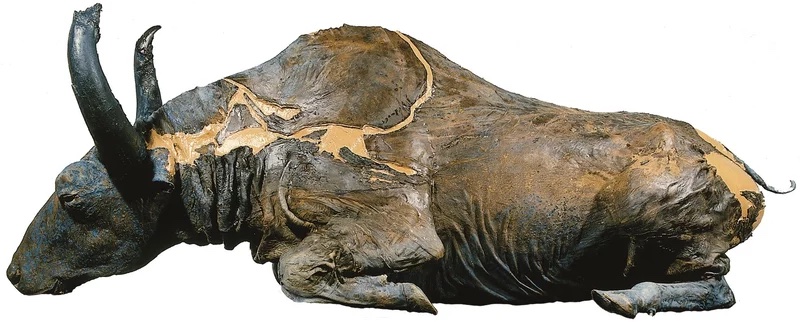
I don’t know which would be worse, 55,000 year old beef or the doggerel they served with it. After uncovering a frozen steppe bison in the Alaskan permafrost, this group of university people, for some unfathomable reason, decided to cut off a chunk and eat it. Then someone decide to make a poem of the meal.

The skeleton, the skin, the muscles — all in near-impeccable condition,
Guthrie named it Blue Babe, then sliced off a piece for a culinary mission.

“You know what we can do?,” he asked
Host a dinner party and with cooking the meat, I’ll be tasked.

The Blue Babe neck steak served eight,
With veggies and spices, and lots of booze they ate

Years later, writing about the taste,
Guthrie said, When thawed, one could mistake

The aroma for beef, not unpleasantly earthy.
But once in the mouth, his wife, Mary Lee Guthrie,
Told podcasters from Gimlet, it was worse than beef jerky.

Here’s what it looked like:

I would not consider for a moment the idea of putting any of that in my mouth, especially since decay and bacteria would have predigested it, and who knows what species of organisms had started breaking it down, or what byproducts had accumulated in tens of thousands of years of slow rot.

I suspect the booze was the most important ingredient in the recipe, and in the composition of the poetry.

I did it, but you didn’t make me do it! So I didn’t really do it.

Jordan Peterson had his Twitter account suspended over a bigoted tweet, and he insisted that he’d never delete it, you sons of bitches.

Guess what? He deleted it, finally. But he did it in the most petulant, childish way possible.

If you can’t see right through his game, you might just be stupid enough to be a Jordan Peterson fan.

Spider journalism isn’t great

I knew it all along. What I read in the popular press about spiders seems to be a lot of spook stories — it isn’t news unless it reaffirms peoples’ fears. I’ve wondered how bad the reporting is, and now it’s been quantified: a bit less than half are sensationalist. That’s slightly better than my impression, but still awful.

Overall, the quality of the reporting was poor: 47% of all articles contained one or more errors and 43% were sensationalist. Stories with photos of spiders or alleged bites were more likely to be sensationalized, as were stories that contained errors. Whereas quotes from medical or other experts were unrelated to sensationalism, stories that contained quotes from spider experts were much LESS likely to be sensationalized.

If it bleeds, it leads — or if it has fangs, too many legs and eyes, and is venomous, it justifies a freak-out on page 3. What to do about that?

We next conducted an analysis to describe the flow of spider news stories around the world and to get at what may be driving the spread of (mis)information about spiders online. Unsurprisingly, countries with shared languages and with higher proportions of internet users were more likely to be connected in the global network. The number of medically important spider species present (i.e., those capable of harming and potentially killing humans) also increased the connectedness of individual countries within the network. Most notably, we identified sensationalism as a key factor underlying the spread of (mis)information.

This study provides insight into what drives the global flow of information about spiders in particular, but can also teach us some more general lessons. Our results make us optimistic because they suggest a way to improve reporting on spiders, and in turn, to shift the quality and spread of online information more broadly. News stories are less sensationalized when they consult appropriate experts, and reducing sensationalism can help decrease spread of misinformation. We found that even local-scale events published by regional news outlets can quickly become broadcast internationally, which means improving news quality at the local scale can have positive effects that travel through the global network.

Journalists, you know you can pick up your phone and call your local university or extension service and contact someone knowledgeable about the species you’re planning to libel, right? It’s not hard, it makes your story better, and it doesn’t compromise your integrity. It would be less lurid and melodramatic, though.

Besides, everyone knows that spiders are really cute and playful.

Bad money drives out good, again

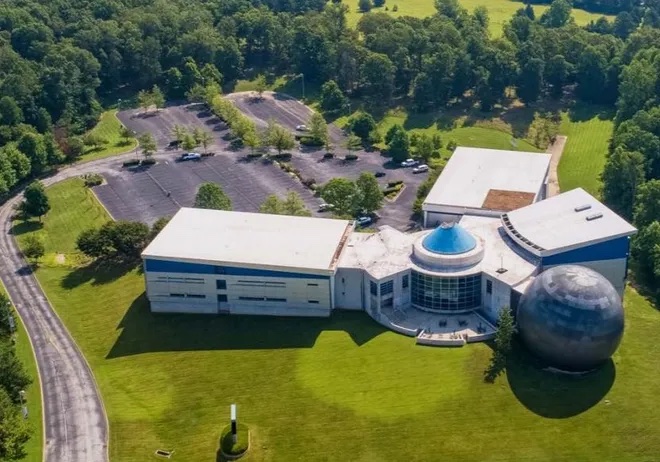
This was the Renaissance Center in Dickson, Tennessee. It was supposed to be an educational resource.

The Jackson Foundation created The Renaissance Center in 1999, four years after the foundation was started with the stated mission to “motivate and educate children and adults through the use of technology in the area of the arts, science and humanities.”

It took some tornado damage a year ago, but was still used to house a community college, a branch campus of Freed-Hardeman college, a planetarium, and various other properties, like a dinner theater.

No more. It’s been bought by David Rives Ministries, and they plan to put some kind of creation museum in there. Yuck.

Who, you may wonder, is David Rives? He’s a baby-faced turdlet who achieved some minor celebrity as an evangelical Christian and columnist for — Jesus, it still exists? — World Net Daily. Apparently, being a Christian fraud associated with conspiracy theories and far right politics is a recipe for riches.

Rives is the kind of guy who claims gravity is in, and only makes sense in the context of, the Bible. He’s a grinning simpleton who calls himself an amateur astronomer while rejecting most of the evidence of astronomy — he’d be laughable if he wasn’t such a goofy little gomer who mostly inspires pity.

Yet somehow he acquired the many millions of dollars needed to buy a local educational institution, spend many more millions of dollars to renovate it, and is planning to rip out anything of value inside and turn it into a collection of lies and religious bullshit.

Plans for The Wonders Center & Science Museum include replicas of life-size dinosaurs, hands-on experiments for children, space-themed exhibits, and a rare historical collection of artifacts, including ancient Biblical scrolls.

I bet he’s going to make it tax-exempt, too.

It’s less than 350 miles from Ken Ham’s parasitic fake museum, and Rives has already fired a shot across AiG’s bows, claiming it will be the largest museum of its kind. I do hope they parasitize each other’s clientele and crash and burn.

The orgy had a happy ending

First thing I had to check in the lab this morning was the status of the spider couples I’d paired off yesterday, one pair seen in this video. I half expected carnage, with the grooms all bled dry and the brides bloated with spider juice.

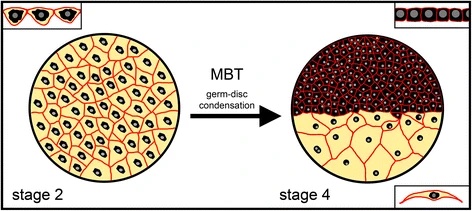
But no! No deaths at all! All of them were resting quietly, a couple of them were even snuggled up together. It was very sweet. I still separated them all this morning, you know, just in case. After class today I’ll be moving the females into extra-large, roomy, deluxe cages, where they can produce all the egg sacs I could dream of. Don’t tell them, but I’ll need a fresh egg sac soon — I’m going to be popping out eggs and embryos, fixing them, and staining them a few at a time over the next few weeks with DAPI. Anyone got a good DAPI protocol for spiders? Or fruit flies? (This one will probably do. I also see that the embryos at the mid-blastula transition look, in some ways, like good ol’ zebrafish.)

Germ-disc formation in Parasteatoda tepidariorum. A contiguous blastoderm is present at stage 2 of embryonic development. The mid-blastula transition (MBT) is at the end of stage 2 and germ-disc formation needs the onset of zygotic gene expression. The germ-disc is formed by a condensation like mechanism. Cell membranes (red); nuclei (grey circles); perinuclear cytoplasm (black); yolk (yellow). Upper left corner: schematic representation of the cross-section of blastodermal cells (st. 2). Upper right corner: schematic representation of the cross-section of germ-disc cells (st. 4). Lower right corner: schematic representation of the cross-section of an extra-embryonic cell (st. 4). Not to scale

Meanwhile, that other egg sac I’ve had my eye on as being close to emergence is still doing nothing. The biggest difference between Parasteatoda tepidariorum and Steatoda triangulosa that I’m seeing is that P tep develops like lightning while S stri dawdles along. That may be an advantage for me since I have to interleave everything with a fairly robust teaching load.

Girls get growth spurts

This is a fairly trivial change, but I color coded the growth rate data for Steatoda triangulosa (yellow for females, blue for males), and what jumps out at me is how the females so distinctly surged in size above the males. It’s also obvious differences in morphology, with the females developing enormous abdomens and the males looking lean and rangy.

Also, some of the females started out as the smallest of the cohort, but even they started surpassing the males in the last two weeks.
Now, unfortunately, I am summoned to the doctor’s office for more tests (no worries, all routine), which means I have to wait another hour for the answer to the question: did any of those little males survive spending the night with the majestic massive females?

Fortunately, I don’t listen to overpaid athletes’ opinions on physics

Shaquille O’Neal said some incredibly stupid things five years ago, claiming to believe the Earth is flat. Those stories died down a while ago — I suspect a publicist took him aside and explained “Ouyay oundsay ikelay anyay idiotyay, ixnay ethay atflay earthyay BS” — but it has flared up again with recent remarks on a podcast.

The NBA legend, 50, was asked during an appearance on The Kyle & Jackie O Show if his former comments about the conspiracy theory were a “joke” or if he did, in fact, believe the notion to be true.

“It’s a theory,” O’Neal told hosts Kyle Sandilands and Jackie Henderson. “It’s just a theory, they teach us a lot of things. It’s just a theory,” he repeated.

“I flew 20 hours today, not once did I go this way,” O’Neal said, noting he “didn’t tip over” or “go upside down.” He added that he’s also unsure about whether the planet is spinning.

It’s OK. If you don’t mind that I’ll forever after disregard everything you say about anything, just announce that you believe the earth is flat, or only 6000 years old, and I’ll happily file you away in my mental bin labeled “bollocks”. That stuff is so stupid that O’Neal might convince me that basketball must be imaginary.