The Fantastic Bonus theory of female orgasm

Larry Moran put up this video of Elisabeth Lloyd discussing the problem of assuming adaptation in evolutionary studies. I think it’s excellent and makes points I wish more people would consider…but strangely, most of the comments over there are expressing extreme distaste while failing to mention any specifics about what they dislike.

Maybe some of you can watch it and explain lucidly what you object to…or what you don’t find objectionable. I get the impression that a lot of people rather rabidly turn their brains off at the merest mention of the word “spandrel”.


In case you didn’t watch it, here’s the main point.

She’s criticizing methodological adaptationists. This is a style of thinking that assumes that only adaptation and selection are important or interesting, and as a philosopher she objects to the replacement of a reasonable null hypothesis (that is, that no selective evolution is occurring for a trait) with the pretense that selections is the null hypothesis…and that if analysis of a trait reveals an absence of evidence for selection, then they will move on to consider other hypotheses.

But they don’t. As she demonstrates with the example of the evolution of the female orgasm, several prominent evolutionary biologists are so fixated on selection that they just make endless chains of adaptive hypotheses, and don’t even consider other explanations (such as drift, genetic hitchhiking, architectural constraints, or developmental mechanisms) as legitimate answers to the question of evolutionary function. It’s a new kind of teleology — they are reluctant to consider that some features of our history were completely purposeless.

Another ugly example of the abuse of Evolutionary Psychology

I have to take one more slash at evolutionary psychology, and then I’ll stop for the day. But first, maybe I should give you the tells I use to recognize good evopsych from bad evopsych (oh, dear, I just admitted that there’s some respectable evopsych out there…).

Here’s an easy indicator. If it’s a paper that presumes to tell you the evolutionary basis of differences between the sexes or races, it’s bullshit. That means the author is going to trot out some prejudice about how sexes or races differ before building some feeble case from a collection of poorly designed surveys or sloppily analyzed statistics to make up a story. Unsurprisingly, those differences always fit some bigoted preconception, and always have, from Galton’s determination of the ‘objective’ degrees of feminine beauty between races to Kanazawa’s, ummm, determination of the ‘objective’ degrees of feminine beauty between races. There really hasn’t been a lot of creativity in this subfield.

If it’s a paper that compares the behavioral psychology or cognitive abilities of different species, there’s a chance it might have something interesting to say. At least there’s a possibility that the crude kinds of essays for examining the workings of the brain might be able to detect a difference of that magnitude. But don’t forget that 90% of everything is crap, so don’t assume that just because the author is discussing chimpanzees vs. humans that it’s necessarily good work.

But now, here’s the ravingly awful side of evopsych, magnified even more because it’s not a scientist trying to make an argument: it’s a floridly batty pick-up artist trying to claim that evopsych supports his hatred of women. His deserved hatred of women, I should say, because he really regards them as little more than hideously deformed animals. Ladies and gentlemen, I give you…Heartiste, explaining why women hate evolutionary psychology. (Warning! You may want a bucket and damp cloth handy, to clean up any vomit. Below the fold because, well, this guy is a fucking abusive moron.)

[Read more…]

Belief in Evolutionary Psychology May Be Hardwired, Study Says

[It’s been a while since I’ve revived an old Pharyngula-safe post from my old blog, and it seemed like we have the appropriate theme going here today.]

Biologists have long assumed that evolutionary psychology, a controversial branch of psychology that ascribes many common social behaviors to genetics, is a muddled blend of half-understood evolutionary biology, selective data mining and resentment of women’s changing roles in society.

A new study, published in today’s issue of the German publication Unwirklichen Genetikjournal, does not challenge that assessment. But it does suggest that some men may be genetically predisposed to believe in evolutionary psychology, a finding that may well suggest future methods of treatment of the psychological malady.

Believers in evolutionary psychology maintain that feminism sets itself in opposition to millions of years of anthropoid evolution, and is thus futile and inhumane to men. Allegations made by believers include references to putative differences in math skills between men and women, a supposedly irresistible but entirely non-visually stimulated female attraction toward powerful and/or arrogant males, and the existence of a genetically preordained male right to multiple female sexual partners.

Many such men hold to these beliefs despite an absolute lack of supporting scientific evidence, says Dr. Ulrike Mann-Esser, chair of the sexual anthropology department at Universität Ulm and the study’s lead researcher. “But we had no way to determine why this was so until last year’s discovery of the locus taedius.”

The locus taedius, discovered accidentally last year by a graduate student working with David Gelernter, is a section of the human hindbrain that shows significant electrical activity when a person retrieves long-term memories that he or she does not find interesting.

In Mann-Esser’s study, 200 male subjects, who had small electrodes implanted in their locus taedius and glued to various places on the skin, were asked to stand outside the door of a glass cubicle and open the door for anyone trying to enter. Inside the cubicle was a male Pilates instructor posing as a researcher. A handful of highly attractive female graduate students were instructed to approach the cubicle, ignore the subjects while the door was opened, then proceed into the cubicle and place a hand on the chest of the “researcher.” Levels of locus taedius activity were recorded for each subject.

“By setting up a stimulus that often spurs EvPsych statements in the susceptible,” says Mann-Esser, “we hoped to be able to detect increased locus taedius activity among those men who had half-remembered bits of evolutionary biology come to mind from high school. The skin electrodes measured galvanic response and thus sexual arousal, which allowed us to determine which subjects were merely trying to recall female sexual anatomy from textbook figures so that we could exclude them from consideration.”

At first, approximately fifteen percent of male subjects showed significant locus taedius activity without sexual arousal. “We thought that seemed rather high,” says Mann-Esser, “until the Pilates instructor’s boyfriend showed up and two-thirds of that fifteen percent showed dramatic galvanic response changes.”

Further study by Mann-Esser’s team found a surprising commonality among the five percent of subjects showing clinical signs of susceptibility to evolutionary psychology, which the team refers to as “Desmond Morris Syndrome,” or DMS. Ninety percent of the DMS-positive subjects shared a single allele, first isolated by researchers at the University of Lucerne. The recessive allele, named luz-R, was absent from the remaining 95 percent of test subjects. (The corresponding dominant allele, luc-ID, has been tentatively linked to critical thought faculties and penis size.)

Mann-Esser admits that the existence of a “DMS gene” is confusing from an evolutionary standpoint. “Most genes persist because they contribute to reproductive success in one way or another. Sometimes this is in surprising ways, such as the gene for sickle-cell anemia, a crippling condition for those possessing two copies of the gene, but conferring resistance to malaria to heterozygous individuals with one normal gene. But the luz-R gene is strongly correlated with complete reproductive failure due to sexual selection against the gene by human females.

“It may be that early human populations carrying the recessive gene in their genome benefited from having certain individuals who were more likely to stand there and lecture the lion about how man is clearly the most fearsome predator on the savannah and then be eaten, thus allowing the rest to escape. It’s puzzling, though. We clearly need to study the issue further.”

One evolutionary psychology partisan maintains that evolutionary psychology itself holds the key to understanding the existence of the luz-R gene. “It’s ridiculously obvious, and has been proven time and again beyond the point where any rational person not swayed by politically correct feminism could dispute it,” says BigBoyBob87, a frequent commenter on a number of feminist blogs.

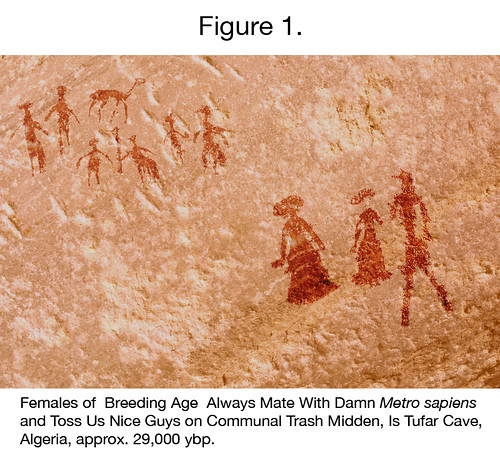
“You only need to look at sage grouse,” continues BigBoyBob87. “They reproduce by leks, in which a group of males converge in a spot to attract females and only the alpha males get to mate, while the others complain about the alpha males being big jerks. Anthropologists have proven that that very same evolutionary psychology observation is a major theme in Paleolithic art, as in for instance the Mousterian Pluvial cave painting Females of Breeding Age Always Mate With Damn Metro sapiens and Toss Us Nice Guys on Communal Trash Midden.” [See figure 1.]

paleoniceguys.jpg

When asked how any of the preceding actually supported his contention that DMS conferred selective fitness on men with the luz-R allele, BigBoyBob87 suggested that this author was only parroting the feminist line in order to get laid.

I really hope none of you went to Walmart today

I’m with Tyrone Robinson, the underpaid Walmart employee who publicly walked out today.

Tyrone Robinson, the lone worker and protester from Chicago’s Walmart on the far south side of the city, estimates he earns about $15,000 a year doing produce management. One of the demands of the strikes is that workers be able to earn at least $25,000 a year if they work full time.

"My ends ain’t meeting," he said. "My hours have gone down to about 30 hours a week, and I make $8.25."

Robinson, a small African-American man buzzing with nervous energy, was wearing his bright green OUR Walmart shirt and a Bulls cap. (OUR stands for Organization United for Respect.) Tears left a trail down his face on the bitterly cold early morning.

"I know there are other Walmart workers in there that feel like me, but they are just terrified of retaliation because Walmart told them that if you walk off, you will be terminated immediately," he said.

"I want to let them know if I can do it, get up and speak up about what you deserve," Robinson said. "We work hard, we get here on time, we do what we got to do. I feel very proud to do this, and once I return I’ll tell them about it."

When you kill unions, you kill labor, and when you kill labor, you kill people.

I will be looking for Tyrone Robinson’s name in the news tomorrow. I hope he still has his job…but I don’t have much hope for Walmart.

It must be “Let’s all beat up Evo Psych” Day!

Earlier, when I was writing up that criticism of Rybicki and Stangroom, I read through that article on shopping and foraging and evolution that he had cited in defense of his views. There was something in it that drove me to distraction and made me want to find a match and light the whole paper on fire (a bit of indulgent exorcism of annoying work that is getting increasingly difficult to do; I was reading it on my iPad). It’s something that afflicts almost all of the evo-psych work on the evolution of sex differences, and it rankles. So let me try to purge my irritation in a way other than incinerating an expensive bit of electronics. Let me instead pretend to be an evolutionary psychologist.

First, let me stipulate that everything is a product of selection; that the only interesting features in human evolution are adaptive ones. This one really, really hurts, because I’m by no means a panadaptationist, and think a lot of features are far easier to explain as a product of pure chance rather than having to come up with an elaborate just-so story to rationalize them. But have no fear, I’ll return to a pluralist view at the end.

Second, the paper included this nice chart on the differences in roles in hunter-gatherer societies (it’s relevance to a paper on shopping preferences in 19 year old American college students is still in question).

I will stipulate that every single cell in that table is true. I’ll go further and stipulate that the correlation with the sexes is absolute and perfect: in all hunter-gatherer societies, women never hunt and use those hunting skills, and men never gather and use those gathering skills. I’m not an anthropologist, so that table could be totally crackers and there could be a thousand exceptions, but I’m not going to worry about it; we’re stacking the odds to favor the evo-psych hypotheses as much as possible right now.

Further, I will stipulate that many of those skills are biologically based and founded on genetically determined cognitive abilities, and that they have no overlap. That is, for instance, hunters need a theory of mind that is built on an elaborate cortical substrate in order to more efficiently predict the behavior of prey; this ability is not used by gatherers when they’re searching for tubers. Gatherers, on the other hand, need very precise sensitivities to color and nuances of shape to assist in pattern-matching while searching, abilities that hunters do not use.

I will also stipulate that these specific cognitive and perceptual abilities have no utility outside hunting or gathering. There are no social circumstances, for instance, in which these abilities might be an exaptation.

Finally, I stipulate that the circumstances that produce these adaptations are still relevant today, and that 95,000 years of human evolution in hunter-gatherer societies completely dominates and makes irrelevant the last 5,000 years of evolution in agricultural and urban societies; we can ignore any processes that might have undone prior adaptations.

Is that enough yet? Have I given enough of the store away? ‘Cause I’m really feeling a little psychic stress here, since giving up some of those premises makes me want to claw them back and stab them a few times, until they’re bleeding and dead. But I’m playing the game, let’s give evo-psych every possible advantage, and grant them every assumption they make as a default.

Now here’s the part that infuriates me when reading these sex difference papers. They almost always act as if they’re discussing two independent breeding populations facing different selection pressures.

But…

Every hunting man had a gatherer mother; every gathering woman had a hunting father.

Seriously, it’s this feeling that I have to remind them that they’re not dealing with two species, Man and Woman, or even two populations, the man-tribe and the woman-tribe, but one goddamned species, obligately breeding within themselves. If there is a ‘spatial navigating gene’, both men and women have it. If there is a gene that grants us the color sensitivity to distinguish puce from plum, we all carry it. With the exception of a minuscule number of genes involved in sex-specific trait determination on the Y chromosome, we’re sharing everything.

Wait, the naive among you are wondering, does that mean men are carrying genes for large breasts, wide hips, and ovaries, while women are carrying genes for baldness, baggy scrotums, and testicles? Yes, we are. All shared. But these genes are also regulated so that they are expressed or repressed differently in the different sexes. You have to think of each one as a Gene Plus: a gene plus an added switch to turn it on or off differently in different sexes (commonly, they’re regulated differently by the presence or absence of testosterone.)

In most of these reproductively relevant sex differences, it’s easy to understand what maintains the Plus; a man whose testes did not see the signal to make male-specific gonads and instead produced some very confused ovaries would be a reproductive failure. Some of the secondary characteristics are only weakly maintained — breast size, for instance, doesn’t seem to be a major factor in reproductive success, and we see a large variation in that parameter…but there are stronger pressures that have maintained lactation, and so that function is more reliable (but not invariant!)

This is the problem for the evolutionary psychology of sex differences: for each trait that you want to claim is a product of selection for a behavior that is different between sexes, you have to postulate a Plus that restricts its expression to a single sex.

You can’t simply have a just-so story that Woman evolved ability X to cope with gathering berries; you have to also have a just-so story that explains why Man evolved a repressor to shut off X for better hunting. And vice-versa for ability Y that aids in hunting.

So, sure, tell me that humans evolved cognitive mechanisms to aid in navigating by landmarks for better fruit and tuber searching, and I might well believe it to be reasonable; now tell me why you think it would only operate in women, and how it would be actively suppressed by genetic mechanisms in men. Then you can tell me why navigating by distance and direction is actively shut off in women. You’re the ones who like purely adaptive explanations: why would there be an advantage to individuals having each only half the suite of potential genetic navigation tools switched on?

And then you can go through each line in the table up above and explain how confining each of those abilities to only one sex or another led to more babies being made than if both had it, and how having that trait in an ‘inappropriate’ sex would be culled by death or reduced fertility…because you know that’s how evolution works, right?

Right about then, my inner pluralist will come roaring back to life, and I’ll have to point out that your feeble rationalizations, even if I were to accept them, can only represent tiny fitness effects, and that in small populations of humans drift is going to dominate over small fitness coefficients, and selection won’t even see your hypothetical advantages. And maybe you don’t understand how evolution works, after all.

I think a better answer is that there are evolved human traits that are shared among every individual in the population without regard to sex, and that culture acts as the repressor/enabler of particular attributes in particular individuals. That ought to be the default assumption, with exceptions requiring exceptional evidence beyond just reading the cultural codes. Change the culture, and all those fully human abilities can be expressed in everyone, not just the ones permitted by convention.

Anything else is a betrayal of our potential.

The Stangroom Experience

So this odd tweet flies by me:

Jeremy Stangroom
Ed Rybicki speaks out about the consequences of the vile bullying he received at FtB: http://bit.ly/TT9CWz #FTBullies

8:52 AM – 23 Nov 12

“Vile bullying” here at FtB? “Consequences”? Really? And who the heck is Ed Rybicki? I don’t remember him. So I did a little digging.

Oh, yeah. Ed Rybicki — he’s the guy that wrote that “Womanspace” short story that parroted goofy evopsych myths.

At this point I must digress, and mention, for those who are not aware, the profound differences in strategy between Men Going Shopping and Women Going Shopping. In any general shopping situation, men hunt: that is, they go into a complex environment with a few clear objectives, achieve those, and leave. Women, on the other hand, gather: such that any mission to buy just bread and milk could turn into an extended foraging expedition that also snares a to-die-for pair of discounted shoes; a useful new mop; three sorts of new cook-in sauces; and possibly a selection of frozen fish.

It was a not-very-good piece that relied on sexist stereotypes for a crutch. It gets a very thorough going over in the comments section there — a great many people were appalled that such a “tongue-in-cheek” exercise in perpetuating falsehoods about women could get published, even as fiction, in a science journal. It also got slapped down by Jacquelyn Gill, who compiled a huge list of negative responses, such as this one by Anne Jefferson. This wasn’t an FtB-led rejection — it was a massive, science-internet-wide gag reflex that puked all over poor Ed Rybicki’s story. Dana Hunter was our local huntress spearing the wild Rybicki, with follow-ups that included Ophelia Benson.

But to claim it was “bullying” or that FtB was responsible…well, that’s typical Jeremy Stangroom, not letting the evidence cloud his hatred of everything on this network.

But I’m happy to join in now, because I read Rybicki’s awful whine. He doubled down on some truly egregiously bad research in an attempt to salvage his story and credibility.

Oh, by the way, nowhere in his excuse-making does Rybicki mention anything about consequences to himself or his career. That’s another Stangroomism, I’m afraid, and should be completely discounted. Along with everything else he claims. It’s also a year old; I guess Stangroom just wanted to revive an old argument that he saw as damaging to FtB (alas, he’s wrong on all counts.)

But oh, gob, the excuses. They’re embarrassingly bad. Rybicki has to settle on one strategy, first of all. He tries to claim that it was just a fictional story, a little exercise in what-if, and that no one should be offended. But he also tries to cite a whole bunch of articles to show that his hypothetical sex difference in shopping vs. hunting is actually reasonable and true, and therefore no one should be offended because he’s just using the facts.

Look, guy: you could possibly try to make a case for either of those, but you can’t do both: they’re mutually incompatible arguments. Especially when you announce your intent to pursue the evidence like this:

Being a scientist, however, I have been trained to demand evidence, to either support or disprove a hypothesis.

And then what he proceeds to do is cite a series of papers with complete credulity. About a paper titled “Evolved foraging psychology underlies sex differences in shopping experiences and behaviors” he writes:

So: a reasonably respectable gathering, then, of respected academics, reporting academic work? One has to assume so – and that this paper is in good standing, otherwise it would never have been published? Again, a reasonable assumption – so to quote from said article could possibly come under the heading of scientific reportage, rather than sexist assumptions based only on gender bias? If the chain of logic holds, then what I will write now cannot be held as evidence of my innate gender bias – can it?

Good grief, the man is a trained academic at a university, and he hasn’t yet figured out that a horrific amount of crap gets through peer review and manages to get published? How could he read the 15 pages of bloated speculation in that paper, all built on the results of a survey of the shopping habits of students enrolled in an American college introductory psychology course, and not see the flaws?

No, all that matters is…

Right: so it went through an Ethics Committee, then? Evidently – it being a large, respectable US university, and all.

I don’t know. At this point it’s hard to believe this guy is being serious: none of those are grounds to trust a paper’s results. But then he claims that the study has been confirmed by two other papers!

I give you “‘Men Buy, Women Shop’: The Sexes Have Different Priorities When Walking Down the Aisles” – from “researchers at Wharton’s Jay H. Baker Retail Initiative and the Verde Group, a Toronto consulting firm”.

Gosh, when I grow up I want to study evolutionary biology at the Jay H. Baker Retail Initiative. And this is the source for the other confirming study:

The study was commissioned by PayPal, meaning again, big $$$ are involved.

I give up. Really, Stangroom? This is the basis of your accusation that FtB is a place of “vile bullying”? That some of us, at least, are willing to call out bad science?

By the way, I’m sure Ed Rybicki will be grateful to you for resurrecting his shamelessly bad story out of the blue like that. I suspect he’s actually been hoping everyone would just forget it after that net-wide panning it received the first time through.


Oh, wait. In the pile of links I dug up to figure this out, I lost track of the main one Stangroom was pointing out: Ed Rybicki himself has brought it up recently. It’s still true, though, that there were no consequences to Rybicki.

While I received next to no personal communications, other than replies to blog comments, I was vilified at my place of work in what amounted to a systematic campaign – despite never having used a Departmental or institutional affiliation anywhere, and having written and published the thing in my private capacity – to the extent that the principal and a DVC of my university actually asked if we could have a public debate on the issue. I told the DVC he HAD to be joking; getting abused in print was one thing, but public attacks would be another thing entirely. I advised our hierarchy that it would blow over – and you know, it did? Quite quickly, too.

So where am I, now? Well, pretty much in the same place I was in prior to early November, 2011, because I have stopped reading Hatespace: that’s right; I no longer bother to check in on the circle-jerk that FtB had obviously become. I also got good news which completely distracted me from the bullshit: my long-shot effort at getting my 30-year dream project funded struck gold, and yes, the wonderful person who walked into my office and asked “Does anyone here know anything about viruses?” and I will be exploring oceanic viromes (thank you, Maya!).

So – all I can say is that I am wiser (but not sadder); that while as an atheist, humanist and liberal, the FtB blogs would look like they were made for me – they can Fuck. Right. Off.

So he’s had no adverse affects on his career, recently got a grant funded (I presume), and the only effect on his life is that he now blames freethoughtblogs for all the criticisms he received over his petty little story. He hasn’t learned one single damned thing.

FtB was not made for him. Scientists who can’t recognize pseudo-science and who use it to defend sexism aren’t quite our audience.

Nature’s sexism

The magazine, that is, not the natural world. They’ve published a good editorial today in which they acknowledge inequalities in their editorial staff (14% of their editors are women, 6% of the researcher profiles they did in 2012 were about women).

Unfortunately, they do make a few excuses.

One can speculate that there also may be a tendency for women to be less willing than men to push themselves forward, which may lead to editors being less aware of them. But it is certainly the case that women typically spend more time than men as homemakers and looking after children, further reducing the time available for journal contributions

One could say there is also a tendency for men to shout down women, and to assume that they’ll be the ones taking care of the babies. These are all self-perpetuating stereotypes, you know, and the first step in breaking them involves consciously rejecting them.

But the editorial goes beyond that to recommend steps to break unconscious biases.

However, we do not believe that these considerations can fully account for, or excuse, the imbalance in Nature’s pages. Nor do we believe that our own editors consciously discriminate against women.

That leaves the unconscious factors, and here we believe that there is work to do. We believe that in commissioning articles or in thinking about who is doing interesting or relevant work, for all of the social factors already mentioned, and possibly for psychological reasons too, men most readily come to editorial minds. The September paper speculated about an unconscious assumption that women are less competent than men. A moment’s reflection about past and present female colleagues should lead most researchers to correct any such assumption.

We therefore believe that there is a need for every editor to work through a conscious loop before proceeding with commissioning: to ask themselves, “Who are the five women I could ask?”

Under no circumstances will this ‘gender loop’ involve a requirement to fulfill a quota or to select anyone whom we do not know to be fully appropriate for the job, although we will set ourselves internal targets to help us to focus on the task. It is not yet clear just what difference this workflow loop will make. But it seems to us to be a step towards appropriately reflecting in our pages the contributions of women to science.

This is the same step many of us asked meeting organizers to take in the atheist community, to simply start being aware of the gender balance in their speaker rosters and to think about bringing good and interesting women to the fore…which was no problem for anyone and has resulted in great progress. Honestly, I believe that most people want to be fair and can respect people of all sexes, but it takes work to overcome deeply ingrained cultural assumptions.

My sad and pathetic thanksgiving

I cancelled my Thanksgiving this year — I just have too much work piled up on me right now. So Mary went off to Madison to visit my daughter Skatje today — we had a small bowl of pad thai together for our feast, just before she left — so I’m home alone all weekend. I got all my grading sorted out into six stacks, though, and finished off one of the most difficult ones, so yay.

My dinner tonight was a bowl of rice, and I’m going to celebrate by kicking back with a glass of wine and something on netflix — anyone got any recommendations? It’s my one bit of fun for the weekend, so make it a good one.

Tomorrow: complete two stacks of grading.

In which Americans celebrate their traditional regard for Native culture

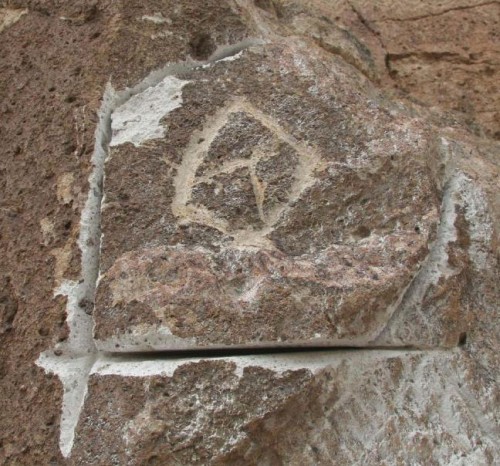
Damaged petroglyph


Happy Thanksgiving from those of us in the United States! It’s a day in which we Estadounidenses traditionally gather to celebrate the debt of gratitude we owe the original inhabitants of the land for helping the first European colonists survive. The remembrance takes many forms. Most commonly, we commemorate our Native cousins by not paying any attention to them at all, though on occasion we note their contributions by red-baiting their allies. And every once in a while, we celebrate this holiday by destroying irreplaceable Native ceremonial art dating back to a time contemporaneous with the European Bronze Age.

From my KCET story linked above:

The petroglyphs are thought to be as much as 3,500 years old, and still play an important role in the cultural life of the Owens Valley Paiute and Shoshone people. Paiute tribal historic preservation officer Raymond Andrews told Los Angeles Times reporter Louis Sahagun this week that the vandalized petroglyphs are regularly visited by modern-day Native people of the Eastern Sierra. “We still use this sacred place as a kind of church to educate tribal members and children about our historical and spiritual connections. So, our tribal elders are appalled by what happened here.”

According to the BLM, the vandals drove ladders, power saws, and portable generators to the site to attempt to remove the petroglyphs. Four were apparently removed successfully. A fifth, shown above, was damaged by saw cuts but left in place: a sixth was broken after removal and left on site. BLM rangers also reported hammer damage to dozens of nearby petroglyphs.

You don’t have to buy into Paiute/Shoshone religious beliefs to find an act like this appalling, just as you wouldn’t need to be a Magdalenian animist to get pissed off if someone took a crowbar to the Megaloceros paintings at Lascaux. A couple years ago a couple of slack-jawed nitwits took their paintball guns into a canyon in southern Nevada that figures prominently in the origin myths of a number of Native people along the lower Colorado River. Said nitwits defaced a number of petroglyph panels there. One doesn’t have to actually believe that Mastamho the creator’s son dug the Colorado out of the desert sands with his walking stick and sent the local tribes off in different directions to feel grief and anger at that damage to culturally significant artwork.

I won’t venture a guess as to the motivation of the thieves, though I suspect — to steal a joke from Professor Bérubé — a primitive form of outrage influenced by what the Greeks called μεθαμφεταμινε. Whatever their motivation, they need to be found and corrected before they do it again. The desert has a deep human history every bit as fascinating and inspiring as its natural history. Damaging it damages our common heritage. On the off chance a reader here has a friend of a friend who knows something, the BLM and the local Tribal government have set up a reward for info.