You say that like it’s a bad thing

There’s a surge in the spider population going on, and people are calling it an Arachnid Apocalypse.

It isn’t just your imagination. Scary sightings of larger-than-usual spiders are on the rise in Metro Vancouver this fall.

Pest control specialist Randy Bilesky has seen a 50 per cent increase in calls to his service this season over last.

“People panic … we get the phone call after someone has walked through a spider web,” said Bilesky. “They are sure it’s still in their hair, especially if it is one of the big hobo spiders.”

I prefer the term “Spider Renaissance”.

What next? Is everyone going to start complaining “Oooh, there are too many squid in the ocean” and “Ick, there are prokaryotes crawling around in my colon”?

If it’s Monday, it must be spider feeding day

Mondays are usually awful, but now at least I have one thing to look forward to: it’s feeding day down on the spider ranch. The adults get a nice chewy cricket each, while I go through the spiderlings’ chambers and toss them a fruit fly each. Since Vera was so avidly hungry today, I recorded her trapping her prey and then picking at it for an extended period of time.

This one is only for spider obsessives who can enjoy staring at close-ups of arachnids doing strange things with their jaws for 15 minutes or more. Are you one? Let me know, and we can start a club.

[Read more…]

Spider update (no spider photos)

I’m getting a little anxious — my spider family is in a quiet phase right now. I have 6 breeding pairs of adults (well, Gwyneth ate her consort after mating, so 5½, and maybe bred pairs is the better term). I’m down to one egg sac — again, from Gwyneth, who is a sick Goth freak because she knitted an ugly, sloppy sac with the dead corpses of her prey imbedded in it, but it does have developing embryos inside it. She also littered the floor with decapitated fly heads. Gwyneth scares me sometimes.

But otherwise, I’m just waiting for them to produce more. My goal is to have a steady reliable output of eggs, and these little hiatuses are nerve wracking, but also understandable, since the colony is so small yet.

I do have a lot of tiny little juveniles coming up, at least. They’re getting a little overwhelming — these are my spider-children, in these little vials I picked up at JoAnn Fabrics (they’re intended for storing and sorting beads, but I have perverted them to my own wicked ends.) Thirty vials, thirty hungry little babies.

I have to go in every couple of days and tend to them. Put one or two flies in each vial (I made a little fly-shaker out of an Eppendorf tube — it’s like a salt shaker, only when you shake it flies come out), give ’em a spritz of water from an atomizer, and agonize over their health and predatory instincts. As they get big enough, I move them to an adult-sized tube, and when I’m confident of their sexual maturity, I’ll pair them up.

But right now it’s a waiting game with placid little beasties (except for Gwyneth) quietly tending to their webs, nibbling on flies and crickets, making me fret over when they’re going to spawn again.

By the way, over half the vials I’m cultivating contain Gwyneth’s progeny — she’s a fecund little monster. I’ll be interested to see if her distinctive behaviors carry on into the next generation. I’m planning on doing some inbreeding of her offspring to see if I can get a brood of savage spider mothers.

Spider update (no photos)

We’re in a mundane phase of this project — I’ve got swarms of baby spiders, a handful of wild-caught adults, and I’m waiting for them to reach sexual maturity, so I can start breeding lab lines.

I’ve got a naming convention — the wild-caught adults (Generation 1) all get simple names like Cathy, Barney, Gwyneth, etc. I’ve had a few of them die off already, although I think it was actually murder. It seems that crickets above a certain size are actually able to turn the tables and eat the spider, or at least kill it, and they will definitely consume an egg sac if they stumble on it. I’m learning lessons as I go along — only small crickets. I’m considering trying mealworms as a safer alternative.

For the second generation, each clutch gets named by the first letter of their mother’s name, and the month their egg sac was made. As they reach sexual maturity, they’ll get a letter after the month to distinguish them as individuals. Third generation will get the initials of both parents, but we’re not up to that point yet. I am planning to keep track of the pedigrees of these spiders as I go, in case something unique and interesting crops up.

I do have a sad story. I’ve been particularly watching on individual, GIIXa, Gwyneth’s daughter by an unknown father, laid in August. I’d been calling her Igor, because she had a few deformities — her left foreleg was much longer than her right (it looked like a duplication of one limb segment), and her two hindlegs had limited mobility, so she crawled around dragging her hindlegs, and with her left foreleg raised high up in the air. She made it to near-adulthood, so clearly she was able to capture and eat flies, but today I found that she had died at last. I’d actually be interested in teratological defects, and that I’ve already seen one isn’t too surprising, given how prolific the spiders are.

I’m also pretty sure some of the second generation are reaching sexual maturity, which is about right, since some of them are almost two months old. I’ve got one, AIIXa (a son of Amanda), which already has the massive dark pedipalps that allowed me to recognize him as male — he’ll be losing his virginity soon. I don’t want to give him to one of the first generation females, since they’re so much bigger they might just eat him, but am waiting to be confident that one of the second generation females is ready.

I’m a little bit nervous about getting this next generation to maturity, because I’ve noticed that this species has become scarce as the weather is changing. We noticed that the best spots for finding them this past summer were our garage and sun room, places with lots of fresh air (and diverse prey, I presume) that were still sheltered by the proximity of a human habitat. We couldn’t find any indoors, but only in these attached spaces. Now we’re only finding Pholcidae out in the garage, as if there has been a seasonal shift in the spider populations. It’ll be interesting to see what spider species survive a Minnesota January. Maybe Steatoda/Parasteatoda are moving indoors? Maybe they die off and leave behind egg sacs to weather the winter and emerge in the spring? I’ve got my eye on a couple of egg sacs attached to my garage door, and I may bring them into the warm to see if they hatch out.

Anyway, that’s all I’m doing right now, the tedious business of spider breeding. I’ve ordered some of the reagents I’ll need to start poking around spider embryos, but those won’t arrive until next month, and I’m not doing experiments on babies until I have a stable colony anyway.

Spider party!

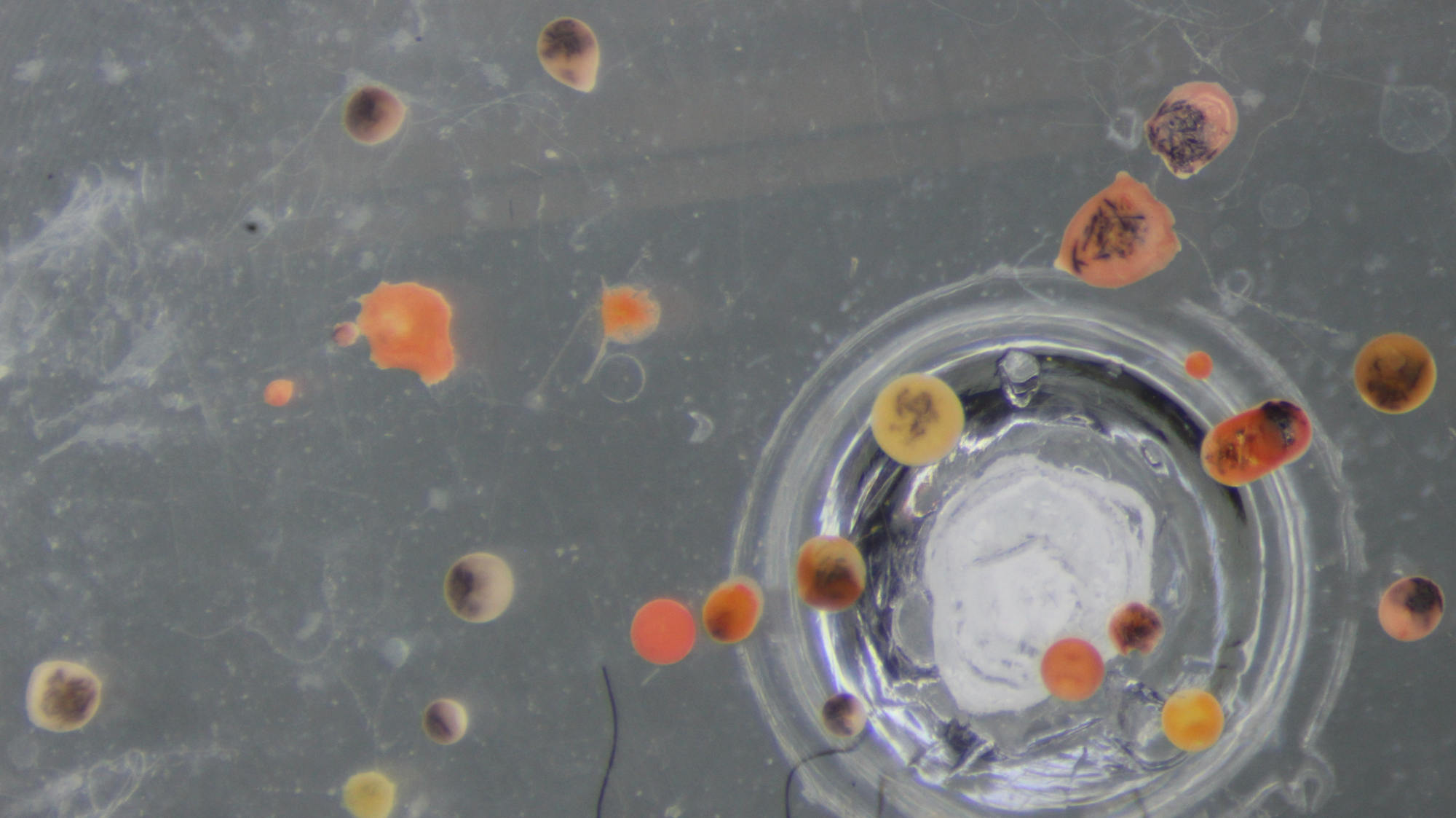
Just another mundane spider update. This batch of babies are now 18 days post-fertilization, and they’re just rockin’ out in their dish.

I also got some good news: I was awarded a small in-house grant to pick up a bunch of supplies for embryo imaging, so that’s in the works. I ordered a few necessities today.

And now everywhere I go on the internet, ads for halocarbon oil pop up everywhere. Or does everyone get those?

[Read more…]