I get email

It’s from another physics and Christianity crank. I wish he’d go bug Paul Davies; I’m a biologist, not a cosmologist.

Atheists are superstitious

1. There is no rational reason to reject the Our Lord Jesus Christ since it is scientifically demonstrated He is Divine and the One and Only True God. Only unscientific minds would reject empirical scientific evidence.

2. The universe is geocentric. Every experiment designed to measure the speed of the earth through space has always returned a speed of zero just as the Bible claimed all along. Only prejudicial minds reject scientific facts. Your leading Pagan cosmology writers offer biases with no scientific proof . Unbeknownst to you is the fact that no one in all history has ever proven that the Earth moves in space. As an honest scientist Lincoln Barnett admits in his book endorsed by Einstein “…nor has any physical experiment ever proved that the Earth actually is in motion.” (Lincoln Barnet, The Universe and Dr. Einstein, p. 73.) Einstein invented his relativity mythology to counter the Michelson-Morley experiments and other innumerable successor experiments demonstrating the earth is immobile in space and at the center of the universe.

“So which is real, the Ptolemaic or the Copernican system? Although it is not uncommon for people to say that Copernicus proved Ptolemy wrong, that is not true. As in the case our normal view versus that of the goldfish, one can use either picture as a model of the universe, for our observations of the heavens can be explained by assuming either the earth or the sun to be at rest.” (The Grand Design, Stephen Hawking and Leonard Mlodinow, 2010, pp. 41-42) Hawking cannot face the empirical scientific evidence that Geocentrism is scientifically proven and heliocentrism disproven. In his bias he ridiculously opts to put the two systems on the same level.

3. That the myth of Copernicanism is the foundation for modern man’s independence from God is a connection that was recognized by the editor of the world’s most prestigious scientific journal. When confronted in the late 1970s with the model of cosmology promoted by the evolutionist well-known physicist George F.R. Ellis – it promoted geocentrism – Paul C. W. Davies, the editor of Nature, was forced to reply: “His new theory seems quite consistent with our astronomical observations, even though it clashes with the thought that we are godless and making it on our own.” (P.C.W. Davies, “Cosmic Heresy?” Nature, 273:336, 1978. In the same article Davies admits: “…as we see only redshifts whichever direction we look in the sky, the only way in which this could be consistent with a gravitational explanation is if the Earth is situated at the center of an inhomogeneous Universe.” Confirming Davies’s agnosticism is a letter he wrote to Dr. Robert Sungenis on Aug. 9th, 2004, stating: “I have long argued against the notion of any sort of God who resides within time, and who preceded the universe.” Davies, however, is honest enough to admit he cannot lightly dismiss Ellis’ science and mathematics that connect the Earth with the center of the universe.

So in addition to being a friend to the Templeton Foundation, a coauthor on the arsenic life paper, and proponent of a bad cancer theory, Davies was, once upon a time, speculating about geocentrism? Somehow I’m not surprised. Here’s the “Cosmic heresy?” paper.

Hey, if Nature can publish kooky weird speculations, who am I to say Jesus ain’t science?

Science you can use!

It’s not to late to sign up to attend the 66th Annual Meeting of the American Physical Society’s Division of Fluid Dynamics meeting, where you can witness this presentation:

Abstract: E9.00003 : Urinal Dynamics

In response to harsh and repeated criticisms from our mothers and several failed relationships with women, we present the splash dynamics of a simulated human male urine stream impacting rigid and free surfaces. Our study aims to reduce undesired splashing that may result from lavatory usage. Experiments are performed at a pressure and flow rate that would be expected from healthy male subjects. (Lapides, J., Fundamentals of Urology, W.B. Saunders, Philadelphia, 1976.) For a rigid surface, the effects of stream breakup and surface impact angle on lateral and vertical droplet ejection distances are measured using high-speed photography and image processing. For free surface impact, the effects of velocity and fluid depth on droplet ejection distances are measured. Guided by our results, techniques for splash reduction are proposed.

Like, aim?

I think I have acquired some insight into the mind of our weird foster cat. She always comes racing into the bathroom when I’m trying to use it, and she peers intently at streams of water and will hop onto the toilet to stare fixedly at the vortex when it flushes. She’s just a wanna-be fluid dynamics physicist!

Sci Culture

Did you fall for this? Science published a paper which claimed that reading literary fiction, you know that stuff that gets taught as highbrow reading material in college literature classes, is objectively better than genre or popular fiction at improving your mind and making you better able to understand other people’s mental states. It was all over the popular news sites.

Language Log shreds the paper wonderfully. It’s a great example of stirring the muck and taking whatever odor wafts out of the mess as a great truth. You might be able to see some obvious flaws just from my brief description: what the heck is “literary fiction”? Isn’t that a contentious division already? How do you recognize it (mostly, I fear, it’s because they’re old books that you’d never pick up to read for pure pleasure)? How did the authors of the study choose it?

As it turns out, the authors hand-picked a few passages from books that they subjectively placed into their categories of literary vs. popular fiction, had subjects read them, gave them a couple of standard tests of theory of mind or empathy, and got a very weak statistical effect. You know, if you shovel garbage at a wall, you can probably find some seemingly non-random distribution of the pattern of banana peels, too.

But it got published in Science, which is dismaying. Unfortunately, here’s where Language Log fails — they infer nefarious commercial intent from it.

The real question here is why Science chose to publish a study with such obvious methodological flaws. And the answer, alas, is that Science is very good at guessing which papers are going to get lots of press; and that, along with concern for their advertising revenues from purveyors of biomedical research equipment and supplies, seems empirically to be the main motivation behind their editorial decisions.

Oh, nonsense. I’m sure that Science is quite careful to keep editorial/review and advertising decisions entirely separate, and if their main concern was peddling expensive biomedical gear, why would they waste space on a simple and flawed paper using cheap psychological techniques? There are trade journals that are much better sources for overpriced gadgetry and reagents.

I’ll also point out that they’ve reversed the situation: Science isn’t good at guessing what papers will appeal to the popular press, the popular press is accustomed to turning to a few journals, like Science and Nature, for finding what the scientific soup d’jour is.

This is not to say that Science or Nature are objective paragons at finding the most important science of the day. To the contrary, both are self-consciously elitist journals, jockeying for position as the premier sources of distilled scientific wisdom. Language Log completely missed the boat: paper decisions at Science are not made to satisfy either the popular press or the scientific supply houses; they are decisions to appeal to the tastes of other scientists, and the financial benefits flow secondarily from that.

There is a Sci Culture, just like there is Pop Culture and High Brow Culture and Redneck Culture. And all of these fragments of a greater whole have their various organs of communication and modes and expectations of behavior, which are all much more complicated than being simply driven by the invisible hand of the market.

That looks like an OK way to dispose of a body

I wouldn’t mind someday having my corpse disposed of by freezing, shattering, and dessicating it prior to composting, but I don’t know that it’s the best way.

The process is simple. Within a week and a half after death, the corpse is frozen to minus 18 degrees Celsius and then submerged in liquid nitrogen. This makes the body very brittle and vibration of a specific amplitude transforms it into an organic powder that is then introduced into a vacuum chamber where the water is evaporated away.

The now dry powder passes through a metal separator where any surgical spare parts and mercury (from old tooth fillings) are removed. The remains are now ready to be laid in a coffin made of corn starch. The organic powder, which is hygienic and odourless, does not decompose when kept dry. The burial takes place in a shallow grave in living soil that turns the coffin and its contents into compost in about 6-12 months’ time. In conjunction with the burial and in accordance with the wishes of the deceased or next of kin, a bush or tree can be planted above the coffin.

Unfortunately, the story is a little too credulous and not quite critical enough. It’s billed as a more eco-friendly method of body disposal than cremation, but I was wondering throughout about how the energy costs of generating and maintaining large amounts of liquid nitrogen, of large scale vibration of specific frequencies, and of pumping out all the water in the fragments would compare to burning. None of that is free, you know; that it’s all out of sight at a distant electrical power generation plant doesn’t mean it has no cost.

There’s also this weird squeamish tone about how one advantage is that you can bypass all that icky rotting business. What’s wrong with decay? The modern funeral business is all about pumping the body with toxic preservatives and burying it in a sealed concrete vault, but it doesn’t have to be that way. Wouldn’t the real eco-friendly way of death be to drop bodies where condors or sharks could eat them?

I think I’d rather my meat were used to feed the sharks, and especially the hagfish and deep sea bacteria. Fling my corpse out of a boat over a deep trench, let me drift down getting nibbled and shredded as I go, and let my bones rest artfully on the sea floor, feeding crustaceans and fish and all that wonderful oceanic diversity. That seems like the least harmful way to dispose of this mortal frame.

It’s Ada Lovelace Day!

Buy the T-shirt!

Buy the T-shirt!

You’re supposed to celebrate the achievements of women in science, technology, engineering and math today. Some of you women out there will be doing science today, some of you will read about it, and some of you will be doing like I’m doing: teaching it to women (and men!). At the very least, try to tell a girl that she can grow up to be anything she wants — and that includes being a mathematician, an engineer, or a scientist.

Sean B. Carroll talking to atheists

This morning, in 45 minutes, I’ll be tuning in to AM950 to listen to Sean B. Carroll on Atheists Talk radio. He’s going to be talking about his new book, Brave Genius: A Scientist, a Philosopher, and Their Daring Adventures from the French Resistance to the Nobel Prize, the story of Jacques Monod and Albert Camus. Bringing the Two Cultures together!

One cat, finally in repose

I’ve tried. This busy little cat we’re fostering simply will not sit still for a good photograph. This week we tried torture: she was sent off to the vet for a day where they applied needles and knives to her, injecting her with vaccines and doing tests and snipping various organs. I was sure she’d come home worn out and sore and tired, but no — she’s running around the place, jumping on me, chasing dust bunnies as if she hadn’t had her belly sliced open and both forelegs shaved for the various needles she was stuck with. This was getting ridiculous.

Then, moments ago, she found a good book and curled up with it. Unbelievable.

ivy_relaxes

She’s a developmental biologist. Either that or she’s a Wolpert fan.

I’m thinking of trying the ultimate test, and leaving out a copy of The Happy Atheist. All cats are godless, right?

You want her? Contact the Stevens Community Humane Society. Tell them you want to save Ivy. I’ll even throw in a developmental biology textbook to sweeten the deal. I wouldn’t want her to get bored.

microRNAs and cancer

I’m trying to raise money for the The Leukemia & Lymphoma Society, and I promised to do a few things if we reached certain goals. I said I’d write a post microRNAs and cancer if you raised $7500. And you did, so I did. I kept my clothes on this time, though, so here’s a more serious picture of yours truly: this is what my students see, which is slightly less terrifying, nicht wahr?

seriously

If you want more, go to my Light the Night fundraising page and throw money at it. If we reach our goal of $10,000, I’ll organize a Google+ Hangout to talk about cancer. Note that we’re also getting matching funds from the Todd Stiefel Foundation, so join in, it’s a good deal.

It’s all epigenetics. Now I’ve gone and done it: I’ve used the “e” word, epigenetics. Nothing seems to fire off well-meaning misconceptions from otherwise sensible pro-science folks than epigenetics — it’s a major new revolution in evolution! It changes everything! It’s a way to get inheritance of acquired characteristics!

Nope.

Epigenetics is routine and has been taken for granted by cell biologists for at least 6 decades. It is simply a principle of gene regulation — switching genes off and on — that persists over multiple cell generations. You aren’t surprised that when liver cells divide, they produce more liver cells, are you? They’ve simply inherited transcription factors and patterns of modification of DNA from their parent cell that restricts their cell fates. There are also patterns of gene expression induced in gametes within parents that modulate initial patterns of gene expression in the fertilized zygote — that is, the state of the parental cells affects the state of the embryo’s cells — which is exactly what you’d expect.

What seems to set people off is that it is an effect of the environment on the state of the genome, and there is this bizarre bias floating around that that can’t happen. Of course it can! Every summer when you get a tan, every winter when you put on another five pounds, every time stress at work makes you prone to get sick…those are environmental factors influencing your biology.

In previous installments of this series, I told you about oncogenes, genes that when over-expressed or over-active switch on cellular processes (like proliferation) that promote cancer, and tumor suppressor genes, which protect against cancer, and which in cancers, are often found to be inactivated or down-regulated. Over-expressed? Down-regulated? That sounds like the sorts of things epigenetic changes can do.

transcription-translation

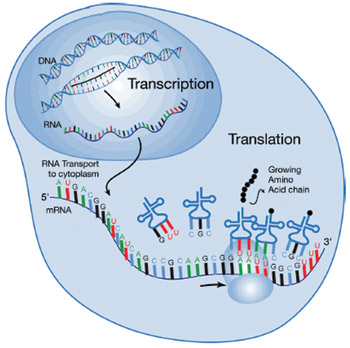
Further, here’s an interesting observation. Everyone knows the standard pathway: genes in DNA are transcribed into RNA which is then translated into protein. One might naively imagine, then, that the amount of RNA produced would be roughly correlated with the amount of protein produced. It’s not. In analyses of cancers, only 20% of the mRNAs involved showed any correlation between the quantity of mRNA and the quantity of protein — there is something else that is modulating either the amount of translation or the turnover of proteins in the cell, and the fact that 80% of the genes playing a role in cancer show such variation tells us that these kinds of regulatory effects are important.

There must be something stepping in and interfering somewhere between transcription of the gene into messenger RNA, and translation of messenger RNA into protein. One of the somethings is microRNA.

These are tiny little snippets of RNA, typically 22 nucleotides long, that have complementary sequences to their target gene mRNA — they bind to matching RNAs and inhibit translation. Thousands of these microRNAs have been discovered in the last few years, and they’ve also been found to play important roles in regulating gene expression in blood cell lineages, brain activity, insulin secretion, and fat cell development…and in cancer.

As you might guess from the previous articles in this series, there are obvious ways microRNAs could promote cancers. A microRNA that blocks tumor suppressor genes from being expressed could be modified to be produced at a higher level, or a microRNA that would hamper an oncogene’s activity could be mutated to be unable to recognize its target. Easy! Simple! Well, except that this is biology, and nothing is simple in biology (trust me, if you don’t enjoy problems blowing up in your face and getting harder and harder, don’t become a biologist.)

One reason this is complicated is that there are so many details to be worked out — swarms of microRNAs are involved, we don’t know the majority of them, and we don’t know what we’ll learn as we discover more. As Weinberg says,

…the discovery of hundreds of distinct regulatory microRNAs has already led to profound changes in our under- standing of the genetic control mechanisms that operate in health and disease. By now dozens of microRNAs have been implicated in various tumor phenotypes, and yet these only scratch the surface of the real complexity, as the functions of hundreds of microRNAs known to be present in our cells and altered in expression in different forms of cancer remain total mysteries. Here again, we are unclear as to whether future progress will cause fundamental shifts in our understanding of the pathogenetic mechanisms of cancer or only add detail to the elaborate regulatory circuits that have already been mapped out.

But also, we’ve learned that it’s not simply a matter of a few short bits of RNA getting transcribed and dumped into the cytoplasm — there is a whole elaborate cellular apparatus dedicated to microRNA processing. Behold!

oncomirs

Don’t panic, I’ll hold your hand and we’ll walk through it. miRNA genes are first transcribed into RNA by RNA polymerase II; notice that the transcript, which is called a pri-miRNA (or primary microRNA) contains some long stretches of internal complementarity, and that the RNA folds into a hairpin loop. This RNA is grabbed by an RNA binding protein, Pasha, and an RNA cutting enzyme, Drosha, which snips off some excess bits to produce a smaller stem-loop structure about 70 nucleotides long, which is partially double stranded RNA. It also gets a new name: Pre-miRNA. Pre-miRNA is then exported out of the nucleus and into the cytoplasm by a channel protein, Exportin-5.

Once in the cytoplasm, another RNA cutting enzyme, aptly named Dicer, snips off a few more bits to reduce it to two very roughly complementary RNA strands, now called the miRNA:miRNA* duplex. One of these strands is then loaded into a set of proteins to form the miRNA-associated multiprotein RNA-induced silencing complex, thankfully called miRISC for short.

The short, 22-nucleotide long strand of RNA in the miRISC is what gives it specificity — the miRISC proteins carry it along as a template to match against messenger RNAs they encounter. If the miRNA makes a perfect match to some unfortunate strand of messenger RNA, the miRISC cuts up the mRNA to destroy it. If it’s an imperfect match over just some significant fraction of the 22-nucleotide sequence, it it just locks up the RNA and represses its translation.

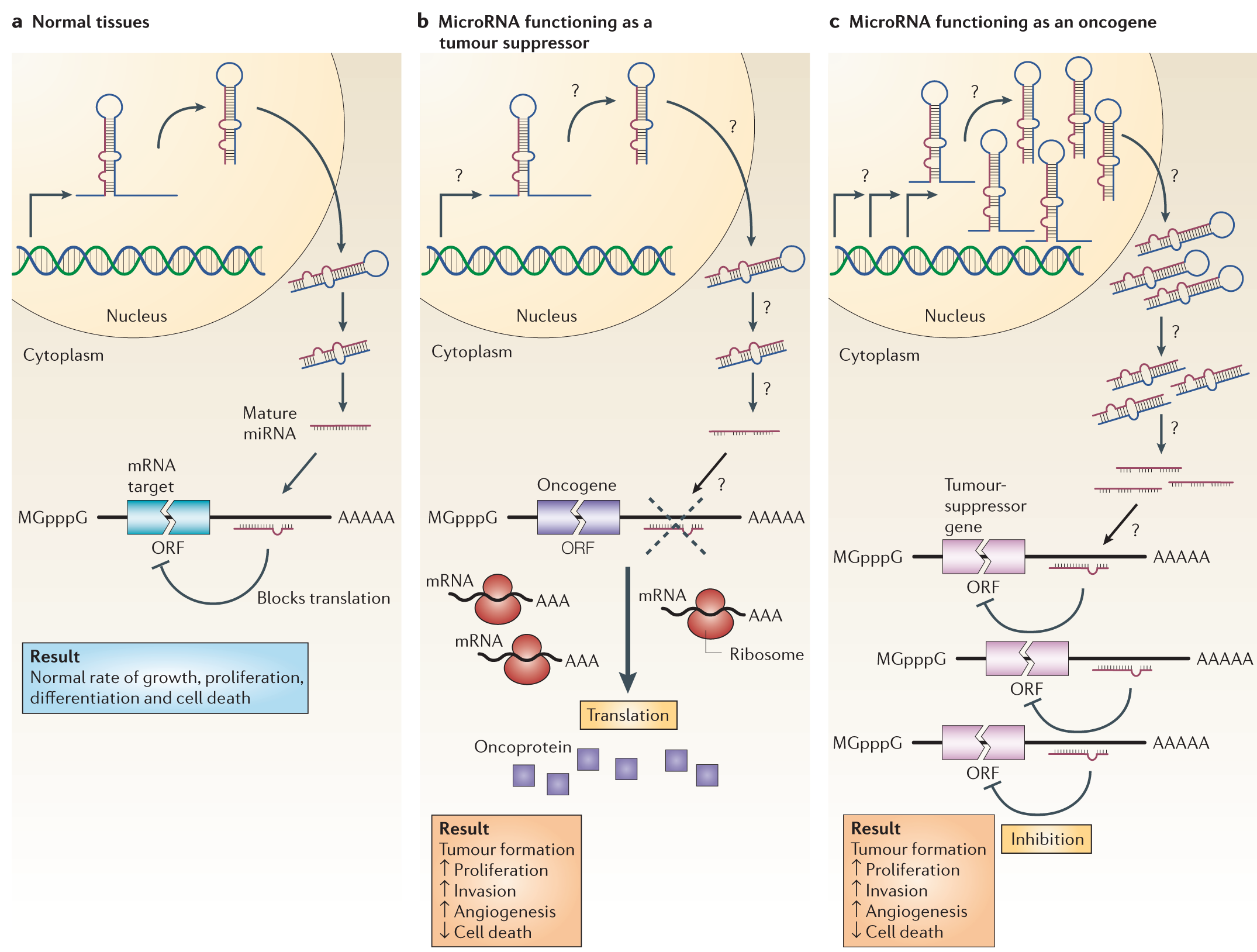
The way these can affect cancer is illustrated below. If a microRNA that inhibits an oncogene is mutated (b), that oncogene will increase the amount of protein produced from the available RNA; the oncogene could even be normal in sequence and function, and just the boost in its signal could contribute to tumorigenesis. Alternatively, a mutation in a microRNA gene that affects a tumor suppressor could amplify its production (c), producing a greater inhibition of a healthy gene that acts to prevent tumorigenesis.

MicroRNAs can function as tumour suppressors and oncogenes. a | In normal tissues, proper microRNA (miRNA) transcription, processing and binding to complementary sequences on the target mRNA results in the repression of target-gene expression through a block in protein translation or altered mRNA stability (not shown). The overall result is normal rates of cellular growth, proliferation, differentiation and cell death. b | The reduction or deletion of a miRNA that functions as a tumour suppressor leads to tumour formation. A reduction in or elimination of mature miRNA levels can occur because of defects at any stage of miRNA biogenesis (indicated by question marks) and ultimately leads to the inappropriate expression of the miRNA-target oncoprotein (purple squares). The overall outcome might involve increased proliferation, invasiveness or angiogenesis, decreased levels of apoptosis, or undifferentiated or de-differentiated tissue, ultimately leading to tumour formation. c | The amplification or overexpression of a miRNA that has an oncogenic role would also result in tumour formation. In this situation, increased amounts of a miRNA, which might be produced at inappropriate times or in the wrong tissues, would eliminate the expression of a miRNA-target tumour-suppressor gene (pink) and lead to cancer progression. Increased levels of mature miRNA might occur because of amplification of the miRNA gene, a constitutively active promoter, increased efficiency in miRNA processing or increased stability of the miRNA (indicated by question marks). ORF, open reading frame.


MicroRNAs can function as tumour suppressors and oncogenes. a | In normal tissues, proper microRNA (miRNA) transcription, processing and binding to complementary sequences on the target mRNA results in the repression of target-gene expression through a block in protein translation or altered mRNA stability (not shown). The overall result is normal rates of cellular growth, proliferation, differentiation and cell death. b | The reduction or deletion of a miRNA that functions as a tumour suppressor leads to tumour formation. A reduction in or elimination of mature miRNA levels can occur because of defects at any stage of miRNA biogenesis (indicated by question marks) and ultimately leads to the inappropriate expression of the miRNA-target oncoprotein (purple squares). The overall outcome might involve increased proliferation, invasiveness or angiogenesis, decreased levels of apoptosis, or undifferentiated or de-differentiated tissue, ultimately leading to tumour formation. c | The amplification or overexpression of a miRNA that has an oncogenic role would also result in tumour formation. In this situation, increased amounts of a miRNA, which might be produced at inappropriate times or in the wrong tissues, would eliminate the expression of a miRNA-target tumour-suppressor gene (pink) and lead to cancer progression. Increased levels of mature miRNA might occur because of amplification of the miRNA gene, a constitutively active promoter, increased efficiency in miRNA processing or increased stability of the miRNA (indicated by question marks). ORF, open reading frame.

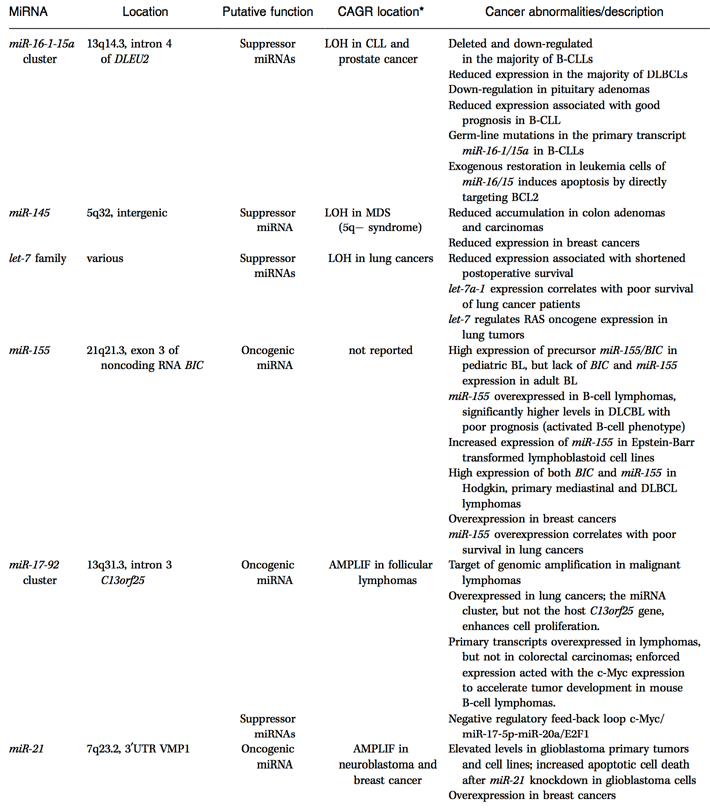
This is not simply a hypothetical possibility, either. Dozens of miRNA genes have been implicated in human cancers — they show abnormal variations in expression in specific cancers and also have known oncogene/tumor suppressor targets.

miCancer

These microRNAs are a relatively new scientific phenomenon — they weren’t even a blip on the radar when I was a graduate student, and when I did start hearing about them in the 1990s, they were thought of as a weird mechanism found in highly derived nematodes. Now we’re seeing them everywhere, and beginning to recognize their importance in controlling all kinds of genes. The process of developing tools to control miRNAs is underway in the laboratory, but it has a long way to go before we have effective clinical tools to combat cancer with miRNAs or antagonists to miRNAs. At the very least, it’ll be another tool we can use.


Calin GA, Croce CM (2006) MicroRNA-cancer connection: the beginning of a new tale. Cancer Res. 66(15):7390-4.

Esquela-Kerscher A, Slack FJ (2006) Oncomirs – microRNAs with a role in cancer. Nat Rev Cancer 6(4):259-69.

Hanahan D, Weinberg RA (2011) Hallmarks of cancer: the next generation. Cell 144(5):646-74.