Kraken man is back

He’s persistent, I’ll say that for him. I first encountered Mark McMenamin as an enthusiastic promoter of Stuart Pivar’s inflatable donut model of development. He then sank from sight, along with the pretentious septic tank salesmen, until two years ago, when he presented piles of ichthyosaur vertebrae as evidence that a giant cephalopod, a kraken, had been creating Mesozoic art by arranging the disks into a self portrait.

You may laugh now.

He presented at the Denver GSA meeting this year. Here’s his abstract.

THE KRAKEN’S BACK: NEW EVIDENCE REGARDING POSSIBLE CEPHALOPOD ARRANGEMENT OF ICHTHYOSAUR SKELETONS

MCMENAMIN, Mark A.S. and SCHULTE MCMENAMIN, Dianna L., Geology and Geography, Mount Holyoke College, South Hadley, MA 01075

In 2011, we hypothesized that extremely large Triassic cephalopods may be responsible for certain anomalous aspects of an unusual assemblage of giant ichthyosaur skeletons in the Luning Formation of Nevada. The hypothesis has been criticized by researchers who do not accept the ichnological evidence suggesting that the skeletons were deliberately arranged rather than being deposited by currents.

Hydrodynamic considerations regarding the probability of displacement (PD) of ichthyosaur vertebral centra arrays (n=12) show that three different biserial arrangements have PDs of 17%, 89% and 100% respectively by currents strong enough to displace a single centra. The critical Specimen U array at Berlin‑Ichthyosaur State Park has PD=~100, indicating that it is highly unlikely that the biserial pattern was imparted by submarine currents. The unwinnowed wackestone matrix confirms that competent water velocities did not frequently occur in this deep-water depositional environment. The Luning Formation also hosts Protopaleodictyon ichnosp. and supergiant amphipods.

We recently obtained photographs of a retired exhibit formerly on display at the University of Nevada, Las Vegas, Museum of Natural History. The display reconstructed a well‑preserved Shonisaurus skeleton as it was found in the field. The exhibit is well documented by photographs from a variety of vantage points. The skeleton appears to have been partly disassembled during the Triassic, and a biserial array of centra very similar to the Specimen U array occurs adjacent to the nearly complete skeleton. The UNLV array has a PD=~100, again indicating that the biserial pattern was not the result of current assembly. Finally, at least three of these centra show what may be triangular bite marks removed from their margins.

His latest evidence consists of a second array of vertebrae in a line (that’s right, his earlier remarkable claim was based on a single example of bones in a line), and he is also claiming that a non-random arrangement of the bones can only be explained by an intelligent cephalopod, with no other natural processes possible.

Furthermore, as the Huffington Post credulously (their only mode) reports, he has additional evidence in the form of a giant fossilized beak. Here it is:

krakenbeak

It’s a fragmented, unidentified chunk of rock, a few inches long, which he extrapolates by comparison to a Humboldt squid beak he bought on eBay to be the tip of a giant beak belonging to a squid that was between 50 and 100 meters long.

That’s it. When ichthyosaurs decay, their vertebrae tend to fall in a line, and here’s a broken rock that kinda vaguely looks like a bit of a beak, and from this he builds this elaborate fantasy of a giant kraken roaming Triassic seas crushing ichthyosaurs to death and then sculpting their bones into squid pictures.

He should go back to praising balloon animals.


Whoops. I neglected to mention another indictment of his rationality: McMenamin is a “devout Christian” who also believes in Intelligent Design creationism.

My name is Mark McMenamin. I have completed a PhD on the fossils of the Cambrian Explosion, have published several books on the subject, and am a devout Christian. At the present time I am actively researching the latest fossil discoveries from Cambrian boundary strata.

Friday Cephalopod: A festive way to display your cuttlefish babies

The Monterey Bay Aquarium has a clever scheme for aerating their babies that involves a little creative surgery on pop bottles. It looks good, though!

bubblingcuttlefish

I’m tempted to try something similar with zebrafish, just because. I don’t have a problem with keeping them supplied with oxygen, but I do have to maintain good concentrations of food available…and this would hinder more than it would help. But it’s the coolness of it!

If you can’t get rid of garbage, worship it

Every time you use a plastic bag at the grocery store or buy another bottle of water you are contributing to the deluge of one-use, throw-away plastic products that pile up in our landfills or float out to sea. One group in Baton Rouge is trying to raise consciousness with Sacred Waste, a performance art piece that illustrates the problem.

This performance art show is a unique blend of art and science – it conveys some of its information in some unusual and compelling ways: the costumes, the set, and all the props are made of discarded plastic – each costume is made of 100-300 plastic bags, one costume is made of about 300 plastic bottle caps, there’s a dragon made of about 3000 bags, and a tree made of plastic – yet we’re reminded that all the plastic on stage during the show only represents the amount of plastic Americans discard about every 100 milliseconds. One scene in the show personifies the Great Pacific Garbage Patch in a whirling dance…one scene involves a shaman ecstatically scrawling the structures of polyethylene, polypropylene, and polystyrene on a plastic screen…one scene depicts the flow of plastic through a bird’s body. Each scene in the show explores a different aspect of our relationship with plastic and mixes science with mysticism, animal instincts with consumerism, creation myths with post-apocalyptic evolution and the “new nature”. If we taught more science this way (just a little more of it, certainly not all of it) – we might change a lot of people’s attitude toward science, in the way that this whole show hopefully also changes its audience’s attitudes toward plastic.

They have a kickstarter to play at the New Orleans Fringe Festival. They aren’t asking much, but a little donation would be very encouraging.

Oh, and try to stop buying stuff in disposable plastic packaging, too.

I should have Cthulhu teach my classes

Now you too can grasp the great Lovecraftian insights into biology. They’re pretty simple: you’re going to die, and the universe doesn’t care.

By the way, the article is from the makers of Call of Cthulhu: The Wasted Land, which happens to be one of only three games that I have on my iPad. It’s grim and bloody and horrible, and I’ve made it through every level except the last one, where the Leng Spiders and Cthulhoids turn my team into a rotting smear of decaying jellied flesh. Which seems fitting.

Mary’s Monday Metazoan: a venomous crustacean

I had no idea such things existed, but behold the remipede:

remipede

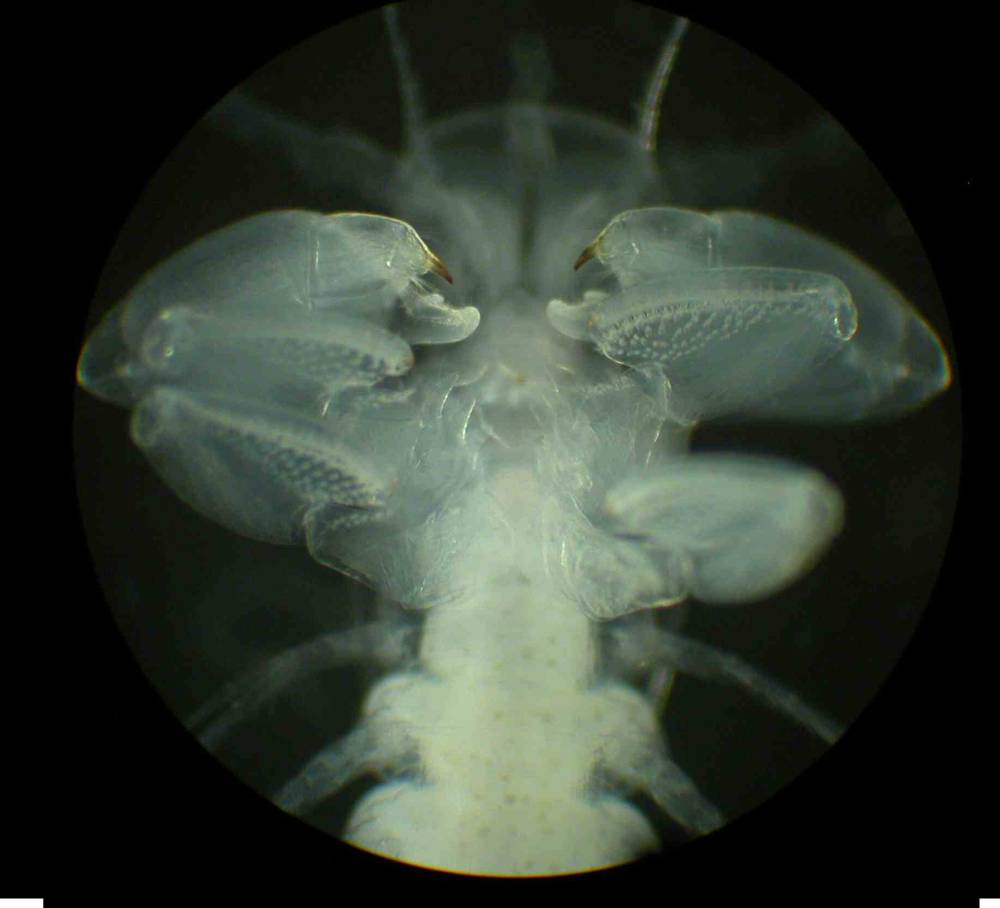
Yes, it’s a crustacean, although it doesn’t look like any I’ve seen before. You’re not likely to run into them casually; they’re found deep in Central American caves, with one species found in the Canary Islands and another in Western Australia. Besides being weird-looking critters, they’re also the only known venomous crustacean. Take a look at that clawed face!

remipede_close

There are no known instances of humans being bitten by one of these things — they aren’t exactly living underfoot. They have big sacs inside those front claws that contain a cocktail of proteases, chitinases, and a neurotoxin.

remipede_venom_sacs

They poison their prey with an injection of a poisonous mixture that simultaneously paralyzes or kills them, and reduces their guts to a slurry that can be sucked out.

This toxin is represented by two distinct contigs that have the conserved cysteine pattern characteristic of β/δ agatoxins with virtually identical spacing [C-x(6)-C-x(6)-C-C-x(4)-C-x-C-x(6)-C-x-C] (Figure 5). β/δ agatoxins are a recently described type of spider venom neurotoxin (Billen et al. 2010), which causes pre-synaptic voltage-gated sodium channels to open at resting membrane potentials in insects. The resulting neurotransmitter release generates a stream of action potentials in motorneurons, resulting in irreversible spastic paralysis of the victim.

Charming!


von Reumont BM, Blanke A, Richter S, Alvarez F, Bleidorn C, Jenner RA. (2013) The first venomous crustacean revealed by transcriptomics and functional morphology: remipede venom glands express a unique toxin cocktail dominated by enzymes and a neurotoxin. Mol Biol Evol. 2013 Oct 16. [Epub ahead of print]

What I’d be telling my kids nowadays

I’m one of those people who is hopelessly addicted to babbling on the internet, and even I don’t understand this statistic.

the leading cause of death for teenage drivers is now texting, not drinking, with nearly a dozen teens dying each day in a texting-related car crash.

You cannot type and drive, or read and drive, at the same time. It’s really that simple. So why are people trying?

Leeuwenhoek is drooling in his grave

Ooh, ick, I guess that’s a really disgusting zombie image. But anyway, look at this: a cheap and easy DIY photomicrography setup.

Back in the day, I once built a homely kludge consisting of our very expensive microscope, a nice 35mm SLR, and a bit of cardboard and duct tape to hold it exactly the right distance from the eyepieces that did sort of the same thing. And then we had a lab in cell biology at the start of the semester in which students looked at a variety of cell types and were asked to draw them…and all over the room students were just whipping out their cell phones, aiming them down the eyepieces, and taking photos instead.

Maybe we’re getting to the point where we can save the department a whole lot of money on those low-end student scopes and instead build a bunch of these little frames and ask our students to bring their cell phones to lab.