Eyes in the sea

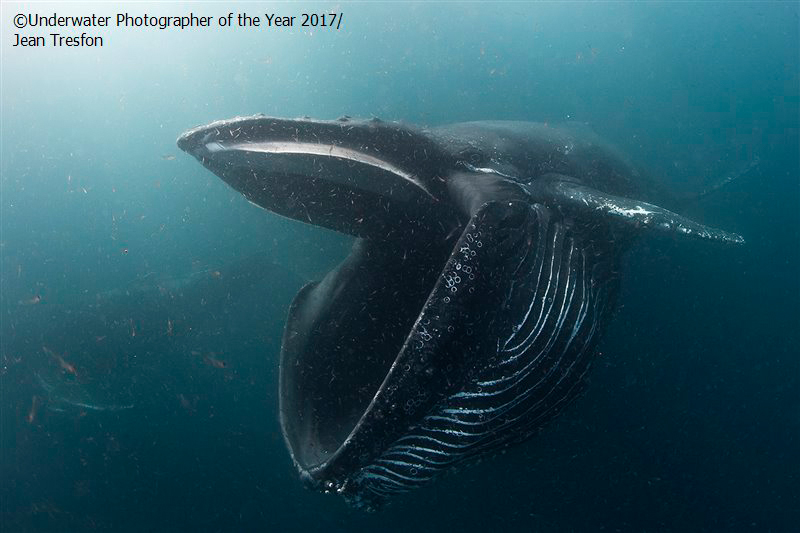
I was informed that a panel of judges had selected the top underwater photos for 2017, and the grand winner was a photo of an octopus — so clicked over and looked. I was a little disappointed, since I’d already used that photo before…as well as a couple of others. I guess that means I must have good taste and a good eye to spot quality images before they win awards, right? But maybe it’s just that they’re all fantastically beautiful, as any fool can see.

So go browse all the candidate photos — they’ve all also got a short summary of how the picture was taken, and judges’ comments. You’ll find that whales are popular subjects, as are closeups of fish, and shots of underwater wrecks.

Fabrice Guerin
Fabrice Guerin

Jean Trestin

Jean Trestin

The Southwest is going dry

A great story from Rebecca Solnit: the huge dams that were erected in the 1950s are failing. Not in a catastrophic sense, but in the sense that the water is going away, leaving them useless, due to a combination of aggressive consumption by humans (Las Vegas and Phoenix are going to face huge problems) and climate change — less rainfall, more evaporation. It’s not entirely a bad thing.

When the Sierra Club pronounced Glen Canyon dead in 1963, the organization’s leaders expected it to stay dead under Lake Powell. But this old world is re-emerging, and its fate is being debated again. The future we foresee is often not the one we get, and Lake Powell is shriveling, thanks to more water consumption and less water supply than anyone anticipated. Beneath it lies not just canyons but spires, crests, labyrinths of sandstone, Anasazi ruins, petroglyphs, and burial sites, an intricate complexity hidden by water, depth lost in surface. The uninvited guest, the unanticipated disaster, reducing rainfall and snowmelt and increasing drought and evaporation in the Southwest, is climate change.

So at the same time that Florida and all those coastal cities face inundation, the desert boom is going to die the slow death of dehydration. Don’t imagine that you’re living someplace where nothing will change, though; it’s going to hit us all.

The idea is that climate change doesn’t merely increase the overall likelihood of heat waves, say, or the volume of rainfall — it also changes the flow of weather itself. By altering massive planet-scale air patterns like the jet stream, which flows in waves from west to east in the Northern Hemisphere, a warming planet causes our weather to become more stuck in place. This means that a given weather pattern, whatever it may be, may persist for longer, thus driving extreme droughts, heat waves, downpours and more.

I wonder what the economic cost of shutting down the golf courses of Scottsdale and the fountains at the Bellagio might be? And then of course there are the unpredictable disruptive effects as millions of people living in a place temporarily made habitable by futile exercises in short-term hydroengineering find themselves having to migrate elsewhere.

Don’t come to Minnesota! We’re probably going to experience an arctic vortex now and then and plunge into the deep freeze for a month at a time, alternating with winters that barely happened (like this recent one), and overall we’re going to turn into Kansas North.

The University of Louisiana at Monroe has some interesting priorities

They’re shutting down a museum collection to make room for a larger gym for the track team. Here’s a letter sent out by involved faculty.

Dear Friends,

It is my sad duty to report to you that the ULM administration has decided to divest the research collections in the Museum of Natural History. This includes the 6 million fish specimens in the Neil Douglas fish collection and the nearly 500,000 plant specimens in the R. Dale Thomas plant collection. They find no value in the collections and no value of the collections to the university. The College was given 48 hours to suggest an alternate location for the collections on campus so that Brown Stadium can be renovated for the track team. With only about 20 hours left, we have found no magic solution yet. To add insult to injury on what was a very hard day, we were told that if the collections are not donated to other institutions, the collections will be destroyed at the end of July.

While we weep that our own institution would turn its back on 50+ years of hard work and dedication, we will not abandon the collections to the dumpsters. They did not have the courage to inform us face-to-face, but we have the courage to persevere through these dark times.

Oh, in other sad news, we were informed that there will not be any expansion of the public displays in Hanna Hall.

Do they even realize that a museum collection is an irreplaceable historical resource? Once it’s gone, there’s no way to decide to restore it at a later date, when funds become available. But they have short-sightedly decided that an academic treasure ought to be cavalierly discarded to benefit university sports.

Another problem mentioned at the link is that Louisiana has cut support to the university by 50%. It seems to me, though, that if you’re starving you pare away the non-essentials first, rather than critical resources. I guess ULM thinks their natural history museum is expendable, while their track team is not.

The confusing world of nutrition

Fats? Carbohydrates? Protein? It’s hard to tell what I’m supposed to eat anymore, because the recommendations seem to change every few years. Jerome Groopman does an excellent job of reconciling the confusion…or, at least, politely explaining that none of the answers are definitive, yet.

Science is an accretion of provisional certainties. Current research includes much that is genuinely promising—several groups have identified genes that predispose some people to obesity, and are studying how targeted diets and exercise can attenuate these effects—but the more one pays attention to the latest news from the labs the harder it becomes to separate signal from noise. Amid the constant back-and-forth of various hypotheses, orthodoxies, and fads, it’s more important to pay attention to the gradual advances, such as our understanding of calories and vitamins or the consensus among studies showing that trans fats exacerbate cardiovascular disease. What this means for most of us is that common sense should prevail. Eat and exercise in moderation; maintain a diet consisting of balanced amounts of protein, fat, and carbohydrates; make sure you get plenty of fruit and vegetables. And enjoy an occasional slice of chocolate cake.

I would add, though, that there won’t necessarily ever be an answer. Your physiological response to food is a product of your genetics, your fetal environment, your early childhood exposure, and your overall nutritional history, which means that everyone will have a unique set of needs and reactions. But moderation and a balanced diet sounds like a safe approach — just pay attention to what your body is telling you. If you feel dizzy and hyper and experience stomach distress when you eat that slice of chocolate cake, stop eating it.

Aaaaaargh.

A Republican, Scott Wagner. Running for governor of Pennsylvania. Has some novel explanations for climate change.

I haven’t been in a science class in a long time, but the earth moves closer to the sun every year–you know the rotation of the earth, Wagner said. We’re moving closer to the sun.

But…but…but the Earth is moving around the sun in an elliptical orbit — its distance from the sun varies over the course of a year (and seasons are a product not of that, but of the axial tilt). What does the rotation of the earth have to do with its orbit around the sun?

He hasn’t been in science class in a long time, and I suspect he didn’t understand it even when he was taking classes.

We have more people, he said. You know, humans have warm bodies. So is heat coming off? Things are changing, but I think we are, as a society, doing the best we can.

Yes, heat is coming off, but it’s not enough to affect global temperature.

If he really believes that, is he one of those rare conservative Republicans who is going to endorse birth control and family planning to prevent climate change? That would be nice, but for some reason I’d rather this klutzamaboob did not get elected.

I guess science is going to pay for that wall

When your president is an idiot on a quixotic mission to build a pointless, stupid wall between us and one of our allies, the money has got to come from somewhere. And when the Republicans in general are elected by the ignorant to go on a crusade to destroy the government and promote even more ignorance, there’s an easy target: take the money away from science.

Look at what Trump has announced that he’s going to do to science funding.

President Donald Trump, who had just proposed slashing the National Institutes of Health’s budget for next year by 20 percent, suggested an immediate $1.2 billion cut to the agency Tuesday.

It’s hard to get an NIH grant now, and it’s going to get worse. This is also the kind of cut that does long term damage, since established researchers tend to get supported first; I wouldn’t want to be a new investigator right now. There are also other deep cuts all over the place.

  • Take $350 million from the National Science Foundation’s $6.9 billion budget
  • Cut $37 million from the Department of Energy’s $5.3 billion worth of science programs
  • Excise $48 million from the Environmental Protection Agency’s research and development budget of $483 million
  • Cut in half the $101 million Teen Pregnancy Prevention program
  • Reduce Food and Drug Administration staff spending by $40 million
  • Cut domestic and global HIV/AIDS programs by $100 million plus cut the Presidential Emergency Program for AIDS Relief (PEPFAR) $4.3 billion budget by $242 million
  • Completely delete the $72 million Global Health Security fund at the State Department and cut other global health programs by $90 million and $62 million for global family planning

More evidence that this administration wants to outright kill American science: putting Lamar Smith as head of the science committee in congress, and — this is the most ridiculously petty thing — dictating what words bureaucrats are allowed to use.

A supervisor at the Energy Department’s international climate office told staff this week not to use the phrases “climate change,” “emissions reduction” or “Paris Agreement” in written memos, briefings or other written communication, sources have told POLITICO.

One subdivision of the Energy Department is the Office of International Climate and Clean Energy. Boy are they gonna get a shock when they discover that even the name of their office has become anathema. It’s also going to be magical — the climate won’t change if you’re not allowed to say “climate change”!