At least, that’s the message I take away from this video about the evolution of turtles.
OK, OK, it turns out they’re both complementary sources of information. And you also need genomics.

At least, that’s the message I take away from this video about the evolution of turtles.
OK, OK, it turns out they’re both complementary sources of information. And you also need genomics.

Larry Moran summarizes some criticisms of evolutionary psychology. He even cites philosophers who recognize the deep flaws in the field! But then, as a coup de grâce, he carries out the most damaging criticism of all: he quotes an evolutionary psychologist. Dang. That’s low.
Even more cruelly, he quotes the ridiculous Gad Saad, a professor of marketing who has made a career out of peddling poor interpretations of evolution designed to pander to MRAs and other frauds. Saad was asked to provide a list of notable achievements by evolutionary psychology, and he obliged.
- Women alter their preferences for the facial features of men as a function of where they are in their menstrual cycles. When maximally fertile, they prefer men possessing markers of high testosterone.
- Babies display an immediate instinctual preference for symmetric faces (at an age that precedes the capacity for socialization).
- Children who suffer from congenital adrenal hyperplasia display a reversal in their toy preferences. Furthermore, using inter-species comparisons, vervet monkeys display the same sex-specific patterns of play/toy preferences as human infants. This suggests that contrary to the argument made by social constructivists, play has an evolved biological basis.
- Individuals who score high on an empathy scale are more likely to succumb to the contagion effects of yawning. This is indicative that this particular contagion might be linked to mimicry and/or Theory of Mind.
- How provocatively a woman dresses is highly correlated to her menstrual cycle (a form of sexual signaling found across countless Mammalian species).
- Culinary traditions are adaptations to local niches. For example, the extent to which a culture utilizes meat versus vegetables, spices, or salt is a cultural adaptation (this is what behavioral ecologists study).
- Maternal grandmothers and paternal grandfathers invest the most and the least respectively in their grandchildren. Whereas all four grandparents have a genetic relatedness coefficient of 0.25 with their grandchildren, they do not all carry the same level of “parental uncertainty.” In the case of maternal grandmothers, there is no uncertainty whereas in the case of the paternal grandfather, there are two sources of uncertainty. This last fact drives the differential pattern of investment in the grandchildren.
- Good male dancers are symmetric (paper published in Nature). One would expect that some behavioral traits might correlate with phenotypic quality as honest signals of an individual’s desirability on the mating market.
- Self-preference for perfumes is linked to one’s immunogenetic profile (Major Histocompatibility Complex).
- When a baby is born, most family members (especially those of the mother) are likely to state that the baby looks like the father. This phenomenon is found in countless cultures despite the fact that it is objectively impossible to make such a claim of resemblance. The reason for this universally found cultural tradition lies in the need to assuage the fears of paternity uncertainty.
- Environmental stressors (e.g., father absence) and the onset of menarche (first menses) have been shown to be highly linked. In numerous species, the likelihood of a female becoming reproductively viable is affected by environmental contingencies.
- Women are less receptive to mandatory hospital DNA paternity testing (for obvious reasons). In other words, their willingness to adopt a new product/service is fully driven by an evolutionary-based calculus.
- Women can smell the most symmetric men. In other words, women have the capacity to identify men who possess the best phenotypic quality simply via their nose. This is what I have referred to as sensorial convergence.
- Using fMRI, the exposure to ecologically-relevant stimuli (e.g., beautiful faces) yields distinct neural activation patterns in men and women.
- In choosing a mate, humans tend to prefer the smell of others that are maximally dissimilar to them along the MHC. This ensures that offspring possess a greater “defensive coverage” in terms of their immunological system.
That’s a curious mix of dubious pop psychology, random correlations, non-universal cultural biases, and unjustified assumptions that certain behaviors have a genetic, as opposed to psychological, basis. For example, you don’t need a gene for assuming that infidelity exists…you can know how conception works and figure out that women can get pregnant by men who are not their socially defined partner, which may be why there is a certain level of distrust of paternity claims.
There’s also a total inability to recognize that physiological properties are not always adaptive consequences. For instance, evolutionary psychologists seem to be obsessed with ascribing deep evolutionary causes to fluctuations in behavior associated with menstruation. I can certainly believe in hormonally-driven variation in personality and behavior — that’s unexceptional and ordinary — but to then argue that small day-to-day differences in behavior have all been driven by a necessarily intense selection pressure is absurd panadaptationism.
You might also expect a Professor of Marketing to realize that a culture saturated with commercial marketing of stereotypical sexual imagery might develop abnormal response patterns — we are bathed in messaging that is conditioning us to advertisers’ influence, and may not have anything at all to do with our evolutionary history. There’s a circularity to it all. Marketing is all about shaping our preferences in particular directions, and then you get EP marketing professors trying to persuade us that they have no influence at all, they’re just discerning the deep patterns evolution has burned into our brains, so that they can be better able to influence us to buy their cologne and the associated body images with which they advertise it.
Also, and this might just be my personal bias, but marketing is simply the blood-laced, putrefying pus oozing from the suppurating teats of that great Satan, Capitalism, upon which Evolutionary Psychology greedily feeds. It is a potent poison that is not to be trusted.

Musk is doing it again. We have to colonize Mars to save humanity!
Humans must prioritise the colonisation of Mars so the species can be conserved in the event of a third world war, SpaceX and Tesla founder Elon Musk said on Sunday.
“It’s important to get a self-sustaining base on Mars because it’s far enough away from Earth that [in the event of a war] it’s more likely to survive than a moon base,” Musk said on stage at SXSW – just days after Donald Trump announced plans to meet the North Korean leader, Kim Jong-un, in an attempt to defuse rising nuclear tension.
“If there’s a third world war we want to make sure there’s enough of a seed of human civilisation somewhere else to bring it back and shorten the length of the dark ages,” Musk said, responding to questions from his friend Jonah Nolan, co-creator of TV show Westworld.
OK. Simple question.
Which is more likely to be a habitable environment for humans?
A. Mars.
B. Earth after a massive nuclear war.
Bonus question!
After Musk’s colonization of Mars, and after a massive nuclear war, which planet is more likely to send a rescue mission to the other?
A. Mars.
B. Earth.
I could be mean and ask what the probability of either being able to mount a rescue mission would be (I’m guessing about 0%), or whether there would even be a colony to rescue on Mars (nope), but I’ll just sit down and take your answer, Mr Musk.

I can be sympathetic to transhumanism — I do believe that we’ll be gradually increasing the incorporation of biotechnology in our lives — while also thinking most of the transhumanists around today are a gang of goofy twits. In particular, this guy, Ben Greenfield, a “biohacker” who brags about trying every wildly improbable, untested biomedical treatment he encounters, is a transparent fraud. That way lies eventual catastrophe, but at least he’s up-front about what he’s trying to do.
In November, Greenfield visited U.S. Stem Cell, a controversial clinic in Florida, to have his penis injected with his own stem cells. If the name of the clinic seems familiar, that’s because it’s the same Florida clinic that last year unintentionally blinded three patients in a clinical trial of an unproven stem cell therapy. In August 2017, the Food and Drug Administration sent U.S. Stem Cell and its chief scientific officer Kristin Comella (who appears in the webinar video with Greenfield) a warning letter for “marketing stem cell products without FDA approval and for significant deviations from current good manufacturing practice requirements, including some that could impact the sterility of their products, putting patients at risk.” U.S. Stem Cell Clinic, the FDA said, even tried to interfere the FDA’s investigation by denying agency employees access to facilities. (U.S. Stem Cell did not respond to repeated requests for comment.)
“I wanted to go from good to great, and to get a bigger dick,” he told Gizmodo. “I’m not going to lie, that’s why guys without erectile dysfunction would do this.”
This is the worst of transhumanism, a guy who is trying to find a magical solution to his inadequacies, and meanwhile, even if they don’t work, he gets to call himself a brave “biohacker”. More like a biocharlatan — there’s no science here. An n of 1 in an uncontrolled “study” in which there is no assessment of elementary stuff like dosage and side-effects and even any measurement of primary effects is just garbage — it puts himself at risk with no possibility of learning anything new. And get a load of this:
Nonetheless, Greenfield said in the webinar that the procedure had made him “noticeably better hung.”
Three or four days after the procedure, he said, it was “almost like it grew.” His erections were also bigger, his penis got harder, and his orgasms were better, he said. The better orgasms, he said, might be a placebo effect, but the anatomical changes in size “cannot be denied.”
Gizmodo asked Greenfield whether he had measured his change in size.
“I haven’t taken out a ruler,” he said, explaining that he felt the size fluctuates too much to get a consistent measurement. But he thinks it looks noticeably larger.
“When inside of my wife, she can tell,” he added.
almost like it grew
— oh, that’s persuasive. Everything he’s looked at is entirely subjective, and I’m sorry, but his wife’s vagina is not a calibrated scientific instrument, nor is her motivated opinion an objective assessment. That he hasn’t even bothered to try measuring the range of sizes before and after the treatment is a terrible indictment.
Penis enlargement scams seem to be a popular thing, though, at least from my observations of typical spam advertisements. US Stem Cell is going to get some business from desperate sad sacks with poor body image — I wonder if Greenfield gets a cut? They seem to be promoting a kind of sloppy pseudo-biology with the science removed.

Here it is:
One thing I’m noticing about this youtube business: I’m getting good enough to notice how bad I am at it. This one was a struggle because on my first test, I noticed this really annoying low level hiss in the audio — it was a faint noise from my laptop. I ended up juggling gear all over the place to get rid of it, rearranged bits of my office, and got so focused on improving the audio that I didn’t bother with video.
Oh, well. Some year I might know what I’m doing.

I have just learned about something called tweetdecking. You and your buddies form a secret group in which you agree to re-tweet each others’ words, gaming Twitter into thinking you’ve all got vast social reach and influence, and then — this is the key step — you offer to re-tweet other peoples’ words for a payment of a few dollars each. It sounds stupid, and it is, and like this can’t possibly work, but it does.
Customers, which can include both individuals and brands, pay deck owners to retweet one or more of their tweets a specified number of times across deck member accounts. Some decks even allow customers temporary access to the deck, almost like a short-term subscription to unlimited deck retweets. Single retweets tend to cost around $5 or $10. Week- or monthlong subscriptions can cost several hundreds of dollars, depending on the deck’s popularity.
People who run their own decks frequently make several thousands of dollars each month, multiple deck owners said.
“It’s the simplest thing ever, all you do is have your friends join and you have fun and tweet and make money,” Kendrik, aka @Simpnmild, an 18-year-old from Chicago who runs two of his own decks, said. “It’s the easiest thing ever. No hard work at all.”
As the owner of two decks with about 15 people in each, Kendrik works with all sorts of people and brands who want their tweets seen by the deck’s massive collection of followers. These customers pay a few hundred dollars to gain temporary access to the Tweetdeck so they can retweet themselves across several of the powerful deck accounts, pretty much ensuring it goes viral.
Kendrik said he makes between $3,000 and $5,000 a month doing this, and he pays members of his deck “based on who has the most page activity for the month” via PayPal.
And a 19-year-old named Lewie, aka @lxwie, who said he both runs a deck and is a member of another deck, said he makes between $2,000 and $3,000 each month.
I’m sorry, teens might be nice people, but they don’t usually have much experience, and don’t generally have great insights to share. There are exceptions, of course, but these don’t sound like kids who do yet. They’ve got a social media racket and that’s about it.
Worse, many don’t have anything creative to say — they “steal” tweets.
I’m so naive I didn’t even know you could do that. I guess it involves finding clever tweets, and then copy-pasting them as if you wrote them, without acknowledging the true author. I would have called it plagiarizing, but OK.
Anyway, Twitter hasn’t yet figured out how to shed the Nazis on their service, but at least they’ve now begun to purge the site of unoriginal, boring, shallow teenagers, who are all very sad about losing thousands of dollars every month.
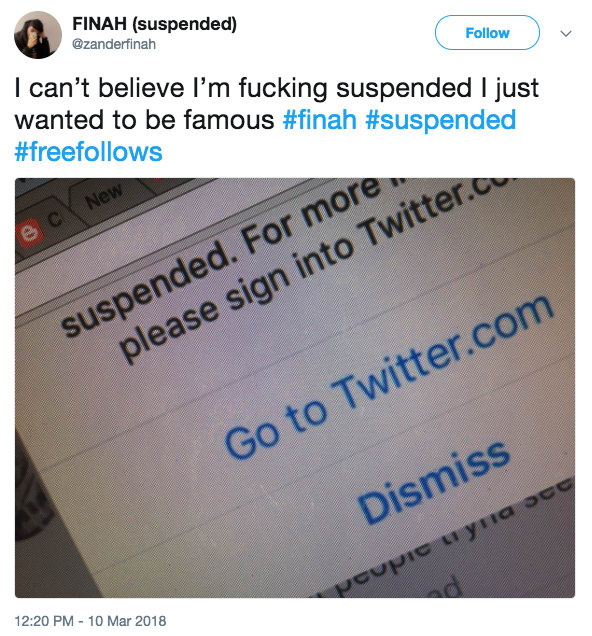
Awwww.
You know, it says something about Twitter that they were so trivially gamed, and it says something about these kids who think that gaming social media is how you get “famous”.

This is a sad, wounded, immature giant squid dying in a harbor in Spain.

It was wounded by fellow giant squid, bigger than she was, and hungry.
Off of northern Spain, giant squid often feed on schools of fish called blue whiting. The schools swim 400 meters or less below the surface, while the squid prefer to hang out around a mile deep. The squid must ascend to hunt, probably seizing fish from below with their tentacles, then descend again. In this scenario, a squid could save energy by pirating food from its neighbor rather than hunting its own fish, Guerra says: If the target squid has already carried its prey back to the depths to eat, the pirate could save itself a trip up to the shallow water. Staying below would also protect a pirate from predators such as dolphins and sperm whales that hang around the fish schools.
If a pirate happened to kill its victim, it would also reduce competition. The scientists think that’s what happened with the Bares squid: Its tentacles were ripped off in the fight over food. “The victim, disoriented and wounded, could enter a warmer mass of water in which the efficiency of their blood decreases markedly,” the authors write in a recent paper in the journal Ecology. “In this way, the victim, almost asphyxiated, would be at the mercy of the marine currents, being dragged toward the coast.”
It’s a squid eat squid world out there.


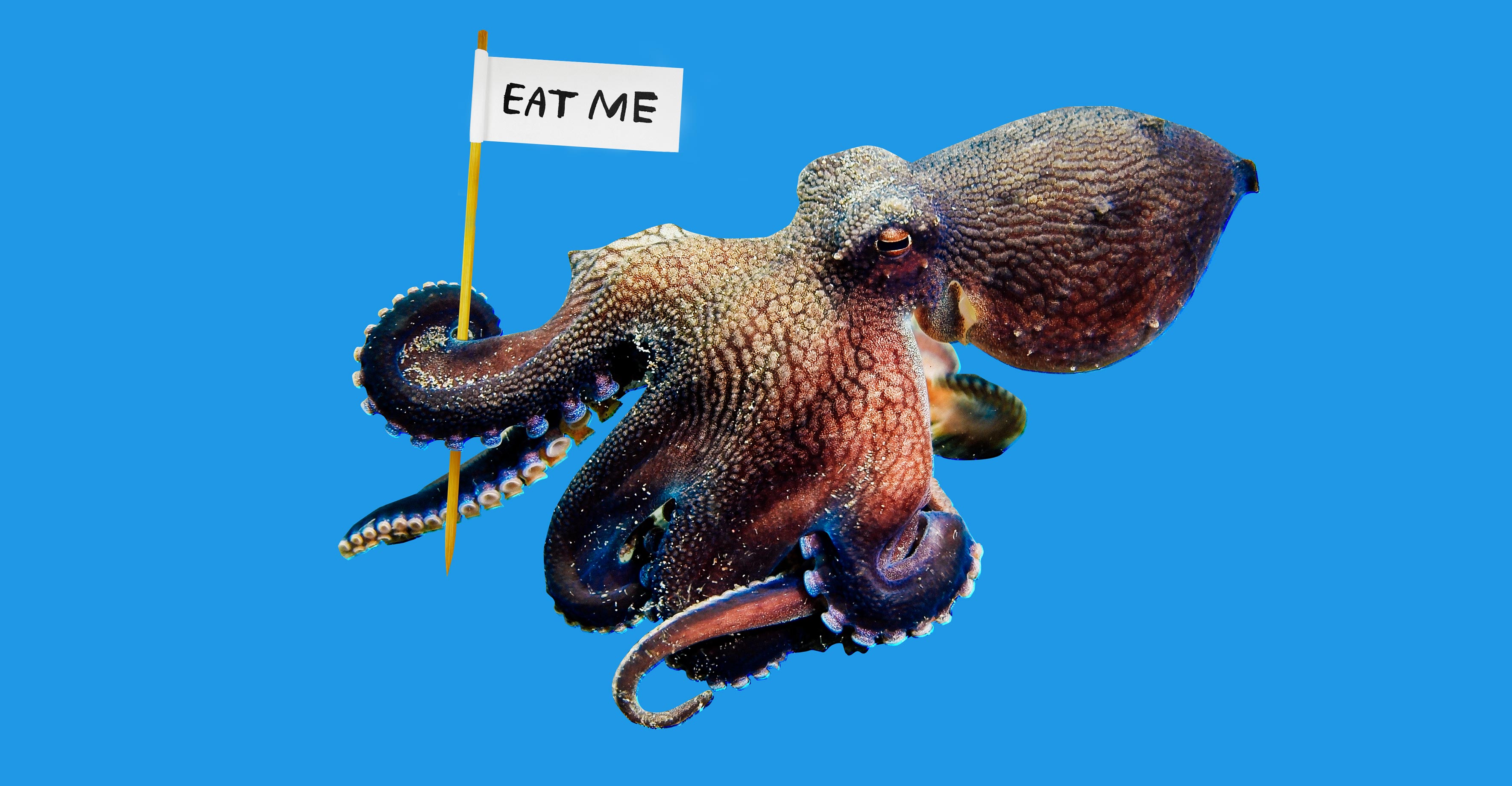
I am horrified by this article by Daniel Engber — remember that name — that denies that amazingness of cephalopods. I thought everyone loved them, but no, there is apparently a backlash of contrariness beginning.
For 10 years, I subscribed to this very point of view, forgoing any dish with octopus on account of the animal’s half a billion neurons, its sophisticated behavioral repertoire, and its apparent capacity for learning. How could one go on eating something so remarkable?
But, reader, I’m no longer having it. Or rather, I should say that in the past few years I’ve been having it every way I can: raw on sushi rice, braised with black olives, grilled with garlic and a pinch of Spanish paprika, etc. You see, as the cult of octopus intelligence has taken on adherents, I’ve begun to have my doubts. A slimy, brainy, eight-armed sea snail has been rebranded, uncritically and all at once, as the soulful “genius of the ocean.” But are Inky, Otto, and their ilk really what they seem—or could it be that we’re the suckers in this story?
<gasp> Everyone. Point and hiss at the heretic. Shun him.
Some of his arguments…OK, I will admit they do have smaller brains, they don’t exhibit the degree of abstract thought we might expect of a complex intelligent creature, and there are brainier aquatic organisms, like cetaceans. But still, this is a bad argument:
Hochner and his colleagues made several big discoveries, among them how the octopus controls the nearly infinite degrees of freedom in its arms. In short, it simplifies the task and does its best to dumb things down. Instead of waving all those arms around willy-nilly, the octopus falls back on a narrow set of “motor primitives.” When it reaches to a piece of food, for example, it aims the base of its arm in the right direction and then elongates and unfurls along its length. When it needs to bring an object to its mouth, it bends its arm in three specific places. And when the octopus crawls along the ocean floor, it works its arms like worms: One or two will shorten up, sucker to the ground, and then push off, always with the same amount of force.
From a scientific point of view, these facts are very interesting: They tell us how the octopus evolved to handle its outrageous anatomical complexity. But from the octopuses-are-amazing point of view—the perspective that might inspire you to get octopus tattoos, buy octopus best-sellers, or watch octopus-related content on TV—these facts seem a little sad. Sure, it makes a lot of sense for the octopus to use simple motor programs to control its arms instead of calculating every bend and twist of eight muscular hydrostats. But wouldn’t it be a little more impressive—wouldn’t it be cooler—if the octopus really did those calculations?
All right. Go outside with a ball right now, and throw it to someone. This is actually an interesting problem in geometry and physics, yet people who know no math and no theoretical physics have no problem doing this at all. Wouldn’t it be cooler if humans really did those calculations?
This is a non-argument. Simplifying cognitive tasks is exactly what even the brainiest creature routinely does. Would we be more impressed if it did tasks in the most computationally intensive way, with the most difficult, intricate calculations, or should we be more impressed with its efficiency?
Engber almost makes up for his heresy with his conclusion. Almost.
The modern octopus stands not for terror, exploitation, and expansion, but for amazement and delight.
We know that cephalopods can change their colors in an instant, or even flip their boneless bodies inside out. Now we’ve inverted octopuses for ourselves. We say that we’re enchanted by their shifty, frisky otherness, but I think it’s more apt to say that we’re the victims of that quality—that we’re beguiled by their talent for disguise. Yesterday we peered into the main and thought we’d found a ruthless, suffocating tyrant. Today, we see a charming rascal. Who knows what sort of animal we’ll think we’ve come across tomorrow. The mollusk of a thousand faces appears at different times in different ways, as a monster or a genius or perhaps a bag of slime. Maybe that’s the secret at the heart of its phylogeny: We may be on the hunt for greater meanings, but the octopus evolved to get away.
OK, so I won’t sic the Kraken on him just yet. Yet. But I’ve got my eyes on you, Engber. Terror and exploitation aren’t entirely off the menu, you know. Especially if you keep photoshopping bogus “eat me” signs onto my friends.

My wife gave me my birthday present a month ago. “It’s not my birthday,” I said. She told me to be patient.
My present was a bucket of dirt. “Gee, thanks,” I said.
“You have to take care of it,” she said. “Oh, great,” I said, “A bucket of dirt and a new chore.”
I did as I was told. It was supposed to do something on my birthday, but my birthday is still more than a week away. And now the bucket of dirt looks like this already.

Is it going to get bigger and more garish by my birthday? Should I be worried that it’s going to eat me? Because that would be a surprise.
