Spider update

All I want for Christmas is another egg sac, and they aren’t obliging.

  • Vera ate another husband. Again. She’s the voracious jaws of death, and all I can hope for is that the poor doomed fellow inseminated her before getting sucked dry. Vera is hugely bloated right now, having consumed a large male and a smorgasbord of flies.
  • The other pairs of spiders are much more placid and are coexisting well, but no eggs yet. I did notice that one of them had molted, so maybe they’re too young? Have I set up a Blue Lagoon scenario here?
  • All of the spiders (except those sacrificed to the bloodthirsty Vera) are looking healthy and active, and are quite swift in demolishing flies presented to them.

So I’m just waiting. Waiting waiting waiting. Don’t they realize I’ve got plans for their progeny?

Now thinking about starting up a dairy spider farm on the prairies of Minnesota

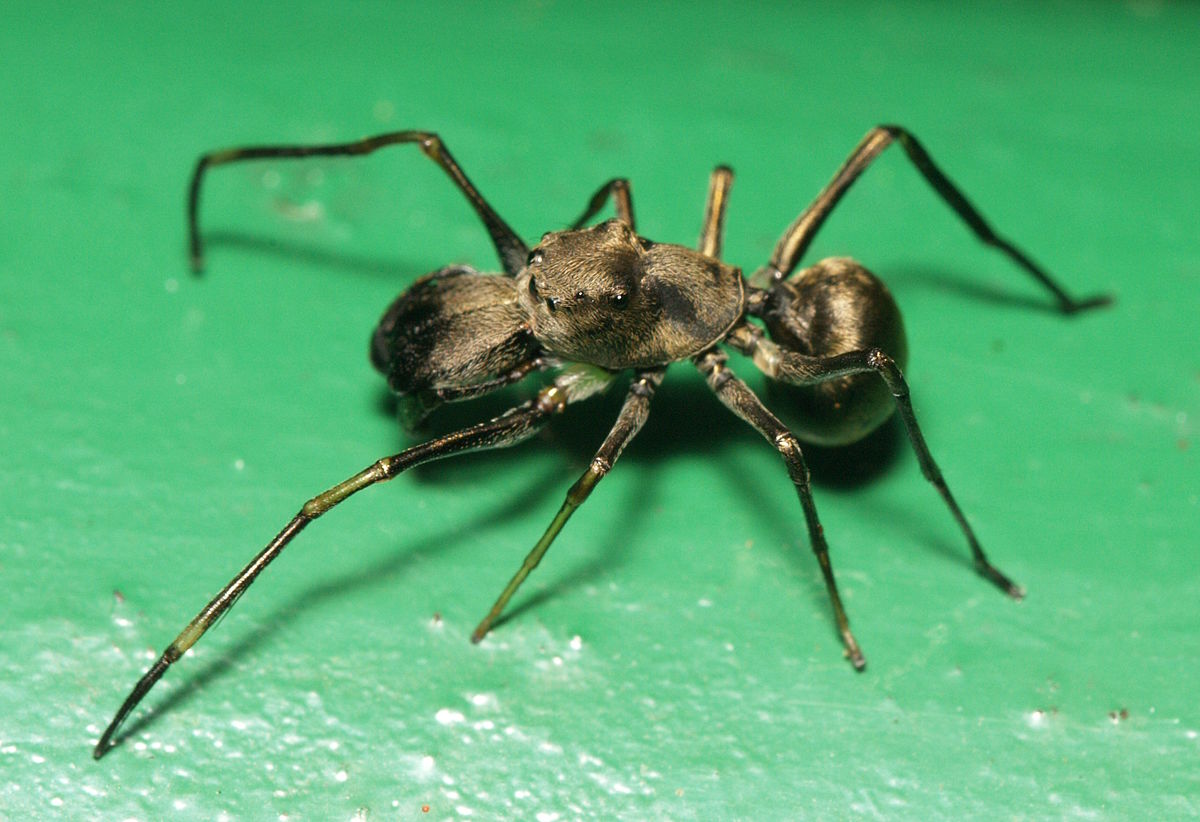
There are these weird salticid spiders that have evolved a radically different morphology — they live in ant nests, and physically mimic the ants. Look at this ant-spider. Isn’t this amazing enough?

That’s a spider? Yeah, count the legs. It’s trying so hard to fit in with tunnel-dwelling insects with three body segments, you just have to applaud the effort.

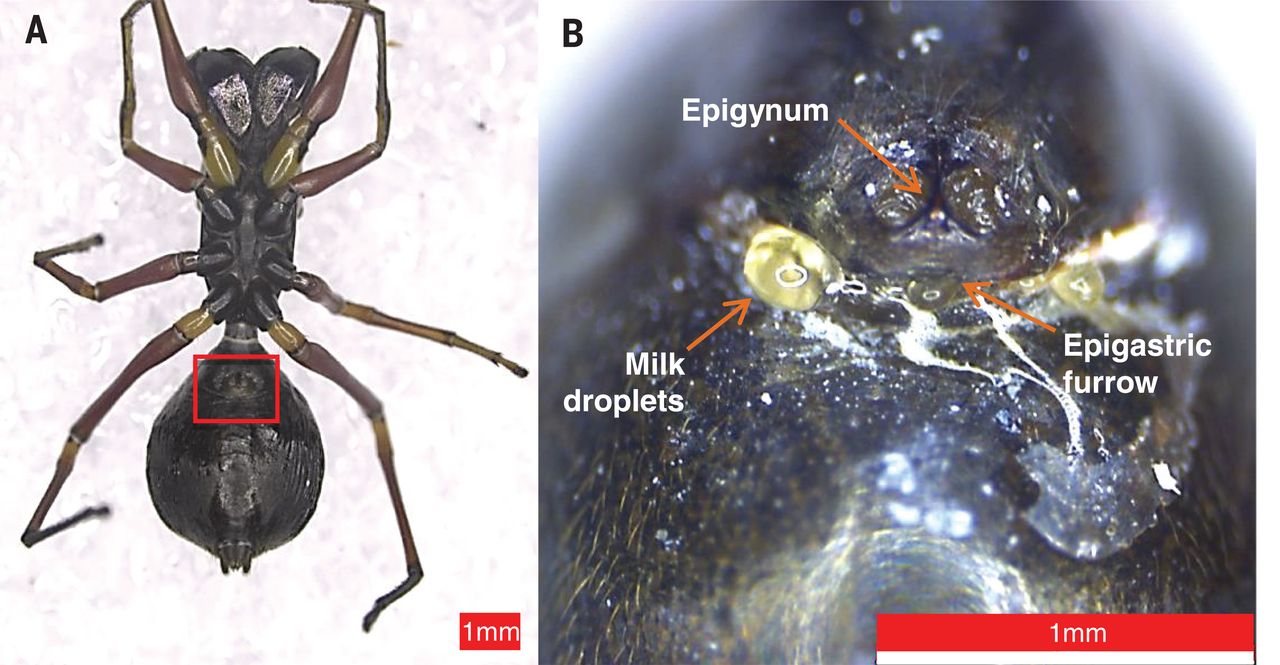
What’s more, they’ve acquired another evolutionary novelty: they secrete ‘milk’ to feed their young, and have extended parental care. The necessity of milk production was tested with the cruel experiment of painting over the epigastric furrow (the site of secretion) with White-Out, and what happened? All the spiderlings starved to death. The utter bastards. There are things you can get away with when working with invertebrates that you couldn’t do with cute fuzzies with bones. Try doing that experiment with bunnies, just be prepared for torches and pitchforks.

There’s another revelation in this figure caption.

Spider milk and its secretion site in Toxeus magnus.

(A) Ventral view of mother. (B) Milk droplets secreted after slight finger pressure on abdomen.

Did you get that? They are milking spiders. I come from a long line of Norwegian dairy farmers in Minnesota, so you can guess where my mind went from here. Can I get state and federal subsidies for my spider farm? I’ll have to look into it.

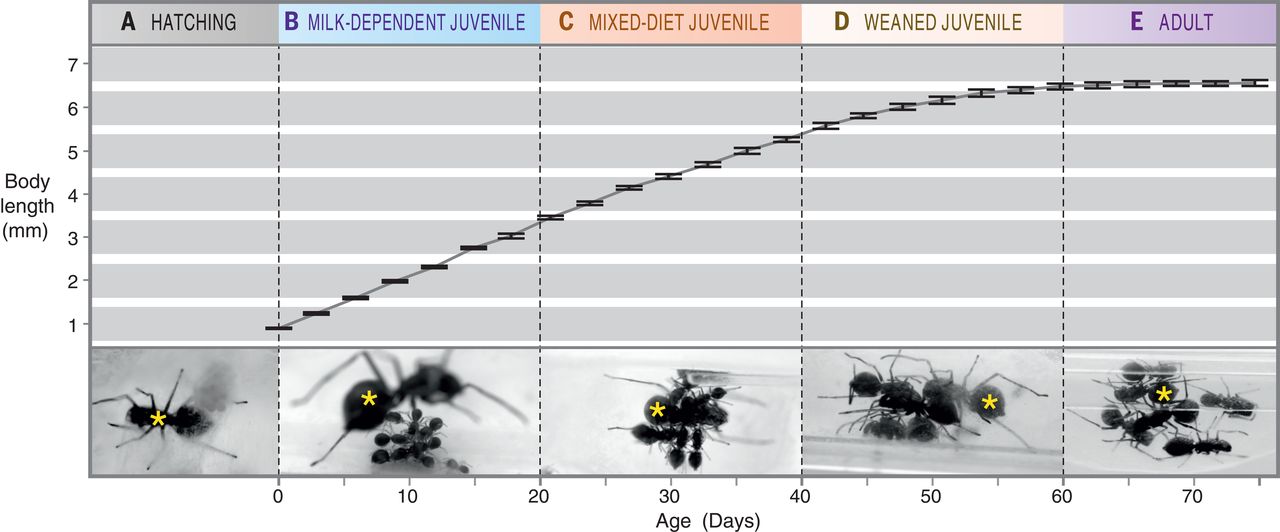
The study is primarily about the life history of this spider species, with some experimental manipulation, and it does a thorough job of that.

T. magnus offspring body length growth and food resources during development.
(A) Egg hatching. (B) Absolute milk dependence: Spiderlings do not leave the nest, and the mother releases milk droplets to the nest internal surface. (C) Spiderlings forage during the day and suck milk at night. (D) Subadults nutritionally independent but still return to nest. (E) Spiderlings reach sexual maturity, but some stay with the mother. *The mother. N = 207 offspring, Nnest = 19 surveyed nests, error bars (SEM).

It’s missing one thing, though: any analysis of the chemical make-up of spider milk. I’m going to take a wild guess that unlike mammal milk, which is rich in fats and carbohydrates, spider milk is going to be more like a protein shake — that it’s going to be in many ways similar in composition to the dissolved bug guts that spider adults live on, to simplify the transition from an independent hunting spiderling to a spiderling with an obligate dependency on parental care. Which means a) humans can probably synthesize it by homogenizing masses of fruit flies in a blender with some digestive enzymes, and filtering out the chitin, and b) there’s not going to be much of a human market for it. Alternatively, they suggest that spider milk may have evolved from the breakdown of trophic eggs — that is, eggs produced that do not develop, but provide a food source for other members of the brood. In that case, it may be a soup of phospholipoglycoproteins, similar to the vitellogenins of other arthropods, and its closest vertebrate analog would be egg yolks.

Inquiring minds want to know. They’re going to have to milk a lot of spiders to get enough to analyze, though!


Chen Z, Corlett RT, et al. (2018) Prolonged milk provisioning in a jumping spider. Science 362(6418):1052-1055. DOI: 10.1126/science.aat3692

P.S. There is a Minnesota milk song. They might have to change some of the hand gestures.

Always ask for permission first, before playing God

That story I posted yesterday about the rogue Chinese gene editor? The Chinese government has responded swiftly and repudiated He Jiankui’s work.

Chinese Vice Minister of Science and Technology Xu Nanping told state broadcaster CCTV that his ministry is strongly opposed to the efforts that reportedly produced twin girls born earlier this month. Xu called the team’s actions illegal and unacceptable and said an investigation had been ordered, but made no mention of specific actions taken.…He’s experiment “crossed the line of morality and ethics adhered to by the academic community and was shocking and unacceptable,” Xu said.

Uh-oh. He’s in trouble. I know there’s the idea that it’s easier to ask for forgiveness after the fact, but maybe that doesn’t apply when you’re tinkering with human lives.

Is it progress when a self-aggrandizing mad scientist performs a reckless experiment?

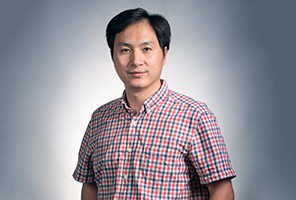
Does this look like your idea of a mad scientist?

China is racing ahead in human biotechnology — it really helps when you can disregard ethical concerns altogether. It especially helps when you pay lip service to bioethics while simultaneously carrying out a major research program that directly contradicts the ethical concerns you’re piously declaiming.

There is a heroic history of scientists engaging in self-experimentation. The example that comes to mind is Barry Marshall, who drank down a solution of Helicobacter pylori to prove that the bacteria was the causal agent behind stomach ulcers. No research review committee would have approved such an experiment, but it paid off in that he won the Nobel for it. He also made himself very sick. It was a dramatic and rather stupidly dangerous gesture — there are safer ways to evaluate pathogens, and we drill safety into our students all the time.

Maybe we’re wrong. Maybe we should be encouraging students to lick random slime they find on the lab benches. We might lose a few, but the tiny percentage who discover brand new drugs or new diseases will make the deaths worthwhile, right?

But that’s self-experimentation. The new era of gene editing really is meaningless when done on yourself. It’s got to be done on embryos, on someone else. Is modifying genes in some other helpless, innocent person still heroic, or even heroically stupid? I don’t think so. We’re at the stage where experimentation on human cells is important, but the ethical guidelines don’t allow you to grow up that blastocyst to birth, because at that point you have a person who did not consent to the manipulation, and they have to live their whole life with the consequences of your tinkering.

That didn’t stop He Jiankui from launching a research program in which he genetically modified IVF embryos with Crispr, implanted them back in their mothers, and then cheerfully announced when the first of them gave birth.

There are more than a few problems with this experiment.

  • We don’t know all the limitations of Crispr yet. He assures everyone that there were no spurious modification of the genome in this case. Were there other cases, though? Do we trust that failures would be reported?
  • The entire purpose of this modification was prophylactic. They knocked out a component of the immune system that HIV uses to infect cells, presumably giving the child resistance to AIDS. Was this a pressing need? The child did not have a disease, they deleted a molecule to make it less likely they would get a disease. (The father is HIV-positive, so there was greater risk of exposure…but how much fluid transfer were the parents expecting?)

  • The deleted gene is CCR, which provides a kind of latch between T cells of the immune system and antigens. Most humans have CCR, a small percentage do not, and they have a greater resistance to some specific pathogens. But are there trade-offs? Are they more susceptible to other pathogens, or does it generally weaken the immune response? We don’t know, but hey, maybe now there will be a bunch of kids in China who will have genetically engineered weaknesses!

  • The experimenter had rushed a paper on bioethics to publication before this conference where he announced his result. The paper states that this kind of experiment is unethical.

    On Monday, He and his colleagues at Southern University of Science and Technology, in Shenzhen, published a set of draft ethical principles “to frame, guide, and restrict clinical applications that communities around the world can share and localize based on religious beliefs, culture, and public-health challenges.” Those principles included transparency and only performing the procedure when the risks are outweighed by serious medical need.

    He was actively pursuing controversial human research long before writing up a scientific and moral code to guide it.“We’re currently assessing whether the omission was a matter of ill-management or ill-intent,” says Barrangou, who added that the journal is now conducting an audit to see if a retraction might be warranted. “It’s perplexing to see authors submit an ethical framework under which work should be done on the one hand, and then concurrently do something that directly contravenes at least two of five of their stated principles.”

    It’s true. Patent dishonesty ought to be a good reason to pull a paper.

  • He doesn’t seem to be particularly aware of the limitations of genetics.

    He appeared to anticipate the concerns his study could provoke. “I support gene editing for the treatment and prevention of disease,” He posted in November to the social media site WeChat, “but not for enhancement or improving I.Q., which is not beneficial to society.”

    OK, I’ll bite. What genes for “improving IQ”? It’s easy to say you won’t do experiments on a gene that doesn’t exist, or involves modifying a very large number of mostly unidentified genes. I also don’t believe him. Of course improving intelligence would be beneficial to society — we try to do that all the time, it’s called education. If he had a target gene that was associated with greater intelligence, you know he’d be recruiting volunteers to do the study right now, which he’d carry out surreptitiously until he got a positive result that he could highlight at a major conference.

  • The lack of transparency while the experiment was ongoing is deeply troubling. If you don’t let people be aware of and monitor your potentially risky experiment, it’s too easy to literally bury (or cremate) results that you don’t like. It’s like p-hacking, where in this case the “p” stands for “people”.

  • This guy is a biophysicist and bioengineer. He is not qualified or trained in any way to assess ethical risks, but heck, we all know that the magic words “physicist” and “engineer” make one all-knowing, confident, and wise. I can only dream of having the degree of certainty that would allow me to publish a paper in a complex field which I know nothing about, and where my actual work flouts everything I say others should do. But then, I’m not a physicist.

I also have to add that this is not a particularly radical experiment. Crispr is now an established technique, and these sorts of experiments have been carried out in experimental animals. The only thing novel about it is that he rushed to execute an experimental technique, developed by other, more careful scientists, on a different experimental animal, human children. I expect there will be a day when gene editing on embryos is done to improve the quality of life for human beings, but that day doesn’t seem to be here yet, and reckless experiments don’t bring it any closer.

The space people are getting busy

We have successfully invaded Mars again, this time to poke holes in it.

The InSight lander, operated by NASA and built by scientists in the U.S., France and Germany, touched down in the vast, red expanse of Mars’ Elysium Planitia just before 3 p.m. Eastern Monday.

There it will operate for the next two Earth years, deploying a seismometer, a heat sensor and radio antenna to probe the Red Planet’s interior. Scientists hope that InSight will uncover signs of tectonic activity and clues about the planet’s past. Those findings could illuminate how Mars became the desolate desert world we see today.

Oh. Practical knowledge, since we’ve got an ongoing experiment to see if we can turn Earth into a similarly desolate desert.

If you don’t want to learn about how to end all life as we know it, you could tune in here on Wednesday afternoon, when I’m getting together with some other space people, the Deep Astronomy channel, to talk about the origin of life. It’ll be fun! Space people are cool!

Spiders will just break your heart

Last Wednesday, I was so optimistic. I’d paired up Vera with a first-generation son of Gwyneth (GI-♂), they’d gone at it hot and heavy, and had produced an egg sac — an egg sac with a peculiarity I’ll get to in a moment. My plan was to go in today and open up the sac and see what embryos I’d find.

The peculiarity was that although I’d classified all my spiders as Parasteatoda tepidariorum, there was still a little uncertainty. The patterns of pigment on their cuticles were a bit ambiguous. Here’s part of the description of P. tepidariorum from Common Spiders of North America.

This is a medium-sized to large cobweb weaver. The abdomen appears teardrop shaped as the spider hangs updide down in its web, spinnerets uppermost. The cephalothorax is tan or brown. The abdomen color is extremely variable, usually shades of light brown with a mottled tan or brown. Some individuals are nearly black, others unmarked and pale. The legs are darker at the joints.

The egg cases of this spider are tan and tardrop-shaped, point uppermost.

This describes my spiders perfectly, given that there is variability in the patterning of the abdomen. They look different, which had me worried that I may have gathered a couple of different species, but then the description of the egg case settled it for me: Gwyneth had produced lovely tan, teardrop-shaped egg cases. Case closed, right? Gwyneth and her progeny were P. tepidariorum.

Then Vera produced an egg sac. Vera herself also fits that description of P. tepidariorum to a T.

But the egg sac she produced was a cottony, pure white ball. What? I flipped through my books looking for some indication of what this might mean, and found a description of Steatoda triangulosa, which is also common in this part of the country.

This is a medium-sized cobweb weaver. The cephalothorax is reddish brown. The legs are light brown with dark brown bands. The apdomen is light brown with two rows of angular spots or bands of dark reddish brown separated by white areas with a mottled appearance. In some individuals this pattern looks checkered.

The egg case is a fluffy white sphere.

Uh-oh. Are Vera and Gwyneth from two different genera? There’s nothing in Vera’s abdominal pattern that fits S. triangulosa, but maybe that’s highly variable in this species, too, and the egg case definitely fits this description. But she’d bred with P. tepidariorum! Were the new eggs hybrids? Was I just a terrible ignorant klutz playing the taxonomy game poorly? I went into the lab to take a few steps towards finding out.

And…disappointment. The “fluffy white sphere” was gone — it had been torn apart. The eggs within were dried up lumps. Uncertainty reigns.

I put the two lousy parents into a petri dish and made a video. You look and tell me: Parasteatoda tepidariorum or Steatoda triangulosa? Looking at just the adult morphology, I’m saying P. tepidariorum, but what do I know. Video below the fold, with an agitated pair of spiders scurrying about.

[Read more…]

Happy Spider Report: Vera was preggers!

It’s all good news. All the spiders are thriving right now, chowing down on flies. Vera produced a very pretty egg sac — I’m thinking the 14/10 light/dark cycle may have something to do with it — and has shrunk to about half her previous size. I’m planning to open up the sac on Sunday as part of my devotional, just to check on the health of her embryos. Although I’m low on adults, the next generation is coming along, and with any luck I’ll have a swarm of spiderlings this time next week.