So I had to purge them.
Pharyngula
Evolution, development, and random biological ejaculations from a godless liberal

So I had to purge them.


not sentiment shared by the Declaration of Women’s Sex Based Rights
Apparently, it’s not trans women, and trans men don’t even exist. This Declaration of Women’s Sex Based Rights is making the rounds — Richard Dawkins proudly signed it, doesn’t that make you want to put your name on it? I like the idea of supporting equal rights for all men and women, and it’s true that women need special legal protection as the targets of current and historical discrimination, but this document seems to be mainly focused on legitimizing discrimination against trans women. It practically seethes with resentment against trans women, and singles them out as the big problem that must be eradicated from society. Cast them out! They don’t deserve to have any of the rights which they want to reserve for true human females, a category that they don’t even bother to define (probably because if they tried, they’d get hung up on the boundary conditions). So women are simply specified by vague “physical and biological characteristics”, which are completely different from “gender identity”, which means their manifesto is primarily a long whine about how the existence of trans women taints the concept of lesbianism.
However, the concept of ‘gender identity’ has enabled men who claim a female ‘gender identity’ to assert, in law, policies, and practice, that they are members of the category of women, which is a category based upon sex.
The CEDAW General Recommendation No. 35 notes that, “General recommendation No. 28 on the core obligations of States parties under article 2 of the Convention as well as general recommendation No. 33 on women’s access to justice confirms that discrimination against women is inextricably linked to other factors that affect their lives. The Committee’s jurisprudence highlights that these may include…being lesbian.” (II, 12).
The concept of ‘gender identity’ is used to challenge individuals’ rights to define their sexual orientation on the basis of sex rather than ‘gender identity’, enabling men who claim a female ‘gender identity’ to seek to be included in the category of lesbian, which is a category based upon sex. This undermines the sex-based rights of lesbians, and is a form of discrimination against women.
Some men who claim a female ‘gender identity’ seek to be included in the legal category of mother. The CEDAW emphasises maternal rights and the “social significance of maternity’’. Maternal rights and services are based on women’s unique capacity to gestate and give birth to children. The inclusion of men who claim a female ‘gender identity’ within the legal category of mother erodes the social significance of maternity, and undermines the maternal rights for which the CEDAW provides.
OK, so how does the existence of trans women compromise the identities of lesbians and mothers? If a person who identifies as a woman is a primary caregiver to a child, what else do you call her but “a mother”? If she happens to be trans, how does that harm a person who identifies as a cis woman and is the primary caregiver to a child, who should also be called “a mother”? If they’re doing everything that a mother does, and if they suffer the same social disempowerment, what is the problem here, and what do you propose that people and the law should call them? I know, they may not have a uterus, and they may not have actually carried an embryo/fetus for 9 months, but are we prepared to deny the “M” word to adoptive mothers, then?
The whole thing is one special effort to carve out an exclusion and to deny one group of people the rights that they ought to share with everyone else. That’s not a good reason to sign this thing. An equal rights declaration ought not to be focused on saying “except these people, we don’t like them and we want to make sure they don’t get these same rights.” Especially when that subgroup has been specifically targeted for hatred and discrimination.
I’m also really curious to know why trans men are not mentioned, and how they handle that concept. Are trans men really women in their minds? How do they cope with their weird sexual essentialism if they accept trans men?
Oh well, one useful feature of their web page is that they list 393 organizations that really hate trans people, which is a useful reference if you want to know who you should never support (although many seem to be just disgruntled people with a website that you’ll never hear of again).


I thought this was going to be a happy story about a small town in Minnesota.
Chris and Kelsey’s younger child was always the extrovert in the family.
Assigned male at birth, they were into more traditionally feminine things — if there was a truck being played with, it was likely being driven by a Disney princess — so the couple took it in stride when their child asked for a Kit Kittredge American Girl doll for a fourth birthday present. Kelsey wondered about the future but Chris just thought it was his child responding to living with a mother and sister while he was deployed overseas with the Navy Reserve.
“So we got this doll and Kit’s eyes just lit up. And Kit was so happy and so excited to get this doll,” Kelsey said.
“About a week later, when dad was in Japan, and I was standing right there in the kitchen, Kit walks up to me and goes, ’Mom, can you call me Kit?’ And my stomach dropped a little bit. Because all of a sudden, maybe things were making a little more sense. Click. And I said, ’Sure. Still my little … boy?” And Kit goes, ’No, your little girl.’
“I was like, ’Absolutely, sweetie, you got it.’ And then I ran into the other room with a panic attack and called Daddy in Japan and said, ’What the heck just happened?'”
Chris Waits said his first thought was that Kit might be going through a phase. Like his wife, he had to learn about trans kids.
Neither parent said they knew much about trans kids, and decided to let Kit be Kit while they figured things out.
See? An accepting family who were concerned about doing what was right for their child. This is going to be a good story, right? I can tell you the parents continued to be supportive and accepting, but as you might predict, small town America is small minded America.
But after one parent posted a long complaint about a whole host of things involving Kelsey, another parent went uglier.
“She should be locked up for child abuse,” the parent wrote. “Her younger ‘daughter’ is actually a boy.”
Others jumped in, attacking the Waits as “woke parents” who had pushed their views onto their child.
Kelsey soon found out what was being written.
“This was my most precious secret. The thing I protected most and the thing I was most afraid of ever being used in a political way because for me, this isn’t political. This is my family, this is my child,” she said. “I dropped to the floor, and I cried.”
Yeah, it just got worse and worse. The family eventually decided to leave the community altogether, because the asshole parents have decided to target a vulnerable child.
So the Waits are moving from the dream house they designed, the one where Kelsey spent hours hand painting murals. They are seeking more privacy, and they believe safety, in a new address that has not been publicized.
“That’s where we’re at right now. There are people that we know, that are not safe for our kids in our neighborhood,” Chris said. ”We can’t trust our kids alone at the bus stop waiting for the bus, not because of the kids necessarily, but because of the parents.”
Goddamn TERFs. These are people who probably wouldn’t identify as any kind of feminist, though — they’re just hatemongers. And they’re everywhere.

Minnesota had a rather active intellectual life with an international reputation early in the 20th century. It had the bad — Moody Bible College, for instance, which was one of the formative centers of fundamentalist and evangelical Christian thought — but it also had some progressive thinkers, like Charles Malchow, who I’d never heard of before. Malchow was a doctor at Hamline University who was inspired to write an open-minded textbook about human sexuality, and suffered the consequences.
The Sexual Life (dedicated to Malchow’s mother, Marie), appeared in 1904, the same year Maclhow married Lydia Gluek, a daughter of the Minneapolis Gluek Brewing enterprise. The Sexual Life, over 300 pages, described in straightforward language a wide range of sex practices and problems—contraception, youthful experimentation, same-sex attraction, the physiology and psychology of sexual excitement, sexual pleasure, and sexual frustration. The book took particular aim at encouraging equality of knowledge and enjoyment for women and men.
As we’ll see, that is a charitable summary. The book does talk a lot about equality of the sexes, though, and seems to have triggered some knee-jerk reactions in the establishment.
In 1873 Congress had enacted the Comstock Act, which made using the US mail to distribute obscenity (including specifically any information about abortion) a felony. Malchow and Burton knew about the law and inquired of Minneapolis post office officials whether their advertising pamphlet—which described the book in detail—could be sent through the mail. The unhelpful answer merely referred them to the Comstock Act. They took a chance, and mailed 25,000 copies of the pamphlet to doctors, ministers, and lawyers around the country. The book quickly sold 3,000 copies.
In August 1904, just two months after Malchow’s marriage, a Minneapolis federal grand jury indicted Malchow and Burton for violating the Comstock Act. Trial began in October before Judge William Lochren, an Irish immigrant, a Civil War hero (he survived the famous charge of the First Minnesota at Gettysburg), and Minnesota’s second federal district judge. Lochren disapproved of The Sexual Life and made his views known to the jury, who quickly convicted both men. The First Amendment played no part in Malchow’s defense—it had not occurred to anyone at the time that the Constitution might protect the publication of explicit sexuality. And under the law of the time, Malchow and Burton were guilty of the crime.
Lochren gave both Malchow and Burton eighteen months in prison, later reduced to twelve. While their appeal made its way to the Eighth Circuit Court of Appeals, Malchow’s supporters appealed to President Theodore Roosevelt for a pardon. They failed: Roosevelt wrote that he found The Sexual Life “a hideous and loathsome book.” The Court of Appeals affirmed the conviction in April 1906; Roosevelt declined the pardon in April; Malchow and Burton reported to Stillwater State Prison in May. They were released in March 1907.
Teddy thought this was a loathsome book? Well then, I must read it. Fortunately, The Sexual Life is freely available on the internet archive. It disappoints. It’s tame stuff for the 21st century, no illustrations, and it hammers away on the importance of traditional sexual and gender roles. Women can be equal to men, as long as their sexual behavior is exactly as would be expected in the pages of a Victorian romance novel — and not the seedy novels you could find under the table at men’s clubs, but the kind a gentlelady could be seen reading in public.
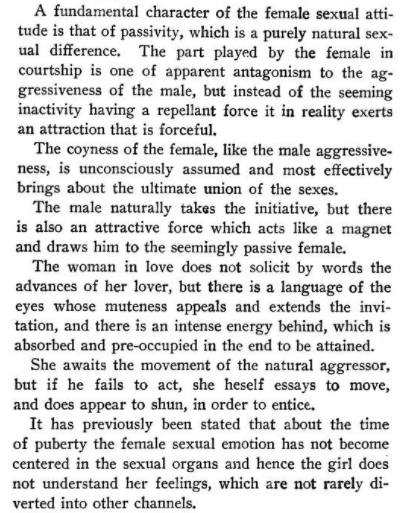
The word “natural” sure does a lot of heavy lifting in the text. It was “encouraging equality of knowledge and enjoyment for women and men”, but only within the narrow bounds of acceptable social behavior. Women were supposed to act one way, men another, and Medicine and Science would discourage any deviation.
It also doesn’t say much at all about same-sex attraction, briefly mentioning only male homosexuality (unthinkable that passive, mild-mannered ladies would consider such a thing), and then only to call it a perversion and dismiss it from further consideration.
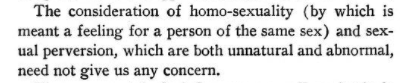
Uh, right. I’m certainly not going to praise Malchow as an open-minded, forward-thinking person — the book is a paean to customary gender roles, and is built on conservative assumptions throughout.
He did go to prison for it, though, which was not just. It’s weird to read it now and realize that, for its time, it was a wildly libertine, radical perspective on sexuality. Nowadays, though, I could imagine Ben Shapiro or any of those crimped, narrow minds on the Right praising it as a great prescription for how we all should live now.

They tend to be very tentative, and wrap themselves in the cloaking device of civility because they get banned hard otherwise, but we get an occasional TERF hijacking threads here. If you must, here’s the latest example. My defense is a great collection of eloquent readers who thoroughly shred TERFy arguments, and there are some beautiful examples in that thread. Look for the rebuttals by CripDyke and abbeycadabra and other worthy commenters, like Frederic Bourgault-Christie.
Abbey has also written her own post on the subject. Why are you reading the blog of an old cis man for trans issues anyway?

Louis CK remains the king — wow, but that guy destroyed his reputation spectacularly — but it looks like Dave Chappelle is working hard to catch up. Where once I could respect him for the ol’ “speaking truth to power” routine and his sometimes exceedingly edgy comedy, I guess he found that work too taxing and has decided it’s easier to punch down and start mocking the trans community, while getting highly paid by Netflix.
Netflix, unfortunately, has so much money that quality doesn’t matter anymore — they’ll greenlight anything. I’ve learned that any science-fiction movie promoted by Netflix is going to be mostly garbage, so I’ve been skipping the service more and more. Comedy specials are even worse. They’re ridiculously cheap to make, so it seems that any bigot who wants to make other bigots laugh will get handed a platform. There are exceptions, of course. Netflix put on Hannah Gadsby, who was marvelous and thought-provoking, but that was a rare occasion in a sea of same ol’, same ol’ boring white men with grievances.
Now a Netflix executive, Ted Sarandos, is trying to rationalize hosting an ugly anti-trans comedian by claiming it’s all about “diversity”. I got news for you, Ted: diversity does not mean you should encourage hatred and ignorance. We don’t need stupid to counterbalance intelligence, and we don’t need to slather shit on a tasty sandwich to make it better. I don’t need to “teach the controversy” in the classroom and educate students about evolution by promoting creationist propaganda.
And then he cites Hannah Gadsby as an example of their rainbow of lovely entertainment choices. Gadsby has a few words for that.
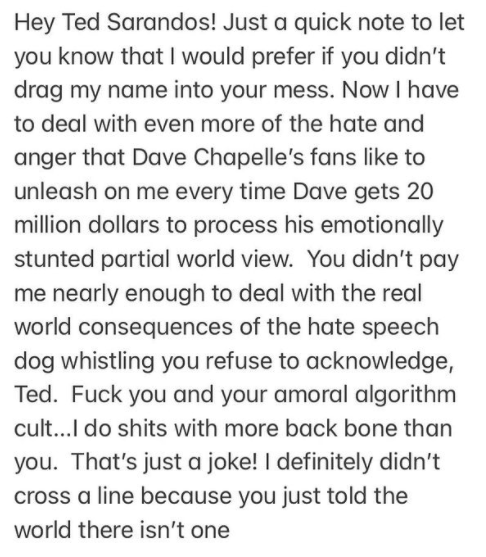
Hey Ted Sarandos! Just a quick note to let you know that I would prefer if you didn’t drag my name into your mess. Now I have to deal with even more of the hate and anger that Dave Chapelle’s fans like to unleash on me every time Dave gets 20 million dollars to process his emotionally stunted partial world view. You didn’t pay me nearly enough to deal with the real world consequences of the hate speech dog whistling you refuse to acknowledge, Ted. Fuck you and your amoral algorithm cult…I do shits with more back bone than you. That’s just a joke! I definitely didn’t cross a line because you just told the world there isn’t one.
Gadsby just shot the cash cow, very good.
Sadly, Chappelle (and Louis CK) will only experience fleeting interruptions in their careers. They’ll bounce right back — in Chappelle’s case, there doesn’t seem to have been any significant pushback at all — and will see their fans rushing into the warm embrace of comfortable bigotry again.


Rev. Carlson & Father Rogan
I should be used to this by now. I spent decades punching back at the weaponized stupidity of creationism: I saw it as a pathological extreme generated by narrow domains of primitive religious thought, but I also recognized it as an expression of a peculiar human property of our minds. We seek out patterns to make the world comprehensible and predictable, and we are susceptible to latching on to whatever idea gives us security, and instead of testing and challenging it, we can instead fall into the trap of selectively reinforcing whatever makes us feel better about ourselves.
My error, though, was to think too small. Get rid of religion, we get rid of a major pitfall. I still think that’s true (but very, very difficult), but I did not anticipate that humanity would simply find another dangerously deep hole to fall into right away, and that encouraging people to find another path with that “reason and logic” stuff would lead them there so fast.
I also did not expect that our doom would be maleness, the new cult same as the old cult. Yikes. I’m a member of that club. So let’s get the perspective of someone outside the club, a woman, in this case Amanda Marcotte, who I think is spot on in her analysis. The noisy mouthpieces of the far right are dominated by a group of regressive jerks who are riding to personal prosperity on the backs of the fears and inadequacy of the worst men. Tucker Carlson, for instance, is an appallingly stupid person who has found a wild niche of pandering to angry men.
As feminist writer Jessica Valenti noted in her newsletter, in the past, Carlson has done segments of his show denouncing “fatherless” homes and claiming children brought up in them are “poor, uneducated and have disciplinary problems.” But now he, a father of four, is making fun of men who actually want to be present in their children’s lives. “Are fathers necessary for stable families and children, or is spending time with your kid a sign of weakness and something to be laughed at?” Valenti asks.
What this dissonance reveals, of course, is all the hand-wringing about “fatherlessness” is just a feint. After all, many divorced or separated fathers are deeply involved with their children’s lives. No, as the Proud Boys rally this weekend showed, what’s really at stake is anger at women for rejecting subservience. Single mothers, same-sex marriages, and egalitarian marriages all show that there’s nothing inevitable about male-dominated marriage. That threatens men who are attracted to the dominance fantasy of traditional marriage to silence their own nagging sense of inadequacy.
It’s not just Carlson and the Proud Boys who have figured out how to monetize male mediocrity and fragility.
Just to clarify, though, “male mediocrity and fragility” is not saying that being a man means you are intrinsically mediocre and fragile. Any group will have a subset of individuals who are mediocre and fragile, the weak links that a con artist can scoop up, organize, and turn into a force for evil. It means there is a troubling group of humans who have been recruited into a cadre with a stereotypically male flavor, who then send money to and increase the power of people like Carlson. You can find this in any group. For instance, right now we can see TERFs harvesting female mediocrity and fragility, and atheists profiting off atheist mediocrity and fragility. OK? Not all men. Not all women. Not all atheists. But there are still characteristics of those groups that can be manipulated and abused.
It’s also not just Carlson. She doesn’t mention him, but Jordan Peterson is another classic example of someone harnessing mediocrity for personal gain, and she does talk about Joe Rogan.
Podcaster Joe Rogan has made a mint off of appealing to the sea of men who want an easy boost to their self-esteem through chauvinistic chest-thumping, rather than developing real skills and a personality. Rogan can be a little more subtle than Carlson about it, but ultimately, they’re playing on the same set of anxieties and insecurities in American men, and prescribing the same toxic masculinity as a supposed cure.
In Rogan, it’s easy to see, for instance, how refusal to get the COVID-19 vaccine got encoded for the fragile masculinity set as a way to “prove” their manly bona fides. He falsely claimed that “healthy” men who are “exercising all the time” don’t need the vaccine. He repeatedly suggested that vaccine mandates were somehow an assault on freedom, rather than what they are: a common sense health measure that helps free everyone from far more miserable pandemic restrictions. Taken together, it paints a picture of vaccination as the behavior of supposedly weak men. Unsurprisingly, then, Rogan ended up with COVID-19 and had to admit that he had kept finding excuses to put off getting a vaccine he had routinely insinuated was emasculating.
Right. Turning anti-vaccination sentiments into a chest-thumping display of masculinity is the new trap. We can turn any stupidity into a virtue if we couple it to some aspect of stereotypical manliness. See also America’s gun obsession.
Once you’ve got your in-group of weak, gullible men (in this case) you have to find a target to push around. What use is your power, otherwise? So here we go. Let’s go after the transes! And the gays! And the libs!
Carlson went after a gay man with a breastfeeding joke. Rogan’s preferred target for exercising his gender anxieties is all too often trans people.
Rogan has repeatedly used his show to make fun of trans people, paint being trans as a perversity, and elevate anti-trans bigots as somehow experts on the subject. Now that comedian Dave Chappelle has joined in making being transphobic a point of pride, unsurprisingly, he and Rogan are going on tour together. The obsession with trans people isn’t just gross, it’s a little confusing. Why do these cis men care so much about the lives of trans people who have nothing to do with them?
The ugly truth is that trans people, because they’re a small and misunderstood minority, just feel like an easy punching bag for these insecure men to take their gender anxieties out on. The very existence of trans people is a reminder that gender — and therefore gender hierarchy — is a social construct, and therefore can be analyzed, criticized, and even changed. Or, as in that famous 2019 rant from a One America News Network host, transgender penguins are a threat to the “family unit” and everything conservatives hold dear.
What’s also interesting here is how easy it is to spot these self-appointed leaders dragging us down into a sewer. It used to be we could just lock in on televangelists and such, who would happily label themselves with an easy and contemptible myth, and overlook all those people who seized on other myths that we didn’t think were so contemptible (like being a man), and churned them into red meat to feed their followers. We have to get better at spotting these charlatans, and they aren’t all going to be conveniently wearing clerical collars. Some of them just sport testicles.
Hey, here’s another insecure fraud who’s making bank off male mediocrity and fragility: Steven Crowder.
Warning: that video contains what I think is the most tasteless, cruel, pointless “comedy” routine I’ve ever seen, in which Crowder and his cronies pretend to act out the George Floyd murder to show that kneeling on someone’s neck is totally harmless. That didn’t get him instantly demonetized and evicted from social media channels everywhere? That’s another part of the problem, that these fools and liars are enabled by toxic social media rules.

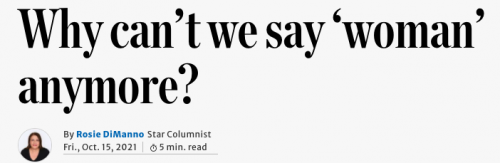
Rosie DiManno is wondering why we can’t say ‘woman’ anymore, which is a rather self-contradictory thing to declare in a big bold headline that got published in a major metropolitan newspaper. It’s also counter to common sense and every day experience, since I don’t seem to know anyone who is actually opposed to calling women women, except maybe TERFs, who are generally extraordinarily confused about just about everything to do with sex and gender. It’s a really simple concept, though!
Here’s the rule: you should address people by the identities they prefer and declare themselves. Rosie DiManno bills herself as a woman, and I am perfectly comfortable with addressing her as a woman. If I were to call her a man, I would either be hopelessly addled about who she is, or I’d be trying to insult her with a gendered insult, which is bad. So, hi Rosie, Woman, Human, Bipedal Vetebrate, etc. Strive to be respectful and accurate, is all.
Most/all of my interactions with Ms DiManno, if I were to have them, would be genderless, and there are only a few circumstances when I would have to call her a woman. “The boat is sinking, Ms DiManno — women and children to the lifeboats, you first,” perhaps, or “The ladies room is to the left, ma’am”. There are occasions when sex and gender are relevant, and you do not want to mix them up, lest you seem addled, insulting, etc.
Then there are the situations where some nuance is required, because the world isn’t the simple binary she thinks it is. She seems a bit incensed about a scientific article.
“The Lancet,” the prestigious and highly influential British medical journal, put “Bodies with Vaginas” on the cover of its latest issue, referring to an article inside, entitled “Periods on Display,” a review of an exhibit about the history of menstruation at the Vagina Museum in London.
Maybe the editors, who tweeted the piece, were just looking for clickbait, with a pullquote on the cover teasing that “Historically, the anatomy and physiology of such bodies have been neglected” — this although the author had used the phrase “bodies with vaginas,” only once and “women” four times.
But…but…there are trans men who menstruate and have vaginas. There are trans women who do not have them, and do not belong in an article about menstruation. There are cis women who do not have vaginas, and large numbers of both cis and trans women who do not menstruate. Acknowledging their existence and medical relevance is not erasing cis women at all. But Ms DiManno seems determined to erase trans men (who we call “men”, to keep it simple) and trans women (called “women”, that forbidden word in the minds of TERFs), all by inventing a totally non-existent imaginary problem.
It seems to be a common disease among right-leaning people who need imagined persecution to help them keep up their own sense of identity, so they have to create grievances. Without them, their concerns do seem to be rather petty and indefensible.


A truly horrific case has rightfully caught the attention of the media in the UK, the murder of Sarah Everard. She was abducted by a police officer who raped and murdered her.
Yesterday, Sarah Everard’s killer – serving police officer Wayne Couzens – was sentenced to a whole life order. In kidnapping her, Couzens, who was a firearms officer at the time, showed Everard his warrant card and placed her in handcuffs, having ‘arrested’ her under Covid-19 powers. The 48-year-old then drove Everard 80 miles, before raping and murdering her.
It’s not just the personal horror of what happened to Everard, but the betrayal of a public trust, as we’ve witnessed over and over again here in the US. George Floyd was in terror of getting into a police car, and can you blame him? Imagine being a woman, expecting the police to protect you, but then they put handcuffs on you and lock you in the back of a police car, helpless.
That trust wasn’t violated by just one wretched awful person who deserves a long prison sentence, though — it’s the whole damn police culture.
But, this morning, it has emerged that five of Couzens’ colleagues are facing criminal investigation after sharing racist, misogynistic and homophobic material with him over WhatsApp. This follows earlier reports that Couzens had been nicknamed “the rapist” by former colleagues for making women feel uncomfortable. Numerous incidents of indecent exposure, including two at a McDonald’s, which should have been linked to his vehicle just 72 hours before the kidnap, rape and murder of Everard weren’t properly investigated. Couzens’ criminality was facilitated by the incompetence and blasé attitude to misogyny embedded within the institution that he worked for.
But wait. This is being reported in the UK media. You know what else the media over there is obsessed with, even more than the US news? You may have guessed it. Certain people are already, somehow, turning this from a “cops are bad” story into “let’s blame the transes”, which is rather remarkable given that neither the murderer nor his victim are trans. Would you believe that Catherine Bennett is using this crime as an excuse to deny trans women safety? Of course you would.
David Lammy, the shadow justice secretary, was among the prominent men tweeting their abhorrence: “Enough is enough. We need to treat violence against women and girls as seriously as terrorism.”
Sometimes, you gather, it’s acceptable to discuss endemic male violence against women and girls and sometimes it’s not. Just before the Everard verdict, Lammy had angrily dismissed women exercised by this very subject as “dinosaurs”. Women who value women-only spaces – where they feel safe from male violence – he characterised as “hoarding rights”.
Lammy, along with some Labour colleagues, simultaneously denounces male violence, then, taking victim-blaming to as yet unprecedented levels, is furious with any women concerned about losing the few places that individuals he depicts as terrorists can’t access.
These single-sex spaces – from refuges to hospital wards and rest rooms – historically protected women by excluding men where women were particularly vulnerable. #Notallmen, of course, but that’s safeguarding. “Preventative measures,” as Professor Kathleen Stock writes in Material Girls, “are usually by necessity broad-brush. They aren’t supposed to be a character reference for a group as a whole.”
She is quite wrong. Lammy called TERFs “dinosaurs”, not women who are exercised by misogynistic violence. Expecting the rights and safety of trans women to be respected is not synonymous with denying cis women any preventative measures.
Also, citing Kathleen Stock is an insta-nope from me.
I have to say I find it very disconcerting to read UK media and find such a wildly different focus with one conservative obsession that is somewhat different over here. Mainstream US news doesn’t usually turn every bad news story into an excuse to rail against trans women quite like a media culture saturated with transphobic mumsnet culture. There’s a difference there in our social media that’s probably worth serious study sometime down the road.
But not now. Now is the time to deal with the more pressing issue of police violence and corruption, and how some weird media figures try to place the blame on the blameless as a distraction, or how they play “blame the victim”.


But not you. I’ve long been a fan of Cassandra Peterson, AKA Elvira, Mistress of the Dark, because she’s goofy and kitschy and flamboyant and doesn’t take her persona at all seriously. Now she has come out, and revealed that she’s been in a same-sex relationship for almost 20 years, but was afraid to go public about it.
The two have been together for more than 19 years now, with Wierson taking on the role of Peterson’s assistant. They had to keep the relationship quiet because, as Peterson writes, the couple felt they had to protect the Elvira brand. “Would my fans hate me for not being what they expected me to be?” she shares in the book, adding, “I’m very aware that there will be some who will be disappointed and maybe even angry, but I have to live with myself, and at this point in my life, I’ve got to be truthful about who I am.”
And Peterson’s truth? She writes that she’s never been happier. “For the first time in my life,” she writes, “I’m with someone who makes me feel safe, blessed, and truly loved.”
Her fans would not hate her or be disappointed or angry with her for being her true self. The only disappointment is that we have to live in a culture that makes love something to be ashamed of.
