Academic freedom isn’t always honored in the breach

This is a rather chilling story of academic freedom getting trampled. A whole pile of documentation is available at that link, I’ll try to simplify it down a lot.

UC Davis was sponsoring a public seminar on prostate cancer; specifically, they were actively promoting the prostate specific antigen (PSA) test. One professor, Michael Wilkes, objected — the PSA test is now discouraged as worse than useless. Wilkes is a specialist in prostate cancer; he knew this. Heck, I knew this, and my local MD knows this. He explained to the department that was sponsoring the seminar that it was wrong, and he also published an op-ed in the San Francisco Chronicle that does a very good job of explaining why tests with lots of false positives and false negatives are no good.

UC Davis just announced a seminar for the public on “men’s health.” That title notwithstanding, the program appears to be entirely about prostate cancer and in particular about the prostate specific antigen screening test. Prostate cancer can be devastating, and the PSA is intended to find cancer early – in time to do something about it.

If only it were that simple. Research has shown that there are steps people can take to improve the quality and length of their lives, even before they’re having any symptoms. (That’s what “screening” for disease is.)

Unfortunately, though, the devil’s in the details, and many possible screening programs turn out not to do any good – and in fact some tests like PSA cause harm. That’s why virtually all expert public health panels do not recommend the PSA test.

A blood test that isn’t accurate can fail to find disease that’s present, leading to false reassurance. It can also report disease when it’s not really there, leading to unnecessary use of other tests (like biopsy) that are not so benign. Perhaps most concerning, the PSA test frequently identifies something that qualifies as cancer under a microscope but acts nothing like cancer in real life. That is to say, the large majority of PSA-discovered “cancers” would never cause any problem whatsoever if they went undetected.

But because doctors can’t tell whether one of these “cancers” is benign (as it usually is), or might occasionally be one of the bad actors, finding something through screening invariably leads to treating it.

Most of the men so treated would have been just fine if they never knew about the cancer. But when they’re treated (whether with surgery, radiation or chemotherapy), the majority suffer really life- affecting effects, such as impotence and/or incontinence. That’s why both of the two very large trials of PSA screening published in 2009 found no (or at most a tiny) benefit, but a great deal of harm.

Wilkes was doing exactly what a responsible scientist ought to do, correcting public misinformation about his field of expertise.

Unfortunately, a dean, an associate dean, and the Health System counsel at UC Davis were very upset that a professor was criticizing a public health program that they were putting on. Never mind that they were dispensing unsound health information; he was dissing their turf. Among other things, they responded by threatening Wilkes academic appointment and and taking away his lab space.

The good news in the end, though, is that the UC Davis Committee on Academic Freedom and Responsibility has come through; reviewing the case, they’ve determined that Wilkins’ academic freedom was violated and slapped down the various administrators who’d punished him for being a responsible public scholar.

I’m wondering, though, how often these kinds of cases come up and the scholarly responsibilities are squelched. For a lot of people, these are tough decisions: their livelihood can be threatened and their ability to do the work they love compromised. I’m incredibly fortunate in my case to have tenure at a university that so far has demonstrated a commendable commitment to academic freedom — I can publicly declare that my university’s Center for Spirituality and Healing is a colossal boondoggle and complete betrayal of reason and responsibility, and my job is still safe.

But then, I know of other cases. I have a colleague at another university who learned that they were offering seminars that were far worse than what UC Davis was doing — we’re talking New Age bullshit by a con artist who is promising to teach magic powers — and so wrote a polite letter to the individuals in charge of the program. The response was a complete blow-off, an endorsement of the charlatan, and a gentle suggestion that my colleague’s nose ought to stay out of this affair, or risk being an unemployed appendage. I am itching to scream bloody outrage at this nonsense, but I can’t…it’s not my job that would be on the line.

So tell me…who else is experiencing quackery and bullshit peddled through their place of employment, and can’t speak out because your administration is staffed by pandering ignoramuses? Dish, please. Anonymity will be respected.

GET OUT OF LOUISIANA WHILE YOU STILL CAN!

You’re doomed, all doomed. The state is about to privatize their “public” education system, turning it all into voucher-based chaos…and the Christians are looking forward to feasting on the shambles.

At Eternity Christian Academy in Westlake, pastor-turned-principal Marie Carrier hopes to secure extra space to enroll 135 voucher students, though she now has room for just a few dozen. Her first- through eighth-grade students sit in cubicles for much of the day and move at their own pace through Christian workbooks, such as a beginning science text that explains “what God made” on each of the six days of creation. They are not exposed to the theory of evolution.

“We try to stay away from all those things that might confuse our children,” Carrier said.

Other schools approved for state-funded vouchers use social studies texts warning that liberals threaten global prosperity; Bible-based math books that don’t cover modern concepts such as set theory; and biology texts built around refuting evolution.

They’re building idiocracy down on the bayou, I guess. It may be the place where the Mississippi drains, but they don’t have to take it literally and turn the place into the sphincter of the nation.

Anyone know any Amalekites?

Hey, did you know that the schools have the job of teaching our children morality now? They’re having a tough enough time teaching reading and math, but now we’re supposed to add right and wrong. It’s nice in principle, but now there’s another problem: the powers that be believe the right way to do this is to teach them Christianity, a notion which opens the door to the Child Evangelism Fellowship (CEF) and their Good News Clubs. Look at one of the examples of moral thinking they teach in schools.

The CEF has been teaching the story of the Amalekites at least since 1973. In its earlier curriculum materials, CEF was euphemistic about the bloodshed, saying simply that "the Amalekites were completely defeated." In the most recent version of the curriculum, however, the group is quite eager to drive the message home to its elementary school students. The first thing the curriculum makes clear is that if God gives instructions to kill a group of people, you must kill every last one:

"You are to go and completely destroy the Amalekites (AM-uh-leck-ites) – people, animals, every living thing. Nothing shall be left."

"That was pretty clear, wasn’t it?"the manual tells the teachers to say to the kids.

Even more important, the Good News Club wants the children to know, the Amalakites were targeted for destruction on account of their religion, or lack of it. The instruction manual reads:

"The Amalekites had heard about Israel’s true and living God many years before, but they refused to believe in him. The Amalekites refused to believe in God and God had promised punishment."

The instruction manual goes on to champion obedience in all things. In fact, pretty much every lesson that the Good News Club gives involves reminding children that they must, at all costs, obey. If God tells you to kill nonbelievers, he really wants you to kill them all. No questions asked, no exceptions allowed.

Asking if Saul would "pass the test" of obedience, the text points to Saul’s failure to annihilate every last Amalekite, posing the rhetorical question:

"If you are asked to do something, how much of it do you need to do before you can say, ‘I did it!’?"

"If only Saul had been willing to seek God for strength to obey!" the lesson concludes.

Oh, yes, we now have after-school programs to tell the children that not only is it OK to kill people if god tells you to, but that having different religious beliefs is sufficient cause to justify mass murder, and that the only mistake you might make is in being insufficiently thorough in executing your foes.

We can thank the Supreme Court for this state of affairs, in a decision that said schools could not discriminate against organizations they lease their facilities to after hours (a lie; watch what would happen if the KKK tried to organize a White Supremacy Club in the schools), and worse, that teaching bible stories was a good way to instruct children in morals.

In the majority opinion that opened the door to Good News Clubs, supreme court Justice Clarence Thomas reasoned that the activities of the CEF were not really religious, after all. He said that they could be characterized, for legal purposes, “as the teaching of morals and character development from a particular viewpoint”.

I don’t expect the Supreme Court, much less Clarence Thomas, to be capable of deciding what is a proper moral lesson for my kids. I also think it’s quite clear to everyone that the Bible is a highly unethical text — it’s all about justifying evil in the name of tribal self-interest.

(via Ophelia)

The good news

The Howard Hughes Medical Institute has just announced that 47 colleges have been awarded big grants via their Science Education Initiative, and the University of Minnesota Morris is among them. I’m the program director here, which means I get to be an administrator of our $1.2 million grant. Yay me!

Wait…administrator? Work? Why did I write that thing again?

Oh, well. The bulk of the award is going to be used to sponsor undergraduate research, as well as outreach to local schools and the community at large, so I guess it’s all worth it. It’s just…work. <shudder>

The “objective morality” gotcha

There is a common line of attack Christians use in debates with atheists, and I genuinely detest it. It’s to ask the question, “where do your morals come from?” I detest it because it is not a sincere question at all — they don’t care about your answer, they’re just trying to get you to say that you do not accept the authority of a deity, so that they can then declare that you are an evil person because you do not derive your morals from the same source they do, and therefore you are amoral. It is, of course, false to declare that someone with a different morality than yours is amoral, but that doesn’t stop those sleazebags.

[Read more…]

The unbearable squishiness of Jonathan Haidt

I’ve been reading Jonathan Haidt’s work over the years with an attitude that follows an unfortunate trajectory, downwards. At first, it was with interest — his ideas about moral intuition being defined by a kind of emotional response first with the intellectual response forming a veneer of rationalizations after the fact seems valid. But then he went off on this “moral foundations” stuff, where he identified different axes of motivations, like care vs. harm, and then the axes started proliferating, and pretty quickly it all became a lumpy mush without much utility. He’s succumbed to Labeling Disease, something that hits some psychologists hard, in which they observe that which they measure, stick a name on it, and try hard to reify it into existence, even if it has no correspondence to any substrate in the brain at all. Id, ego, superego, anyone?

Then he won a Templeton Prize, shredding most of his credibility. Lately he’s been wandering around in a fog of sincere open-mindedness, letting his brain sublimate into a kind of misty moral ambiguity that looks more like blithe nihilism than anything else.

And now he’s done an interview on Freakanomics, where glibness rules, and manages to be so vapid I’m completely turned off to the new book he’s flogging. He did manage to solidify my opinion of him, though…just not in a good way.

[Read more…]

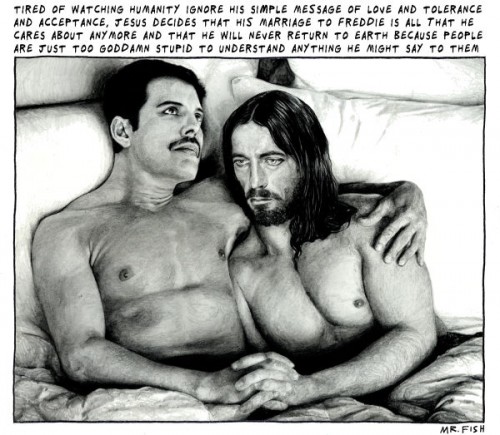
A pretty fantasy

I like the sentiment, but…

Jesus probably didn’t exist, and if he can be said to be modeled after some first century Jewish rabbi, he would almost certainly have been virulently concerned with controlling people’s sexual lives…and would have regarded homosexuality as an abomination. Also, there’s no afterlife, so he isn’t lounging about in heaven moaning about our bad behavior on earth. Also, Freddie Mercury is, regrettably, dead and no longer exists: no afterlife, remember.

This has been a clarification from your friendly godless party-pooper.

But otherwise, yeah, nice.

We need a centralized database of non-universities

I would find it very useful to have a public list of universities that say they are, but really aren’t. We could put Liberty University at the very top; these aren’t really institutions of higher learning, but institutions of indoctrination and dogma pretending to be genuine places of learning.

But here’s another: Shorter University.

In October, the college announced it would require all employees to sign a “lifestyle statement” rejecting homosexuality, adultery, premarital sex, drug use and drinking in public near the Rome, Ga., college’s campus. It also requires faculty to be active members of a local church. The statement, one of several steps the university has taken to intensify its Christian identity after the Georgia Baptist Convention began asserting more control over the campus six years ago, provoked an uproar among faculty, alumni and observers.

Any university that requires a pledge of allegiance to a particular dogma, or that monitors and restricts the private life of its faculty and staff, ought to just be denied the right to use the unqualified word “college” or “university” in its name. “Bible college” is OK; that’s an open admission of its worthlessness. Otherwise, I think that ‘university’ ought to voluntarily rename itself “Shorter Church” (wait, that might even draw in a few suckers!), or “Shorter Gulag”, or perhaps “Shorter Madhouse”.

I also like “Liberty Prison” for its ironic qualities.

(But do read the story: for all the risible failings of the administration of Shorter Clown College, it has some commendable faculty who are openly protesting the imposition of a “lifestyle statement”, and many are resigning. There are good people even at these abominations of education.)

No One Is Good but One?

Ken Ham is chortling over those silly atheists and their National Day of Reason. No One Is Good but One, he says. It’s the standard Christian anti-human self-loathing crapola that insists we need a tyrant in the sky to tell us what is good.

There is only one absolute standard by which anyone can determine what is “good,” and that is from the absolute authority who is all “good”—God! Outside of such an absolute standard, “good” is whatever you want to make it to be (if you can get away with it)—it is totally subjective. Some people think it is “good” to steal, for instance. When a culture abandons the absolute standard for what is “good” (as this culture is progressively doing in throwing out God’s Word), then we will see people doing what is right in their own eyes—as we are increasingly experiencing. The recent announcement by the president of the USA in support of “gay” marriage is just one such example—he abandoned the absolute standard for what is “good” and now is wanting to impose his subjective opinion on the nation.

Unfortunately, this God-thing doesn’t seem to be able to tell us all about this goodness: it all seems to be filtered through a cacophony of self-styled prophets and mutually contradictory holy books. It’s pointless to tell me there’s an absolute standard, but that I don’t get to see it.

Also, atheist morality is not totally subjective. We can ask ourselves what works for the majority of people: what rules and behaviors minimize conflict, maximize productivity and happiness, and produce stable, long-lasting societies that get along well with others. We do have a standard — a human standard, one that is real and measurable.

I think it is entirely rational to see that about 10% of our nation is discriminated against and treated unfairly, and to make changes in our policies that promote equality and make that 10% happier. Especially since those changes do no harm at all to the other 90%.

And then I look at the absolute morality that Ham proposes should rule our nation, and see that its solution to those 10% is to stone them to death, and I think, “I think I can objectively determine that making people happy is good, and killing them is evil, because I value humans, not voices in hateful people’s heads.” And I conclude that Ken Ham is a wicked cretin.

Also, coincidentally, I notice that NonStampCollector has a new video on a similar point.

Ken Ham says we must obey the Bible literally, in every word. In Exodus 21, the Bible clearly and unambiguously says “Whoever does any work on the Sabbath day is to be put to death.” So, I want to know: in his ideal world based entirely on Biblical morality, when his neighbor mows the lawn on Sunday afternoon, would Ken Ham kill him? Or just gather a group of his friends and kill him in a communal exercise? And would they wait until Monday to do it?

Would that be moral?